7 Reasons Your Arms Won't Grow | How Many Weekly Sets Biceps and Triceps Actually Need
The most common reason arms stop growing is that lifters don't know how many effective direct sets they're doing for the biceps and triceps. Start each muscle at 8–12 hard sets per week, then adjust them separately based on your pressing and pulling volume, RIR, and recovery.
There is no single number that works for everyone. Counting every compound exercise as one full arm set makes it hard to isolate the problem, and so does adding curls and extensions without a limit.
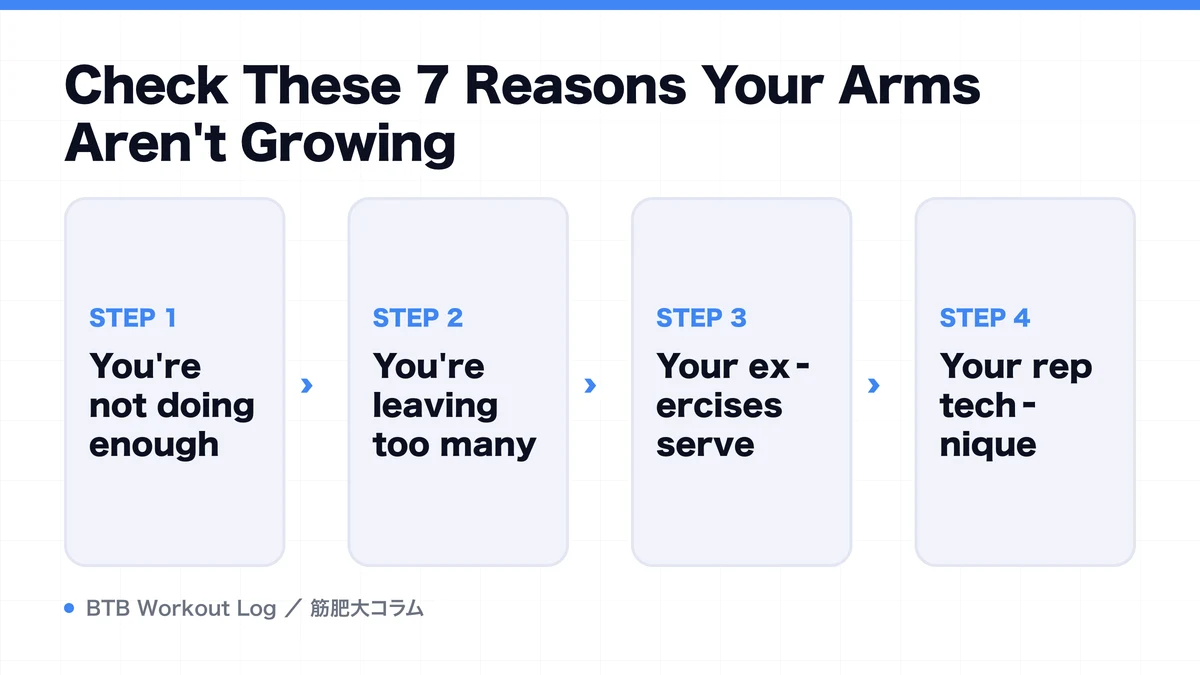
Check These 7 Reasons Your Arms Aren't Growing
- You're not doing enough direct sets: Chest and back exercises provide few opportunities to take elbow flexion and extension close to failure.
- You're leaving too many reps in reserve: Finishing the prescribed reps becomes the goal even though the target muscle could perform several more.
- Your exercises serve the same purpose: Every movement uses a similar elbow position and resistance curve.
- Your rep technique keeps changing: You're adding weight or reps by using momentum, moving your elbows, or shortening the range of motion.
- Your weekly schedule creates conflicts: Fatigue from chest and back sessions overlaps with arm training, reducing output before you begin.
- You have no progression plan: You get a pump and soreness, but your weight, reps, and range of motion haven't improved for several weeks.
- Your measurements are too inconsistent: You decide your arms aren't growing based only on day-to-day fullness or appearance.
Checking these issues in order shows you what to fix before adding sets. If your direct volume and effort per set are still unclear, blaming fast arm recovery or naturally skinny arms gives you nothing actionable.
Track Weekly Biceps and Triceps Sets Separately
A hard set ends with roughly 0–4 reps in reserve, or RIR 0–4, while maintaining the intended movement. Count curls as direct biceps sets and exercises such as pressdowns and overhead extensions as direct triceps sets. Bench presses and rows also train the arms, but if your chest or back fails first, they do not provide the same arm stimulus as one direct set.
A practical starting point is 8–12 direct weekly sets each for the biceps and triceps. If you already perform a lot of high-effort pressing and pulling, 6–10 sets may be enough. If you're doing 4 direct sets or fewer, neither reps nor arm circumference is improving, and you have no elbow problems or lingering fatigue at your next session, add 2 weekly sets to only one muscle first.
The dose-response relationship covered in the complete guide to weekly sets does not give the arms one fixed target. The benefit of adding sets does not continue at the same rate, and the recoverable volume can differ between the biceps and triceps. Increase only one at a time and hold the conditions steady for about 4 weeks so you can identify the response.
Add One Missing Exercise Role and Keep Elbow Mechanics Consistent
For the biceps, choose 2 movements you can progress reliably from these options: incline curls with the upper arm behind the shoulder, preacher curls with the upper arm supported in front of the body, and standing curls that let you adjust the path naturally. See the curl exercise comparison for the differences between dumbbell and preacher curls. The key here is not to stack 3 exercises that serve the same role.
For the triceps, combining a pressdown with the arms at your sides and an overhead extension gives you 2 distinct elbow positions. See choosing exercises for the triceps long head for suitable long-head options. Still, progressing the load on 2 exercises matters more than adding more angles.
Curl without shrugging your shoulders or letting your elbows drift far forward or backward from their intended position. During extensions, keep the upper-arm angle fixed and move only the forearm. Control the lowering phase and use enough pain-free range of motion to let the elbow bend fully. If adding weight immediately introduces momentum and a shorter range of motion, don't count it as arm progress.
Set Your RIR and Rep Range, Then Progress Set Quality
Use 8–15 reps as the main range for isolation arm exercises, with cable movements extending to 12–20 reps. The exact rep range matters less than choosing a load that makes the target muscle the limiting factor while allowing you to maintain your technique through the final reps. Taking every set to failure from the start can reduce reps on later sets while only increasing stress around the elbows. For most sets, stop at RIR 1–3. If needed, take only your final safe set close to RIR 0.
For example, choose a 10–15 rep range. Once every set reaches 15 reps with the same range of motion and RIR, increase the load by the smallest available increment next time. Dropping back to 10–12 reps after the increase is not a failure. Progressive overload includes more than adding weight. It can also mean performing more reps with the same load, reaching the same reps with more RIR, or improving your controlled range of motion.
If every metric has remained flat for more than 3 weeks, first check your sleep, nutrition, and any changes in form. Only add 2 weekly sets to the plateaued muscle if those factors are stable and you're recovered by the next session. If your reps keep falling, your elbows feel persistently heavy, or your main chest and back lifts also regress, reduce volume by 2–4 sets instead.
Split Volume Across 2–3 Sessions and Avoid Compound-Lift Conflicts
If you perform 10 weekly sets, splitting them into 5 sets on 2 days usually preserves rep quality better than doing them all at once. For example, perform 5 biceps sets at the end of a pull day and 5 early in another session. For the triceps, you could do 4 sets late in a pressing session and 6 sets on a day roughly 48–72 hours later. The goal is not to add more training days. It is to distribute volume so the target muscle can produce force at the start of each session.
If your triceps fail first on chest day, placing heavy extensions the day before may be a poor choice. Compare your situation with why your triceps fatigue first so you don't make an existing chest-training problem worse by adding arm sets. Apply the same logic to your back and biceps. If your elbow flexors reach their limit on every row before your grip or lats do, start with less direct biceps volume.
You don't need to copy a prescription designed for a large muscle group such as the quadriceps and apply it directly to your arms. Even short exercises accumulate local fatigue. Once you've set your weekly volume, compare reps between the first and final set of each session to make sure performance isn't falling apart.
Use the Same Metrics for 4–8 Weeks to Judge the Results
Track weight, reps, and RIR on one representative curl and extension, along with direct biceps and triceps sets and recovery by the next session. Because changes in body weight can also change arm circumference, measure about once per week at the same time of day, in the same posture, and at the same location on the arm. Don't use your daily pump to judge growth. If you take photos, keep the lighting and distance consistent.
A correction is working if your total reps rise without your form breaking down, you complete the same work at a lower RPE, or your arm circumference and appearance improve over several weeks. If nothing changes, return to the 7 factors and adjust only one variable: direct volume, effort, or scheduling. In BTB Workout Log, track weekly biceps and triceps sets separately, along with trends in your representative exercises, instead of looking only at total arm volume. This makes it easier to decide which muscle needs more work.
Sharp pain or discomfort that persists during daily activities is a separate issue from adjusting a growth plateau. If changing the load or exercise doesn't resolve it, don't try to train through it. Consult a qualified medical or exercise professional.
FAQ
- How Many Weekly Sets Do I Need to Build Bigger Arms?
- Count the biceps and triceps separately, starting with 8–12 direct hard sets per week for each muscle. If you do a lot of pressing and pulling, begin with 6–10 sets. Track weight, reps, RIR, and recovery for about 4 weeks, then adjust only the plateaued muscle by 2 sets at a time.
- Do Chest and Back Exercises Count Toward Arm Volume?
- They train the arms, but you shouldn't automatically count each one as a full direct set. The closer your triceps get to failure during presses, or your biceps during pulls, the greater their contribution. If that happens consistently, start with fewer direct sets.
- Can My Arms Grow If I Train Them Once per Week?
- Yes, if you can maintain rep quality through the end of the session and continue progressing your total weekly volume. However, if your output drops when you perform all 8–12 sets at once, splitting them across 2–3 weekly sessions makes it easier to maintain a consistent range of motion and RIR.
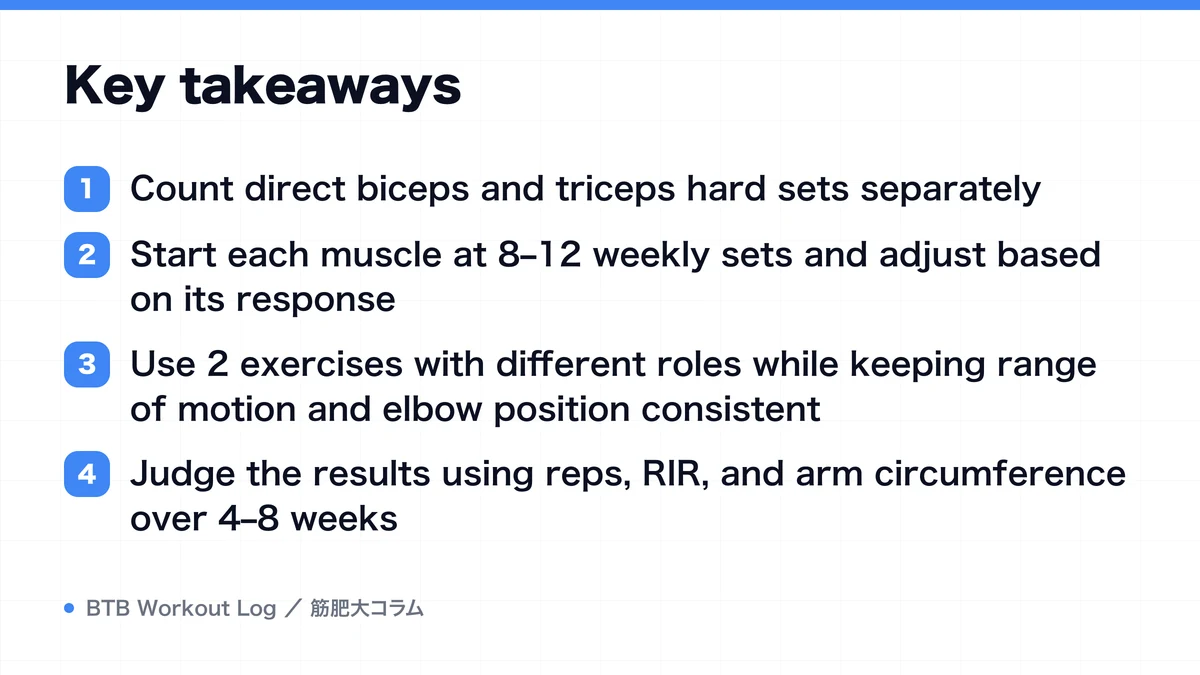
Key takeaways
- Count direct biceps and triceps hard sets separately
- Start each muscle at 8–12 weekly sets and adjust based on its response
- Use 2 exercises with different roles while keeping range of motion and elbow position consistent
- Judge the results using reps, RIR, and arm circumference over 4–8 weeks