
動作種類加太多,為什麼反而看不出進步|給那些很努力卻沒有成效感的人
Add too many exercises and you stop repeating the same movement under the same conditions—making it impossible to separate true strength gain from differences in exercise selection or order.
Varied stimulus isn't the problem. The trap is adding exercises without assigning them a role, then moving the goalposts for measuring progress.
The false comfort of hitting "all angles"
Chest work: flat press, incline, decline, flyes, machine work, dips. Line them up and you feel bulletproof. Yes, matching exercise to joint state matters. Yes, combining different angles has merit. But adding an exercise isn't the same as proving progress happened.
Muscle growth doesn't move fast enough to see daily. Instead, we hold one movement steady—same range of motion, same form, same effort level—and watch whether weight or reps climb. That's our ruler. Swap exercises each week and you swap rulers each time. You feel the work, feel the novelty, but whether you're actually stronger stays fuzzy.
The real issue: adding exercises tanks your ability to read what the program actually did. You thought you were covering all bases. You were actually scattering your signal. Tell the difference.
Progress lives in "same setup, versus last time"
More weight alone doesn't mean muscle growth if you shortened the range of motion, used bounce, or just pushed closer to failure. By contrast, same weight with identical form, range, and RIR—but more reps—is solid progress. RIR ("reps in reserve") tells you effort level, helping you keep it consistent between sets (RIR guide).
For this comparison to work, you need a window where exercise, tool, form, range, order, and rep range stay mostly fixed. Switch from barbell to dumbbell one week, machine the next, and that number change mixes in strength, movement familiarity, stability, and tool resistance curve all together. A new exercise's sudden rep jump may just be learning the pattern, not new muscle.
Progressive overload isn't tacking weight on every session. It's systematically raising reps, weight, or set quality under the same setup. Without a consistent movement to track, you can't tell if load increased or if you just changed how you measured it.

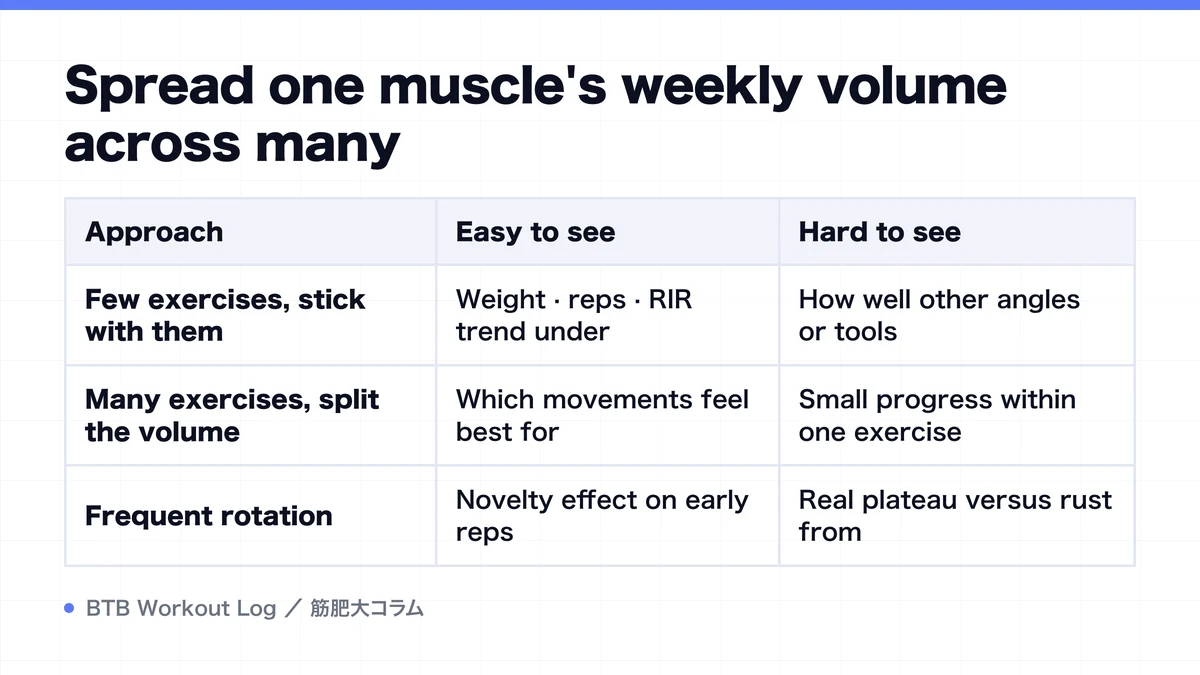
Spread one muscle's weekly volume across many exercises, and each exercise gets thinner data
Divide your chest week three ways instead of one, and each movement appears less often. Rotate exercises weekly, and you won't hit the same one for even longer. When last week's number is weeks old, sleep, bodyweight, tool feel, and position in the workout have all shifted. Short-term noise looks like progress or a plateau.
| Approach | Easy to see | Hard to see |
|---|---|---|
| Few exercises, stick with them | Weight · reps · RIR trend under same setup | How well other angles or tools work for you |
| Many exercises, split the volume | Which movements feel best for your joints | Small progress within one exercise |
| Frequent rotation | Novelty effect on early reps | Real plateau versus rust from time off |
Exercise order adds another layer of noise. Your opening press becomes rep 3 after you add movements. Fewer reps doesn't mean your pressing ability fell—it might just mean the work before it drained your chest. Change exercise count, order, and set scheme all at once, and you've lost track of what moved the needle.
Watch out for cherry-picking. If one of six exercises hits a personal best while the other five stalled, don't declare victory. That one lift isn't your whole chest. Pick anchor lifts upfront and you stop unconsciously picking the good numbers.
Total week volume matters for muscle growth (training volume). But hitting the same per-muscle weekly set count doesn't guarantee the same ability to track progress inside each lift. Keep two separate yardsticks: one for total load, one for overload within each movement.
Stay varied—just cut the role overlap
The goal of narrowing your exercise selection isn't to handle your entire body with only a handful of compound lifts. If you have clear reasons—different movement planes, loading a muscle at longer lengths, direct work on a lagging area, avoiding exercises that don't suit your joints—then multiple exercises serve a purpose. The problem is stacking similar lifts "just in case."
When organizing, place an anchor exercise for each muscle group that you track for progress, then build complementary assistance work around it with different roles. For chest, use a horizontal press as your comparison baseline and add varied-angle presses or flies as needed. What you keep depends on your overall program structure; there's no fixed exercise count that applies to everyone.
For each addition candidate, ask "what does it cover that existing lifts don't?" If the answer overlaps, lower its priority. When swapping assistance work, keeping your anchor constant means you retain a common measurement standard even after program changes. Variety and measurability aren't mutually exclusive—separate what stays fixed from what varies, and you get both.
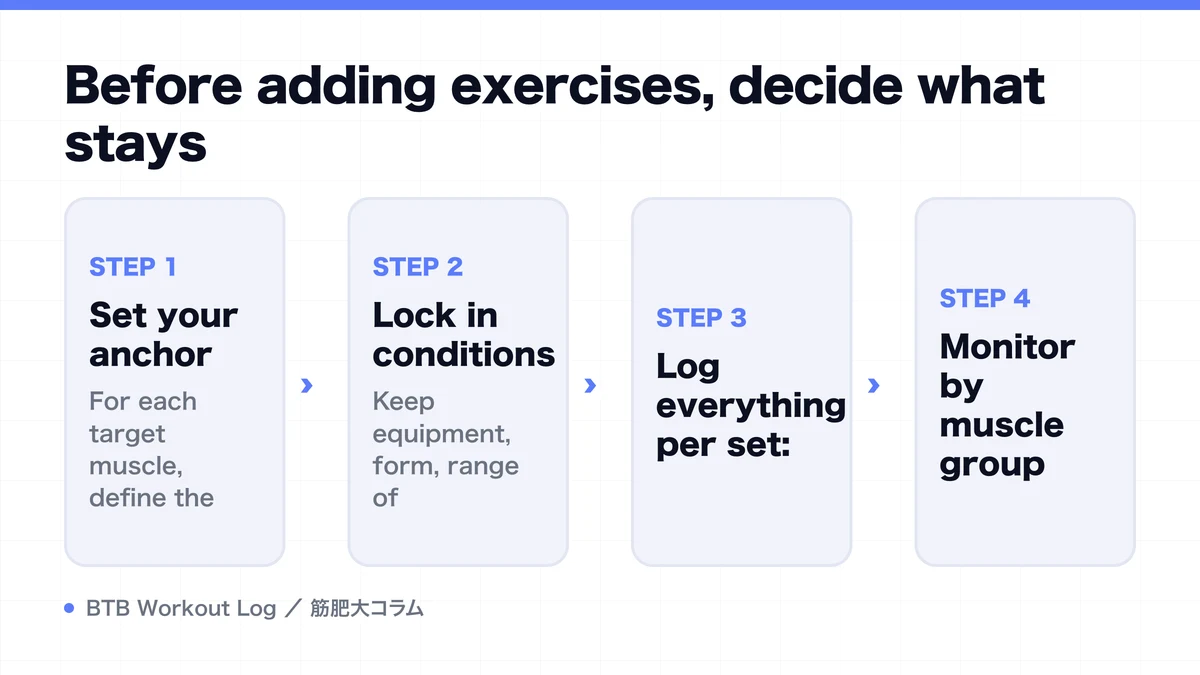
Before adding exercises, decide what stays fixed and what you'll record
When reviewing your exercise lineup, this sequence cuts through confusion:
- Set your anchor: For each target muscle, define the main lift you'll track for immediate progress.
- Lock in conditions: Keep equipment, form, range of motion, exercise order, and rep range as consistent as possible.
- Log everything per set: Record weight, reps, and set count; also track RIR to adjust for effort variance.
- Monitor by muscle group too: Don't just watch individual exercise gains—check weekly hard sets per muscle group and recovery status.
- Change one thing at a time: Identify your reason (pain, equipment limits, poor muscle engagement, sustained plateau), then add or swap one exercise only.
One bad day doesn't warrant adding exercises. Daily output fluctuates with sleep and stress, so spot trends only after multiple records under the same conditions. If your anchor stalls, assistance lifts plateau, and weekly volume and recovery look fine, that's when you question exercise fit or uneven stimulus. The more data you have, the sharper your call: does this lift need to be added, or should you push the one you've got? Logging apps exist not to justify adding exercises, but to link consistent data to your next decision. How many lifts per area are you getting previous-session comparisons on right now? BTB Workout Log preserves the spacing between each exercise appearance, so you see exactly what your data baseline is.
常見問題
- How many exercises per body area should I aim for on a hypertrophy program?
- There's no universal cap. Start by keeping an anchor you can track for progress, then judge each assistance lift by whether it serves a different role. If the same goal appears in multiple exercises and the gaps between sessions get so wide you can't compare your previous numbers, that's a sign you've added too much.
- Won't I plateau if I stick with the same exercise—doesn't the muscle adapt to the stimulus?
- Not if you're still progressing the weight, reps, or set quality in measurable steps. The stimulus stays fresh as long as you're moving the dial. Change the lift if you notice joint discomfort, poor muscle engagement, or a genuine stall under locked-in conditions—but you don't need to swap it every week for novelty's sake.
- When's the right time to swap an exercise?
- Not after one rough session. Make the swap when multiple back-to-back records under the same order, form, and RIR show no progress, and recovery and weekly volume look solid. Pain or equipment changes are exceptions—handle those sooner—but in normal cases, replace only one lift at a time and compare before and after.
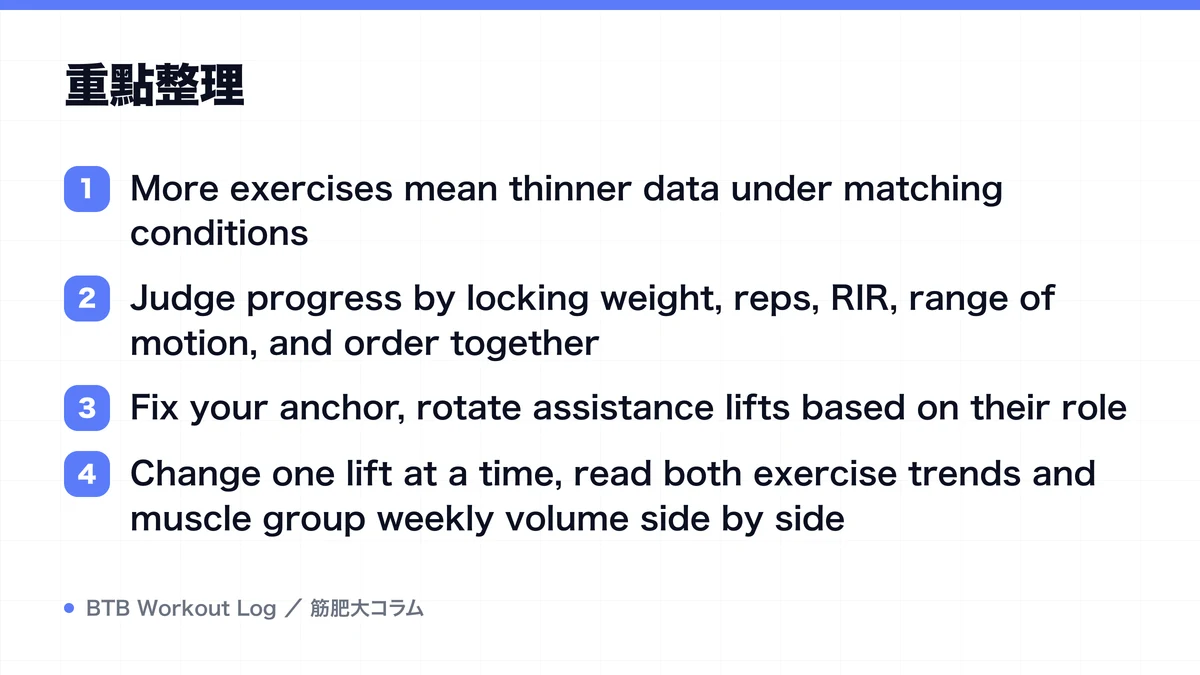
重點整理
- More exercises mean thinner data under matching conditions
- Judge progress by locking weight, reps, RIR, range of motion, and order together
- Fix your anchor, rotate assistance lifts based on their role
- Change one lift at a time, read both exercise trends and muscle group weekly volume side by side