
堅持記錄的人為什麼更快發現停滯?不記錄的人容易忽略的事
Lifters who keep records catch plateaus faster because they can spot them not as "today I felt weak," but as a pattern in weight·reps·set volume·RIR stacked under the same conditions.
Logging itself doesn't build muscle. But it becomes an observation tool to pinpoint where progress stopped and when, so you can decide what to change next.
Why "you'll just feel a plateau" falls short
A plateau doesn't start the moment a set feels heavy. Sleep, food, exercise order, warm-up, rest between sets, work fatigue—all of these cause daily swings in performance, even for the same person. Miss one rep compared to last time and you might rewrite the program, mistaking normal noise for a plateau.
Flip side: trust only feel and you'll miss real plateaus. You might feel you crushed it or got a great pump, but the same weight·reps·effort could be holding steady for weeks. Memory clings to recent strong moments; you can't accurately recall each set from months back.
So feel isn't useless—the problem is feel alone can't separate one bad day from genuine stagnation. A plateau is a pattern over time, not a point. Anyone holding records can spot that pattern early.
Logs lock in "your previous self" as a comparison anchor
The biggest job of a log is holding the baseline. A number like "benched 80kg for 8 reps" alone doesn't tell you if you're progressing or plateaued. If you hit 80kg for 6 reps before, reps went up. Same 8 reps but RIR moved from 0 to 2? You can do the same work with more fuel left in the tank. But if you used to do 10, that's a step back.
Progressive overload isn't just heavier weight. More reps at the same load, the same reps·weight finished with more RIR, hitting your weekly set volume with clean form—these all advance your loading. With a log, you read "did I improve" not as a vague feeling but as a measurable shift from your last baseline.
When this gap vanishes for several sessions, then you have a real plateau hypothesis. Logs don't auto-diagnose, but they keep you from losing the evidence you need.

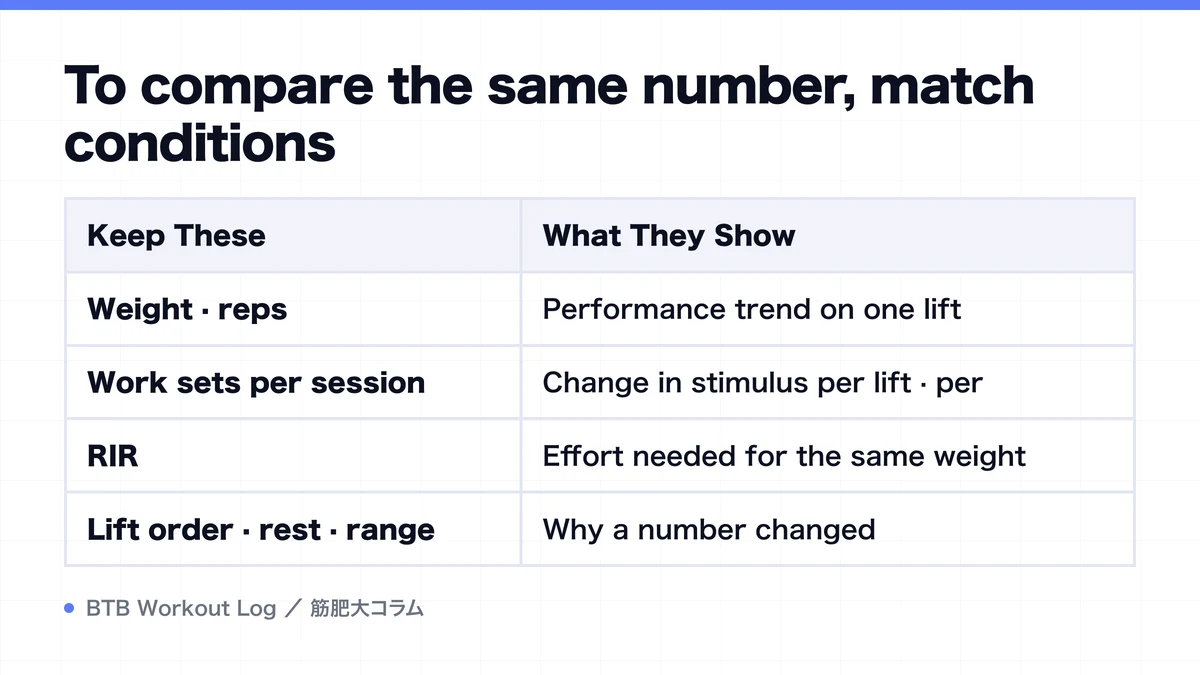
To compare the same number, match conditions and effort too
Even with records, messy comparisons blur the trend. Squatting fresh as the first lift, then after three leg exercises, aren't the same—the second naturally drops. Deeper range, shorter rest, stricter form—each tweak shifts what the number means.
| Keep These | What They Show |
|---|---|
| Weight · reps | Performance trend on one lift |
| Work sets per session | Change in stimulus per lift · per muscle |
| RIR | Effort needed for the same weight · reps |
| Lift order · rest · range | Why a number changed |
| Short notes: poor sleep, pain, etc. | Context for temporary dips |
You don't need to write everything. Start with weight·reps·work sets as the core, then add RIR per set. On days you change something, jot a quick note. That keeps the workload light while preserving what's comparable. Tracking too much kills consistency; a few core numbers logged the same way, every time, matters more.
Weight stuck doesn't always mean plateau
如果只看重量來判斷肌肉肥大的進展,你會太快宣佈進入停滯期。即使重量不變,如果你從8次增加到10次、在同樣次數下不需降低餘力就能多加一組、或者保持了良好的動作幅度和姿態,那麼訓練能力其實在進展。反過來說,即使重量增加了,但次數大幅下降、動作幅度變小、代償動作增多,這也不能算是真正進步。
以週為單位時,我們也要檢查訓練量。研究顯示肌肉肥大與每週組數之間有平均劑量反應關係,但並不是增加組數就能永遠進步。根據RIR、動作、頻率和恢復狀態,相同的組數意義和恢復成本會改變。記錄的優勢不在於找到固定答案,而是能把自己當前能消化的訓練量與後續表現聯繫起來。
用重量×次數×組數計算的總負荷量,在持續同一動作、相同執行方式的範圍內確實有參考價值。但如果把不同動作或動作幅度的數字直接相加,就無法等量比較對肌肉的刺激。如果只有總負荷量在增加,而主要動作的次數或RIR在惡化,不要急著說「做功增加了」,應該反思自己是否真的恢復得了這些增量。記錄不是比誰數字大,而是用來讀懂刺激與反應的配合。
在相同條件下比較多個指標是否都停滯,這樣就能分清假性停滯與真正需要干預的停滯。這不是直接測量肌肉肥大,而是監測日常訓練是否在進展的方法。
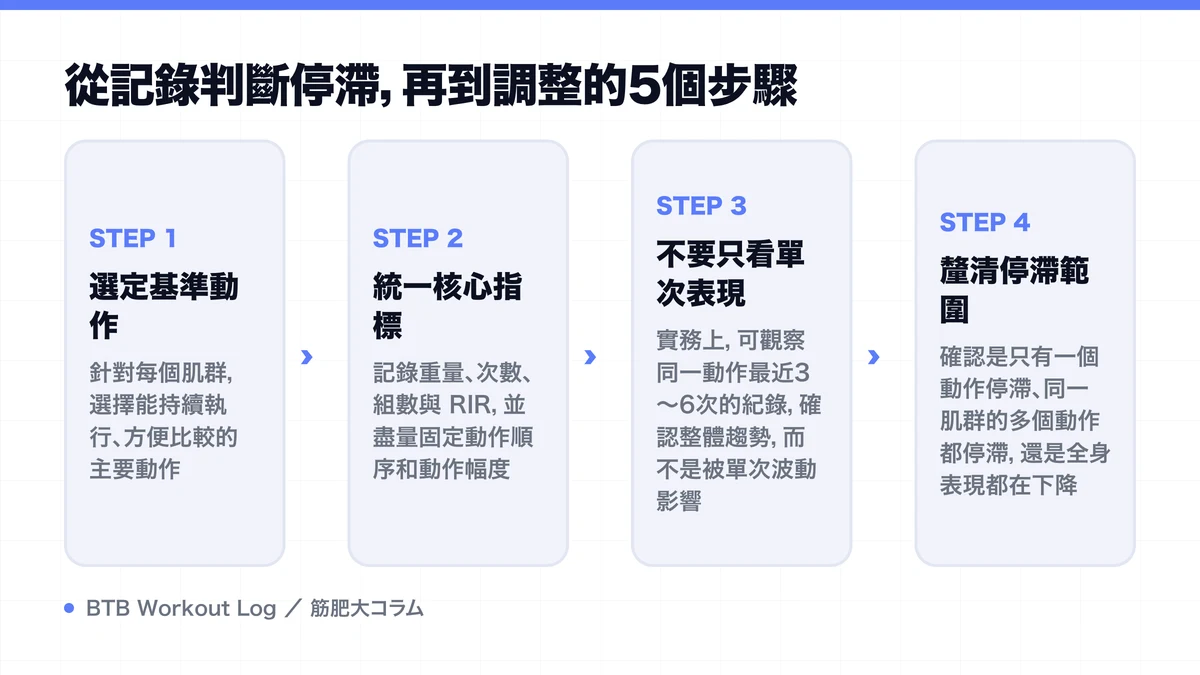
從記錄判斷停滯,再到調整的5個步驟
- 選定基準動作:針對每個肌群,選擇能持續執行、方便比較的主要動作。
- 統一核心指標:記錄重量、次數、組數與 RIR,並盡量固定動作順序和動作幅度。
- 不要只看單次表現:實務上,可觀察同一動作最近3〜6次的紀錄,確認整體趨勢,而不是被單次波動影響。這不是判定生理性停滯期的界線,而是避免過早調整訓練的操作原則。
- 釐清停滯範圍:確認是只有一個動作停滯、同一肌群的多個動作都停滯,還是全身表現都在下降。範圍不同,需要檢視的可能原因也不同,例如技術、刺激量、局部疲勞或全身恢復。
- 每次只調整一項:選擇一項突破停滯期的策略,不要同時改變重量、次數範圍、組數、頻率和恢復條件,再透過下一個比較週期觀察反應。
每週練1次的動作,3週只有3個觀測點;每週練3次,則有9個。因此,與其一律規定「幾週沒有進步就算停滯期」,不如計算在相同條件下實際比較了幾次。訓練經驗越豐富,進步幅度通常越小,因此有時需要連同次數與 RIR 一起觀察,並拉長判斷期間。
不要只憑顯示的數字斷定原因。更合適的做法,是提出一個假設,然後比較採取措施前後有哪些指標發生變化。同一動作的數字連續3週沒有變化,就能判定是否進入停滯期。BTB Workout Log 的作用,就是保留判斷所需的訓練紀錄。
從紀錄找出停滯期有一套固定流程。先依時間排列主力動作的重量與次數,再整理每週總組數,最後疊加體重變化。如果這3項同時停滯,就該進行調整;只要其中一項仍有變化,繼續觀察即可。若只憑感覺判斷,就無法做出這樣的區分。

常見問題
- 多久不進步才能判斷為停滯期?
- 沒有統一的週數。每週1次的動作和每週3次的動作觀察點不同,所以實務上應以最近3~6次、條件相同的訓練為比較窗口。重量、次數和RIR都沒有動靜才考慮調整。
- 最少要記錄什麼才能察覺停滯?
- 動作名稱、重量、每組次數、工作組數和RIR是基本要素。如果改變了動作順序、休息時間或動作幅度,簡單記一下會更方便比較。睡眠和疼痛可以作為補充資訊,在異常日期記錄一下解釋表現下滑即可。
- 重量沒有增加,肌肉肥大也停止了嗎?
- 不一定。同重量下次數增加、同次數下還有餘力、姿態和動作幅度改善,這些都是進步。訓練記錄不能直接測量肌肉肥大,所以體重、圍度和照片應該用另一條時間線來確認。
重點整理
- 停滯期不是一天的狀態不佳,而是多次訓練的趨勢判斷
- 在相同條件下比較重量、次數、組數和RIR
- 看重量外的進展指標,避免誤判假性停滯
- 區分停滯的範圍,一次只改一個變數