動作做得越多,肌肉就長得越快?這個想法可能正在拖慢你的進步
只有在目前的訓練課表缺少某些動作模式或部位刺激時,增加動作才有價值。如果只是加入性質相近的動作,比起帶來更多肌肉肥大,更可能增加疲勞與重複刺激。
判斷重點不在動作數量,而是能否以足夠的品質完成作用各異的硬組,並持續提升這些動作的訓練表現。
「用多個動作刺激肌肉」有多正確
即使是同一塊肌肉,當關節角度或動作方向改變時,受力部位和動作幅度也會改變。比如平握和45°上斜臥推,胸大肌各部分的肌肉激活程度並不相同。腿部訓練也一樣,膝蓋大幅屈伸的動作和以髖部為中心的動作角色完全不同,即使都是「腿部訓練」。
因此,用輔助動作補充主力動作難以充分刺激的部位或方向是有邏輯的。用多關節動作確保整體負荷,再用單關節動作補充不足,就是一個例子。在考慮複合動作是否足夠時,關鍵不是動作數量,而是「還缺什麼」。
不過,觀察到肌肉激活程度的差異,和增加動作能帶來更大的長期肌肉肥大,這是兩回事。變化動作可能有意義,但不是無限增加的理由。
動作數量不是肌肉肥大的「劑量」
誤解始於把動作數量當作刺激量本身來計算。在肌肥大研究中,通常以每周針對肌群的組數為中心來測量。5個動作各做1組就是5組,2個動作各做3組就是6組。單看動作數量無法判斷實際訓練量。
區分「分散」和「增加」
胸部原本計畫12組,從2個動作改成4個動作,周訓練量仍是12組。刺激分配改變了,但總量沒有翻倍。反之,保持每個動作的組數再增加2個動作,周訓練量就會增加。這種情況下帶來變化的不只是動作數量,還有新增的組數。
週間組數與肌肉肥大呈現劑量反應的趨勢已有研究報告,但增加的所有組數價值並不相等。必須區分目標肌群是否承受了足夠負荷,以及是否能以力竭前1~3次RIR的強度執行硬組。
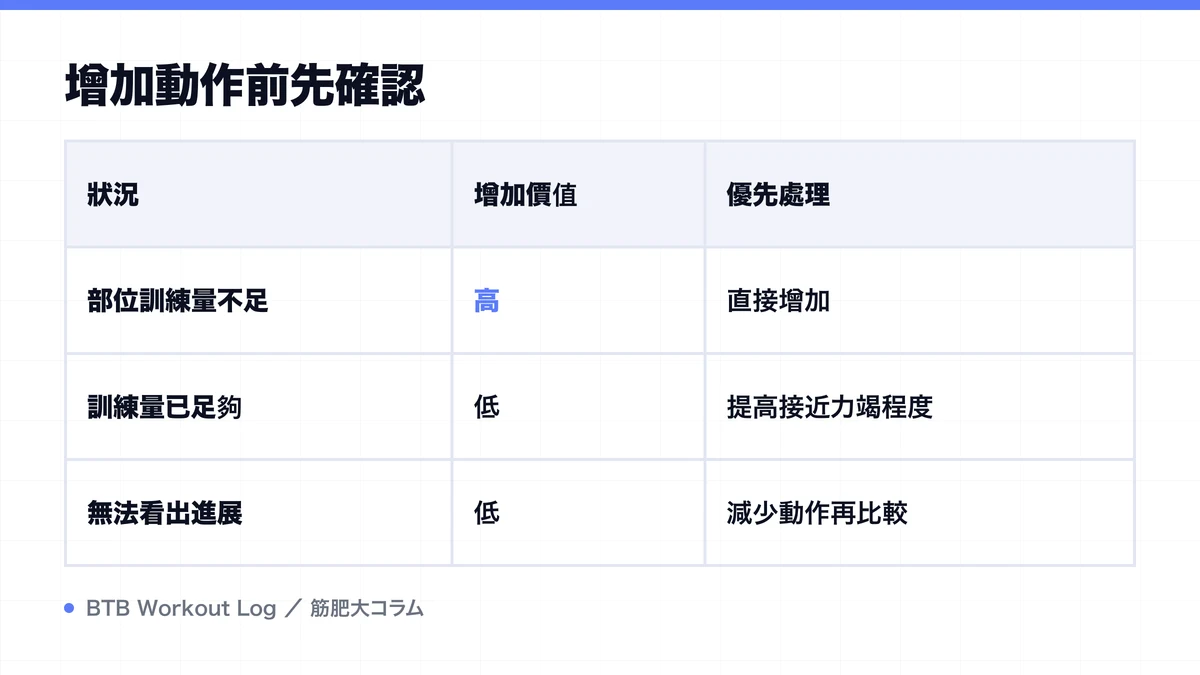
相似動作越多,後期組數品質下降越快
臥推之後加胸部按機、啞鈴臥推,再加上軌跡相似的機械臥推,動作名稱是增加了。但全是推的動作,後面的組數可能先被三頭肌或整身疲勞卡住,而不是胸肌。即使完成了計畫次數,如果目標肌群無法获得高張力的組數增加了,額外花費的時間就談不上有效刺激。
另一個代價是每個動作的練習機會減少。每週輪換8個動作時,重複同一動作的次數減少了,動作穩定和負荷設定需要更長時間才能達到。這不是說肌肥大不需要新鮮感,但如果在進步(提升重量或次數)之前就換到下一個動作,就很難積累漸進超負荷。
此外,新增組數不僅造成局部疲勞,還影響關節負擔、訓練時間和恢復。即使新動作當下有強烈的充血感,但如果主力動作的重量和次數持續下降,整周來看可能是虧的。
研究揭示的是「合適變數的組合」
肌肉肥大無法用動作數量這一個單獨數字來整理。頻率、強度、訓練量、訓練方式等同時發揮作用,相同3個動作如果組數、RIR、動作幅度和頻率不同,訓練計畫的內容就完全不同。
增加周訓練量確實會帶來平均肌肉增長量的上升趨勢。但這不等於「動作名稱越多越成長」的法則。無論是集中有效組於少數動作,還是分散相同訓練量於多個動作,比較重點都應放在目標肌群刺激、組數品質、恢復和持續進度。
一般來說,不同角度會改變肌肉激活分布,但這還不足以判斷長期肌肥大效果。實踐中應該是「按需補充主力動作缺乏的刺激」,而不是「無限增加動作」。也要區分開「每週需要改變菜單」的常見誤解。
為什麼「動作越多越有效」的感覺那麼強
新動作因為陌生,容易引發強烈的充血和肌肉酸痛,這會被誤認為是成長的邊際效益。而且增加動作通常同時增加組數,難以區分進度是來自動作多樣性還是純粹的訓練量增加。新穎感和工作量增加疊加在一起,就很容易形成「動作數量本身是原因」的誤解。
每個新動作都要有一個明確的職責
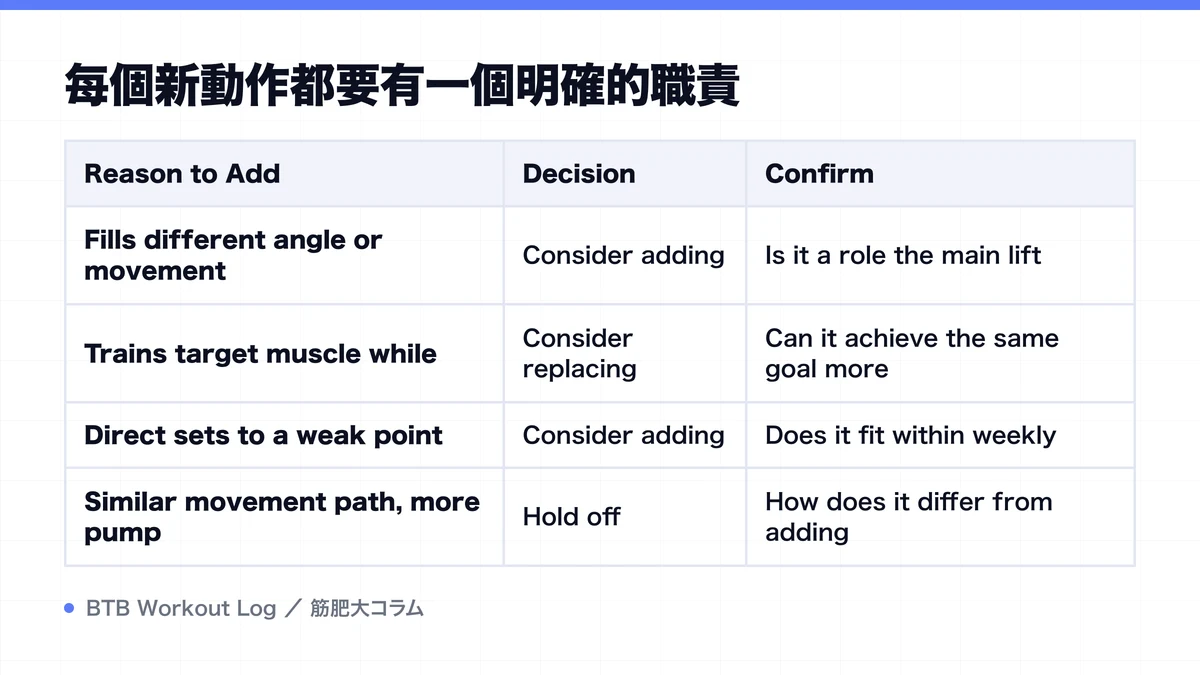
Before adding an exercise, answer in one sentence: "What does this exercise fill in?" If your answer is only "I want a different stimulus" or "I'm bored," that's not a strong reason to add it. Comparing the role against existing exercises makes the decision clearer:
| Reason to Add | Decision | Confirm |
|---|---|---|
| Fills different angle or movement pattern | Consider adding | Is it a role the main lift doesn't cover well? |
| Trains target muscle while avoiding pain | Consider replacing | Can it achieve the same goal more stably? |
| Direct sets to a weak point | Consider adding | Does it fit within weekly recoverable volume? |
| Similar movement path, more pump | Hold off | How does it differ from adding sets to the main lift? |
Fix your anchor exercises, change one thing at a time
First, keep the anchor exercise for each muscle group in place so you can compare load, reps, and RIR. Then add one supplemental exercise to fill a gap, and observe for several weeks without changing much else. The reason too many additions blur progress is covered in detail when comparing your progress data.
The right number of exercises is determined by your data after adding
Whether an addition works isn't felt on day one—look at 3 to 6 weeks of data. If the new exercise applies steady load to the target muscle, your anchor lifts and accessory reps hold or climb, and you recover before the next session, it earns a place in your program. Red flags: large drops in late-session reps, joint discomfort creeping up, stalled anchor progress, or sessions just getting longer—trim those first.
Check in this order: ① Is there a role gap? ② Do you have enough weekly quality sets? ③ Can you keep each set tight after adding? ④ Over several weeks, do you see load or rep progress? ⑤ Are you recovering? This order shifts your mindset from "add more" to "add only what works."
Use your training log to measure the change before and after—same standard, clear comparison.
常見問題
- How many exercises should I do per muscle group?
- There's no fixed number. First, hit your weekly quality sets with anchor exercises, then add only when you need to cover a different angle, movement, or weak point. Prioritize set quality and multi-week progress over counting exercises.
- Won't the same exercise stop stimulating the muscle as my body adapts?
- The same exercise creates fresh stimulus if load, reps, RIR, and movement depth keep improving. Change only if pain develops, a plateau stretches long, there's a real gap in coverage, or you lose motivation—not just to rotate for rotation's sake.
- What signs mean I should cut an exercise?
- Later exercises show big drops in load or reps, your anchor lifts stall, joint discomfort builds, you're not recovered by next session, or time just keeps climbing. Drop one overlapping exercise and track the change over several weeks.
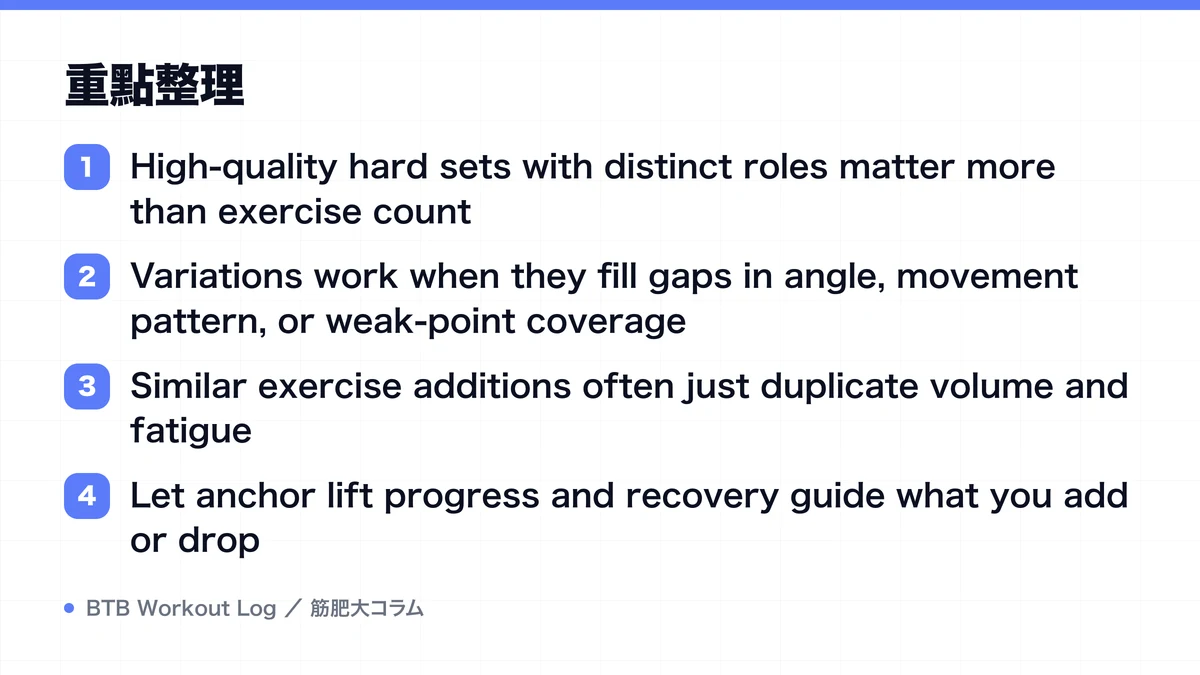
重點整理
- High-quality hard sets with distinct roles matter more than exercise count
- Variations work when they fill gaps in angle, movement pattern, or weak-point coverage
- Similar exercise additions often just duplicate volume and fatigue
- Let anchor lift progress and recovery guide what you add or drop