
力量明明在變強,肌肉卻沒有變大,為什麼?給重量在漲、外觀卻沒變的人
肌力與肌肉肥大有重疊,但它們不是同一種適應。神經系統效率、動作技術和動作熟練度都能提升舉重成績,所以力量增長的部分不一定全來自肌肉增長。
力量提升是真實的進步。但如果目標是肌肉肥大,你需要看的不僅是「增加了多少公斤」,還要分析是什麼因素推動了這個進步。
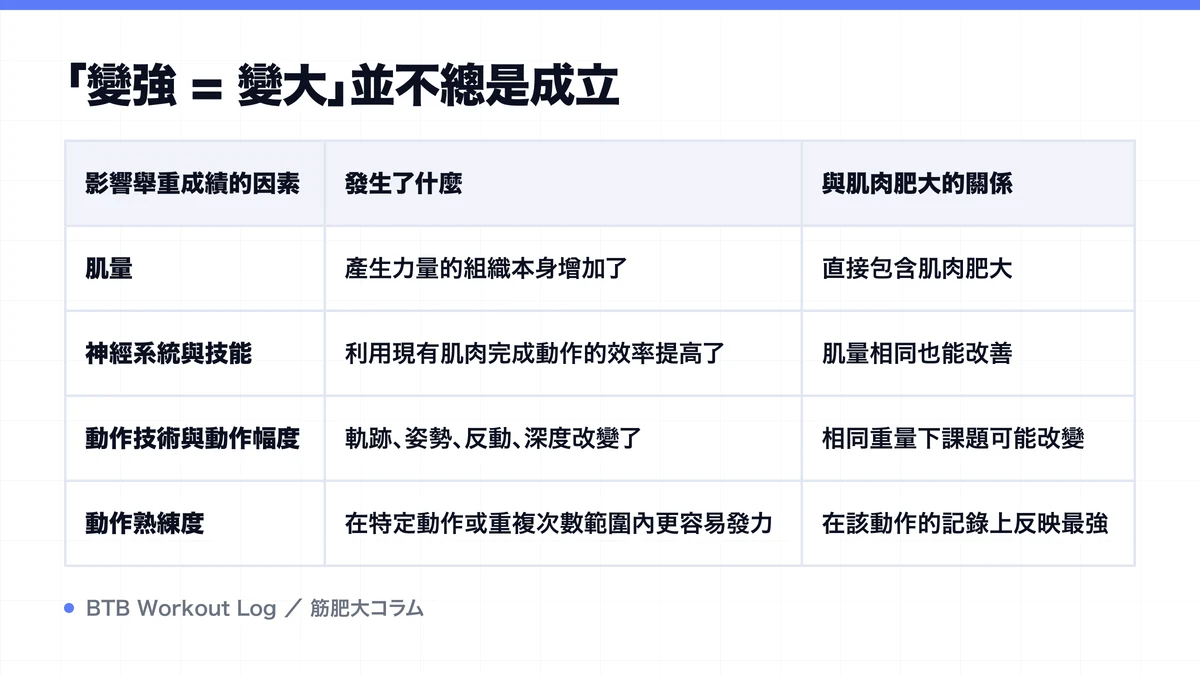
「變強 = 變大」並不總是成立
肌肉增大確實能增加可發揮的力量基礎,長期來看肌量和肌力不是無關的。但槓鈴上的重量數字並不是純粹的肌量測量,而是多種因素複合的結果。
| 影響舉重成績的因素 | 發生了什麼 | 與肌肉肥大的關係 |
|---|---|---|
| 肌量 | 產生力量的組織本身增加了 | 直接包含肌肉肥大 |
| 神經系統與技能 | 利用現有肌肉完成動作的效率提高了 | 肌量相同也能改善 |
| 動作技術與動作幅度 | 軌跡、姿勢、反動、深度改變了 | 相同重量下課題可能改變 |
| 動作熟練度 | 在特定動作或重複次數範圍內更容易發力 | 在該動作的記錄上反映最強 |
換句話說,肌力是包含肌量在內的「成績」,而不是肌量本身。高重量與低重量的比較也顯示,肌肉肥大的結果相近,但最大肌力提升反而是高重量組更明顯。如果混淆這兩者,就會陷入「加了片子今天成功、沒加今天失敗」這種極端判斷。
不增加肌肉也能提升舉重成績的機制
重複同一動作,你的身體會越來越會精準動員目標肌群、穩定軀幹、在最有利的軌跡上傳遞力量。深蹲時腳壓和轉換變穩定了,臥推時支撐和槓鈴軌跡變順暢了,現有肌肉能發揮更高的成績。這不是「作弊」,而是對該動作的合理技能提升。
尤其在高頻率進行低次數·高重量的訓練時期,用重負荷發力的練習量激增。這種情況下1RM或3次左右的記錄先漲不足為奇。但如果目標肌肉在硬組中接近極限的工作量不足,肌肉肥大刺激可能沒有跟上舉重技能的進步。
條件改變的個人紀錄不能直接比較
如果深蹲變淺、臥推用胸反彈更多、彎舉用更多反動才舉起了更重的重量,這個新紀錄在數字上雖然是PR,卻不代表你在相同難度下變強了。動作幅度、速度、器械、組序、休息時間的任何改變都會混入肌力以外的因素。只看重量的危險之處也解釋了為什麼單純增加重量是不夠的。
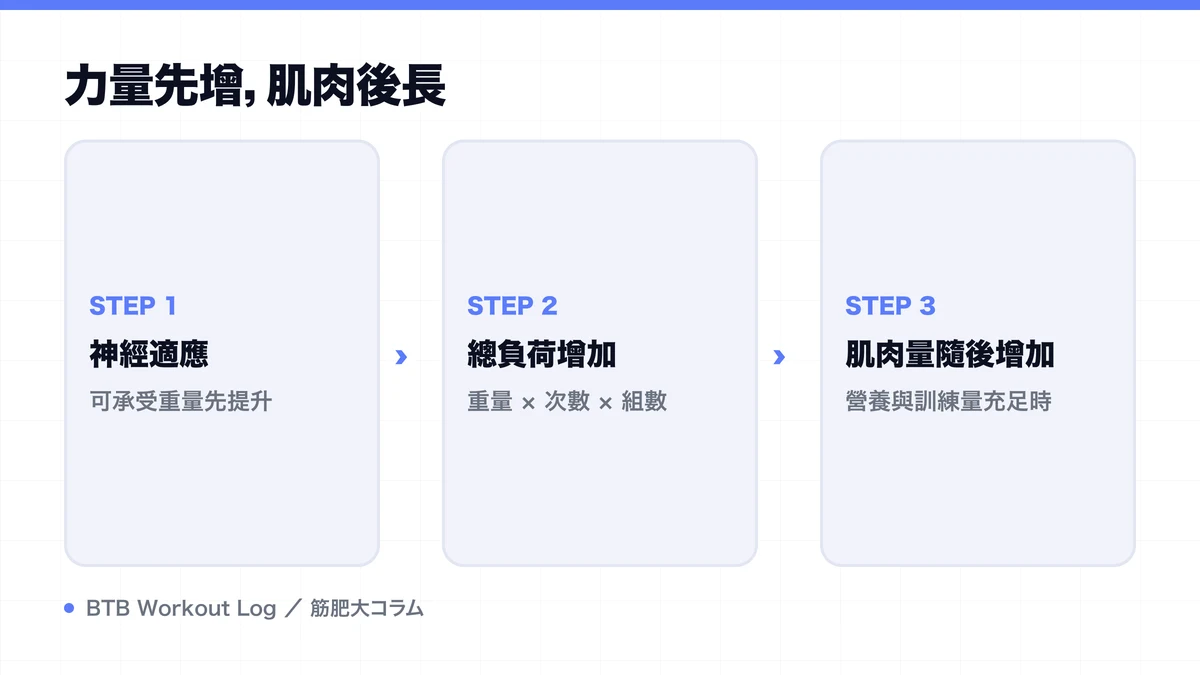
按負荷分類的研究顯示肌肉肥大與肌力有不同軌跡
Schoenfeld等人2017年的元分析指出,當所有組都做到暫時性肌肉力竭時,低負荷與高負荷的肌肉肥大差異很小,但1RM肌力提升則是高負荷組佔優。這是因為製造肌肥大刺激的負荷範圍很寬,但舉起重量的能力則容易受舉重訓練的影響。
這個現象可以用特異性來解釋。特異性是指訓練動作·負荷·次數範圍越接近測試內容,該能力進步越明顯的特性。練習高重量臥推時,臥推1RM測試所需的技能也同時磨練。這不是說肌斷面積可以完全不變,而是說肌量以外的改善會額外加分到測試結果。
反過來,即使以8~15次為主的組訓練增加了肌量,如果沒有練習1RM,最大肌力可能也不會馬上提升。因此漸進超負荷很重要,但要區分清楚是在哪個指標上超負荷。肌力上升是肌肉肥大的基礎,但不是肌肉肥大發生的單獨證明。
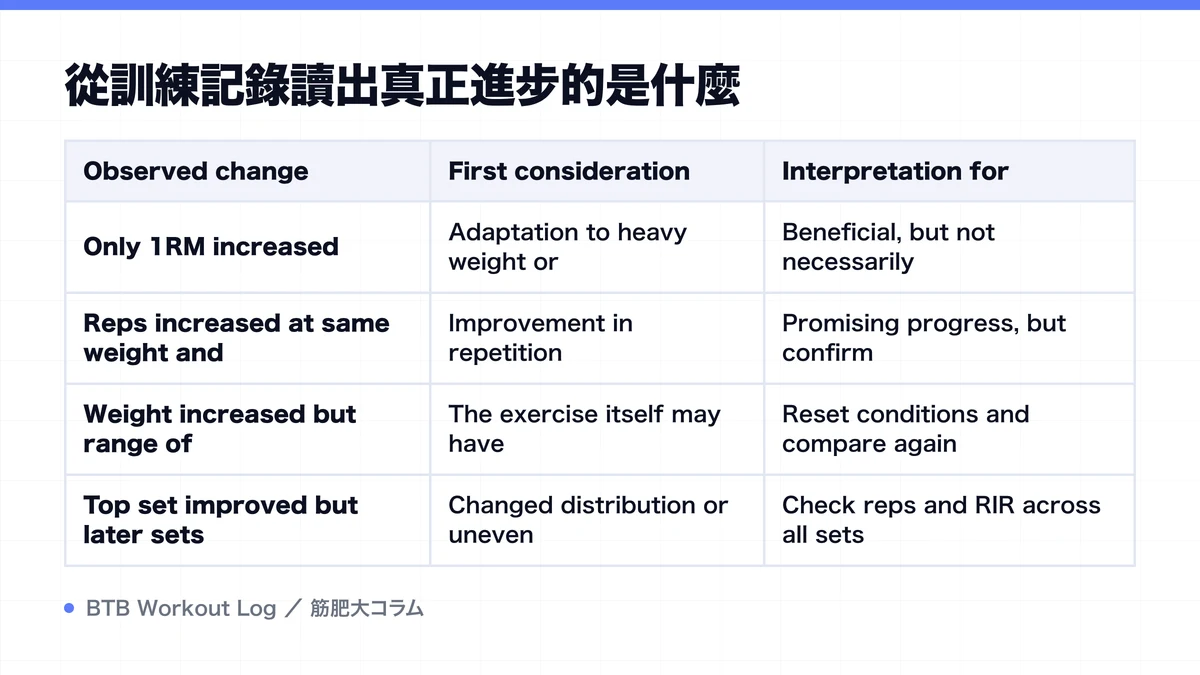
從訓練記錄讀出真正進步的是什麼
For hypertrophy purposes, controlled comparisons have the most value. Look at the same exercise, same range of motion and form, similar rest periods, and similar RIR (reps in reserve) to see whether weight or reps are increasing. This makes it easier to judge that your target muscle is handling more work without drastically changing the difficulty of the task itself.
| Observed change | First consideration | Interpretation for hypertrophy |
|---|---|---|
| Only 1RM increased | Adaptation to heavy weight or technique | Beneficial, but not necessarily evidence of muscle gain |
| Reps increased at same weight and RIR | Improvement in repetition capacity and strength | Promising progress, but confirm with multi-week trend |
| Weight increased but range of motion shortened | The exercise itself may have become easier | Reset conditions and compare again |
| Top set improved but later sets declined | Changed distribution or uneven fatigue | Check reps and RIR across all sets |
Multi-week trends under identical conditions tell you more than a single-day personal record. Appearance and circumference also shift with lighting, measurement location, pump, and hydration status, so measure under consistent conditions each time. When tracking overall session volume, avoid relying only on weight × reps; recording weekly 硬組 count and RIR together makes interpretation clearer.
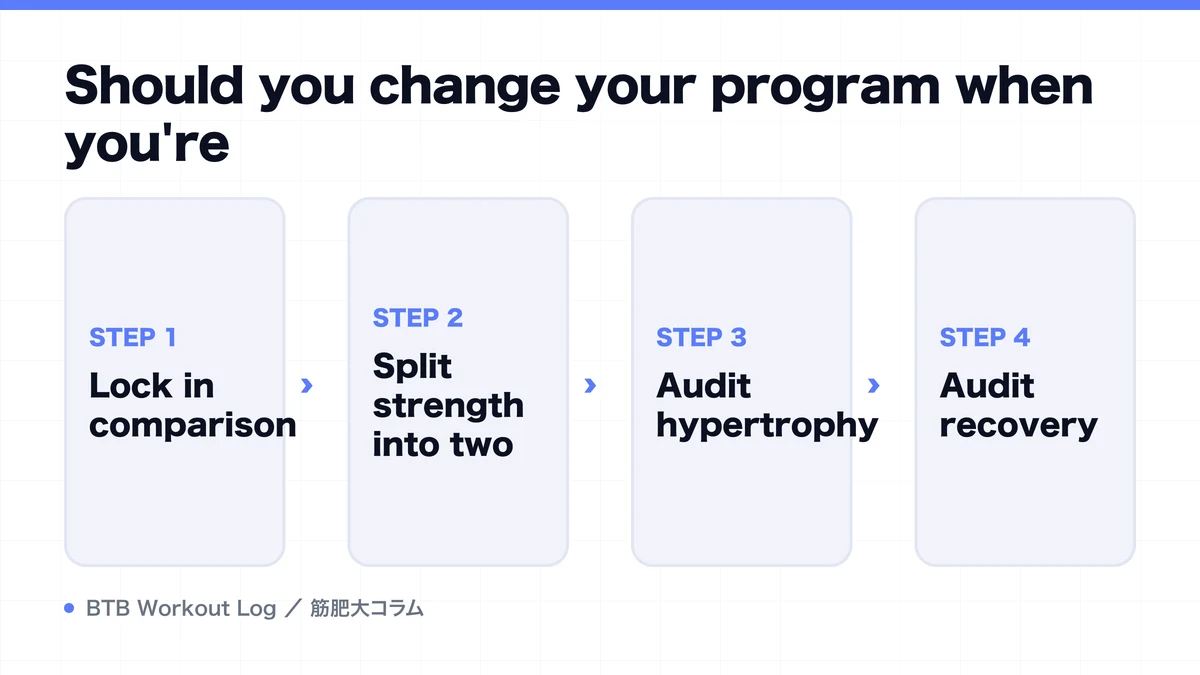
Should you change your program when you're getting stronger?
Even if size appears unchanged, you don't immediately need to add volume. First, check these points in order.
- Lock in comparison conditions: same exercise, equipment, range of motion, form, rest periods, and set order.
- Split strength into two measures: track 1RM and low-rep top sets separately from mid-rep follow-up sets.
- Audit hypertrophy inputs: check your target muscle's weekly 硬組 count, RIR, frequency, and whether exercises overlap in stimulus.
- Audit recovery conditions: look for obvious shortfalls in body weight trend, energy intake, protein, and sleep.
If reps improve under identical conditions, later sets also increase, and you've only tracked body weight or circumference for a short period, there's room to continue your current program and gather trend data. If only your 1RM rises while your target muscle's 硬組 sets and mid-rep range stall, suspect adaptation is biased toward heavy-load technique. When you have recovery capacity left, standardized records have plateaued for multiple weeks, and only then should you consider adding 硬組 or adjusting exercise selection.
The strength-hypertrophy relationship isn't one-directional. The reverse problem—assuming no muscle growth because weight isn't climbing—is addressed in "no strength gain = no hypertrophy" put to the test.
Brief notes on form and range of motion become your benchmark for separating a mere weight PR from genuine progress under consistent conditions. If you suspect a strength-muscle size gap, you must track weight progression and weekly total volume separately. BTB Workout Log lets you inspect both independently.
常見問題
- If strength is climbing, can I assume my current hypertrophy program is working?
- It's a good sign, but not enough on its own. Also check whether mid-rep sets are improving under the same range of motion, form, and RIR; whether your target muscle's weekly 硬組 count and recovery are being maintained. If only 1RM rises, the adaptation is likely skewed toward heavy-load skill.
- How long should I wait before deciding whether muscle has grown?
- Over a few workouts or single days, pump and water shifts cloud the picture; judge by trends over weeks to months. Keep photos and circumference measurements at the same time of day, body position, and measurement point. Review body weight and standardized training records alongside them.
- I'm getting stronger but not bigger—should I add more 硬組?
- Not immediately. First confirm your range of motion and RIR haven't shifted, your target muscle is receiving its required 硬組, and nutrition and sleep are adequate. After these are solidified and you've plateaued for multiple weeks with recovery still available, consider a modest 硬組 increase.
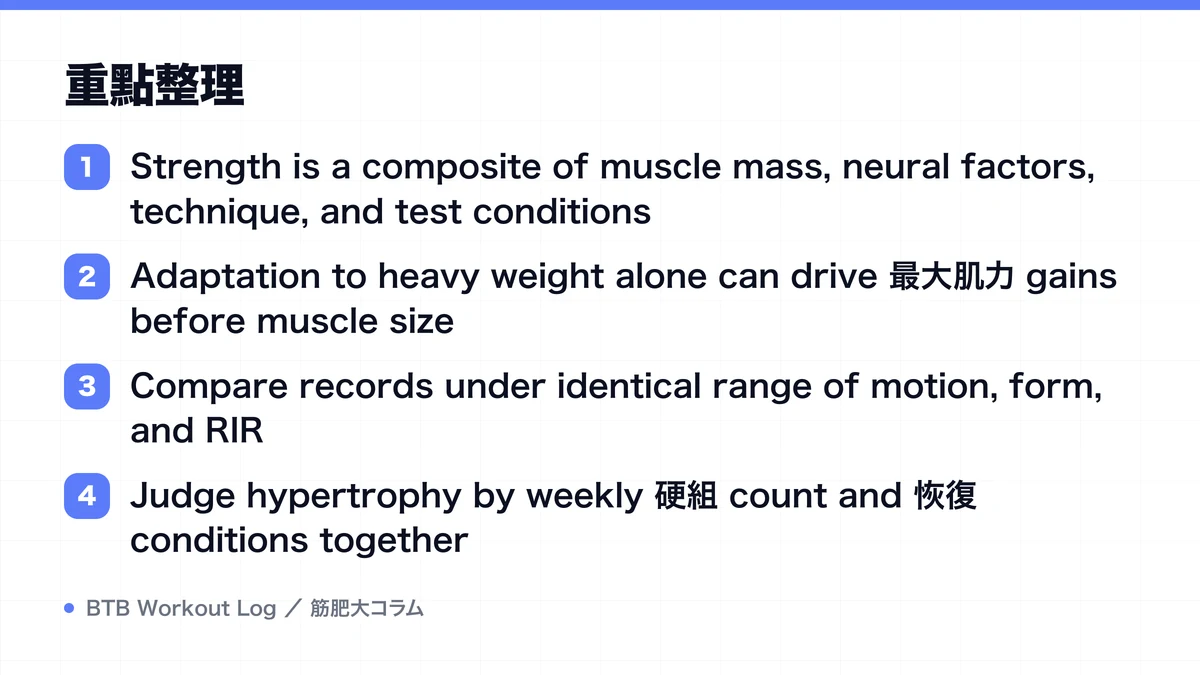
重點整理
- Strength is a composite of muscle mass, neural factors, technique, and test conditions
- Adaptation to heavy weight alone can drive 最大肌力 gains before muscle size
- Compare records under identical range of motion, form, and RIR
- Judge hypertrophy by weekly 硬組 count and 恢復 conditions together