固定菜單 vs 每次都換動作,哪種對肌肉肥大更有效?
以肌肉肥大為目標時,最容易執行的做法是把固定課表當作基礎,只針對需要解決問題的動作進行有計畫的替換。固定動作與輪替動作各有用途,並不是每次都換或永遠不換的二選一。
真正該比較的不是新鮮感,而是能否持續累積足夠的刺激、判斷自己是否進步,並妥善管理疲勞與疼痛。
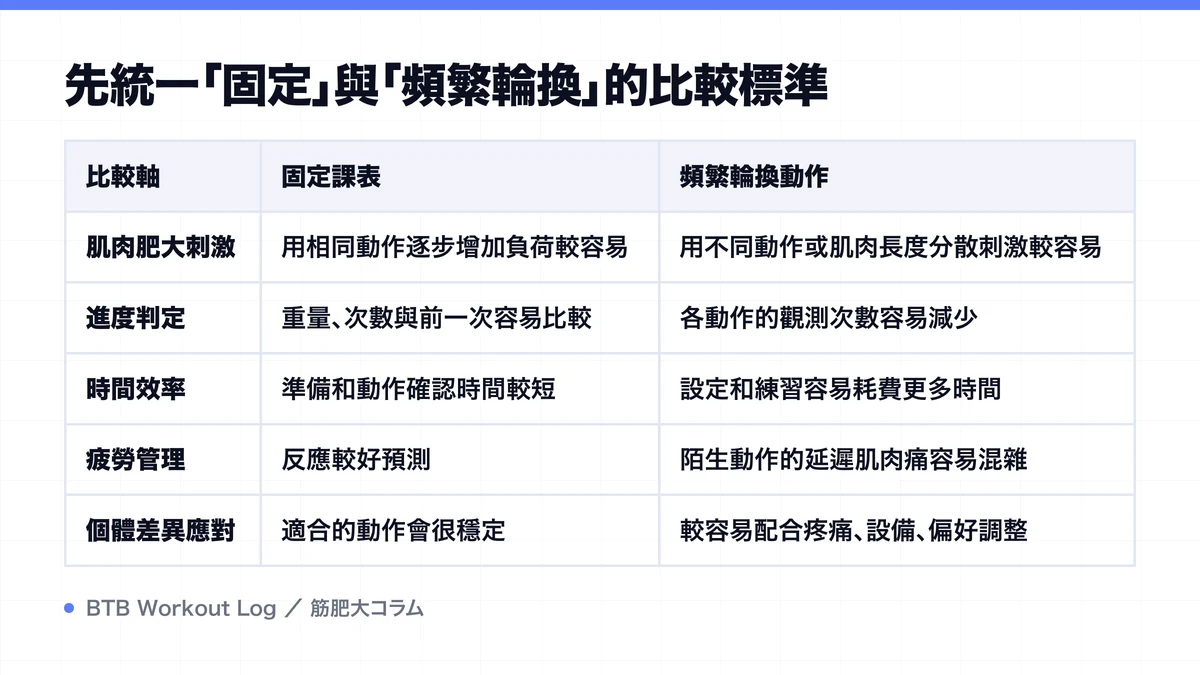
先統一「固定」與「頻繁輪換」的比較標準
這裡所說的固定課表,是指保持主要動作及其順序在一段時間內不變,但根據適應程度調整重量、次數、組數的方法。並不是指機械地重複同樣的數字。頻繁輪換動作,則是指每週或每堂課都更換主要或輔助動作,使得同一動作的觀測期間較短的方法。
要公平比較,需要使各肌群的週間硬組數、RIR、訓練頻率、動作幅度大致相同。如果固定組只有更多組數,那比較的就變成了容量差異而非動作選擇。
| 比較軸 | 固定課表 | 頻繁輪換動作 |
|---|---|---|
| 肌肉肥大刺激 | 用相同動作逐步增加負荷較容易 | 用不同動作或肌肉長度分散刺激較容易 |
| 進度判定 | 重量、次數與前一次容易比較 | 各動作的觀測次數容易減少 |
| 時間效率 | 準備和動作確認時間較短 | 設定和練習容易耗費更多時間 |
| 疲勞管理 | 反應較好預測 | 陌生動作的延遲肌肉痛容易混雜 |
| 個體差異應對 | 適合的動作會很穩定 | 較容易配合疼痛、設備、偏好調整 |
因此評估的對象不是「哪個永遠能讓肌肉變大」,而是現在的你應該優先考慮刺激、可比較性、恢復,還是持續性中的哪個。
肌肉肥大效果不只取決於動作的新穎性
直接比較固定課表與頻繁輪換動作,並為所有進階訓練者找出通用勝者的研究證據不足。另一方面,抵抗訓練的適應取決於頻率、強度、容量、運動形式等多個變數。單純替換動作這個事實本身,不太可能擁有超越其他條件的特殊肌肉肥大效果。
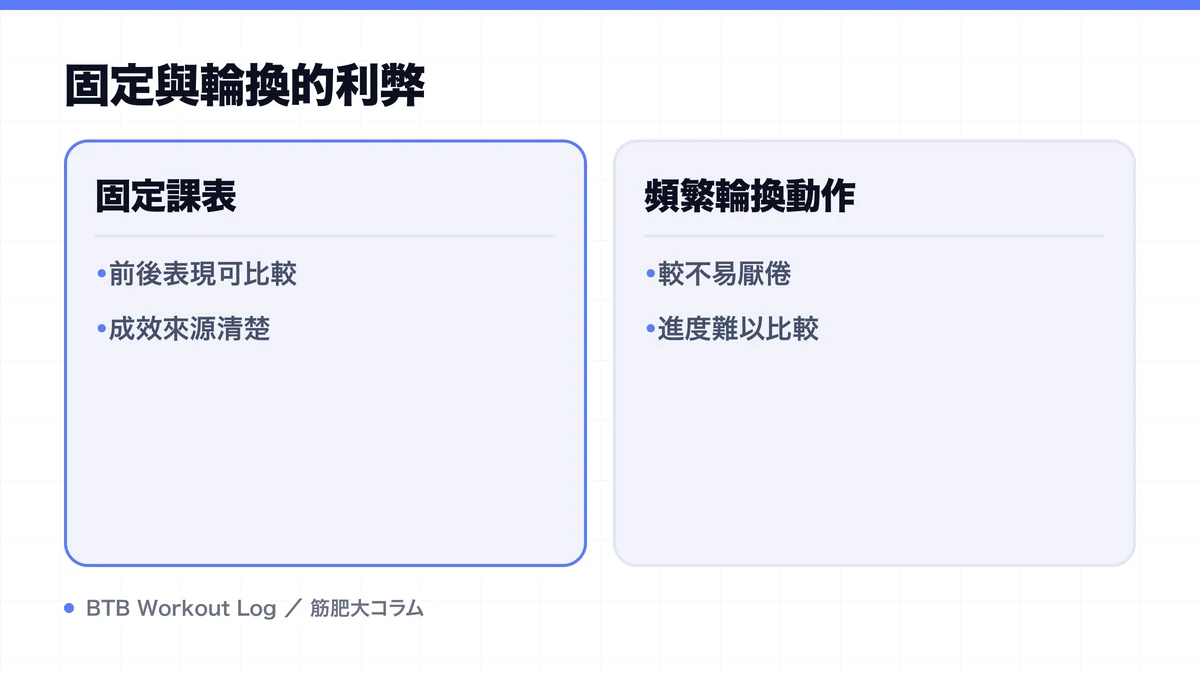
固定課表的優勢在於用相同的技術和動作幅度重複,因此容易解讀重量或次數的增加。比如臥推從80kg做8下進步到10下,RIR也差不多,至少可以判斷在這個動作中你的工作能力提升了。這在執行漸進超負荷時是很大的優勢。
輪換動作有機會用不同的關節角度和阻力特性來填補單一動作難以觸及的刺激。但初次執行一個動作時,光是學習動作技術就會讓數字上升。反過來說,陌生動作引起的強烈肌肉痛不是成長的證明。和沒有肌肉痛也能成長的理由一樣,新鮮的感覺和長期肌肉肥大必須分開評價。
計畫性周期化是根據目標調整負荷或次數範圍的概念。但「加入變化」和「隨意輪換動作」是兩回事。肌肉肥大方面,當總容量相近時,周期化與非周期化通常差異不大,變更需要明確目標。
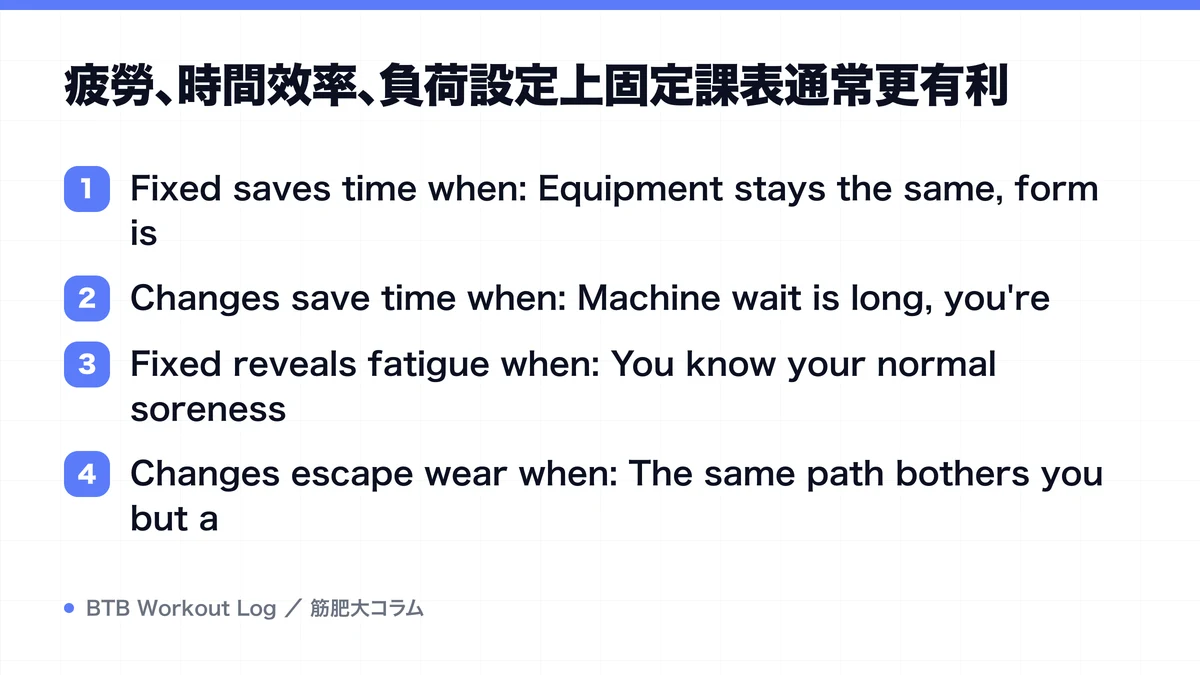
疲勞、時間效率、負荷設定上固定課表通常更有利
Sticking with the same lift locks in your rack position, seat settings, warm-up weights, and form cues. If you're chasing quality sets in limited time, this low prep cost pays off. You'll also find it easier to pick your opening weight from past data and compare sessions with matched RIR.
Frequent switches force you to burn light probe sets hunting the right load. Miss the weight and you conserve too much 餘力; go too heavy and you lose 動作幅度. Even if you complete your planned 硬組 count, the quality won't match. New movement patterns bring localized fatigue and soreness that cloud your actual recovery state.
Fixed routines have a real weakness, though. If the same motion keeps bothering you—a specific joint angle feels wrong, you're bored into low effort—don't keep grinding it for its own sake. Exercise changes work when they solve a problem. Don't swap just because yesterday didn't go as planned. First, confirm whether adjusted form, load, and 恢復 still leave you stuck.
- Fixed saves time when: Equipment stays the same, form is locked, you set weight from your last session.
- Changes save time when: Machine wait is long, you're traveling without your gear, prep doesn't match the stimulus you get.
- Fixed reveals fatigue when: You know your normal soreness and rep dips.
- Changes escape wear when: The same path bothers you but a different tool or angle feels clean.
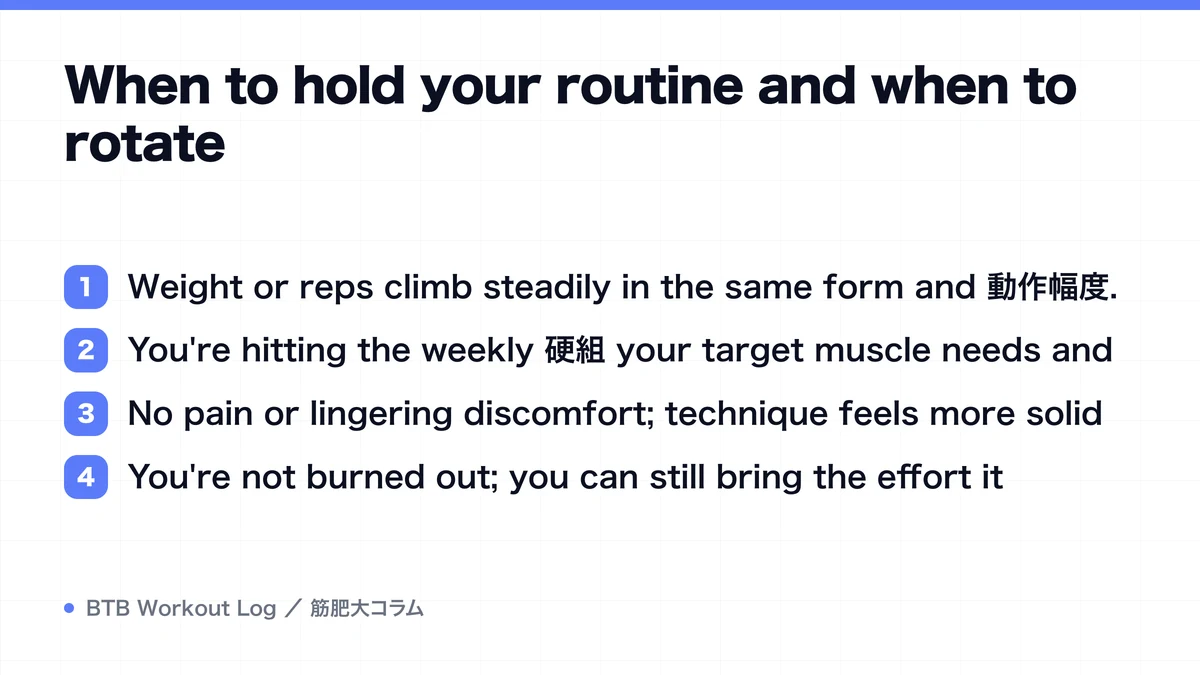
When to hold your routine and when to rotate
Stay fixed when this is true
- Weight or reps climb steadily in the same form and 動作幅度.
- You're hitting the weekly 硬組 your target muscle needs and can 恢復 before next session.
- No pain or lingering discomfort; technique feels more solid each time.
- You're not burned out; you can still bring the effort it demands.
In this state, don't blow up your whole program just because the calendar says so. Running the same menu every week isn't inherently bad—you're still updating load and 次數範圍 in the same lift.
Consider a switch when this is true
- Form or load tweaks don't kill pain or discomfort from the same movement.
- After checking sleep, food, volume, and RIR, one specific lift has stalled longer than the rest.
- Your exercises overlap in what they do; you're missing muscle lengths or movement angles.
- Your equipment, time window, or preferences shifted, making the lift hard to keep.
Even during 停滯期, separate stimulus, 恢復, nutrition, and overload before swapping everything. If you do change, lock your reason to one hypothesis—for example, "swapping barbell for 機械 to dodge shoulder discomfort." Constant wholesale changes leave you guessing whether improvements come from the new exercise or just getting better at the movement.
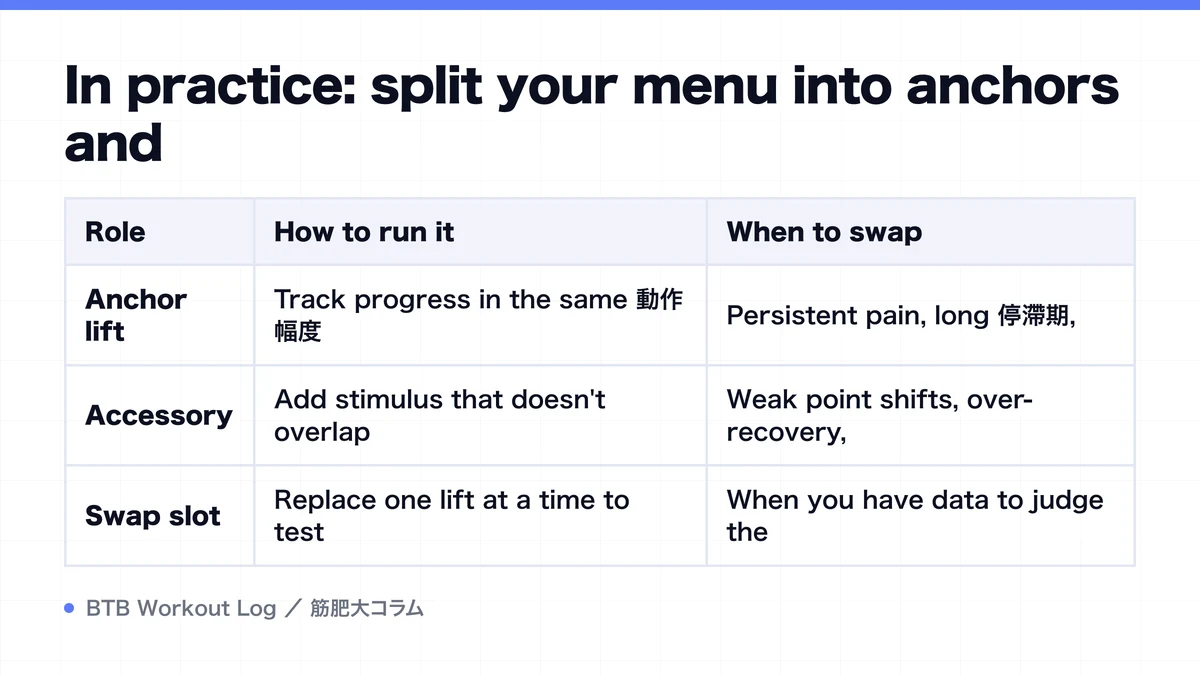
In practice: split your menu into anchors and swap slots
A simple way to use both: divide your menu into anchor lifts and swap slots. Anchors are your main lifts per muscle group—the ones you track progress on—and stay fixed within a block. Swap slots let you adjust each block for weak points, joint fit, equipment, or what you like. A block can be 6–10 weeks, but days matter less than having enough stable data to decide whether to hold or change.
| Role | How to run it | When to swap |
|---|---|---|
| Anchor lift | Track progress in the same 動作幅度 and 次數範圍 | Persistent pain, long 停滯期, equipment change |
| Accessory | Add stimulus that doesn't overlap the main lift | Weak point shifts, over-recovery, overlapping role |
| Swap slot | Replace one lift at a time to test | When you have data to judge the hypothesis |
- Write down why you're changing: Pain avoidance, breaking through 停滯期, filling a stimulus gap—be clear on the problem you're solving.
- Keep conditions close: Match weekly 硬組 count, RIR, and frequency before and after the swap.
- Build a new baseline: Don't compare weight across lifts. Start the new lift's weight and reps from scratch.
- Judge over multiple sessions: Don't look at one pump or one sore day. Wait until technique settles, then watch progress, pain, 恢復, and whether you stick with it.
Why too many exercises blur progress becomes clear when you think about what conditions let you compare. Keep your log not to ban changes, but to decide which lifts to hold and which to swap. Whether a lift stays fixed or rotates comes down to whether you've got a clear baseline for it. BTB Workout Log lets you keep separate baselines for each lift.
常見問題
- 肌肉肥大训练多久应该更换一次菜单?
- 没有适用所有人的固定周期。只要重量或次数还在进步,没有疼痛,恢复和动力都保持良好,就继续这个动作。6-10周只是参考,更换的标准不是日期,而是进度、疼痛感、恢复状态和可持续性。
- 同一个动作坚持做下去,肌肉是否会适应刺激而停止生长?
- 即使动作相同,只要重量、次数、组数、动作幅度或RIR改变,刺激就不会完全相同。熟悉某个动作能帮助你更精准地堆积负荷。只有在数字和努力程度长期停滞不前时,才需要排查原因并考虑更换。
- A日和B日轮流做不同动作,这种安排有问题吗?
- 只要A日和B日的内容是固定的,每次都能和上一次的成绩对比,就没有问题。这比每次都临时选择不同动作要更有参考价值。还要综合考虑每个肌群一周的总组数和恢复情况。
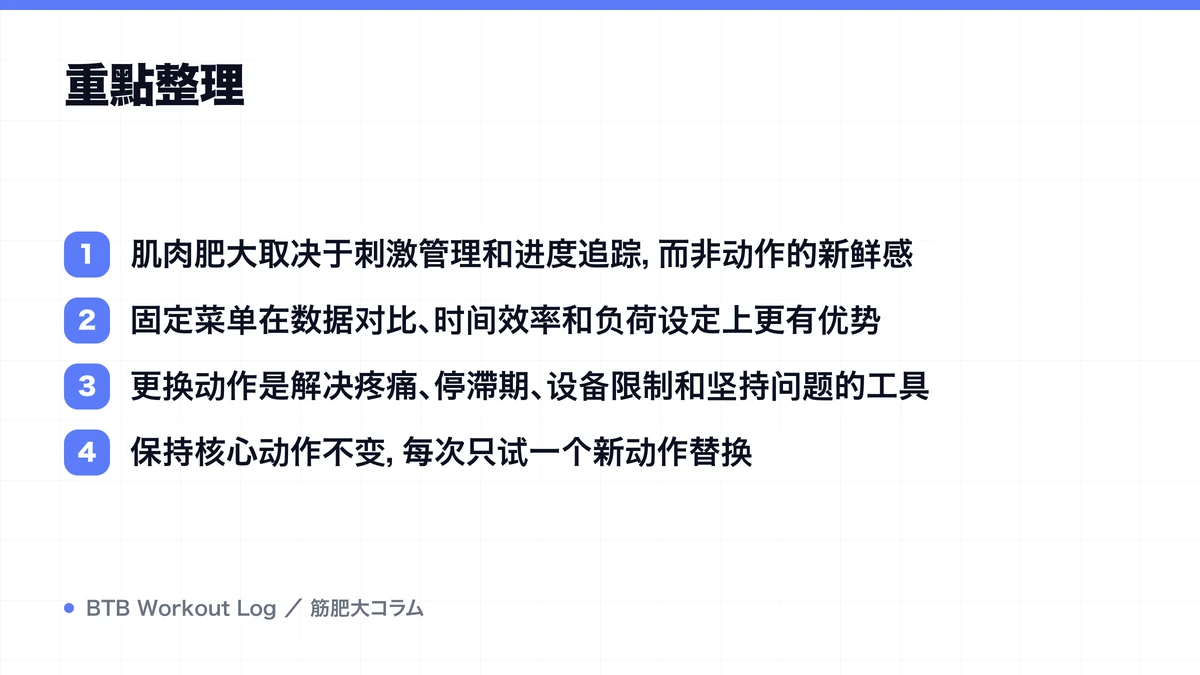
重點整理
- 肌肉肥大取决于刺激管理和进度追踪,而非动作的新鲜感
- 固定菜单在数据对比、时间效率和负荷设定上更有优势
- 更换动作是解决疼痛、停滯期、设备限制和坚持问题的工具
- 保持核心动作不变,每次只试一个新动作替换
參考文獻
- The Influence of Frequency, Intensity, Volume and Mode of Strength Training on Whole Muscle Cross-sectional Area in Humans
- ACSM Position Stand: Progression Models in Resistance Training for Healthy Adults
- Periodization, Strength and Muscle Hypertrophy: Systematic Review and Meta-analysis
- Linear vs Daily Undulating Periodized Training and Hypertrophy: Meta-analysis