
休息訓練1週,肌肉會掉多少?給害怕休息的人的答案
健康人維持日常生活、飲食不出現大幅波動下停訓1週,實際損失的肌肉接近於零。但無法用一個統一的百分比來定義所有人的衰減率。
外觀飽脹感、體重、重訓復工首天的反覆次數在1週內都可能改變,但這些變化不只代表肌纖維本身的減少。我們需要分別檢驗:測量的是什麼、在哪些條件下答案會改變。
驗證的對象是「外觀」「輸出功率」還是「肌肉組織」
「肌肉掉了」這個感受至少混雜三種含義。停訓1週後對著鏡子覺得小一圈,或者首組感覺變沉,都不代表肌纖維按同樣比例減少了。
| 觀察對象 | 1週內可能改變的原因 | 與肌肉量衰減的關聯 |
|---|---|---|
| 外觀·圍度 | 充血、肌糖原及伴隨的水分變化 | 看起來小不等於肌肉組織減少 |
| 體重 | 飲食量、鈉鹽、碳水化合物、水分、腸道內容物 | 短期體重波動無法單獨推導出肌肉變化 |
| 重量·次數 | 疲勞恢復、動作熟悉度、睡眠、熱身 | 增加或下降都不只取決於肌肉量 |
| 肌肉組織 | 刺激不足延續後的長期適應衰退 | 這次真正想了解的對象 |
因此不能簡單地對比停訓前後的照片或體重,就判定「肌肉掉了1 kg」。從數日到數月的變化過程在訓練衰退的進展中有詳細說明,這裡只聚焦1週這個短期範圍。

成長刺激停止與肌纖維立即減少並非同一回事
肌肉肥大不是一次訓練就完成的變化。它源自長期反覆對肌纖維施加機械張力,以及運動後肌蛋白質重建和恢復的累積。反過來說,錯過一次刺激後,之前的適應也不會以相同的速度立刻反轉。
運動後的肌蛋白質合成反應是暫時性的。但這個反應恢復正常,並不意味著「從那一刻起明顯的肌肉萎縮就開始了」。肌蛋白質無論運動與否都在持續合成和分解,同時受日常活動和飲食影響。關鍵是不要把短期生理反應和長期肌肉量變化用同一個時間尺度來看。
而且,在高強度訓練期後停訓1週,疲勞消退的速度可能會超過適應衰退的速度。這時復工後你會發現相同重量變輕鬆了。這更可能是之前被疲勞掩蓋的輸出能力重新顯現,而非短期內肌肉增長。詳細的區分方式與Deload 週如何恢復輸出功率的邏輯相同。

「基本不掉」容易成立的條件,以及需要另作處理的條件
把1週停訓籠統地看待,容易得出錯誤結論。健康訓練者因出差或工作1週沒去健身房,跟因病痛或受傷導致身體活動大幅受限,這兩種情況肌肉承受的條件完全不同。
實際上基本不掉的條件
- 通勤、行走、家務等日常活動維持正常
- 進食能量未極度減少,蛋白質攝取保持在常態水平
- 無發燒、厭食、強烈發炎或患部固定
- 停訓前持續訓練,短期疲勞有所累積
同樣是「1週」但須謹慎對待的條件
- 住院、臥床或石膏固定導致目標肌肉幾乎沒有使用
- 病痛同時造成進食量和活動量大幅下降
- 急速減脂導致能量嚴重不足並伴隨體重急劇下降
- 年長、接受治療中、長期停訓的最後1週等存在其他複合因素
後者不符合「單純停訓1週的效果」的檢驗條件。特別是在病痛或固定情況下,恢復和醫療限制優先於一切。為了疲勞管理而刻意降低負荷的情況也有不同目的,具體做法應參考Deload 週的執行方式而非常規完全休息。

為什麼1週掉的量無法統一成一個比率
The most accurate answer to the title is: if a healthy lifter maintains normal daily life, meaningful muscle loss rarely occurs over one week, though no common baseline guarantees zero change. Pre-break muscle mass, training age, age, activity level, diet, and measurement site all affect how much change appears.
Also, comparing a single week means measurement noise can move in the same direction as the change you're trying to track. Differences in timing (morning vs. evening), meals, hydration, and recent training all shift bodyweight, limb circumference, and appearance. Even if a measuring device shows a number, that difference isn't necessarily all contracting muscle tissue. The more precise the breakdown appears, the more you need matching conditions to make a practical call.
If you want to confirm your own case, use three measurements before the break and three after resuming as your comparison unit. Keep measurement time, meals, hydration, exercise order, and rest intervals as consistent as possible—don't judge by a single-day peak. If circumference returns and you hit the same weight and reps at the same RIR within a few sessions, there's little need to explain the apparent change during the break as actual muscle loss. If output loss persists, check overall condition, pain, sleep, and the reason for the break before blaming muscle.
Research confirms that muscle hypertrophy is a long-term adaptation driven by combinations of frequency, intensity, volume, and movement pattern—not by a single muscle protein synthesis response. From that foundation, you cannot directly calculate "everyone loses X% from one full week off." So rather than chasing decimal-point estimates to decide whether to rest, it's more useful to confirm the reason for the break and your activity and nutrition conditions.
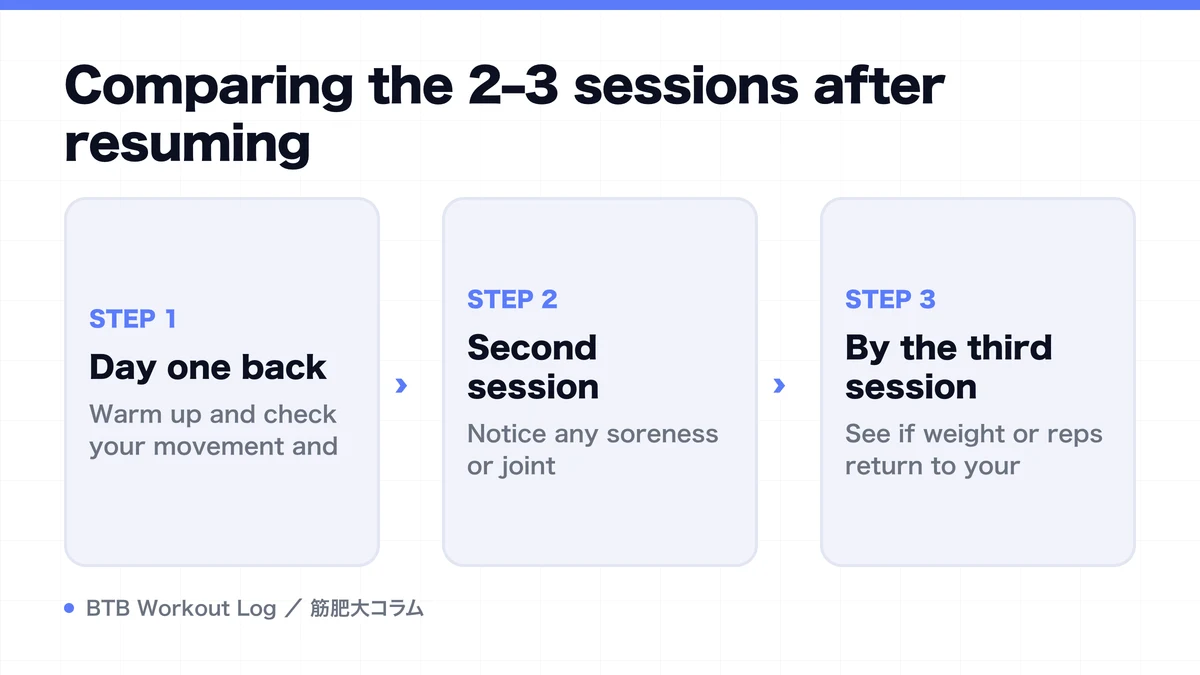
Comparing the 2–3 sessions after resuming under identical conditions makes it harder to jump to "I lost muscle"
If you need a full week of complete rest, you don't have to cram in extra hard sets to protect muscle mass. Keep your last normal session before the break on record, then compare using the same exercises, movement range, and rest intervals after resuming. Look at the combination of weight, reps, and RIR (how many reps you had left)—not a single-session personal record.
- Day one back: Warm up and check your movement and condition. You can try the weight you used before, but don't make hitting it mandatory—leave extra RIR in the tank.
- Second session: Notice any soreness or joint response, and bring accessory work and set counts closer to normal.
- By the third session: See if weight or reps return to your pre-break range at the same RIR. If they do, the first-day dip likely came from skill or that day's condition.
Adding back a full week's worth of sets here breaks the comparison and cancels out the recovery goal of your break by introducing new fatigue. Starting from your pre-break record and resuming progressive overload from your current output is enough.
Don't write off the first day as a loss; line up 2–3 sessions of recovery and you'll separate the "I lost muscle" feeling from what your actual performance is doing. What happened during that one week becomes clear when you match the same exercises before and after. BTB Workout Log makes that comparison straightforward.
常見問題
- Should I do light bodyweight training while taking the week off?
- If the break is to shake off fatigue, you don't need to add training out of fear of losing muscle. If you feel good and want to move lightly for a mental reset during travel, fine—but stay away from hard effort and keep the load light enough not to undermine the purpose of the break.
- If my weight or arm circumference drops over one week, is that proof I lost muscle?
- No. Carbs, salt, hydration, gut contents, and pump status all shift bodyweight and circumference in the short term. Return your meals and training to normal, then measure a few times at the same time of day and under the same conditions before you judge the change.
- Is it safe to use the same weight on day one back that I used before the break?
- You can try it after warming up if you feel good—but hitting the same reps is not mandatory. If it feels heavy, dial back weight or sets and keep extra RIR; over 2–3 sessions, your form and output will settle back to normal.
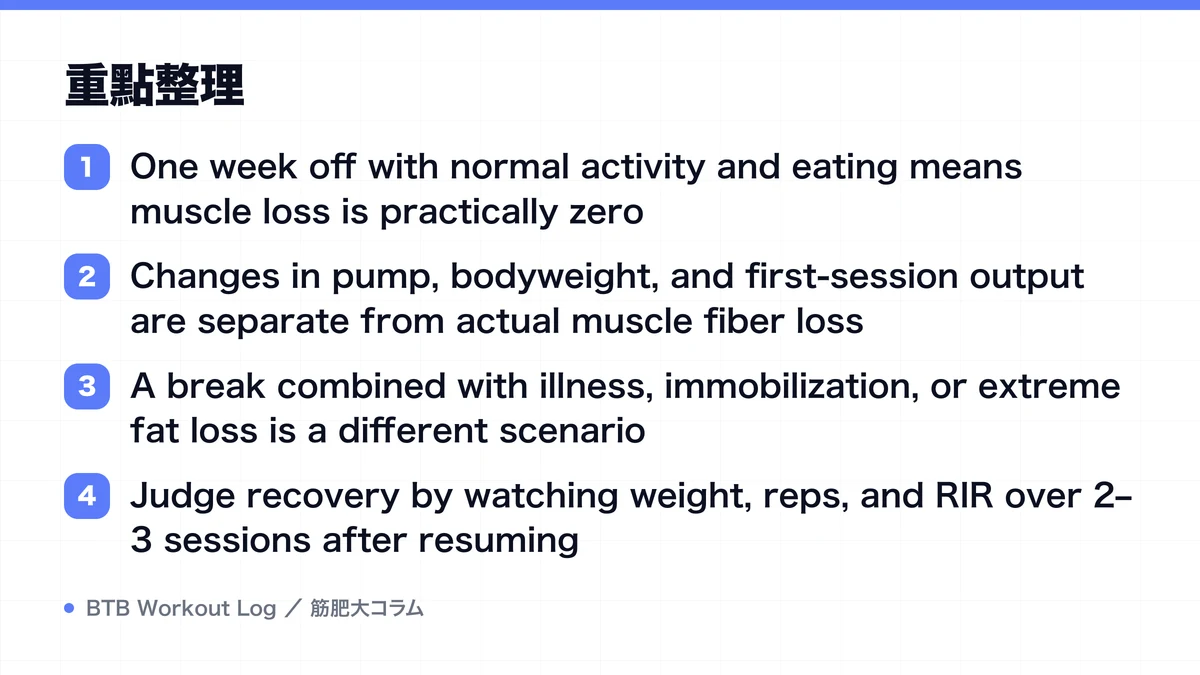
重點整理
- One week off with normal activity and eating means muscle loss is practically zero
- Changes in pump, bodyweight, and first-session output are separate from actual muscle fiber loss
- A break combined with illness, immobilization, or extreme fat loss is a different scenario
- Judge recovery by watching weight, reps, and RIR over 2–3 sessions after resuming