
Deload 週會發生什麼?休息了卻變強,疲勞消退的原理
Deload 週表現力恢復,不是因為短期內新增肌力,而是積累的適應之下壓著的疲勞先一步消退。
降低負荷後,疲勞生成速度下降,睡眠與營養的恢復效應反而佔上風。結果是相同的肌量與技能能更輕鬆地表現為重量與次數。
可見的表現 = 適應 − 疲勞
訓練後留下的不止一樣東西。長期積累的肌量、肌力、動作技能等適應,與近期訓練組產生的暫時性疲勞同時存在。實際的舉重表現,是這兩者重疊後觀察到的結果。
舉例來說,某段時間裡肌力確實進步了,但硬組數量增加到一定程度後,疲勞的影響反而超過進步幅度,同樣重量的次數就會下降。如果此時判斷為「肌力流失」而增加刺激,只會加深疲勞。反之,降低負荷數天後次數恢復了,也不代表這短短幾天內肌肉增長了。更合理的解釋是,隱藏的能力逐漸能被發揮出來。
這不是說適應和疲勞可以作為獨立的數值實際測量,而是用來解讀訓練記錄變化的框架。尤其在訓練至力竭或高週間量的時期,必須把「能力本身」和「當日能否表現出能力」分開看待。
在充分恢復前承受新負荷,疲勞就會浮現
單次訓練課中,肌肉能量耗盡、代謝物堆積、肌纖維與結締組織損傷、神經肌肉輸出下降等,在不同時間軸上發生。有些在組間恢復,有些要到隔天甚至之後。下一次訓練到來時,如果新增疲勞超過恢復量並持續,單日的低迷就會演變成多日跨度的表現下降。
典型表現包括:同樣重量、動作幅度、休息時間下次數卻快速下滑,未達目標 RIR 就速度變慢,後面的組更難維持姿態。RIR 代表餘力指標,同樣重量和次數但 RIR 從 3 降到 1,表面數字一致但身體負擔已增加。
不過單次重訓日可能受睡眠、進食、時刻、熱身等因素影響。決定是否需要 Deload 週的根據,是在條件相同下持續多日的表現下滑,或多個動作都出現恢復不良。如果只是組間疲勞問題,考慮休息時間的影響;如果跨越數天,則檢視週間配置或總訓練量。按時間軸分層能更清楚找出原因。
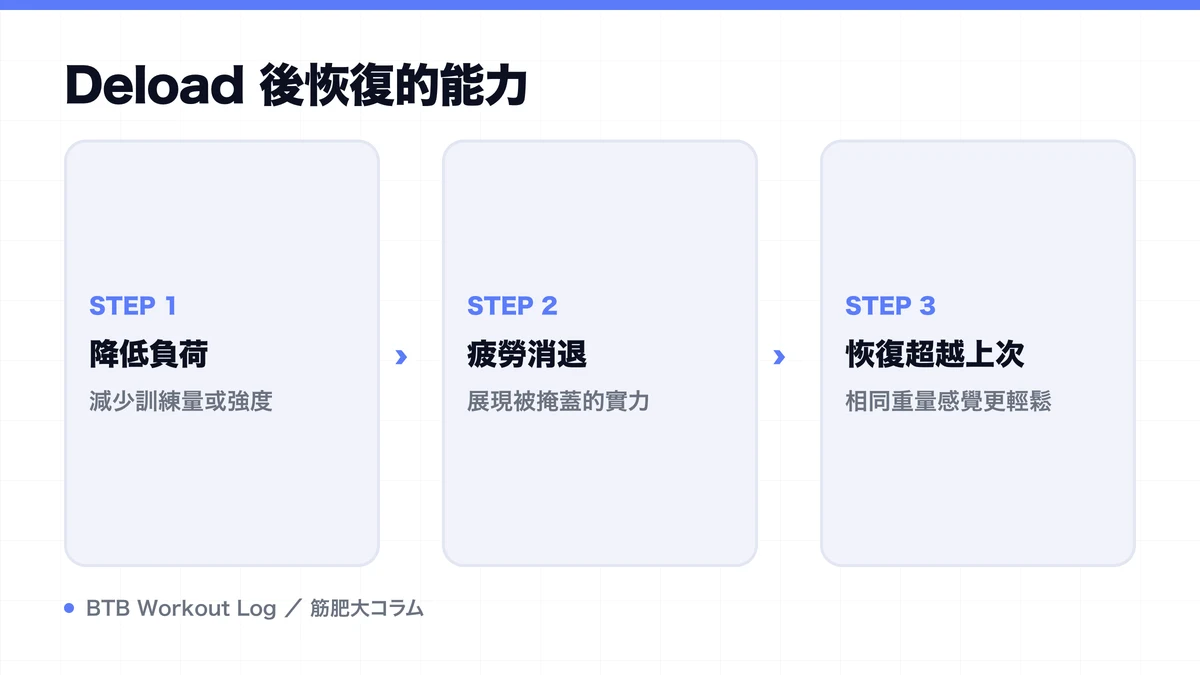
Deload 週暫時讓「疲勞流入」小於恢復量
只要繼續執行常規週的硬組訓練,身體就邊恢復邊累積新疲勞。Deload 週則降低組數、使用重量、接近力竭的程度,刻意減少新生疲勞。睡眠和營養等恢復條件沒有大幅惡化的前提下,疲勞數值就會傾向下降。
關鍵是不用歸零,而是把超出恢復量的負荷降下來。保留輕量動作練習的訓練課,既能維持動作感覺,又能減輕硬組帶來的負擔。但如果有關節疼痛、體況不佳或嚴重睡眠不足,完全休息或其他對策可能更合適。Deload 週不是傷病治療。
具體的組數或重量調整方式見Deload 週的執行方法。從機制角度,重點不在選用哪套方法,而是確保負擔明確低於常規週,且為恢復留出餘地。短期負荷降低和長期中斷不同,休息期過長的變化與脫訓進程區分開來。
疲勞比適應消退更快,能力就以重量·次數呈現
The moment you drop the load, fatigue doesn't vanish uniformly. Local muscle tightness, systemic lethargy, joint discomfort, and reduced focus during lifts all recover at different rates. Still, introducing a low-stress window typically lets short-term fatigue shrink gradually, showing up as faster warm-up speed and restored rep performance on your main sets.
Adaptation doesn't evaporate after a few light days either. Muscle mass shifts through long cycles of stimulus and recovery; technical skill won't reset from a single week of reduced load. When fatigue clears faster than adaptation erodes, net performance climbs. Same weight moves at lower RPE—higher RIR. Same RIR yields more reps. Form consistency returns. That's the pattern.
That said, long-term studies focusing on Deload 週 alone are limited, and not everyone hits a PR right after. Periodized research equating total volume shows load fluctuation offers no clear muscle growth edge, but does outpace non-periodized work for 1RM gains. This supports planned load cycling, but it's not a direct proof that one Deload 週 restores output by a specific percentage through this exact mechanism. Recovery chiefly rebuilds work capacity—not necessarily new muscle. That boundary matters.
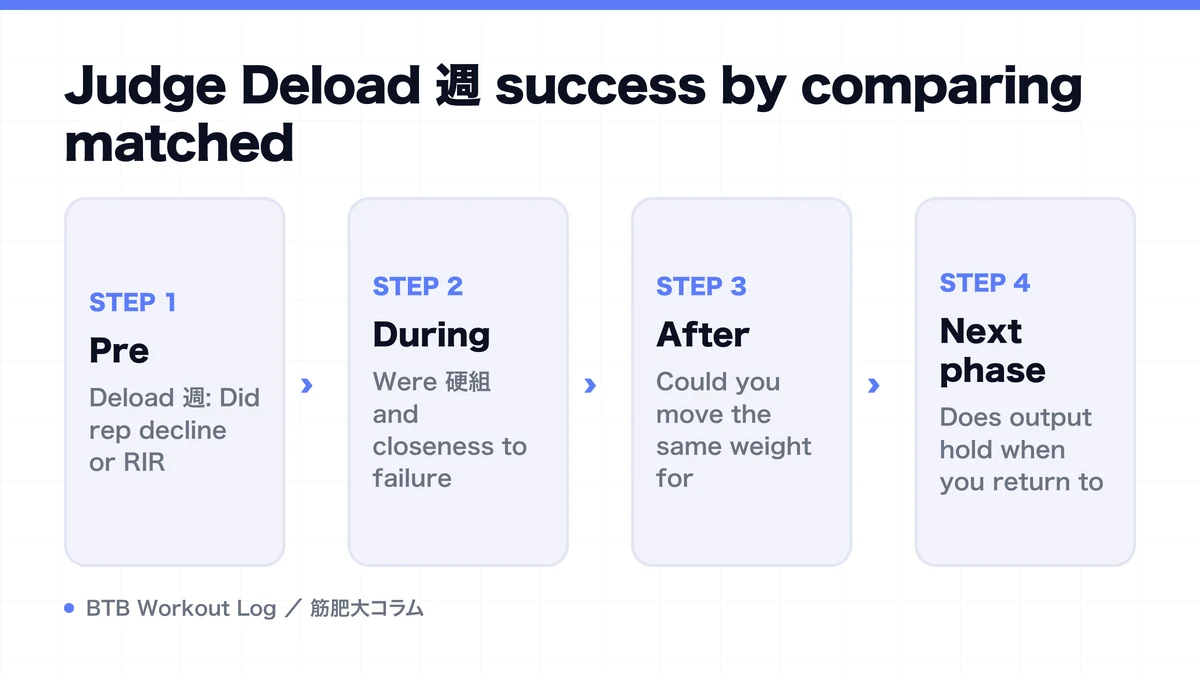
Judge Deload 週 success by comparing matched data after it ends
"Feeling fresh" alone or "hitting a PR on day one" is too unstable. Before Deload 週, during it, and for one or two sessions after, match the same exercise: load, reps, RIR, 動作幅度, rest time. For compounds, track main-set reps and RIR; for single-joints, watch rep drop across all sets. Prioritize metrics you already measure reliably.
- Pre-Deload 週: Did rep decline or RIR decline occur across multiple sessions?
- During: Were 硬組 and closeness to failure clearly less than a normal week?
- After: Could you move the same weight for more reps, or the same reps at higher RIR?
- Next phase: Does output hold when you return to normal training, not just day one?
If it improved, fatigue likely contributed to the previous 停滯期. No change? Examine sleep, calorie intake, pain, technical skill, or insufficient stimulus instead. Rather than extending Deload 週 repeatedly, map how the plateau formed—that steers the next call.
Add RIR and rest conditions to your weight and rep logs, and "felt light" becomes reusable data for the next cycle. Deload 週 success shows up as numbers returning within a few post-sessions. BTB Workout Log lines up pre- and post-Deload 週 on the same scale.
常見問題
- Will I lose strength or muscle during Deload 週?
- A few days to one week of reduced load shouldn't erase prior adaptation. That's different from long-term complete rest. Whether to keep light movement practice or stop entirely depends on fatigue depth, pain, and how you feel.
- Is it a failure if my weight doesn't come back after Deload 週?
- One weak session isn't a verdict. Match sleep, meals, time of day, and rest; check one or two sessions after. Still no rebound? Isolate non-fatigue causes or whether you cut load enough.
- Should I schedule regular Deload 週 before output drops?
- You can block the end of a high-load phase in advance, or insert Deload 週 when logs show sluggish 恢復. Fixed cycles don't suit everyone. Choose based on past 停滯期 timing and your current 恢復 pattern.
重點整理
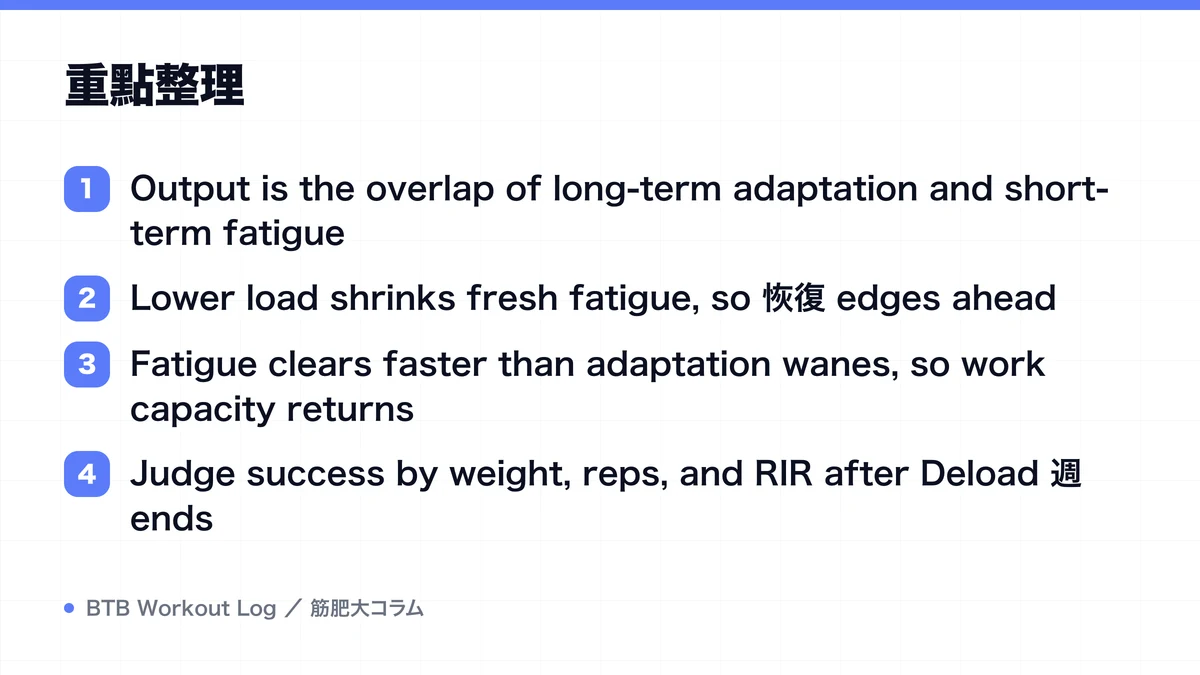
- Output is the overlap of long-term adaptation and short-term fatigue
- Lower load shrinks fresh fatigue, so 恢復 edges ahead
- Fatigue clears faster than adaptation wanes, so work capacity returns
- Judge success by weight, reps, and RIR after Deload 週 ends