
睡眠不足會對訓練產生什麼影響?睡不好拖累肌肉肥大的過程
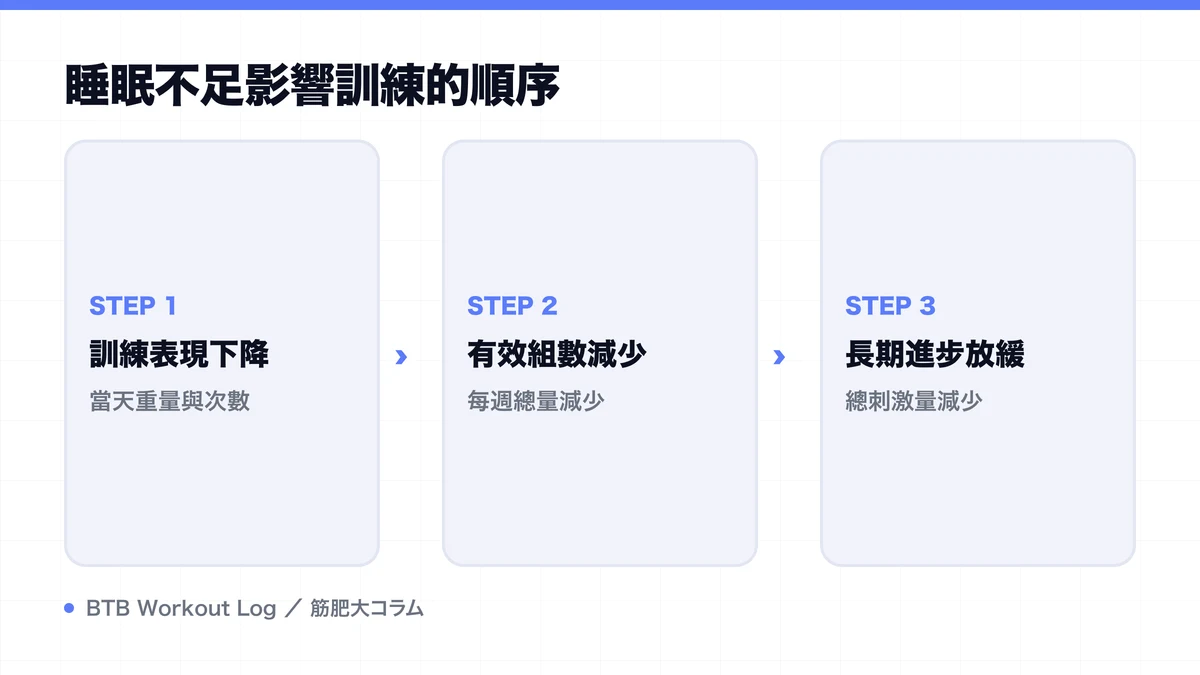
睡眠不足時,訓練的準備狀態會先下降,相同重量的相對難度隨之增加。結果是複合動作的力量輸出、次數、動作形式的穩定性依序出現問題。
一晚睡眠不足不會直接導致肌肉肥大的損失。真正的危害是,低輸出的訓練課次累積,難以積累達到漸進超負荷所需的高品質反覆。
睡眠不足的影響先出現在「準備狀態」,而非肌肉本身
即使睡眠時間不足的早晨,肌肉不會突然縮小,也不會失去之前的適應。最先改變的是眼睛睜得開的程度、注意力維持、啟動動作的意願與主觀的疲勞感——這些是激發高輸出的準備狀態。
在訓練記錄中,準備狀態看不到單獨的數字。它表現為熱身的感覺比平時沉重、開始組前需要更長的集中時間、同樣重量卻在更早失去餘力等跡象。因此,與其說「力量下降了」,不如說「睡眠情況導致那天能輸出的力量減少了」才更貼切。前次能舉的重量為何突然變重,日常重量波動中有進一步解釋。
關鍵在於不要將睡眠不足當成單純的心理問題。訓練就是用設定好的動作形式與動作幅度輸出力量,並在組與組之間複現這個動作的過程。清醒度和注意力一旦崩潰,整個過程的精準度就會下降。
準備狀態的下降波及到複合動作的力量輸出
Knowles等人的系統性文獻回顧涵蓋了一項8名18~24歲男性的研究,在連續3晚僅睡3小時的條件下,上臂二頭肌彎舉的最大肌力沒有顯著下降,但臥推、腿部推舉和硬舉有明顯下降。相關研究的質量有限,不代表所有動作和所有人都會出現同樣的下降。
深蹲、臥推、硬舉等複合動作需要多個關節協調、維持姿勢,並沿著設定軌跡輸出大力量。在睡眠不足導致注意力和準備狀態下降的日子,除了純粹的肌肉收縮外,還涉及其他因素,成績波動較大在實務上並不奇怪。但由於該文獻回顧沒有直接證明協調能力下降是原因,我們需要將機制與觀察結果分開看待。
同樣要避免的誤區是,只看最大肌力就判斷「今天能舉起慣常重量就沒影響」。首次成功只是一方面,能否維持常規次數範圍、後續組數能否複現同樣動作是另一回事。
相同重量下RIR也會減少,組數品質隨之下降
力量輸出略微下降就會改變訓練方案的意義。平時8次動作保持RIR 2(即還能做2次的餘力)的重量,在睡眠不足的日子可能6~7次就接近RIR 0~1。重量數字相同,但相對於那天能力的相對強度卻升高了。
如果忽視這個差異而堅持完成預計次數,就容易出現減小動作幅度、增加反動、用無關的肌肉硬推等代償。反之,若堅守動作形式,次數就會下降。無論哪種情況,都不能說「紙面上的重量×組數相同就代表刺激相同」。只有當RIR、動作幅度和動作形式都一致時,才能與前次訓練做比較。
而且,首組越是用盡餘力,後續組的次數下降就越明顯。如果試圖通過訓練至力竭或額外組數彌補,局部疲勞會增加,整個訓練課次的疲勞也會加重。睡眠不足對肌肉肥大的路徑不是「不睡覺肌肉就長不了」這麼簡單直接,而是相對強度上升 → 次數和動作下降 → 維持品質的訓練量減少,這樣理解會更清楚。
單晚不調與睡眠不足的反覆要分開看
One poor night's sleep doesn't make that day's workout worthless. If you adjust the load on the spot and maintain movement quality within your capacity, you can preserve the training stimulus. There's no need to treat a single performance dip as a plateau and overhaul your entire program.
The real problem emerges when sleep restriction spans several nights to weeks. Reps drop on compound movements each session, the quality of your planned weekly hardsets suffers, and opportunities to advance weight or volume shrink. The lasting impact on muscle growth is best understood through this pathway: losing the ability to sustain progressive overload. This single set of studies can't quantify exactly how much chronic sleep loss reduces long-term hypertrophy gains.
Sleep extension interventions in 14–30 year-old athletes show potential to improve competition performance, but the research pool is small and study quality varies. The takeaway isn't "more sleep always equals more gains"—rather, when chronically sleep-deprived lifters secure adequate sleep, improvement becomes possible.
On poor sleep days, prioritize warm-up over following the plan
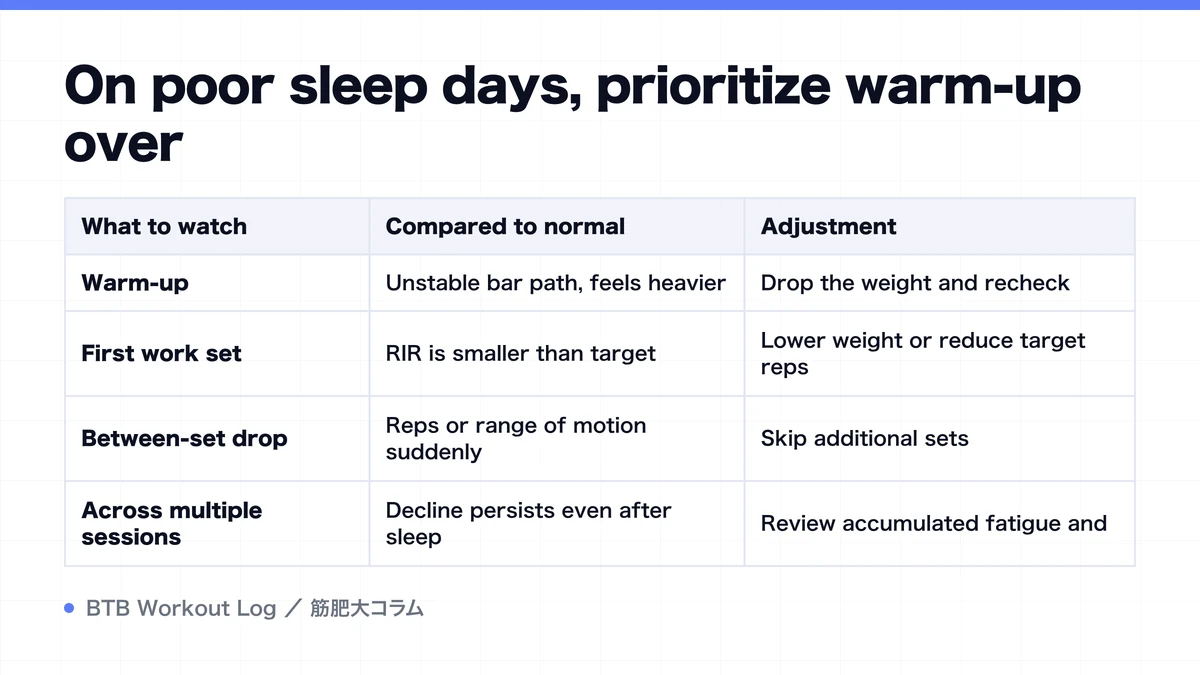
Don't mechanically decide to skip or proceed based solely on that morning's sleep duration. Use warm-up through your first work set as a test—can you execute the planned session?
| What to watch | Compared to normal | Adjustment |
|---|---|---|
| Warm-up | Unstable bar path, feels heavier than usual | Drop the weight and recheck |
| First work set | RIR is smaller than target | Lower weight or reduce target reps |
| Between-set drop | Reps or range of motion suddenly fall | Skip additional sets |
| Across multiple sessions | Decline persists even after sleep recovers | Review accumulated fatigue and program |
When you can proceed normally
If warm-up movement is stable and work sets hit your target RIR and rep range, sleep alone isn't grounds to stop. That said, save personal records and high-risk attempts for a day when you're well-rested.
When to lower load or sets
If you can't hit target reps while keeping form strict, if your first set already feels close to failure, or if reps drop sharply between sets, match the day's actual capacity. Preserving consistent, quality reps in the target muscle matters more than hitting a predetermined weight. Once sleep recovers, return to normal settings—don't fear a single adjusted session as wasted training.
When rest takes priority
Strong drowsiness, difficulty controlling free weight positions, or impaired daily decision-making all mean rest comes first. If output doesn't rebound over several sessions even with normal sleep, separate sleep debt from accumulated training fatigue. Check how a Deload week restores output and think through rest day strategy.
Read sleep impact through conditional patterns, not single lifts
To judge sleep's effect, pair sleep hours with training outcomes. At minimum, log bed-to-wake time, subjective sleepiness, weight · reps · RIR per lift, and rep drop between sets. Sleep duration won't match time actually asleep, so treat it as a boundary marker, not a precise measurement.
One weight drop might be daily variation. If poor sleep days show repeated worse RIR and reps on compounds, then improve on well-slept days, the sleep link becomes clearer. Conversely, if decline persists after sleep recovery, dig into volume, frequency, nutrition, or pain. Rather than a fixed 48-hour rule, judge recovery by pairing conditions with output.
Healthy young and older adults are advised 7–9 hours, but need varies. Don't force yourself to hit a target number. The practical approach: secure whatever sleep amount keeps your output and daytime function stable, then use that as your training baseline.
常見問題
- Should I skip training after just one poor night of sleep?
- Sleep alone doesn't warrant skipping. Check your warm-up bar path, how weights feel compared to normal, and your first work set's RIR. If those check out, adjust the load and train. Skip only if strong drowsiness makes safe movement difficult.
- By what percentage should I reduce weight on poor sleep days?
- Don't use a blanket cut. After warm-up, drop to whatever weight lets you hit your target rep range and RIR. If form or range of motion breaks down even at lower weight, or if reps between sets plummet, also trim sets and plan to return next session.
- Does chronic sleep loss prevent muscle growth?
- Growth doesn't immediately stop. However, if compound strength and set quality repeatedly suffer, advancing weight, reps, or quality weekly volume becomes harder. If decline persists after sleep improves over several sessions, also check accumulated fatigue and other factors.
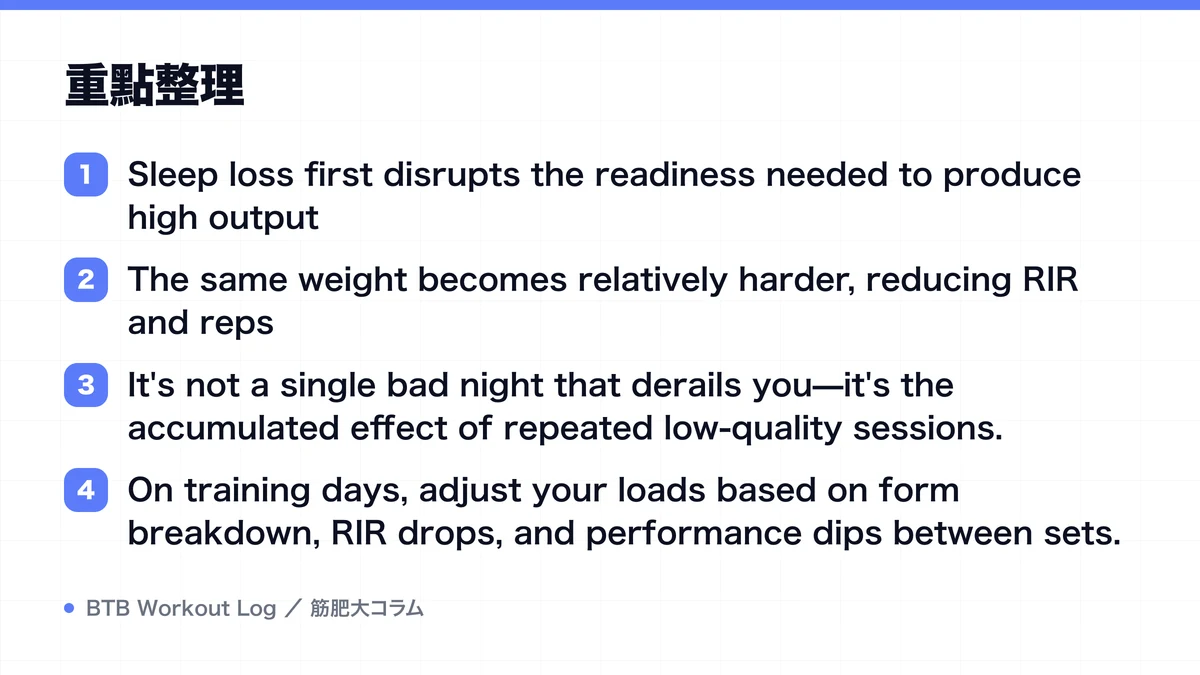
重點整理
- Sleep loss first disrupts the readiness needed to produce high output
- The same weight becomes relatively harder, reducing RIR and reps
- It's not a single bad night that derails you—it's the accumulated effect of repeated low-quality sessions.
- On training days, adjust your loads based on form breakdown, RIR drops, and performance dips between sets.