「練完空48小時就會恢復」是真的嗎?有些人並不適用這個標準
48小時是重複訓練同一部位的起始參考值,但不保證恢復已完成。
恢復時間取決於前次訓練的組數、力竭程度、動作類型、訓練經驗以及睡眠和營養。不能只看時鐘,還要判斷下次是否能重現相同的動作品質和輸出強度。
「間隔48小時」的有效邊界在哪
這個說法並非毫無根據。阻力運動後肌肉蛋白質合成會上升,健康、非肥胖成人在禁食和進食後吸收完畢的條件下進行單次運動的研究,確實有報告顯示48小時後仍高於靜息水平。近年的系統性綜述也證實了持續到48小時的反應。因此,同一肌群不每天強烈訓練,中間隔一天的做法成為實用的初始設定。
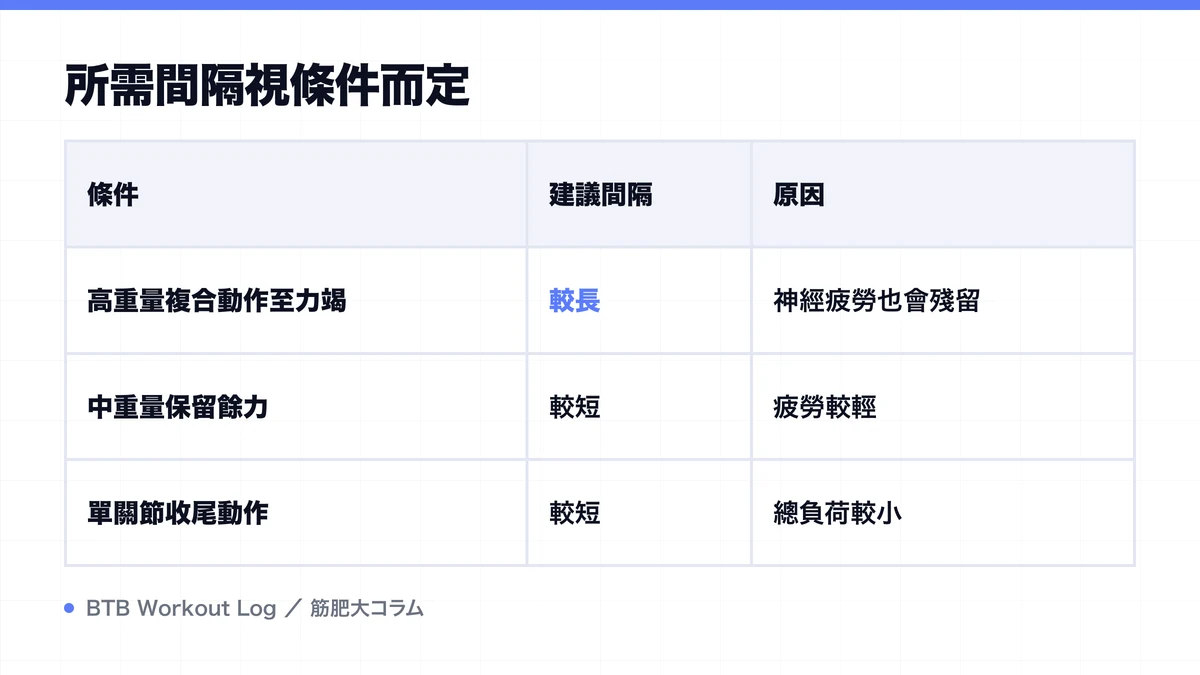
同一個人身上,保留餘力的少組訓練日和挑戰陌生動作、接近力竭的多組訓練日,次回訓練前殘留的疲勞也不同。48小時對個人不是固定的恢復能力,而是隨前次刺激量而改變的相對值。
但研究顯示的是特定條件下肌肉蛋白質合成升高的持續時間,並未證明48小時後所有人的肌力、肌肉酸痛、關節負擔、全身疲勞都一齊恢復。也不意味著合成反應回到常態前就不能進行任何刺激。一般的休息日概念應遵循肌肉肥大所需的休息天數,把48小時當作臨時的間隔參考而非絕對邊界。
為什麼無法用一個時鐘定義「已恢復」
「恢復」其實包含多種彼此獨立變化的狀態。只看其中一項就認定「已經恢復」,很容易誤判下一次訓練的表現。
| 觀察項目 | 需要確認的事 | 與48小時的關係 |
|---|---|---|
| 肌肉內部反應 | 肌肉蛋白質的合成、分解與組織重建 | 反應維持多久會因條件而異 |
| 局部輸出能力 | 能否重現相同的重量、次數與動作幅度 | 恢復速度會受到上次訓練負荷量影響 |
| 局部症狀 | 明顯的肌肉痠痛、緊繃或關節不適是否妨礙動作 | 無法只靠經過時間判斷 |
| 全身準備狀態 | 睡眠不足或多個部位的疲勞,是否導致專注力與舉重表現下降 | 即使讓同一部位休息,影響仍可能持續 |
例如,肌肉痠痛不明顯,卻可能從熱身開始就覺得重量明顯比上次更沉,使用相同重量時次數也會下降。相反地,即使還有輕微緊繃感,也可能照常維持動作幅度與輸出表現。肌肉痠痛只能作為輔助資訊,其程度並不能直接代表恢復狀態或肌肉肥大效果。這項區分也適用於「肌肉痠痛=練得好」的迷思。
研究從未說「48小時時全員相同」
2024年的系統性綜述針對健康非肥胖成人在禁食和進食後吸收完畢條件下進行單次阻力運動的研究,發現肌肉蛋白質合成有明確上升,但上升幅度和持續時間在研究間差異很大。時間經過受年齡、訓練經驗、運動強度·工作量·努力程度等影響。也就是說「48」這個數字雖便於描述觀察範圍,卻無法作為個人下次訓練是否可行的自動計時器。
從長期肌肥大角度看訓練頻度的研究,也不支持簡單的48小時法則。等量周總體積的元分析中,低頻度和高頻度在肌肥大上沒有有意義的顯著差異。頻度是將可恢復的每週組數分配到各天的設計變數。詳細分析見訓練頻度與總體積,增加頻度的注意事項見為什麼增加頻度不一定加快肌肥大。
這裡要強調的是,「頻度差異小」不能理解為「可忽視恢復」。同樣周總量,一次堆砌會讓訓練後半品質下滑,頻度過高分散則可能讓殘留疲勞疊加到下次。研究平均值是縮小候選範圍的材料,個人最適間隔應由實際反覆可能性決定。
「48小時完全恢復」的說法如何形成
The 48-hour rule stuck around because three separate ideas got lumped together. First, there's the physiology: muscle protein synthesis does spike after training. Second, there's supercompensation—the recovery model showing adaptation to a higher baseline. Third, there's the calendar convenience of the "one day off" pattern, which fits most programs with 2–3 sessions per muscle group per week.
Each idea helps shape your program. But the recovery curve doesn't peak at the same time every session, and a spike in muscle protein synthesis doesn't tell you when your lifts come back. Treat every 48 hours the same—whether you crushed the volume, added an unfamiliar movement, or slept poorly—and you trade clarity for losing what actually matters.
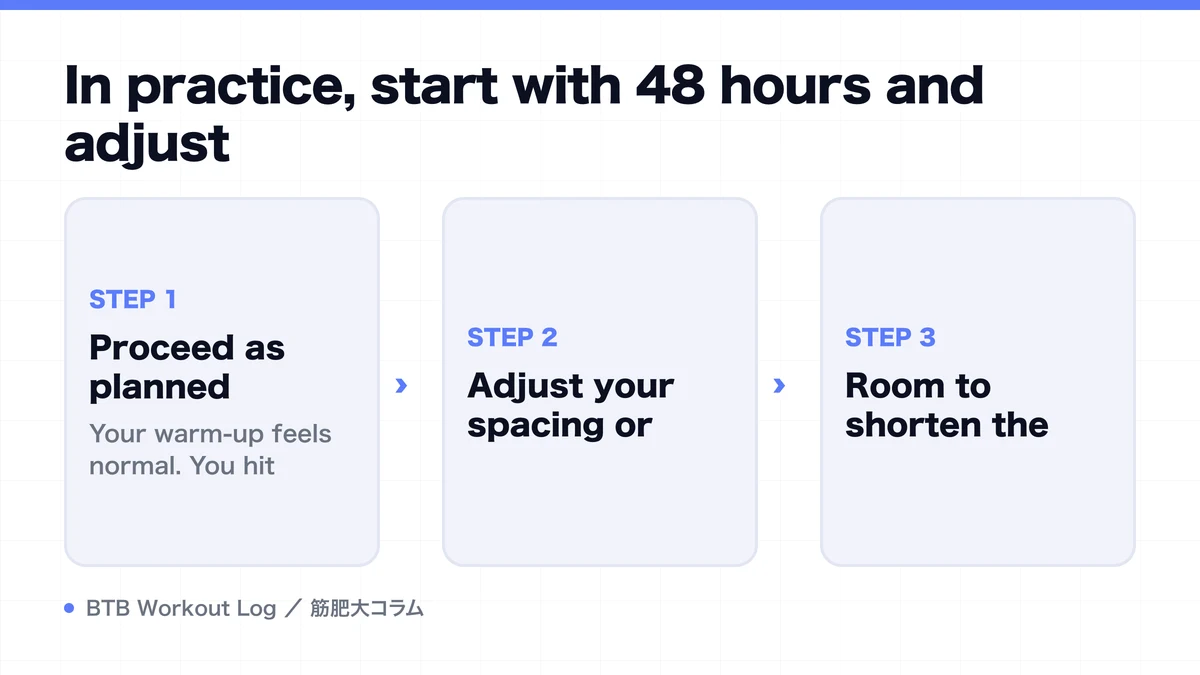
In practice, start with 48 hours and adjust based on your next session's quality
Start by spacing your main sessions for the same muscle group 48–72 hours apart. Keep that structure for 2–4 weeks and watch how you respond. Then use your first main lift at the next session as a "recovery test." Match conditions as closely as you can: exercise, form, range of motion, rest intervals, and your target RIR.
- Proceed as planned: Your warm-up feels normal. You hit the same weight, reps, and RIR as last time.
- Adjust your spacing or volume: Reps drop under the same conditions, and you carry tightness or movement restrictions into multiple sessions. Push your next session back 24 hours, or cut the 硬組 from your previous session.
- Room to shorten the interval: Your output stays consistent, and you hold quality even late in the session. If you want to spread more 每週組數 across the week, try cutting volume per session and testing higher frequency.
Don't overhaul your program after one off day—sleep, food, and work stress swing your output constantly. If you see the same dip across 2–3 sessions, first check your total 每週組數 and how you're distributing it. When performance drops across multiple muscle groups or lifts, sometimes a Deload 週 clears the whole system faster than tacking extra days between sessions.
Pressing hits your chest, shoulders, and triceps. Pulling hits your back and biceps. Think beyond "I rested my chest 48 hours"—count the indirect volume too. Sharp pain, swelling, or anything that breaks your daily movement pattern isn't normal fatigue adjustment; stop training and see a medical professional if needed.
Use your log to make decisions: don't just look at the single session 48 hours later, but stack weeks of data at the same interval. Your ideal spacing shows up when you compare weeks where you changed it. BTB Workout Log pairs dates and results for the same lift.
常見問題
- If soreness is still there at 48 hours, should I skip the session?
- Soreness alone doesn't tell you whether you're recovered. But if the soreness changes your 動作幅度 or form, or if your warm-up numbers are way down, either push that muscle group out or drop the load. Light tightness with normal movement and output is fine to work through.
- Is it wrong to train the same muscle 24 hours later?
- Not automatically. If you keep reps low per session, manage your total weekly volume including indirect work, and your weight–rep–RIR stays solid across sessions, it can work. High frequency isn't about piling on volume; it's about spreading a manageable total across more days.
- Is resting 72+ hours between sessions overkill?
- Not if you hit your weekly target and keep making progress on each lift. Conversely, if you're stacking too many reps into one session and need longer to bounce back, reduce your volume per session and spread it first—before you just add more rest days.
重點整理
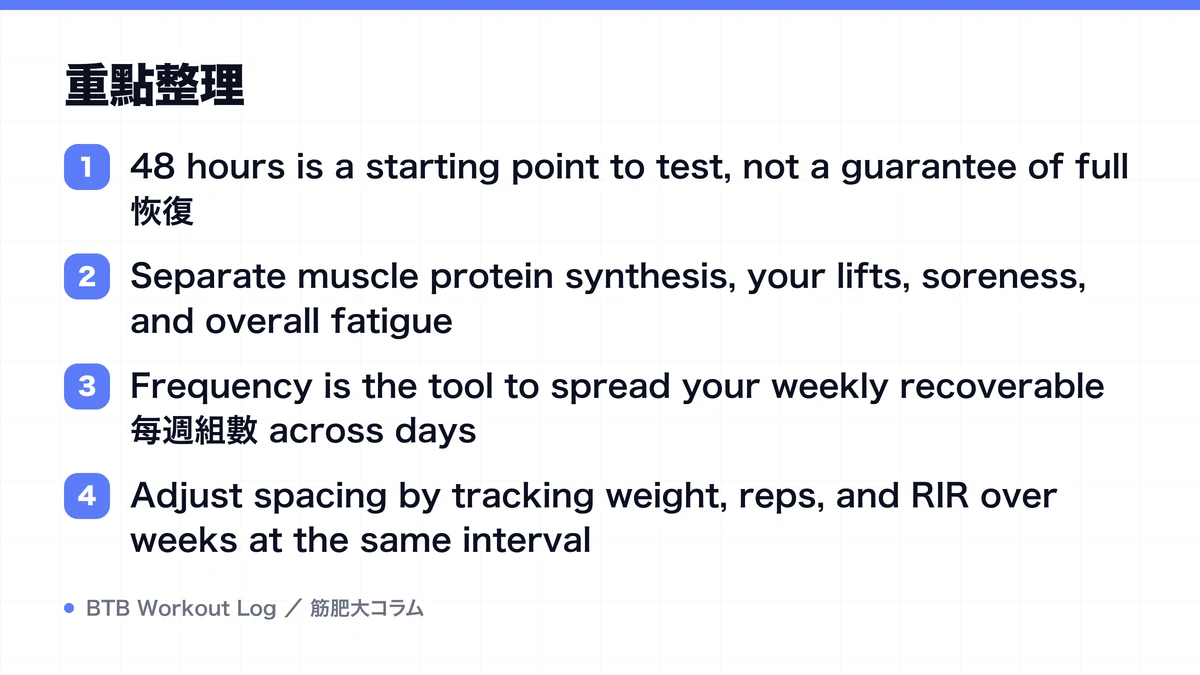
- 48 hours is a starting point to test, not a guarantee of full 恢復
- Separate muscle protein synthesis, your lifts, soreness, and overall fatigue
- Frequency is the tool to spread your weekly recoverable 每週組數 across days
- Adjust spacing by tracking weight, reps, and RIR over weeks at the same interval