昨天能舉起的重量,今天卻變重了,為什麼?在你焦慮「變弱了」之前該知道的事
同一重量突然感覺更重的主要原因,不是肌肉一天內變弱,而是當日的表現能力受疲勞、睡眠和準備條件影響而波動。
一次不佳表現不是停滯期的證據。首先要分清楚:是「能力下降了」還是「今天無法全力發揮」。
「感覺重」和「肌力下降」不是一回事
上次能做8次的重量今天只能做到第5次才變慢。這時發生的未必是長期肌力下降。包括肌量和技術的基礎能力幾天內很難大幅變化,但當天能發揮到什麼程度則會波動。前者像引擎排量,後者像那天的路況、燃料和駕駛條件。
如果馬上認定「變弱了」,破壞動作來強行達到上次次數,連比較條件都變了。反之,只因一天感覺沉重就全換組數和動作,就永遠分不清原因。昨天的成績不是今天必須達成的配額,而是用來檢視長期進步的基準值。
肌肉肥大需要的不是每次自我突破,而是數週到數月間重量、次數和動作品質向上。單日體感是有用的訊號,但光靠這個判斷成長或停滯期,雜訊太大了。
疲勞、睡眠、營養改變「能用的輸出」
影響當日表現的主要因素是前面累積的疲勞。不只是同部位的硬組,前天下肢訓練、工作中的長時間活動、連續多天的高訓練量都會有影響。即使沒有肌肉酸痛,但熱身時就動作速度慢、呼吸比平時亂、多個動作次數都下降,就表示恢復可能跟不上。
疲勞的範圍也是線索。只有臥推下降,下肢和拉力動作如常,那就先懷疑胸肌·三頭肌局部疲勞或臥推特有的技術因素。反之推·拉·腿全部從熱身就沉重、難以集中、有明顯睏意,就不該只加組數來解決,要重新檢視整體恢復。橫向對比不同動作的感受,能更快縮小問題範圍。
睡眠也不能忽視。睡眠不足特別會降低大肌群複合動作的表現。睡眠差的日子深蹲或臥推沉重,不代表整個計畫崩潰。恢復日的思維可參考如何安排休養日,睡眠不足到表現下降的機制詳見睡眠不足如何影響訓練。
用餐間隔長、碳水化合物或水分比平時少、高溫環境出汗多,這些條件也會改變體感。但不必執著於找出唯一原因。從「昨晚睡眠」「最近48~72小時該部位硬組數」「訓練前進食和補水」這類容易改變、易重現的項目開始確認,更實用。
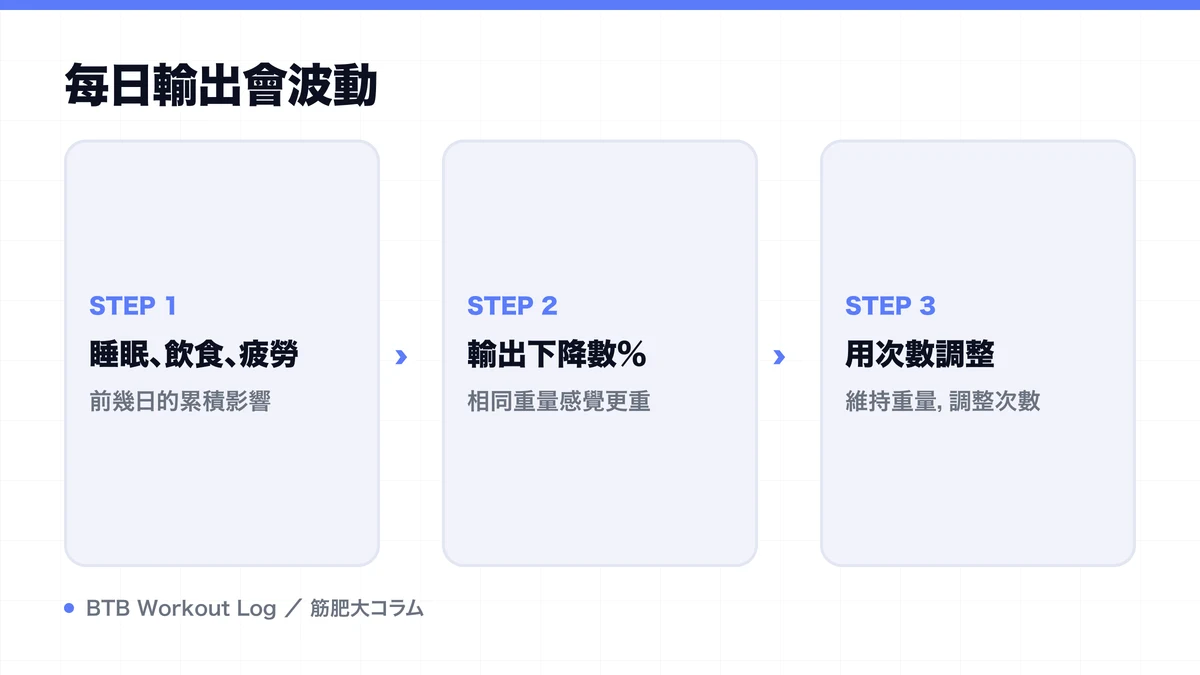
同樣的重量,其實不是在同樣的條件下舉
除了體能外,最常見的是比較條件偏差。上次是第一個動作,今天是第三個;上次組間休息3分鐘,今天90秒;架子高度或椅子位置不同。有這些差異,即使槓鈴上的數字相同,課題也不一樣。
| 改變的條件 | 容易出現的情況 | 確認方法 |
|---|---|---|
| 動作順序 | 先行動作的局部疲勞導致次數下降 | 檢查是否與上次順序相同 |
| 組間休息 | 恢復不足讓後面的組變沉重 | 統一休息時間 |
| 熱身 | 準備不足,或熱身本身消耗 | 固定階段和次數 |
| 動作幅度·速度 | 動作越嚴謹同重量越難 | 用影片或訓練筆記比較 |
| 器材·設定 | 軌跡或發力點改變 | 確認台子、架子、機械編號 |
尤其組間休息時間直接影響總次數。詳細內容可查組間休息時間。另外,如果動作幅度比之前深、反動減少、下降段控制更好,即使次數相同也代表品質進步了。不要只看重量和次數,把比較條件對齐才能真的判斷「今天是否真的變弱了」。
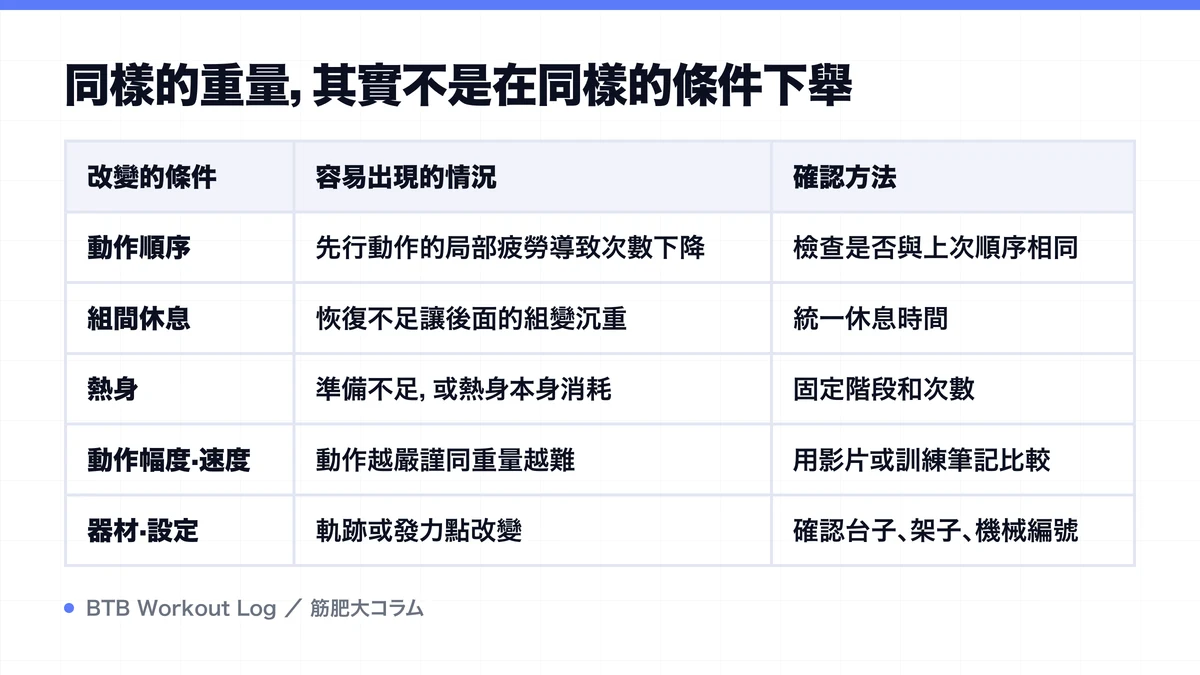
用熱身和RIR決定那天的負荷
You can't pinpoint the exact cause before you start training. That's where standardized warm-ups and RIR come in. RIR measures how many reps you had left in the tank at the end of a set—RIR 2 means you could have done two more. Run through nearly the same prep each time, then use your final warm-up and opening work set to read how your body's responding today.
- Standardize your setup: same exercise order, similar warm-up weights, same rest periods each session.
- Use your first set as a diagnostic: log not just rep count, but movement quality and RIR.
- Adjust if RIR drifts from target: if you were planning RIR 2 but hit failure a few reps early, either drop the weight slightly or stop at your session's rep minimum.
- Separate pain from fatigue: sharp pain, numbness, or unusual joint discomfort means you stop—don't write it off as just an off day.
Lowering the load isn't abandoning 漸進超負荷. It's a same-day adjustment to hit the target muscle at the target RIR. If your warm-up felt light and form held tight, you can go for your previous best. Forcing numbers on a bad day doesn't beat maintaining stimulus quality and keeping the conditions comparable for next time—that's what drives long-term progress.
Judge by trends across matched conditions, not a single session
One heavy session means you adjust the load for that day and move on; watch if it bounces back when you do the same exercise next time. What counts as a real problem is when multiple training sessions run under similar conditions and weight, reps, RIR, and form all decline together. If multiple lifts across your whole body drop at once, check sleep and total fatigue first, then nutrition. If it's just one movement, suspect exercise order, technique, or volume for that muscle group.
Even if the decline continues, don't automatically add more sets. If fatigue markers show up, a Deload 週 or session volume trim might be the move. If recovery looks solid but one lift stalls for weeks, review rep ranges and progression strategy to break through the plateau. Single-session noise and real stalling call for opposite fixes.
Separating them needs more than weight alone: check reps, RIR, exercise order, rest, and how you felt, all lined up chronologically. Look at your log for trend direction under matched conditions, not wins and losses each day. Whether a heavy session is an outlier or the start of a downtrend only shows up when you stack several weeks side by side. BTB Workout Log keeps the history you need to spot the difference.
常見問題
- Should I skip training on days when it feels heavy?
- Heaviness alone isn't a reason to bail. Run through a standardized warm-up, check your movement, RIR, and pain, and if you can still hit the target stimulus safely by dropping weight or reps, keep going. Cancel only if multiple lifts crater or pain is unusual.
- Does dropping weight below last session hurt 肌肉肥大?
- One day of load adjustment doesn't kill肌肉肥大. If planned weight breaks form or pushes you too close to RIR 0, backing off to hold your target RIR keeps the set's purpose intact. Judge growth by the long-term line of weight and reps, not single-day swings.
- How many sessions in a row count as a real plateau?
- There's no magic number, but if weight, reps, and RIR drop across several sessions under the same sleep, order, and rest, that's beyond normal swing—suspect fatigue or a program problem instead. First, make sure your comparison conditions actually match.
重點整理
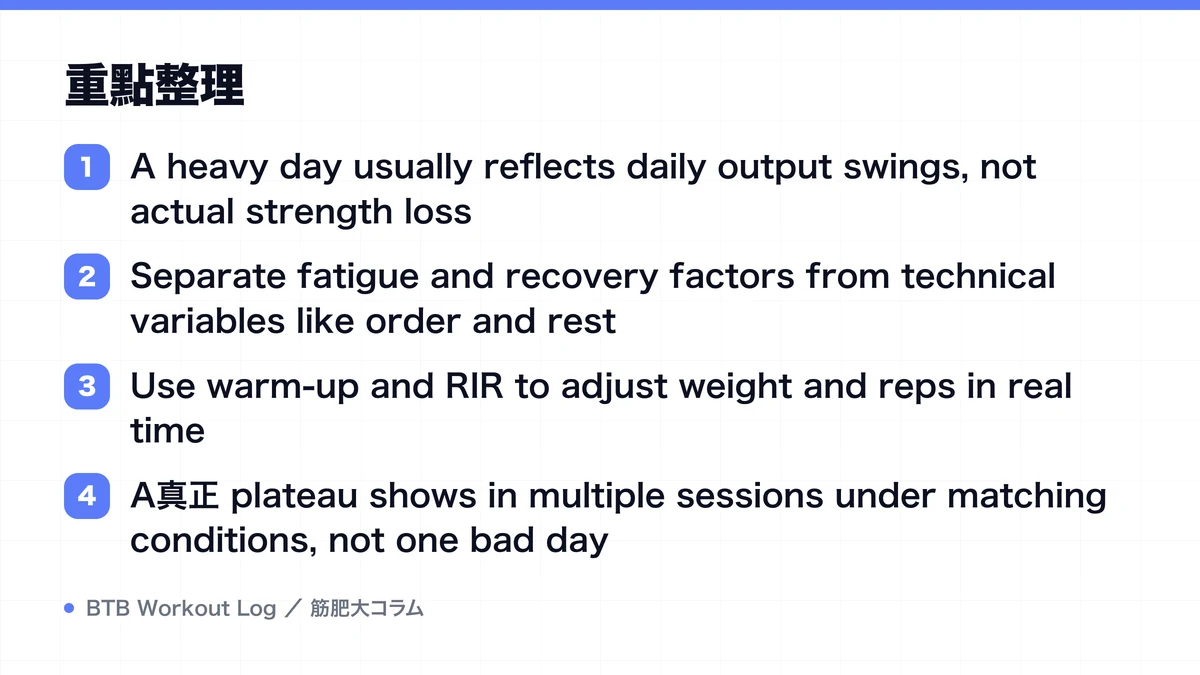
- A heavy day usually reflects daily output swings, not actual strength loss
- Separate fatigue and recovery factors from technical variables like order and rest
- Use warm-up and RIR to adjust weight and reps in real time
- A真正 plateau shows in multiple sessions under matching conditions, not one bad day