停止訓練後,肌肉從什麼時候開始流失?給害怕休息的人的去訓練化解析
休息數天到一週,辛苦練出的肌肉不會突然消失。最先改變的是肌肉飽滿感、體內水分和動作感覺,真正的肌量下降要等休息時間拉長才會發生。
但沒有所謂「第幾天開始掉肌肉」的共同界線。一般度假時還能正常活動,和生病或受傷幾乎無法動的情況,即使都是停訓,進展速度也差異很大。
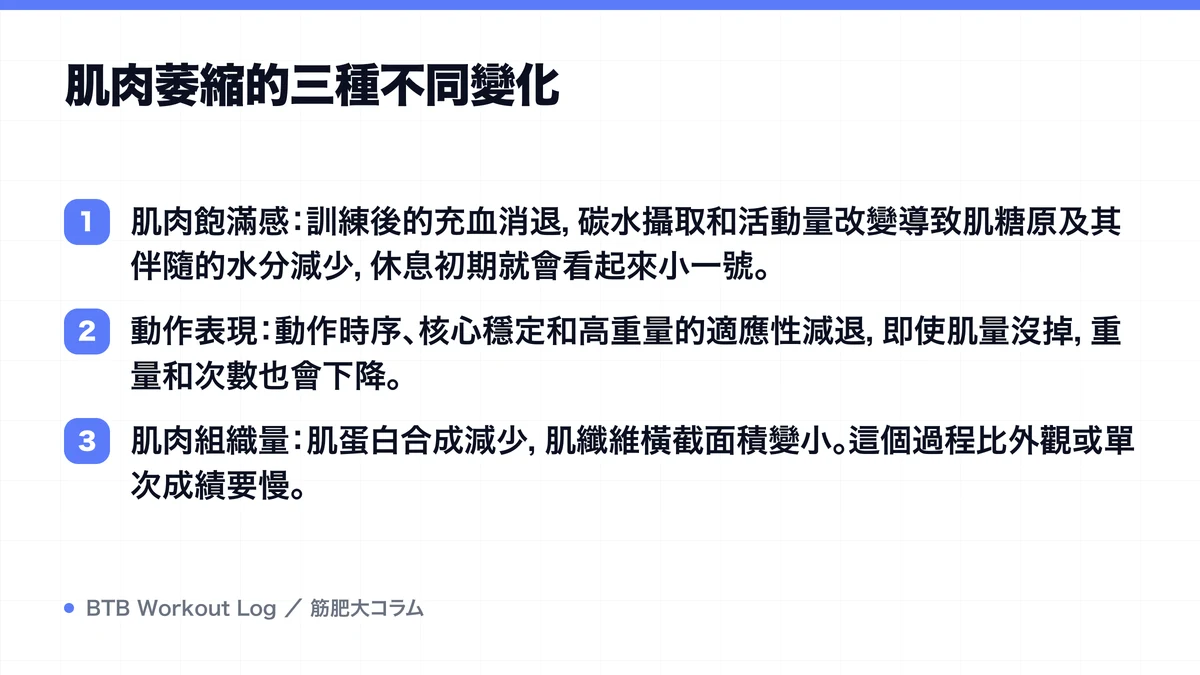
肌肉萎縮的三種不同變化
理解休止期間的變化之前,先區分「掉肌肉」指的是什麼。鏡子裡看起來縮小、之前的重量變重,和肌纖維本身變細,都是不同現象。
- 肌肉飽滿感:訓練後的充血消退,碳水攝取和活動量改變導致肌糖原及其伴隨的水分減少,休息初期就會看起來小一號。
- 動作表現:動作時序、核心穩定和高重量的適應性減退,即使肌量沒掉,重量和次數也會下降。
- 肌肉組織量:肌蛋白合成減少,肌纖維橫截面積變小。這個過程比外觀或單次成績要慢。
忽視這些區分,容易在飽滿感消退時就誤認為掉肌肉,或因為體重沒變就假設肌量保持。短期休息的計畫性恢復(Deload 週)和長期無刺激的去訓練期也不一樣。
最後一組訓練到肌量下降之間發生了什麼
訓練時,肌纖維受到的機械張力驅動細胞內反應,恢復期間肌蛋白重建。運動後肌蛋白合成會短期上升,但這個反應不會持續。大致的因果鏈是:停止訓練→沒有新的張力刺激→運動後的合成反應回到平常→無刺激時間積累→維持的肌組織逐漸下降。理解成長過程的逆向會更清楚,見肌肉肥大的機制。
關鍵在於不要混淆運動後合成反應平復的時間點和可測量的肌萎縮開始。肌蛋白不斷在合成和分解間循環,也受飲食和日常活動影響。最後的訓練效果褪去時,肌纖維不會立刻明顯變細。
休息越久,身體維持大量肌肉的需求就逐漸下降。但速度因人而異,取決於訓練年資、年齡、休息前累積的肌量、日常活動量、能量和蛋白質攝取,以及是否有病傷。
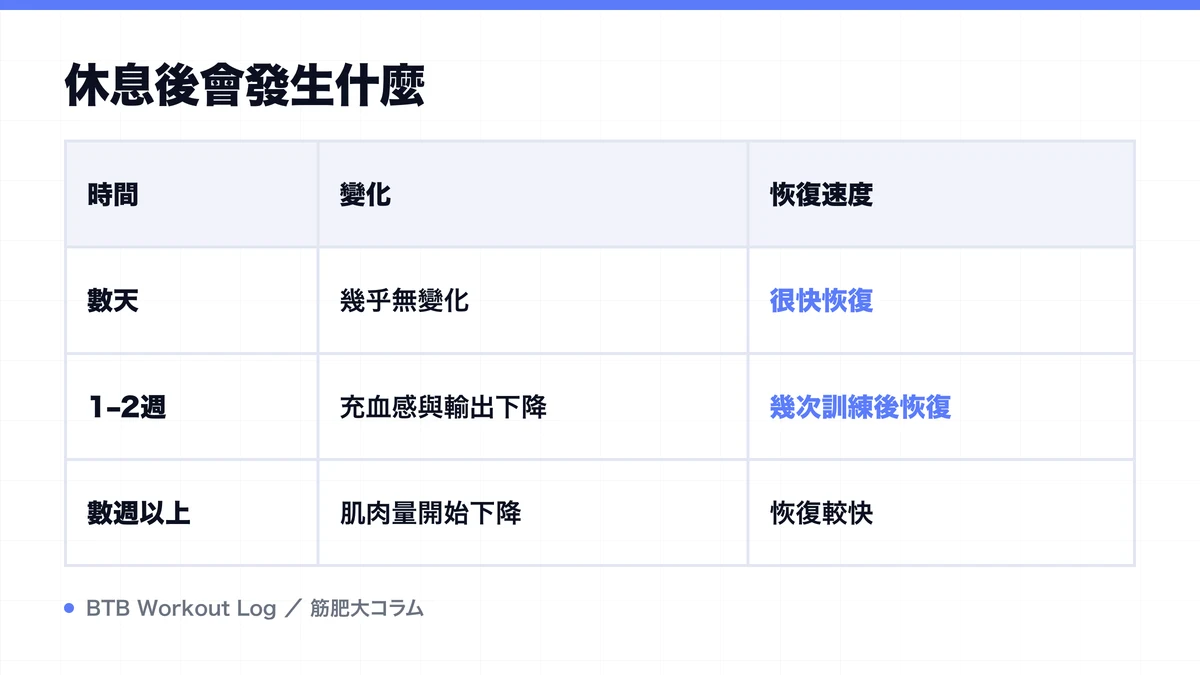
數天到3週:飽滿感和技能變化先於肌量下降
休息初期的數天內,累積的疲勞往往會消褪,運動表現反而上升。高訓練量的人經常因為這種恢復而感到相同重量變輕。短期休息後的好成績,與其說肌肉增長,不如說是疲勞掩蓋的力量輸出回復了。機制和Deload 週後力量恢復的過程重疊。
反面,休假時若飲食或碳水減少,肌肉飽滿感和體重會迅速下降。這不是單純的肌組織變化,所以無法從鏡子或一次體重測量推估萎縮量。大重量動作的動作穩定性也會逐漸掉,復訓第一天可能會發現之前的1RM變得很重。肌力受肌量、神經系統和技能共同影響。
到2-3週左右,有些研究測出肌厚或截面積下降,有些則沒檢測到明顯變化。由於研究對象、部位、休息前的訓練週期,以及超音波、核磁共振等測量方法都不一致,無法為所有人畫出「從第幾天開始」的線。休息後單次重量下降不能斷定肌量流失,應該用相同動作姿態和RIR比較2-3次訓練。肌力與肌量的偏差詳見肌力與肌肉肥大的關係。
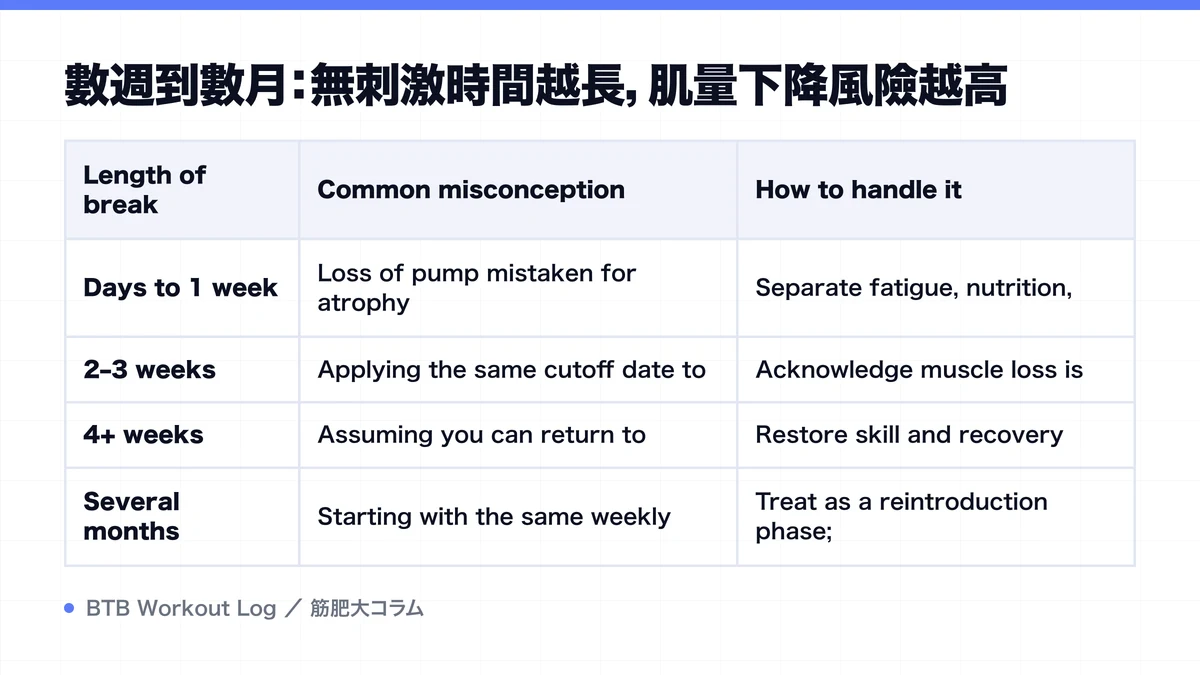
數週到數月:無刺激時間越長,肌量下降風險越高
As break time extends from weeks into months, the absence of tension stimulus repeats, and training adaptations gradually revert. Muscle mass, maximum muscle strength, muscular endurance, and movement skill don't decline at the same rate. Some lifters lose technical proficiency first, while others maintain the strength used in daily activities but gradually lose added muscle mass.
| Length of break | Common misconception | How to handle it |
|---|---|---|
| Days to 1 week | Loss of pump mistaken for atrophy | Separate fatigue, nutrition, hydration, and sleep as factors |
| 2–3 weeks | Applying the same cutoff date to everyone | Acknowledge muscle loss is possible, but confirm via progress after resuming |
| 4+ weeks | Assuming you can return to pre-break weight immediately | Restore skill and recovery capacity in stages |
| Several months | Starting with the same weekly volume as before | Treat as a reintroduction phase; rebuild load and sets |
Even over the same timeframe, immobilization or hospitalization—where the target muscles barely work—causes faster decline than a normal life of walking, carrying objects, and climbing stairs. Older lifters, those in aggressive deficit, and people recovering from illness face steeper losses. Conversely, if you maintain daily activity and retain some light resistance work instead of complete rest, you can create a maintenance stimulus without matching your previous weekly volume.
When you need to rest, control the factors that change before muscle mass does
If you're just missing your regular routine because of travel or work demands, you don't need to replicate the same weekly volume you use for growth. If you can keep some tension on the target muscles using bodyweight, bands, or dumbbells, you shift toward maintenance rather than complete deconditioning. For a break period, choosing a few manageable sets you can repeat without pushing to failure is often more practical than chasing muscle soreness.
For nutrition, the basic principle is not to slash protein intake just because you're resting. Avoid extreme energy deficit. If activity drops, don't fix calories at training-day levels—adjust overall intake while monitoring body weight changes. Use the protein guidelines for the growth phase as your reference.
If the break is due to injury, fever, or severe fatigue, don't force load on the affected area or whole body just to preserve muscle. Prioritize medical clearance and recovery, then consider permitted daily movement or work on uninjured areas. Pushing through to save short-term muscle often prolongs the break and costs you more time overall.
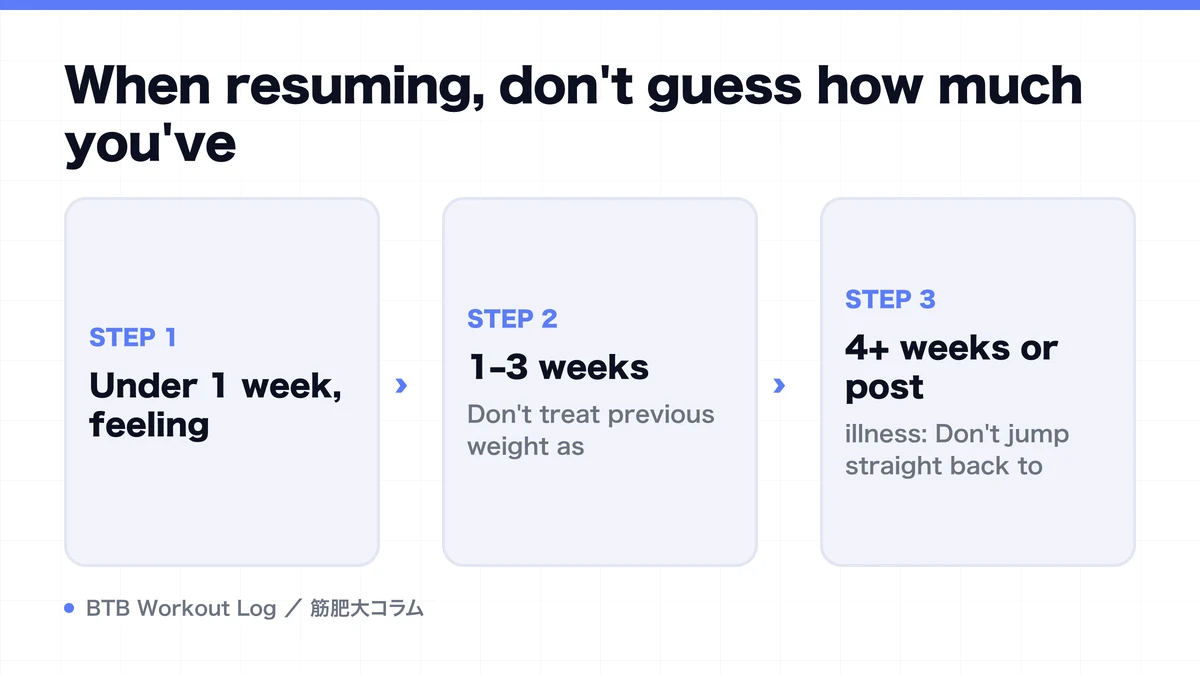
When resuming, don't guess how much you've lost—use your first session to guide the pace
Testing your pre-break personal record on day one won't tell you how much muscle remains, because skill rust and fatigue from work or travel muddy the picture. Use your last solid pre-break record as the ceiling, start with RIR in reserve on the first session, then dial in your return pace from there.
- Under 1 week, feeling good: Use your pre-break workout as a reference, but check warm-up tempo and RIR. Drop weight or sets on the spot if it feels heavy.
- 1–3 weeks: Don't treat previous weight as mandatory. Start from a load that leaves RIR 3–4, use fewer accessory exercises, and trim the back-end sets.
- 4+ weeks or post-illness: Don't jump straight back to previous weekly set volume. Start clearly lighter, then add volume gradually over several sessions based on soreness, joint feel, and how weight and reps progress.
You don't need to make up the sets you missed. What matters now is current form and recovery capacity, not total history. If weight or reps return at roughly the same RIR, you're close to ramping up 漸進超負荷 again.
Don't add sets based on one weak session. Instead, track how fast weight, reps, and RIR come back—this separates real muscle loss from skill and fatigue effects. Whether you've actually lost muscle becomes clear when you compare your pre-break baseline to a few sessions post-return under the same conditions. BTB Workout Log preserves your history across breaks.
常見問題
- Will I lose muscle if I rest for a week?
- If daily activity and eating stay consistent, one week is rarely long enough for trained muscle to disappear rapidly. Pump, body weight, and how lifts feel will shift, but that alone doesn't prove muscle fiber has atrophied.
- Does muscle look smaller after time off because I've lost mass?
- Not necessarily muscle loss. Loss of pump plus drops in carbs and activity reduce muscle glycogen and water, making muscles look flat within days. Reserve judgment until food and training return and you can see the trend.
- Should I start with the same weight when I return to training?
- You can try the same weight after a short break if you feel good, but don't make it a requirement. Reduce the load in warm-up if it feels heavy, and keep extra RIR in the bank. After a longer break or illness, cut set volume too and build back over several sessions.
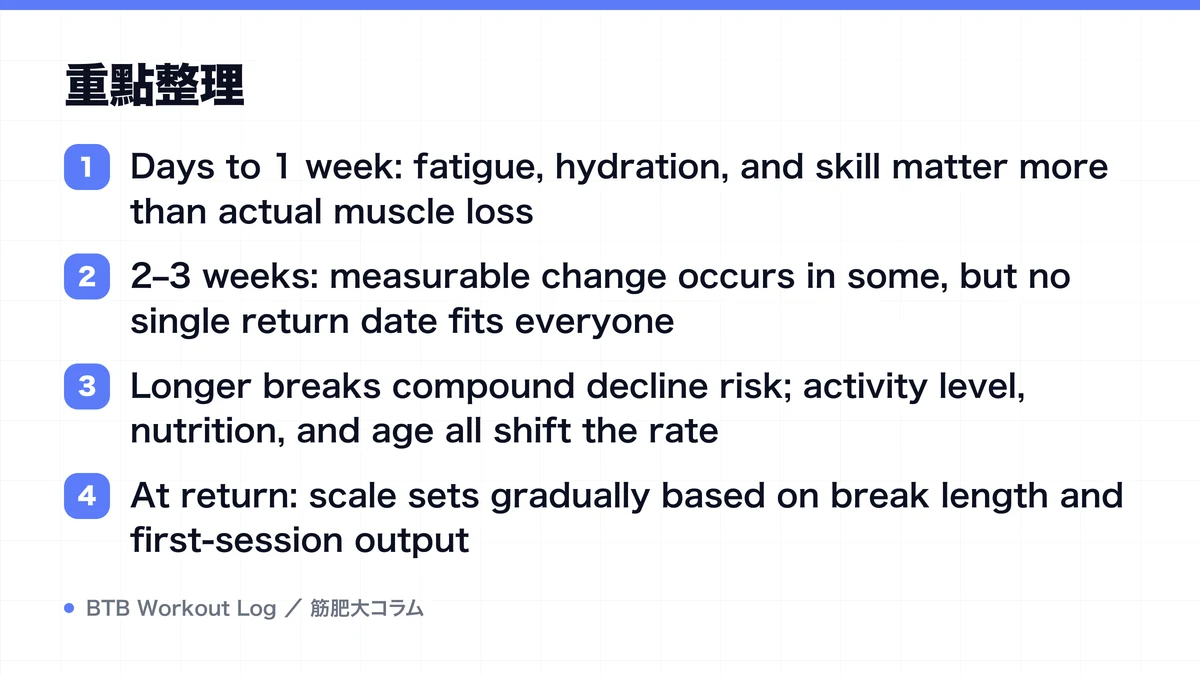
重點整理
- Days to 1 week: fatigue, hydration, and skill matter more than actual muscle loss
- 2–3 weeks: measurable change occurs in some, but no single return date fits everyone
- Longer breaks compound decline risk; activity level, nutrition, and age all shift the rate
- At return: scale sets gradually based on break length and first-session output
參考文獻
- Mixed Muscle Protein Synthesis and Breakdown After Resistance Exercise in Humans
- Muscle Protein Synthetic Response to Resistance Exercise: Systematic Review and Meta-analysis
- The Mechanisms of Muscle Hypertrophy and Their Application to Resistance Training
- Mechanisms of Muscle Hypertrophy: Current Understanding and Future Directions
- The Influence of Frequency, Intensity, Volume and Mode of Strength Training on Whole Muscle Cross-sectional Area in Humans