
攝取蛋白質後,肌肉裡會發生什麼?肌肉蛋白質合成簡單解析
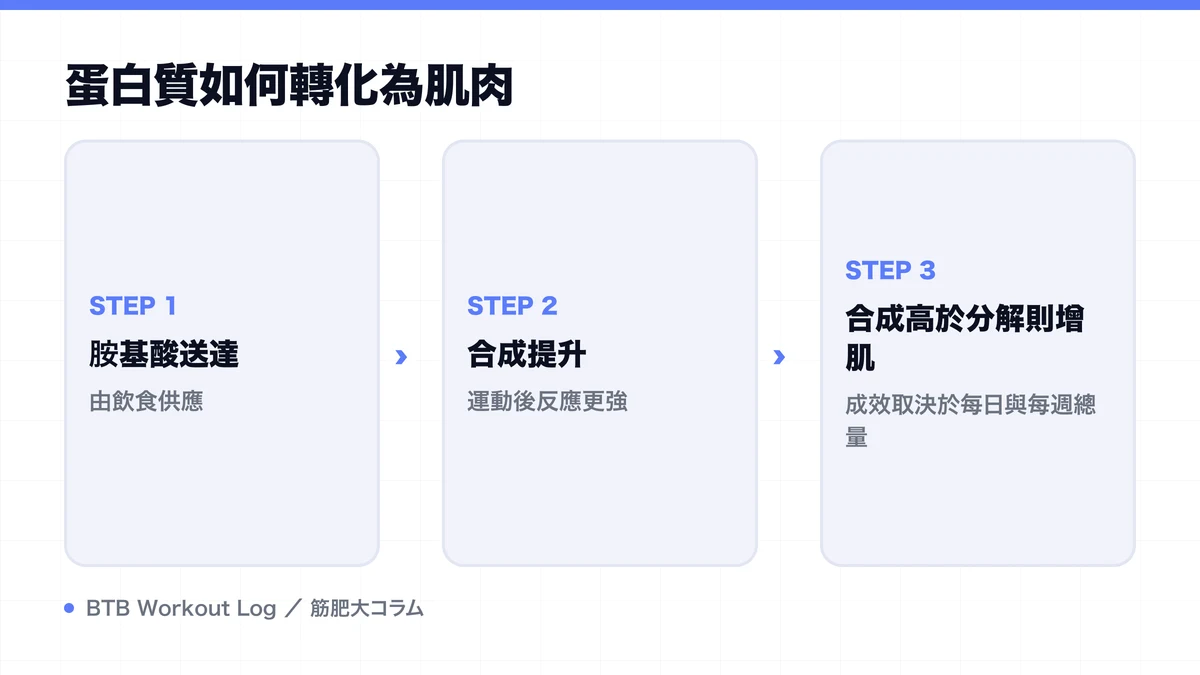
攝取蛋白質後,消化產生的胺基酸運送到肌肉,一方面成為合成的原料,另一方面啟動肌肉蛋白質製造反應。但單次攝取不會立即增加肌肉,而是透過無數次合成速率超過分解速率的短暫時刻累積,最終才導致肌肉肥大。
這不是「蛋白粉變成肌肉」的簡單一步過程。我們來完整追蹤從攝取到長期肌肉肥大的全過程。
第1階段:蛋白質分解為胺基酸
肉類、魚、蛋、乳製品和蛋白粉中的蛋白質是由許多胺基酸連接而成的大分子。它們不會直接運到肌纖維,而是在胃和小腸中分解成肽和胺基酸,然後從小腸吸收。餐後血液中胺基酸濃度上升,就是因為這些可利用的成分進入循環系統。
吸收的胺基酸並非全部用於肌肉。消化管和肝臟等組織也會利用它們,合成酶、激素等各種蛋白質,參與能量代謝。其中被肌細胞吸收的胺基酸才加入肌肉蛋白質組裝的原料庫。
特別是體內無法充分製造的必需胺基酸,必須從食物中獲得。如果把肌肉比作工廠,攝取的蛋白質不是成品,而是供應給各工序的零件。所需量的思考方式詳見肌肉肥大所需蛋白質量,這裡我們繼續探討供應後的反應。
第2階段:胺基酸既是原料,也是啟動合成的信號
胺基酸從血液進入肌細胞時,不只是增加原料存量,細胞會感知「有營養可用於合成」。其中關鍵的一個信號是必需胺基酸亮氨酸。亮氨酸增加與mTORC1信號通路的活化有關,該通路整合了營養狀態、運動刺激等多種信息。
mTORC1 不在肌肉中,而是把開始指令傳送給製造蛋白質的機制的調節器。活化後,遺傳信息的讀取變得更容易進行,合成新蛋白質的「翻譯」過程容易啟動。因此因果順序是:蛋白質攝取 → 胺基酸增加 → 營養感知 → 翻譯機制活化。
常說的「亮氨酸打開開關」是個方便的說法,但不像機器只有開關兩種狀態。即使只有亮氨酸,如果缺少完成鏈條所需的其他必需胺基酸,原料供應就會停止。而且肌力訓練的機械刺激和飲食的營養輸入來自不同的通路。僅有信號或僅有原料中的任一方,都無法解釋肌肉肥大所需的全部反應。
第3階段:核糖體排列胺基酸,製造肌肉蛋白質
收到合成指令後,細胞內的核糖體讀取遺傳設計藍圖信使RNA,按指定順序連接胺基酸。這樣製造出肌動蛋白、肌球蛋白等構成肌原纖維的蛋白質,以及其他新的肌肉蛋白質。單位時間內的生成速率稱為肌肉蛋白質合成(MPS)。
MPS上升時進行的不只是損傷部位的修復。還包括日常蛋白質的週期更新和適應訓練的結構重組。因此肌肉酸痛的強度和MPS不能等同。沒有強烈肌肉酸痛時合成仍可發生,反之強烈酸痛也不保證所有合成的都變成新肌肉量。
這是區分急性反應和長期適應的關鍵。一頓飯後MPS升高表示「製造速度加快」,但單一測量結果無法預測數月後的肌肉肥大量。從訓練刺激到長期適應的全貌詳見肌力訓練如何增大肌肉。
第4階段:肌肉是否增長取決於合成與分解的差值
Your muscles are simultaneously building new protein and breaking down old protein. The net muscle protein balance is the total synthesis minus breakdown over a given period. When synthesis exceeds breakdown, the balance is positive; otherwise it's negative. A single meal creates only a small, temporary positive balance, but repeat training and eating over weeks and months, and that positive balance accumulates—causing muscle fiber cross-sections to grow larger.
Resistance training elevates MPS and primes muscle to respond more readily to amino acids afterward. Protein intake supplies both the raw material and the nutritional signal to capitalize on that state. It's not a choice between "training or protein"—they play different roles in the same process. Diet alone won't trigger the adaptations that training creates, and training without sufficient material will hit a ceiling. Both are required.
This response has a time window, but those few minutes right after training aren't your only chance. That said, training then eating nothing until tomorrow won't work either. Rather than obsessing over a narrow post-workout window, focus on hitting adequate daily protein spread across several meals, with normal eating before and after training. Research on timing details can be found in our amino acid timing explainer.
Why BCAAs and leucine can't complete the job on their own
If leucine is the critical nutritional signal, supplementing BCAAs alone might seem enough. But BCAAs are only three amino acids—leucine, isoleucine, and valine—and they don't cover all nine essential amino acids your body needs to build muscle protein. You get the signal to start, but without all the building blocks to complete the chain, synthesis can't sustain itself.
Complete proteins from whole foods or whey deliver leucine plus every other essential amino acid in one dose. For someone already hitting their daily protein target through regular meals, adding isolated BCAAs typically offers little benefit. This reasoning aligns with our muscle-building supplement priority guide.
Similarly, protein doesn't raise MPS indefinitely as you eat more. Once a meal triggers maximal synthesis, extra amino acids don't keep stacking into muscle at the same rate—they get directed elsewhere in your body and metabolism. The practical order is: hit your daily total first and spread it across several meals without strain, then use protein powder for convenience. That matches how the mechanism actually works.
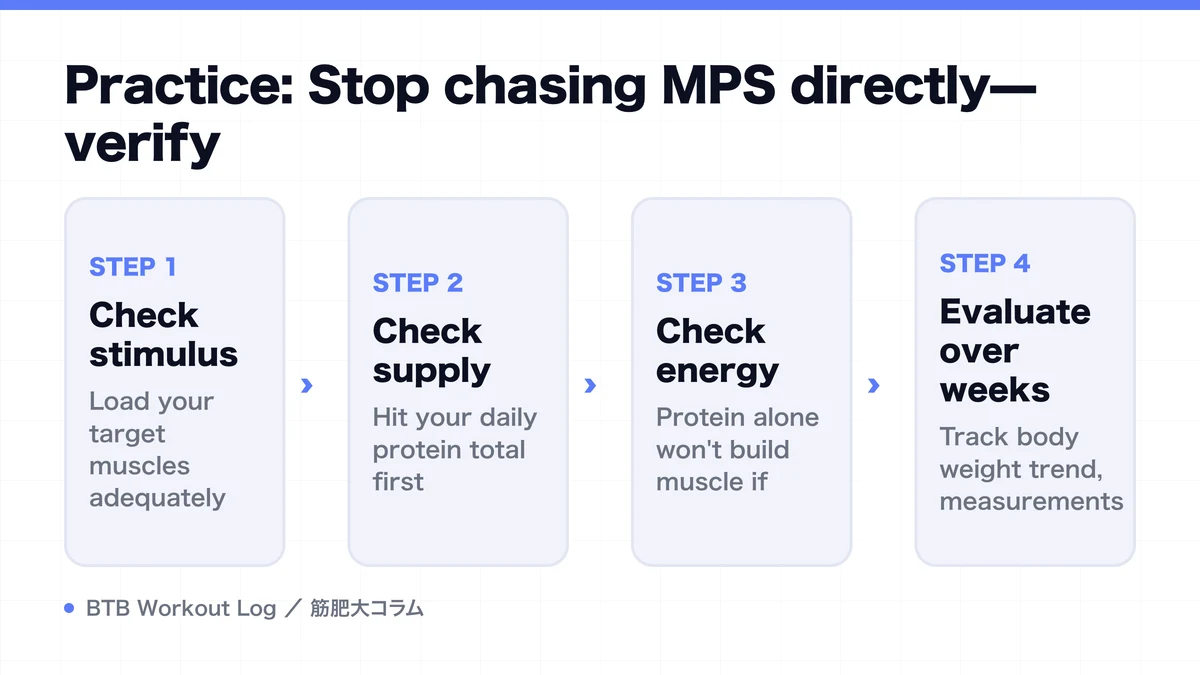
Practice: Stop chasing MPS directly—verify that stimulus and supply are continuous
MPS can be measured in a lab, but you can't feel it or quantify it at home. A temporary pump after protein, daily weight fluctuations, or soreness don't tell you how much synthesis actually occurred. In real training, replace the invisible steps with measurable conditions you can control and track.
- Check stimulus: Load your target muscles adequately and see whether weight, reps, or sets improve under the same conditions.
- Check supply: Hit your daily protein total first and distribute it across meals, not piled into one.
- Check energy: Protein alone won't build muscle if you're in a large caloric deficit for weeks on end.
- Evaluate over weeks: Track body weight trend, measurements or photos, and training performance together—don't judge from one day.
If your intake is genuinely too low, adding food or powder will help. If you're already adequate, increasing it further before checking progressive overload, effective sets per muscle group, and recovery will waste effort. During a cut, remember that caloric deficit itself constrains muscle growth alongside protein. Protein isn't a standalone signal; it's material and a messenger that responds to training stress. Skip the "did you drink it" question and focus instead on whether you're consistently repeating adequate stimulus, supply, and recovery. That's how you turn an invisible process into actual decisions.
常見問題
- How many hours does muscle protein synthesis last after you eat protein?
- Duration and intensity depend on meal size and quality, recent training, age, and training experience. Rather than fixate on exact hours, prioritize hitting your daily total and spreading it across meals over time.
- If I skip protein right after training, do I miss the muscle protein synthesis window?
- Missing those first few minutes doesn't eliminate the response. The priority is ensuring adequate total daily protein from meals before and after. If you trained fasted, eating reasonably soon afterward makes sense, but don't stress if it's not immediately post-workout.
- If MPS is high, does muscle growth automatically follow at the same rate?
- One acute spike in MPS doesn't predict long-term growth. You must account for the balance between synthesis and breakdown, training quality, total intake, and recovery sustained over weeks.
重點整理
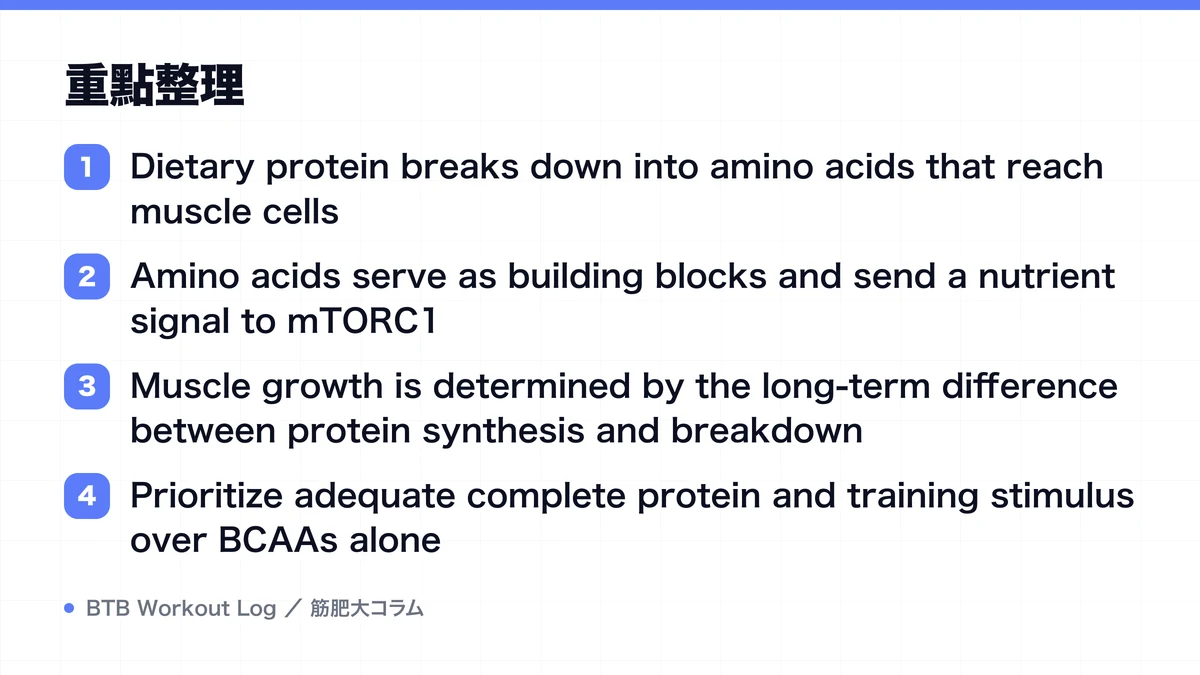
- Dietary protein breaks down into amino acids that reach muscle cells
- Amino acids serve as building blocks and send a nutrient signal to mTORC1
- Muscle growth is determined by the long-term difference between protein synthesis and breakdown
- Prioritize adequate complete protein and training stimulus over BCAAs alone
參考文獻
- Mixed Muscle Protein Synthesis and Breakdown After Resistance Exercise in Humans
- Branched-chain Amino Acids and Muscle Protein Synthesis in Humans: Myth or Reality?
- Protein Supplementation Augments the Adaptive Response of Skeletal Muscle to Resistance-type Exercise Training
- Protein Supplementation and Resistance Training-induced Gains: Meta-analysis