
組數後段次數會下降,為什麼?不是「意志力不夠」,而是疲勞的真相
後期組別反覆次數下降,是因為先前組別下降的能力在休息中沒有完全恢復,導致相同重量相對變重。
反覆次數本身的下降並非異常。更重要的是判斷:是否保持了姿勢和動作幅度,是否在設定的RIR處停止。幅度本身不是判斷指標。
相同重量卻反覆次數下降的因果關係
比如臥推用相同的100kg進行,第1組做到10下,第2組做到8下,第3組做到7下。雖然重量沒變,但各組開始時「能反覆該重量的能力」卻不相同。
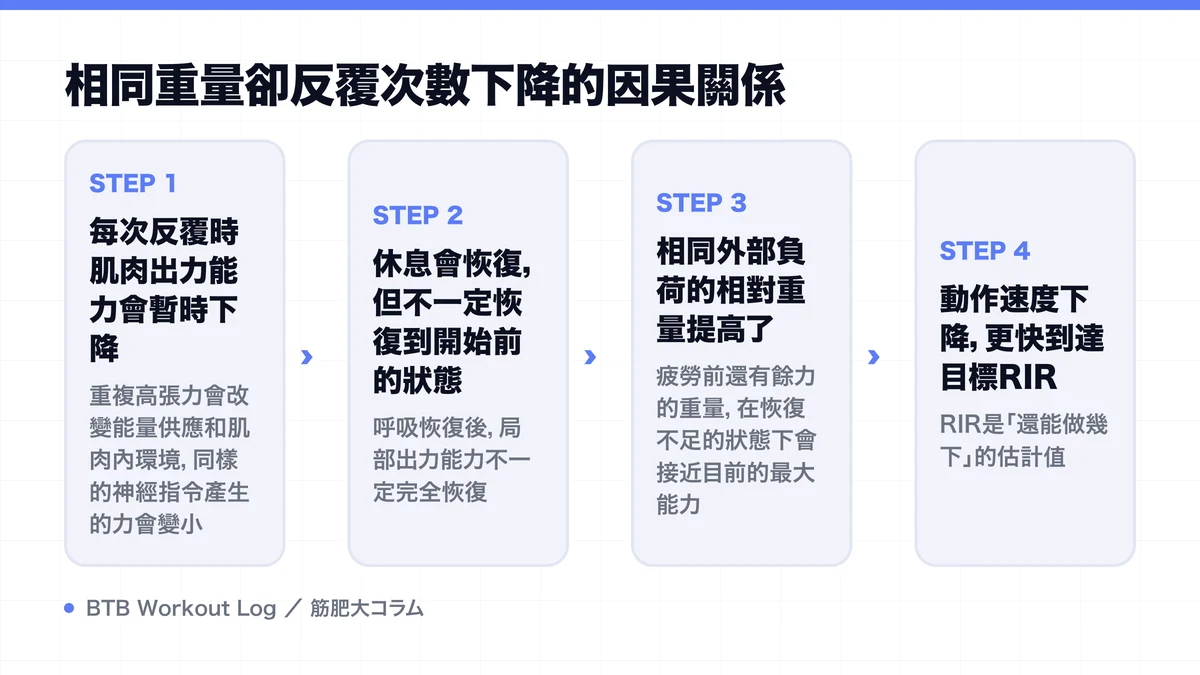
- 每次反覆時肌肉出力能力會暫時下降:重複高張力會改變能量供應和肌肉內環境,同樣的神經指令產生的力會變小。
- 休息會恢復,但不一定恢復到開始前的狀態:呼吸恢復後,局部出力能力不一定完全恢復。休息時間越短,差距越明顯。
- 相同外部負荷的相對重量提高了:疲勞前還有餘力的重量,在恢復不足的狀態下會接近目前的最大能力。
- 動作速度下降,更快到達目標RIR:RIR是「還能做幾下」的估計值。即使第1組和同樣RIR 2停止,後期組別也會以更少次數到達該位置。
也就是說,反覆次數的下降不是意志薄弱,而是開始時能力下降將停止點往前移動的結果。反過來每組都要合到相同反覆次數,後期的RIR就會變小,最後只能靠接近失敗反覆或改變姿勢來湊數。RIR如何影響刺激,結合接近極限的機制會更容易理解。
疲勞不是單一物質,而是出力能力下降的狀態
訓練中的疲勞不只是特定物質在肌肉中堆積。在這裡,把它理解為「暫時無法輕易產生所需的力」的狀態對實踐更有幫助。其本質可分為兩大類。
肌肉和外周發生的局部疲勞
短時間內產生大力量時,磷酸肌酸幫助ATP再供應和再合成、無機磷酸等代謝產物的變化、肌動球蛋白體的鈣釋放和收縮裝置的功能會同時發生變化。不是哪一個單獨決定反覆次數,而是肌纖維能發揮的力整體下降。休息中會逐漸恢復,但速度受負荷、反覆時間、受訓肌肉量和動作種類影響。
神經系統和全身的限制
持續高強度努力時,傳送到肌肉的神經指令也不會固定。此外,多關節動作中,目標肌肉之外的握力、呼吸、姿勢支持肌或協同肌可能先出現限制。比如深蹲時呼吸比腿先累,划船時握力比背部先衰退。同樣是「反覆次數下降」,結束原因不同代表組合方式應該不同。
只把乳酸當作疲勞的元兇無法解釋這些多重機制。酸感和肌肉充血是局部負荷持續的線索,但不是單獨衡量恢復程度或肌肉肥大刺激的指標。應該看的是下一組能再現的反覆次數、動作品質和RIR。

放大反覆次數落差的五個條件
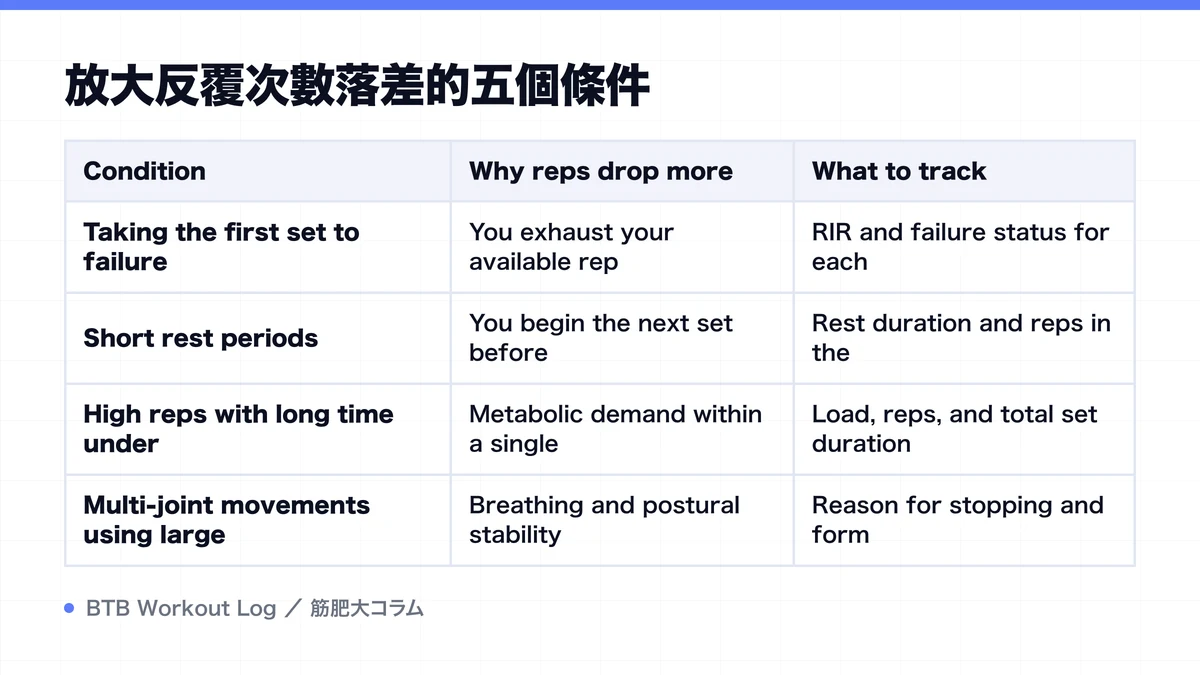
Rep loss across sets doesn't happen at the same rate every time. The more these conditions overlap, the more fatigue tends to carry over into the starting point of later sets.
| Condition | Why reps drop more easily | What to track |
|---|---|---|
| Taking the first set to failure | You exhaust your available rep capacity, leaving little buffer for later sets | RIR and failure status for each set |
| Short rest periods | You begin the next set before local work capacity recovers | Rest duration and reps in the following set |
| High reps with long time under tension | Metabolic demand within a single set becomes larger | Load, reps, and total set duration |
| Multi-joint movements using large muscle mass | Breathing and postural stability become limiting factors, not just the target muscle | Reason for stopping and form quality |
| Exercise position later in the session | You carry over fatigue from the same muscle or synergists from earlier exercises | Exercise order and all sets performed that day |
How short rest periods reduce reps is covered in detail in How Short Rest Changes Your Training. A study comparing 1-minute versus 3-minute rest between sets in 21 young trained men found the 3-minute group performed better on bench press and back squat 1RM and showed greater increases in anterior thigh muscle thickness. However, this doesn't mean every exercise requires 3 minutes. Some lifters maintain output with shorter rests on single-joint movements. Rather than fixing a number of seconds, it's better to decide based on whether the next set can hit enough reps and quality movement to meet your goal.
That said, taking the first set to failure tends to increase the drop-off but isn't essential for muscle growth. A meta-analysis of 15 studies comparing training to failure versus short of failure in young adults found no significant difference in strength or muscle hypertrophy overall. Instead of maximizing reps in every set, you need to think about distributing effective effort across all sets, including later ones.
How much rep loss is normal
There's no universal threshold for "too many reps lost." Dropping from 10 to 8 reps isn't the same as dropping from 5 to 3, even though both are 2 reps. And the meaning shifts between a machine single-joint movement and a barbell multi-joint lift. Don't judge by absolute numbers alone—split performance into two patterns:
Fatigue you can treat as normal
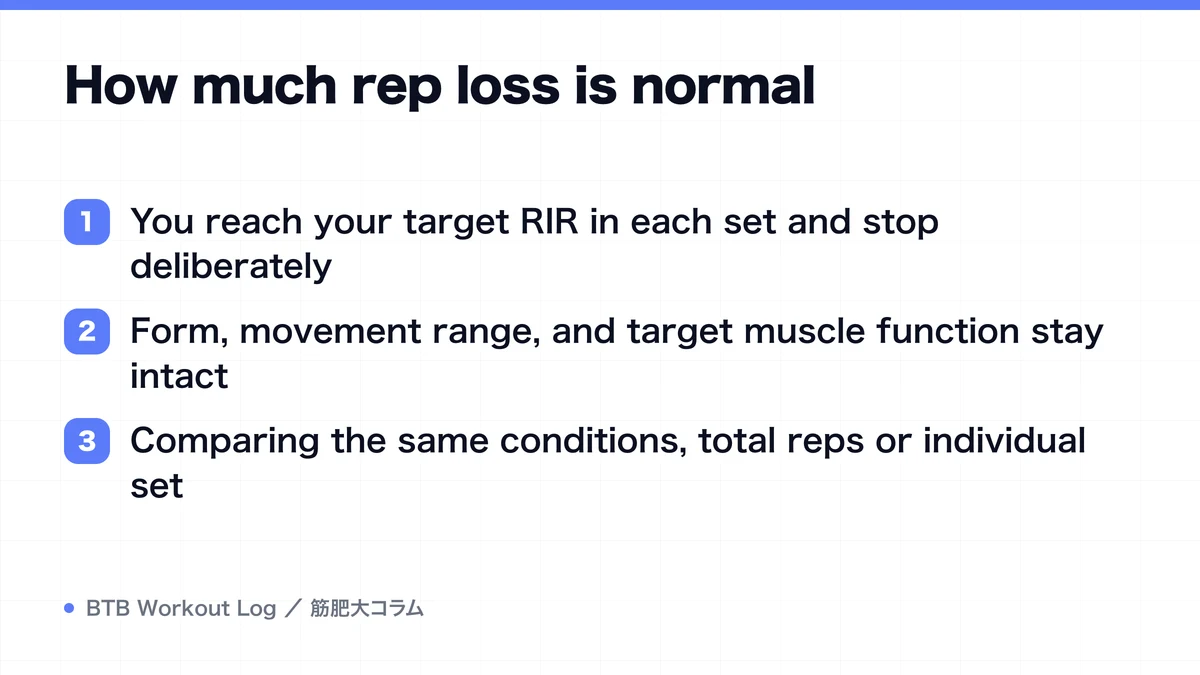
- You reach your target RIR in each set and stop deliberately
- Form, movement range, and target muscle function stay intact
- Comparing the same conditions, total reps or individual set reps hold steady or improve over weeks
In this pattern, a drop like 10, 9, 8 reps doesn't need to be erased. Later sets still reach near-limit at lower rep counts and count as genuine hard sets. If you try to match reps by cutting range of motion or adding momentum, you're actually changing the comparison conditions.
Signs to adjust your setup
- Later sets fail earlier than planned, and form breaks down
- Breathing, grip strength, or synergist muscles give out first, not the target muscle
- Rep loss expands from session to session and doesn't recover by the next workout
- Adding more sets barely increases effective reps in the later ones
When this happens, try these adjustments in order: extend rest by 60–90 seconds, stop the first set one rep short of failure, move assistance work later in the session, or split sets across different days. Lower the weight only if rest and effort distribution don't restore your target rep range. Change one thing at a time so you know what actually moved the needle.
Link set-by-set records to your next decision
To manage fatigue, track not just total reps per exercise, but load, reps per set, RIR, and rest intervals side by side. If possible, also note sets where form or 動作幅度 changed, or where non-target muscles became the limiting factor. Research with young, untrained men showed high test-retest reliability using 1 RIR load prescription on bench press and deadlift. Since RIR has individual and exercise-specific error, treat it as a reference point for general patterns rather than an absolute value—always read it alongside load, reps, and rest intervals.
Follow this sequence to avoid confusion:
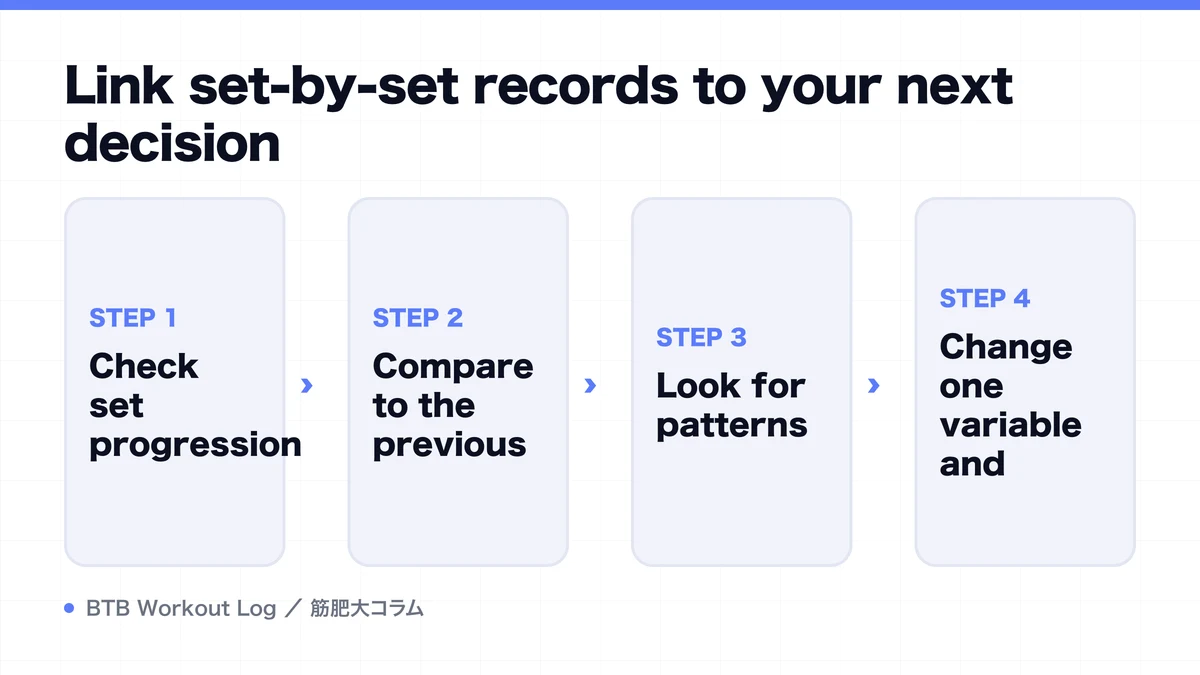
- Check set progression within the same session: If only later sets drop, first suspect incomplete inter-set 恢復 and poor effort distribution in set one.
- Compare to the previous session on the same lift: If total reps climb despite within-set decline, at the same load, rest, and RIR, you're still progressing.
- Look for patterns across multiple sessions: If all sets decline for several sessions straight, check sleep, previous day's volume, or weekly set frequency—factors outside the session itself.
- Change one variable and retest: If longer rest restores later-set reps, time was the bottleneck. If adjusting set-one RIR restores them, effort distribution was the constraint.
肌肉肥大 comes not from the numbers themselves, but rep decline gives you clues to adjust rest or RIR for the next session.
常見問題
- Should later sets match the first set's rep count?
- No. If you stop at the same RIR, hitting the stopping point with fewer reps in fatigued later sets is normal. Rather than force reps, preserve form and 動作幅度, then compare reps and RIR per set to your previous session at identical conditions.
- Should I drop the load right away if reps fall sharply?
- First check rest intervals and how hard you pushed set one. If rest is short or you're going to failure from the start, try extending rest or using RIR 1–2 instead—keep the load the same. Only consider a small weight reduction if you still can't hold your target rep range.
- Do later sets still build 肌肉肥大 even if reps drop?
- If the target muscle works to your target RIR and form and 動作幅度 stay intact, even lower rep sets work as 硬组. But if grip or breathing alone cause the stop, technique falls apart, or fatigue lingers until the next session, the fatigue cost may outweigh the stimulus.
重點整理
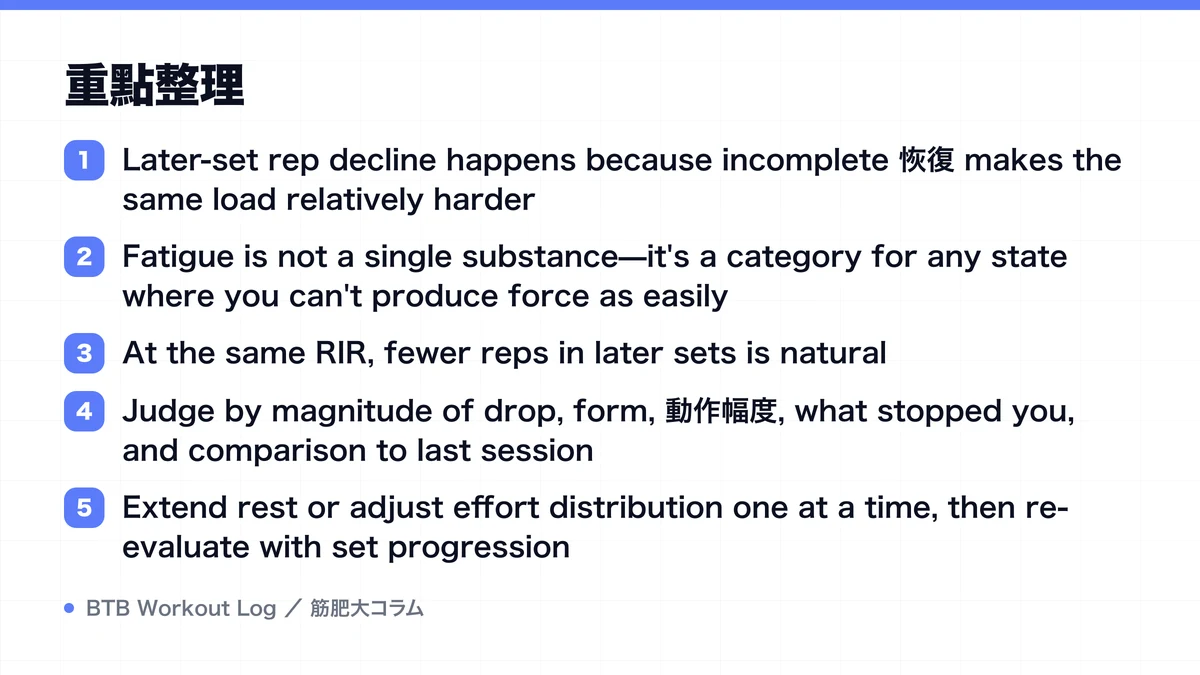
- Later-set rep decline happens because incomplete 恢復 makes the same load relatively harder
- Fatigue is not a single substance—it's a category for any state where you can't produce force as easily
- At the same RIR, fewer reps in later sets is natural
- Judge by magnitude of drop, form, 動作幅度, what stopped you, and comparison to last session
- Extend rest or adjust effort distribution one at a time, then re-evaluate with set progression