
越接近力竭,刺激會怎麼變化?RIR降低時肌肉裡發生的事
RIR 越低,你需要在疲勞狀態下持續用力,承受張力的肌纖維範圍擴大,一般來說肌肉肥大的刺激隨之增強。但 RIR0 時刺激並非突然完成,接近 0 時效果也不呈直線增長。
改變的不只是「難受程度」,還有剩餘力量、運動單元的募集方式、反復速度,以及對後續組的疲勞延續。掌握這個順序,你就能把 RIR 從單純感受轉化為實際的負荷設定工具。
RIR 不是重量,而是「距離這一組極限還有多遠」
RIR(Reps In Reserve)是指在保持既定動作模式和動作幅度下,還能完成的反復次數的估計值。RIR3 表示還能做 3 次,RIR1 表示還能做 1 次,RIR0 表示下一次反復無法完成的肌肉瞬間力竭。詳細用法參考RIR 基礎,但這裡的關鍵是別把 RIR 和舉重重量混為一談。
比如同樣 80kg,最多能做 10 次的人在第 5 次停下來就是 RIR5 左右,做到第 9 次就是 RIR1 左右。從外面看重量一樣,但組結束時剩餘的力量不同。反過來說,沉重的 3 次和輕鬆的 15 次也可能都是 RIR1。所以 RIR 不是「拿起了多少公斤」,而是用這個重量你消耗了自己多少反復能力的座標。
這裡說的極限不是靠反彈或縮短動作幅度硬撐出來的。必須以動作質量崩潰為終止點,否則同樣記錄的 RIR 對目標肌肉的負荷就不一致了。
反復次數增加,剩餘力量下降,相對用力增加
組開始時肌肉仍有很大力量餘裕。隨著反復增多,工作中的肌纖維收縮能力暫時下降,同樣的重量同樣的軌跡變得逐漸困難。這就是組內疲勞。
即使外界重量不變,能發揮的最大力量每次反復都在下降。所以序段輕鬆舉起的重量到了後期,佔了當下能力的更大比例。RIR 從 5 降到 2、1,不只是反復次數消耗,而是現有力量相對於工作負荷的比例降低。
舉起速度自然下降是觀察這種變化的外部線索。但刻意的慢速、動作走形、喘氣也會降低速度,所以「反復慢=準確的 RIR1」不一定成立。RIR 不只看速度,還要結合這個重量和動作你過去能做幾次來推估。
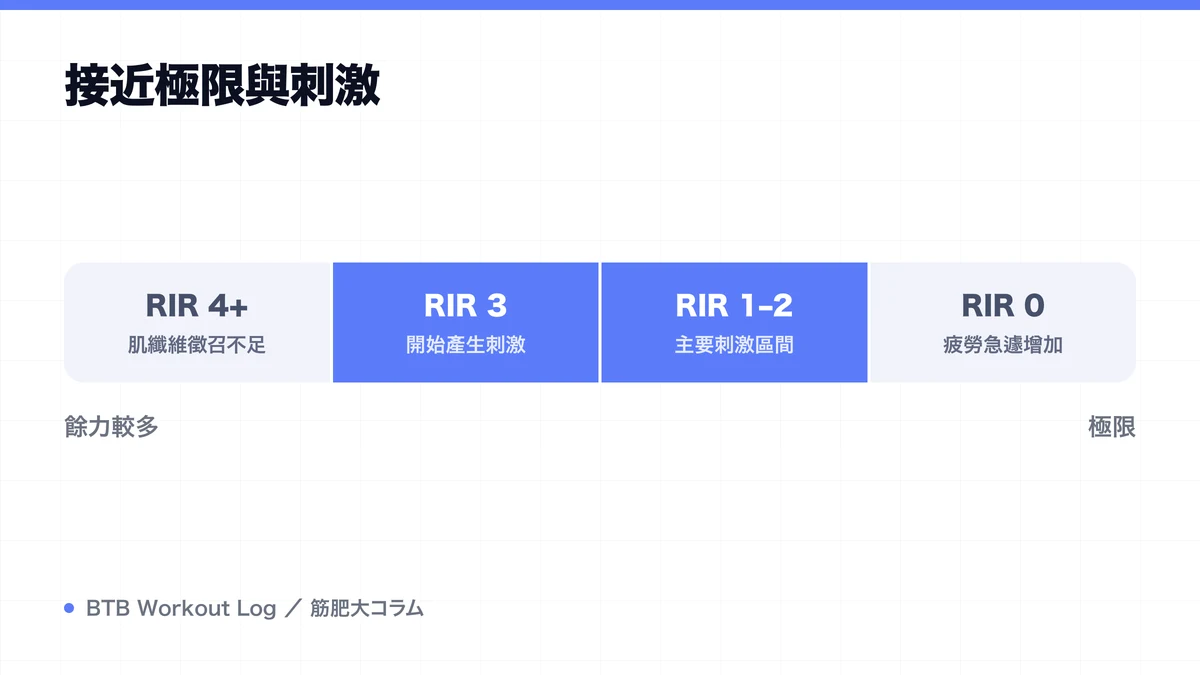
為了維持力量輸出,更多運動單元被徵召進來工作
肌肉由多個運動單元控制。在力量充足的反復中,只需部分運動單元參與即可完成工作。但先前工作的肌纖維疲勞後難以維持相同力量,身體就會徵召尚未充分參與的運動單元,或調整已工作運動單元的放電頻率,來對抗外界重量。
結果是,RIR 越低,在高用力狀態下承受張力的肌纖維範圍越廣。機械張力是肌肉肥大的核心因素之一,之所以重視接近極限,不是因為痛苦本身,而是因為這能讓更多肌纖維經歷充分的張力。
不應該區分出「只有最後幾次有效,之前都是浪費」。重負荷會在早期就需要大量運動單元參與,輕負荷則隨著疲勞積累逐漸擴大參與。高重量和低重量即使用同樣 RIR,反復次數、局部疲勞、呼吸困難也不會相同。
RIR0 不是特殊開關,而是刺激和疲勞的端點
如果把距離極限很遠的組拉近刺激,參與的肌纖維可能增加。但已經接近極限的組,從 RIR1 進到 RIR0,增加的刺激不一定同比例增長。綜合近接度與肌肉肥大關係的研究顯示,瞬間肌肉力竭未必優於非力竭訓練,提示兩者的關係可能是非線性的。
相比之下疲勞在後期會變得更明顯。到 RIR0 時能確認這組已經耗盡輸出,但後續組的反復下降和動作維持難度也會加大。關鍵不是「RIR0 是壞的」,而是最後 1 次反復帶來的資訊和刺激,是否值得之後付出的質量代價。整體失敗訓練研究也指出,肌肉肥大不需要每組都力竭。
因此,不如把 RIR 當成刺激的開關判定,倒不如當成刺激和疲勞的配分旋鈕。力竭訓練組是選項之一,但不能從周訓練量的整體來看。
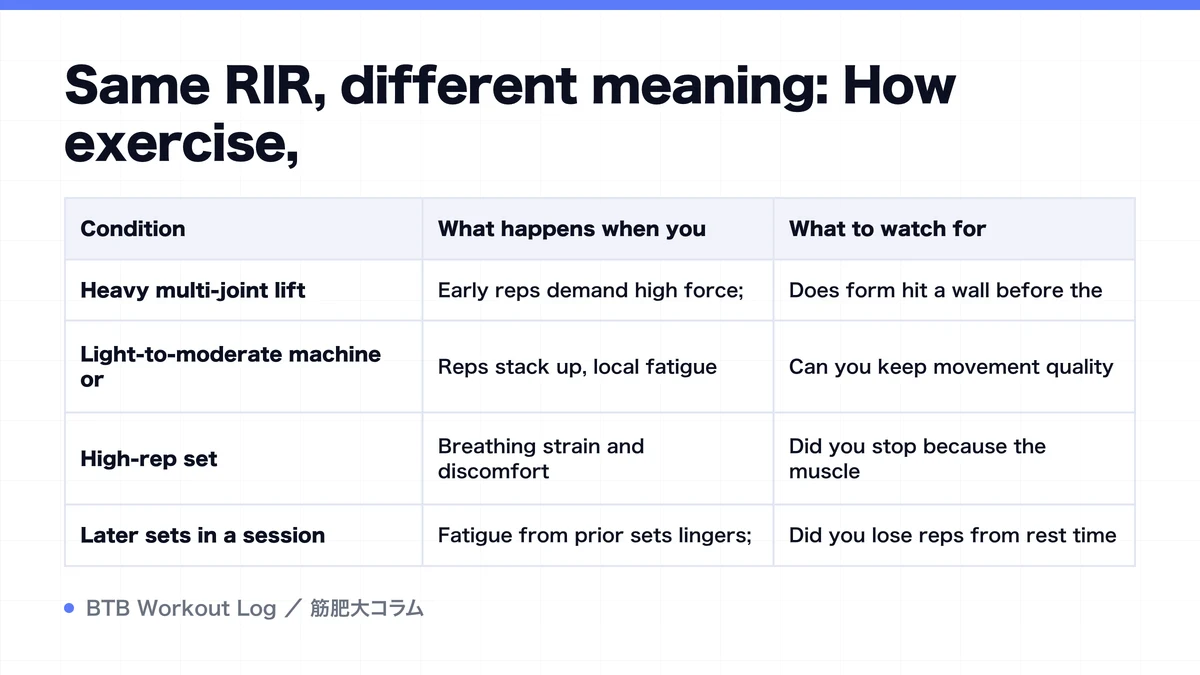
Same RIR, different meaning: How exercise, load, and stopping reason change the picture
| Condition | What happens when you lower RIR | What to watch for |
|---|---|---|
| Heavy multi-joint lift | Early reps demand high force; form breakdown and whole-body fatigue climb fast | Does form hit a wall before the target muscle does? |
| Light-to-moderate machine or single-joint | Reps stack up, local fatigue builds, target muscle approaches limit more easily | Can you keep movement quality intact? |
| High-rep set | Breathing strain and discomfort often stop you before the muscle truly fails | Did you stop because the muscle weakened or just felt uncomfortable? |
| Later sets in a session | Fatigue from prior sets lingers; same weight and reps feel harder than they should | Did you lose reps from rest time or from genuine carryover fatigue? |
So even if you "set everything to RIR 1," the actual stimulus stays all over the map. A squats RIR 1 where breath and posture collapse first looks nothing like a leg extension RIR 1 where your quads simply cannot complete another rep—the reason you stopped is completely different. And if your RIR appears to drop just because of a short rest interval between sets, losing reps from fatigue carryover doesn't mean you squeezed more high-quality work into the week.
When comparing RIR between workouts, keep the exercise, range of motion, tempo, rest time, and set order as consistent as possible. RIR is not a universal converter that makes every condition equivalent. It only becomes a useful metric when the conditions match.
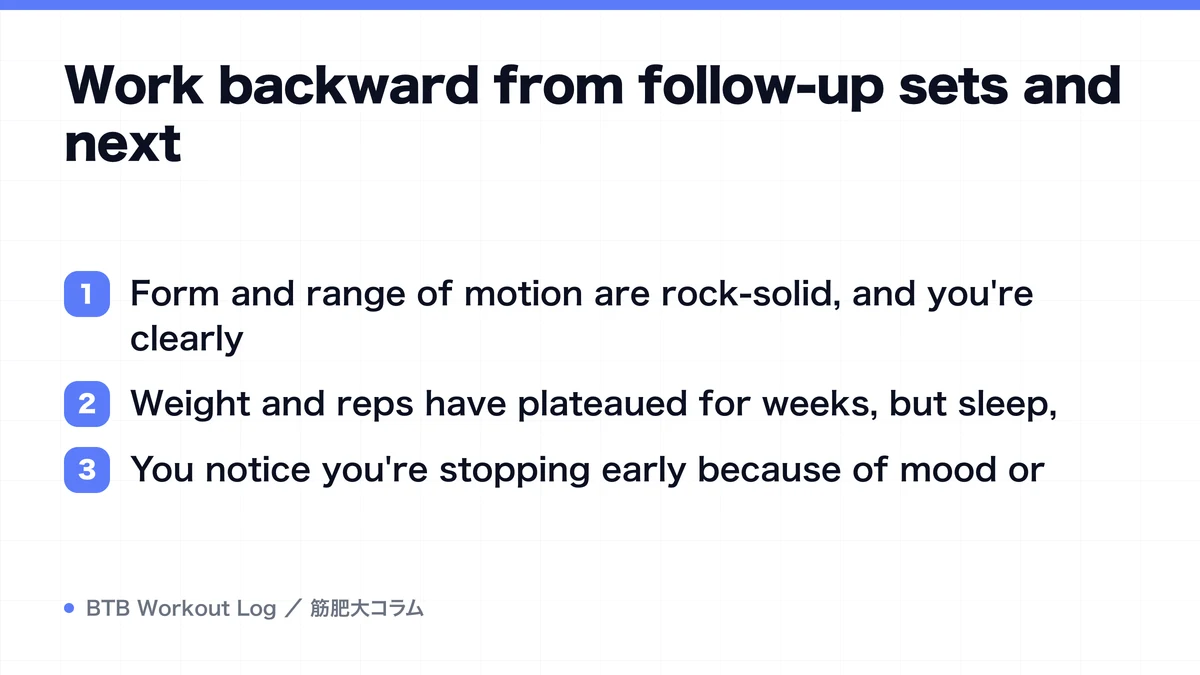
Work backward from follow-up sets and next session's progress to pick your target RIR
In practice, starting with RIR 2–3 on technically demanding multi-joint lifts and RIR 1–2 on stable machines or single-joint moves makes it easier to track stimulus and fatigue buildup. This is a starting point, not a fixed rule. Occasionally taking your final set on safer exercises all the way to RIR 0 is a useful way to recalibrate your RIR estimates, but you don't need to do it every time.
When to lower RIR by one step
- Form and range of motion are rock-solid, and you're clearly getting more reps than you reported
- Weight and reps have plateaued for weeks, but sleep, nutrition, and weekly set volume are fine
- You notice you're stopping early because of mood or mindset, not because the muscle fatigued
When to raise RIR by one step
- Failed reps early on cause a big drop in reps on follow-up sets
- Performance stays suppressed until your next session under the same conditions
- Posture, joint discomfort, or helper muscles fail before the target muscle does
Log not just weight × reps, but the RIR of each set, its position, rest time, and movement quality. Don't look at RIR in isolation—adjust based on whether you can repeat progress under the same conditions week to week.
Your choice between pushing to failure or stopping short should rest on your ability to recover and repeat high-quality sets throughout the week, not the satisfaction of a single all-out set. Closeness to your limit matters, but it's not a simple "closer is always better" dial.
常見問題
- Does lower RIR always mean more muscle growth?
- Bringing a set closer to failure can sharpen the stimulus, but the gain from RIR 1 to RIR 0 doesn't scale linearly. Treat the relationship as non-linear and weigh it against the fatigue cost to follow-up sets and the next session's output.
- Should all sets stay at RIR 1–2 for muscle growth?
- No. Technically demanding multi-joint lifts usually run better with more buffer, while stable machines and single-joint moves tend to tolerate lower RIR. Adjust based on the exercise, load, position in the session, and your recovery state.
- How do you know your RIR estimate is right?
- Keep consistent records of weight and reps with the same form and range of motion, then compare your stated RIR to how you perform next time. You can also occasionally take a safe machine exercise to true failure and count how many reps you actually had left—that's your calibration check.
重點整理
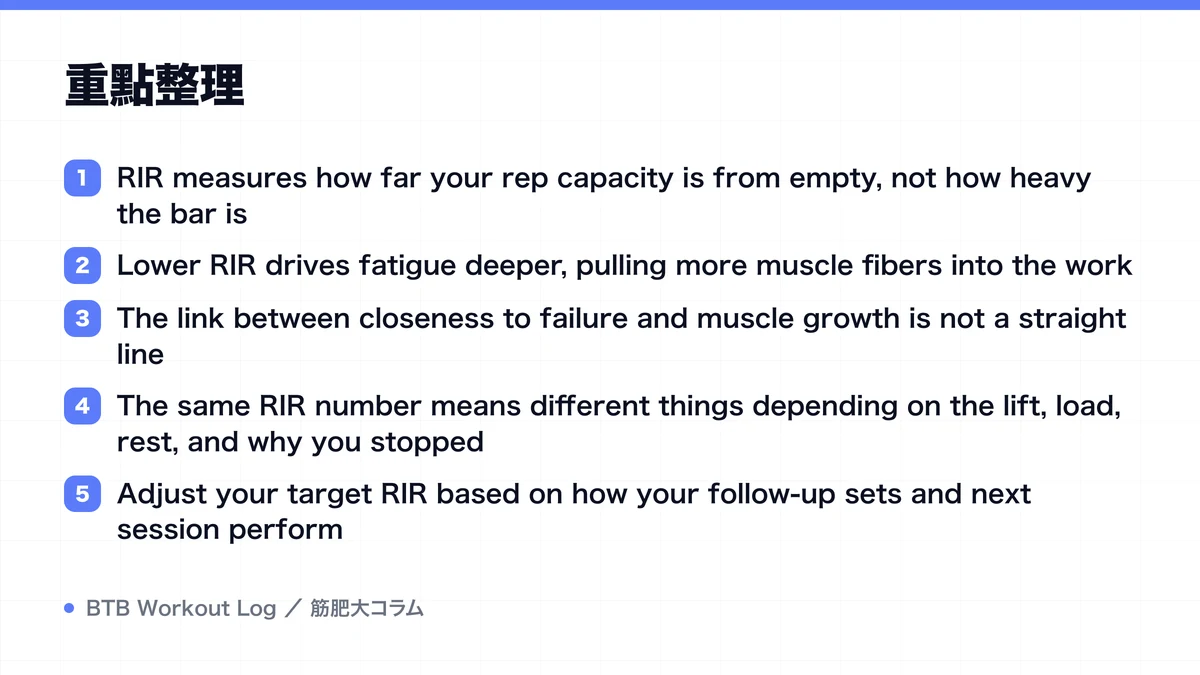
- RIR measures how far your rep capacity is from empty, not how heavy the bar is
- Lower RIR drives fatigue deeper, pulling more muscle fibers into the work
- The link between closeness to failure and muscle growth is not a straight line
- The same RIR number means different things depending on the lift, load, rest, and why you stopped
- Adjust your target RIR based on how your follow-up sets and next session perform
參考文獻
- Proximity-to-Failure and Muscle Hypertrophy: Systematic Review with Meta-analysis
- Training to Repetition Failure or Non-failure: Systematic Review and Meta-analysis
- Repetitions in Reserve Is a Reliable Tool for Prescribing Resistance Training Load
- The Mechanisms of Muscle Hypertrophy and Their Application to Resistance Training