縮短休息時間會發生什麼?想省時間反而讓肌肉肥大變遠的原理
Shorter rest periods mean your strength, breathing, and focus haven't fully recovered before the next set begins. This forces you to hit the same weight for fewer reps or with degraded form. When this decline repeats across your session, your total weekly muscle hypertrophy stimulus can drop significantly.
That said, short rest periods themselves don't inhibit 肌肉肥大. If a lift lets you maintain necessary output with minimal recovery, you gain time efficiency—so what matters isn't the clock, but what actually happens in the set that follows.
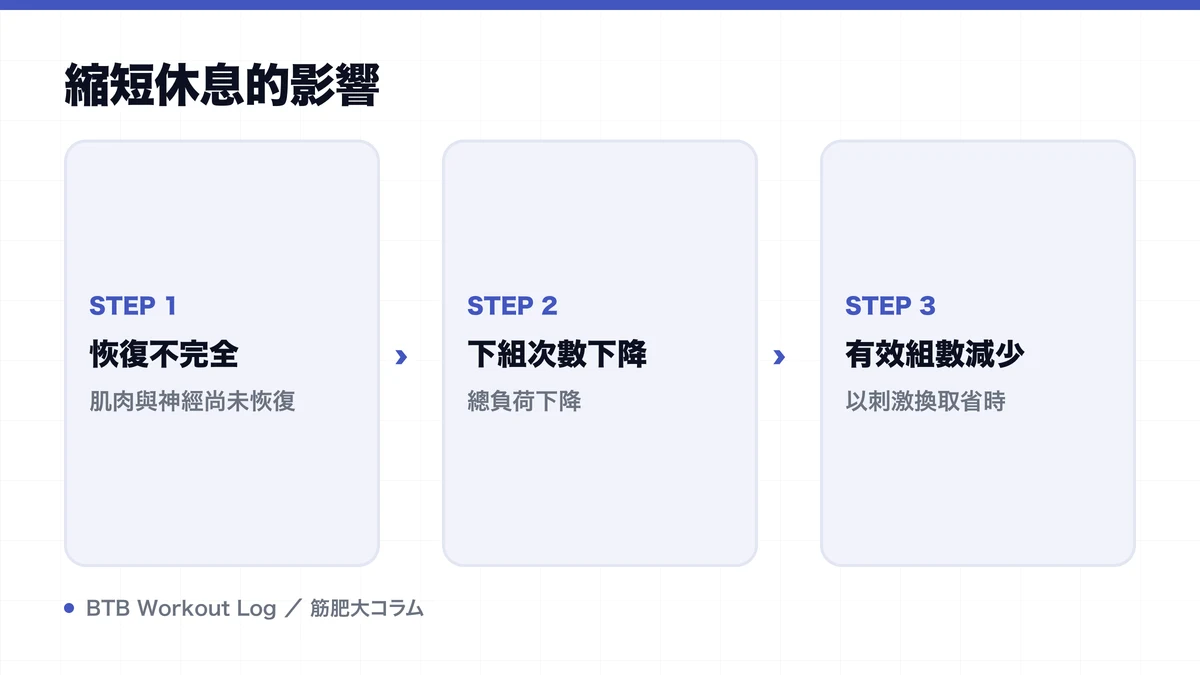
縮短休息時間會導致下一組訓練在肌肉還未完全恢復的狀態下開始
剛完成一組後,你的身體不只是目標肌肉疲勞而已。肌肉收縮的能量供應、發力的神經系統、呼吸循環、支撐姿勢的肌群、握力、專注力,都在以不同速度恢復。組間休息不是要讓這些完全回到起始狀態,而是恢復到下一組所需的水準。
要是休息時間太短,沒恢復好的因素就會成為下一組的起始條件。做大重量深蹲時,限制因素不只是腿,呼吸和核心也會卡住;做划船時,握力有時會比背部先失效。對於單關節動作,即使全身疲勞不大,但目標肌肉的局部疲勞殘留,反覆負荷的能力還是會下降。
因此,減少60秒休息時間對所有動作的影響並不相同。因為所用重量、動員的肌肉量、組的長度、接近極限的程度、訓練的階段不同,需要恢復的機能就會改變。首先不要簡單地把「短休息=高強度」一概而論,要分開思考是什麼恢復沒跟上。
恢復不足會以次數、速度和動作形式下降的形式出現
如果恢復不足就舉相同重量,每一次力量輸出承受的負擔相對變大。槓鈴速度會明顯下降,RIR(距離極限還能做幾下)也會快速遞減。第一組能用100kg做10下,但短暫休息後只能做6下才達到極限,這代表同樣重量也沒有重現同樣的訓練組。
容易混淆的地方在於,休息時間愈短愈容易產生「真的有操到位」的感覺。呼吸急促、肌肉灼熱感、心跳加速確實會強化努力的感受,但這些並不等於目標肌群有輸出高強度的力量。如果呼吸或握力先達到極限,主動肌可能還有餘力,訓練組就已結束。反過來說,輕量的單關節動作目標本來就是局部疲勞本身,短休息時間有時反而足以充分刺激目標肌群。
不只看反覆次數
- 反覆數:同重量從第一組到現在掉了幾下。
- 動作幅度和姿勢:是否出現更多代償動作,或到不了終點。
- 限制因素:是目標肌群、呼吸、握力還是軀幹穩定性讓你停止。
- 目標RIR:是否比預期更快逼近極限,導致後續組數不足。
組數後半為何反覆數會下降,疲勞與反覆數下降有更深入的討論。休息時間是否充分,這些變化往往會比計時器更早提示你。
充血和短期激素反应不等于长期肌肉肥大
短休憩會導致代謝物殘留,下一組動作時幫浦感和灼熱感往往加強。這種感覺有時能增進專注力或訓練滿足感,但強度本身無法直接轉換成肌肉肥大的分數。急性變化與數週到數月才發生的肌纖維生長,時間軸完全不同。
短休憩雖然能令生長激素等荷爾蒙短時間大幅上升,卻無法保證長期適應。針對年輕男性肘部屈肌的研究條件顯示,一時性荷爾蒙上升的幅度,與肌肉肥大或肌力進展的差異沒有相關。選擇休息時間的根據應著眼於能否反覆完成對目標肌群施加必要張力的動作組,而非最大化荷爾蒙反應。
這不表示應該避免幫浦感。無論短休或長休,肌肉肥大都能發生。問題在於為追求強烈感覺而犧牲次數、動作幅度或負重,還沒察覺到這些下滑。休息時間的參考值只是起點,刺激效果與動作組品質應分開觀察。
輸出力下降累積起來,會影響整周的肌肉肥大刺激
The causality from shortened rest to muscle hypertrophy follows this sequence: inadequate rest → incomplete recovery → reduced output on the next set → fewer high-quality reps or sets → change in stimulus accumulated long-term. Rather than jump to "short rest prevents growth," the key is examining set quality in between.
In younger, trained males, 3 minutes of rest consistently outperforms 1 minute for 1RM gains in bench press and squat, as well as quadriceps thickness increases. This shows that allowing recovery often trumps rushing through work for long-term adaptation—though the comparison is specifically 1 versus 3 minutes, and the same gap won't appear across all exercises, rest intervals, and populations.
Maximizing total load indiscriminately won't work either. Reps with broken form or sets with excessive reserve strength don't deliver the same stimulus to the target muscle. What matters is how many hard sets completed within your target range of motion and RIR you accumulate each week in a recoverable manner. When adjusting weekly volume, first check whether shortened rest is thinning out the quality of each set.
Conversely, if reps and form stay stable at 90 seconds and weight or reps progress over several weeks, extending rest won't automatically boost hypertrophy stimulus. Longer rest is a tool, not the goal—it exists only to restore the output you need.
Separating where short rest works from where losses run high
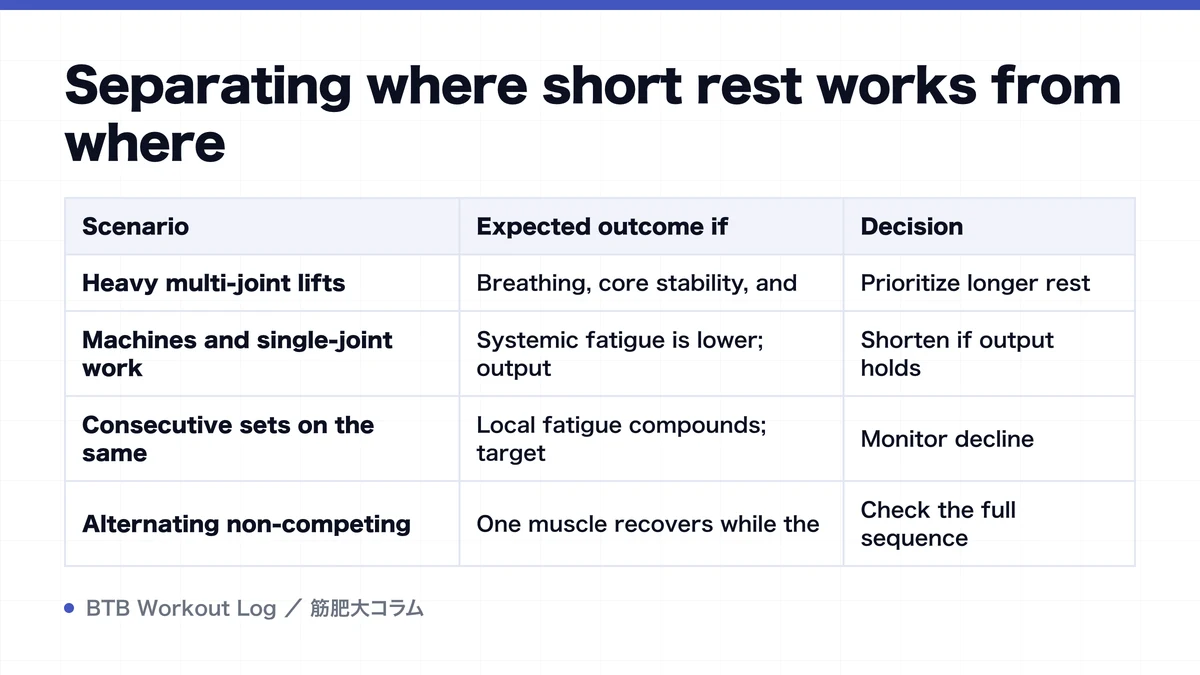
Rest time needn't be uniform across your entire session—vary it by exercise and priority. The benchmark is not "this exercise fatigues less, so cut rest," but rather whether you can sustain the output you're targeting with shorter rest.
| Scenario | Expected outcome if shortened | Decision |
|---|---|---|
| Heavy multi-joint lifts | Breathing, core stability, and technique don't fully recover; reps drop easily | Prioritize longer rest |
| Machines and single-joint work | Systemic fatigue is lower; output often stays consistent even with shorter rest | Shorten if output holds |
| Consecutive sets on the same muscle | Local fatigue compounds; target muscle reps fall readily | Monitor decline |
| Alternating non-competing exercises | One muscle recovers while the other works; time is used efficiently | Check the full sequence |
| Prioritize main lifts over accessories | Preserve quality of main work while securing late-session time | Don't cut main lifts |
If time is tight, trimming all rest uniformly is less effective than giving main lifts full recovery while shortening only the accessory work—output degradation is easier to manage. Alternating non-competing muscle groups is covered in the supersets comparison, and the 2-minute versus 5-minute choice is detailed in rest interval guidelines.
Determine the rest you need by comparing your first and last set
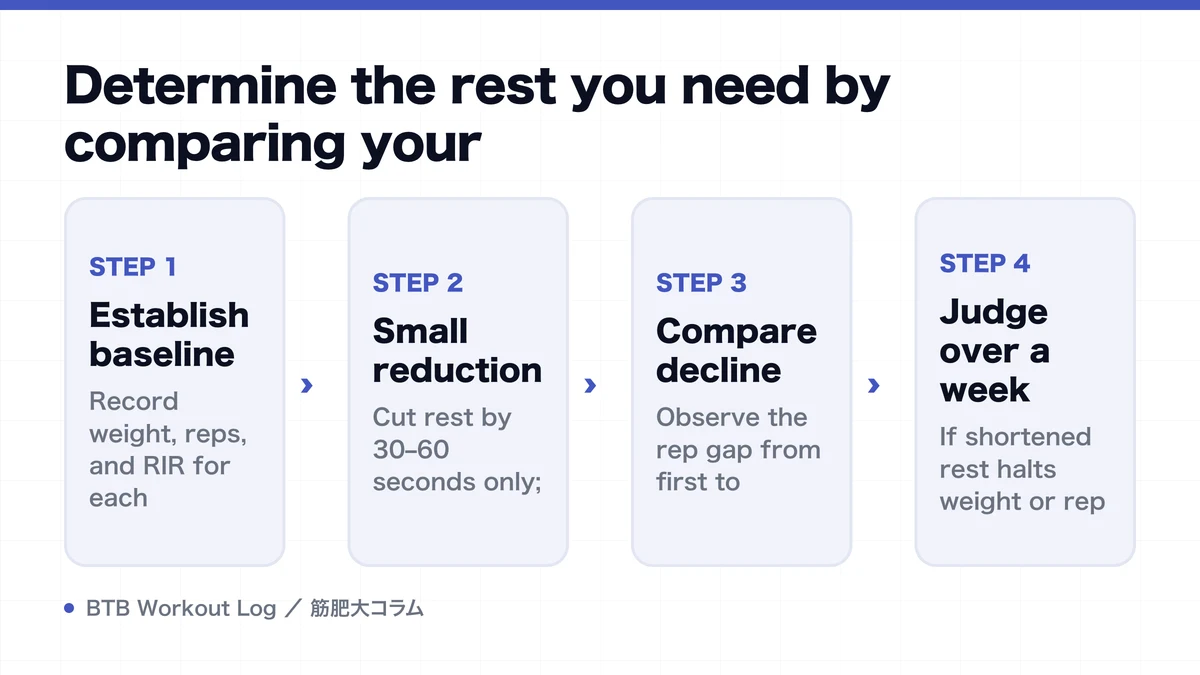
When setting rest intervals, lock in your current conditions for 2–3 sessions first. Match the exercise, load, target reps, set count, target RIR, and exercise order—only change rest. If conditions shift each session, you can't isolate whether rep drops stem from rest, load changes, or prior fatigue.
- Establish baseline: Record weight, reps, and RIR for each set at your current rest duration.
- Small reduction: Cut rest by 30–60 seconds only; perform the same exercise in the same order.
- Compare decline: Observe the rep gap from first to last set, form, what stops each rep, and total time.
- Judge over a week: If shortened rest halts weight or rep progress, revert; if output matches, adopt the shorter setting.
Aligning your target RIR works best with RIR management for clearer decisions. If short rest pushes you to RIR 0 earlier than planned, finishing all sets doesn't mean you hit your intended distribution.
Muscle growth comes not from rest time itself, but from what you build on top of recovery afterward. Use your timer as a calibration tool—nothing more—to reproduce that quality.
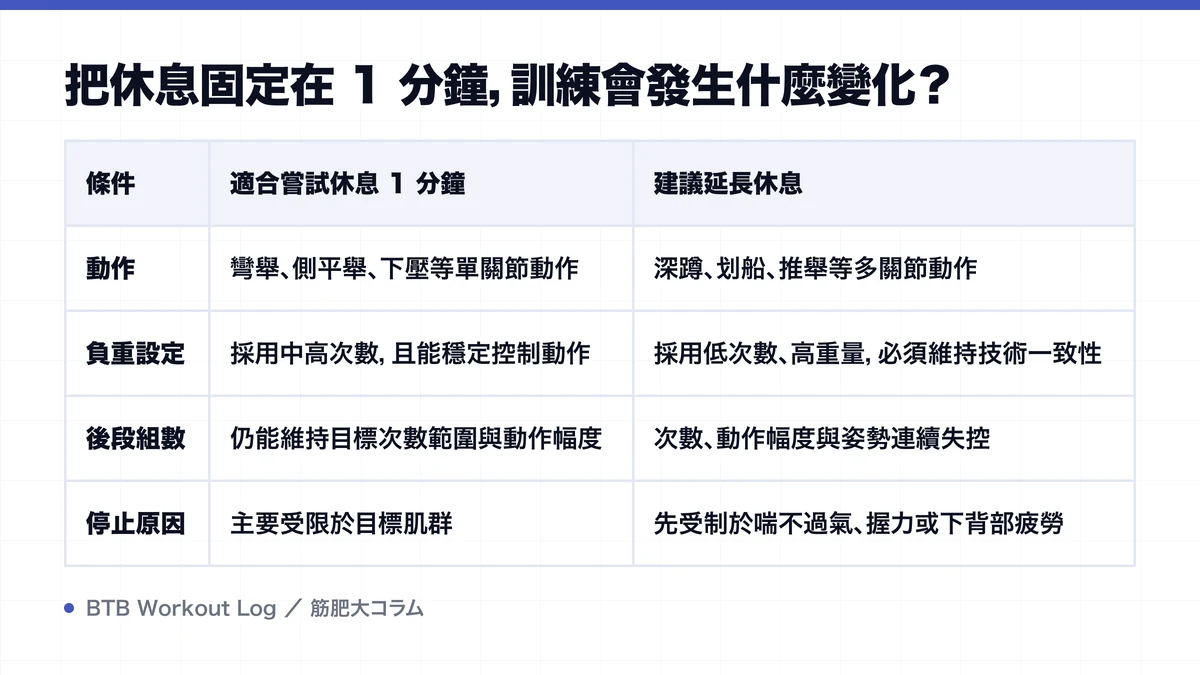
把休息固定在 1 分鐘,訓練會發生什麼變化?
把休息固定在 1 分鐘,訓練時間一定會縮短。真正的問題是:省下的時間,是否以犧牲下一組的訓練品質為代價。判斷標準不該是「1 小時內做完幾組」,而是相對於投入的時間,你能重複完成多少組對目標肌群施加足夠張力的有效訓練。
| 條件 | 適合嘗試休息 1 分鐘 | 建議延長休息 |
|---|---|---|
| 動作 | 彎舉、側平舉、下壓等單關節動作 | 深蹲、划船、推舉等多關節動作 |
| 負重設定 | 採用中高次數,且能穩定控制動作 | 採用低次數、高重量,必須維持技術一致性 |
| 後段組數 | 仍能維持目標次數範圍與動作幅度 | 次數、動作幅度與姿勢連續失控 |
| 停止原因 | 主要受限於目標肌群 | 先受制於喘不過氣、握力或下背部疲勞 |
不需要把所有動作的休息時間都統一成 1 分鐘。優先訓練的多關節動作充分休息,只縮短輔助動作的休息,通常能把損失降到更低。另外,如果把省下的時間拿來增加組數,縮短訓練時間與每週組數增加就會同時發生,無法單獨判斷休息時間的影響。正確順序是先維持相同組數,觀察輸出下降的程度,再考慮是否增加訓練量。
常見問題
- If reps drop with shorter rest but I push to failure, is the effect the same?
- Not necessarily. If breath or grip gives out first, the set ends before the target muscle receives adequate tension. Beyond hitting your RIR, examine range of motion, form, what stopped the rep, and how the next set suffers.
- If the pump is stronger with short rest, does that favor muscle growth?
- Pump intensity alone isn't diagnostic. Short rest can intensify the burn and transient hormonal responses, but those aren't the same metric as long-term hypertrophy. Prioritize holding reps and form, and whether you progress in weight or reps over weeks.
- Is it okay to vary rest between exercises?
- Absolutely. Heavy multi-joint moves warrant longer rest; machines and single-joint work often tolerate shorter intervals. Rather than a fixed minute target, find the shortest rest that reproduces your weight, reps, and range of motion for each lift.
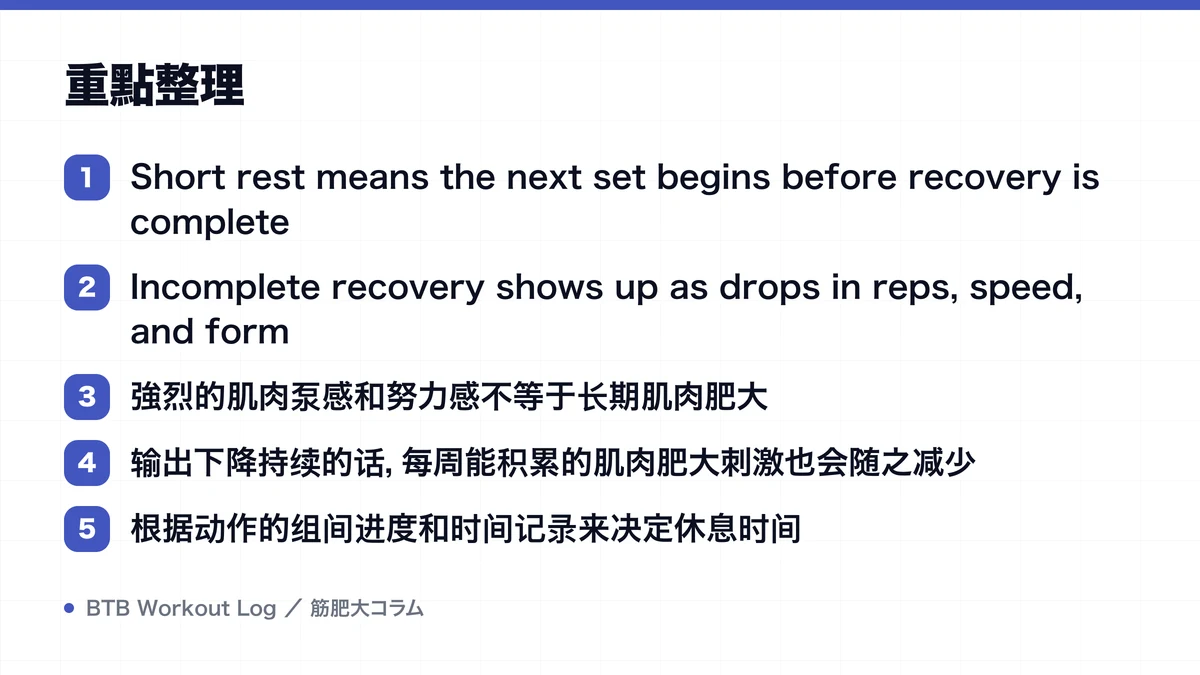
重點整理
- Short rest means the next set begins before recovery is complete
- Incomplete recovery shows up as drops in reps, speed, and form
- 強烈的肌肉泵感和努力感不等于长期肌肉肥大
- 输出下降持续的话,每周能积累的肌肉肥大刺激也会随之减少
- 根据动作的组间进度和时间记录来决定休息时间
- 單關節動作或許適合固定休息 1 分鐘,但用在主要的多關節動作上,訓練損失通常更大