
不用每次都練到力竭,肌肉也能長大|不必把自己累垮的原因
肌肉变大并不需要每组都训练到力竭,而是需要在充足张力下完成多次重复,并在能够恢复的范围内持续施加这种刺激。即使停在极限之前,也能满足这些条件。
训练到极限的组数确实能让你更容易感知刺激的强度,但肌肉肥大并不是只在成功与失败的边界才会启动。关键不在于"是否训练到力竭",而在于你离极限有多近,以及这种代价对下一组甚至下一次训练造成了什么影响。
失败的一次不是肌肉肥大的开关
限界,即反复失败,指的是用正确的动作无法再举起一定负重的那个点。最后一次反复顺利完成的组和下一次反复中途中止的组之间,记录上有明确的分界。但身体内部发生的变化并不会在这个分界处突然从零跳到最大。
随着组数推进,你能发挥的力量余地越来越小,举起速度变慢,维持同样动作需要的努力不断增加。在接近极限之前,肌肉已经经历了多次高强度的力量需求。即便在还能再做一次的时候停止,之前的反复产生的张力也不会失效。相反,即使通过改变姿态勉强达到失败,但如果目标肌肉没有保持受力,仅仅因为"失败了"就高度评价这一次,也不合理。
训练至极限是获得刺激的一种方法,但如果失败本身成了目的,就容易忽视动作质量和下一组的表现。考虑肌肉肥大时,比起关注那"失败的一次",不如看你在接近极限的过程中完成了什么样的反复,这样才更符合实际。
即使未達極限,所需的肌纖維也會被動員
肌肉並不會從一開始就均等動員所有肌纖維,而是根據所需的力量來動員運動單位。在相對較重的負荷下,開始後立即需要很大的力量。即使是輕負荷,當重複進行足夠多次後,先前工作的肌纖維開始疲勞,為了維持相同的力量,額外的運動單位會被募集。因此,即使使用的重量不同,只要是充分努力的組數,也能產生肌肉肥大刺激。
但是,「不需要做到力竭」並不代表「可以隨意停止」。RIR(Reps In Reserve)是衡量組數結束時還能再做幾次的指標。如果 RIR 太大,特別是在輕負荷下,可能會在還未達到必要的動員水準前就結束組數。另一方面,認為 RIR 不為 0 就沒有刺激的二分法也不準確。在RIR 管理中,我們不是看是否為 0,而是檢視你有多大的一致性能接近目標範圍。
負荷越輕,反覆前期的餘裕越大,因此通常需要更接近力竭。對於中到高重量的複合動作,即使保留一些 RIR,也容易發揮較大的力量,並能在保持技術的同時確保刺激。這也涉及高重量和低重量的使用,比起「所有動作都用相同 RIR」,根據負荷和動作特性做判斷更加合理。
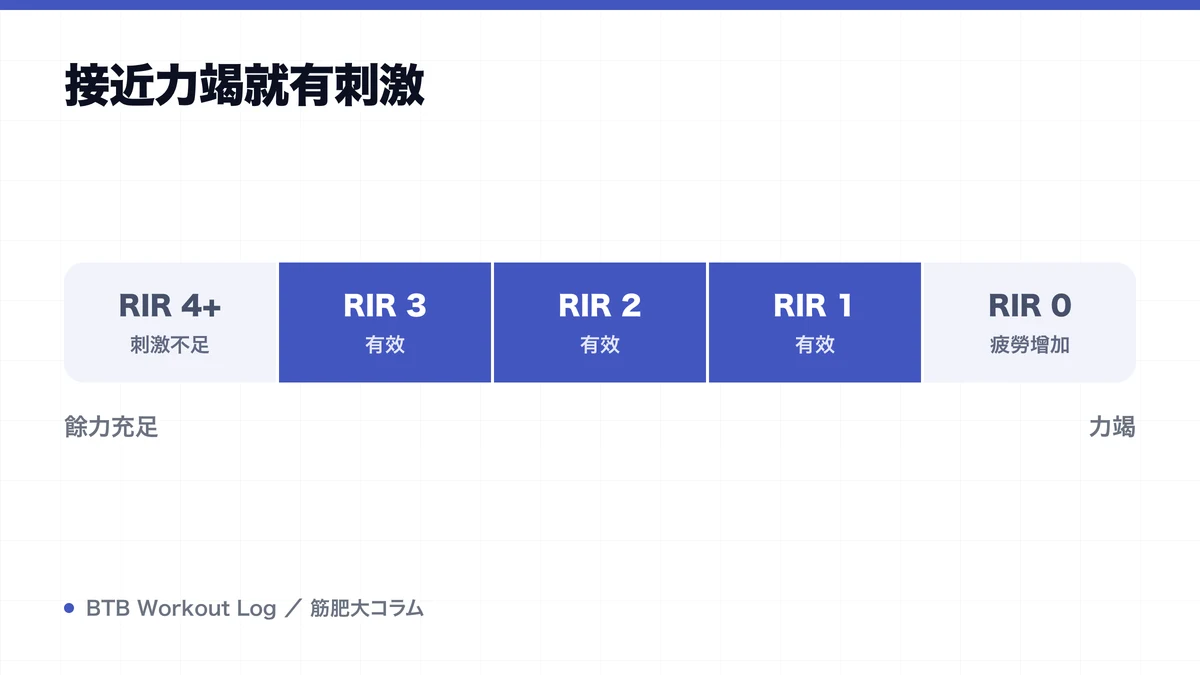
The closer you push to failure, the more fatigue accumulates relative to the stimulus you create.
接近極限的最后几次重复并不轻松。由于需要投入很高的努力,这确实会增强刺激。但从接近极限到力竭这一次反复中,刺激并不会单独增加,疲劳也不会保持不变。局部疲劳、呼吸困难、注意力消耗、动作速度下降都会同时大幅增加。
这个代价在仅看单组时容易被低估。如果第一组力竭进行,结果导致第二组及之后的反复次数大幅下降,那么整周内能用良好姿态进行的高质量反复总数可能会减少。如果疲劳延续到下次训练,重量或次数无法恢复,还会影响训练频率和递进性。肌肉肥大不是来自单组的极端强度,而是数周、数月累积可恢复刺激的结果,所以每次最大努力未必能带来长期的最大成果。
换个角度理解这种关系会更清楚:不要假设刺激和疲劳呈线性增长。略微增加远离极限的组数价值很大,但对已经接近极限的组进行力竭训练,增益可能很小。与此同时,疲劳可能明显上升。同样的逻辑也适用于组数,增加组数并非总是越多越好。就像增加过多组数的问题一样,单组力竭程度也有个可恢复的范围。
How Much Does Research Actually Support "Training Without Failure"?
Systematic reviews and meta-analyses comparing training to complete failure versus stopping short show no clear difference in muscle hypertrophy overall, establishing that pushing to failure is not a prerequisite. Other reviews on proximity to failure similarly found no evidence that training to momentary muscular failure outperforms non-failure training. The assumption that results increase linearly as you approach the limit doesn't hold up.
That said, this doesn't mean "any RIR value works the same." Study definitions of failure, load, set count, participant experience, and volume vary. Research centers on young adults, leaving gaps in conclusions for advanced lifters alone and optimal RIR per exercise. Some analyses did show small advantages for failure in experienced subgroups, but extending that across all conditions requires caution.
What translates from research to practice is that failure is no longer mandatory, and sets far from the limit aren't justified either. Rather than treating RIR1 versus RIR3 as a precise boundary universal to everyone, the evidence-aligned approach is to train sufficiently close to failure, then monitor recovery and progress.
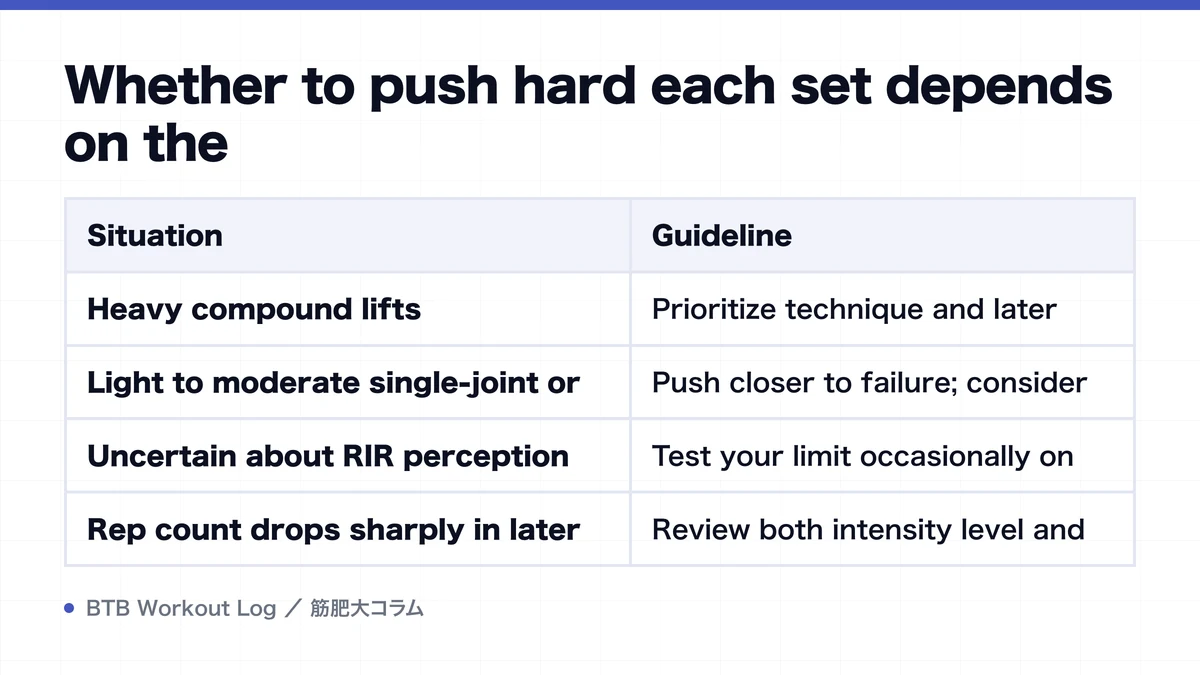
Whether to push hard each set depends on the exercise and your next performance
The basic strategy: leave reps in reserve on earlier sets, approaching the limit as you progress through later ones. For compound lifts like squats and bench presses—where whole-body stability and technique matter—stopping at RIR1–3 preserves quality for subsequent sets. For single-joint movements or machines like leg extensions or cable curls, where failure risk is lower and load isolation easier, you can push the final set to RIR0 to check your feel.
| Situation | Guideline |
|---|---|
| Heavy compound lifts | Prioritize technique and later sets; focus on RIR1–3 |
| Light to moderate single-joint or machine work | Push closer to failure; consider RIR0 for the final set if needed |
| Uncertain about RIR perception | Test your limit occasionally on safe exercises to calibrate your estimates |
| Rep count drops sharply in later sets | Review both intensity level and rest intervals |
Your decision data: RIR, load, reps, form consistency, rep drop under identical conditions, and recovery next session. Since RIR isn't purely objective, periodically go to true failure on safe movements and verify your "I had 2 left." Later, if weight or reps climb while you maintain your target RIR on the same exercise, you're progressing without failing every time.
Overlay RIR feel onto load and rep trends across sets, then watch whether reduced intensity maintains weekly total reps and your next session's numbers. This calibration makes it easier to find your optimal distance from failure.
常見問題
- If I'm not pushing to failure, how many reps in reserve should I leave?
- Most sets can start at RIR1–3. Lighter loads warrant pushing closer to failure; heavy compounds should prioritize technique. Judge by whether weight or reps climb at your target RIR and whether recovery holds to the next session.
- If I can't judge RIR accurately, should I always push to failure?
- No—instead, regularly take safe machines or single-joint movements to RIR0 to calibrate your estimates. Comparing what you predicted versus what you could actually do builds awareness of your reserve and shrinks your error margin.
- Where should I place sets that go to true failure?
- The final set of machines or single-joint exercises late in the session works best—failure becomes safer and later sets stay unaffected. Avoid heavy compounds early on. If reps crash or weight drops next time, dial back the frequency.
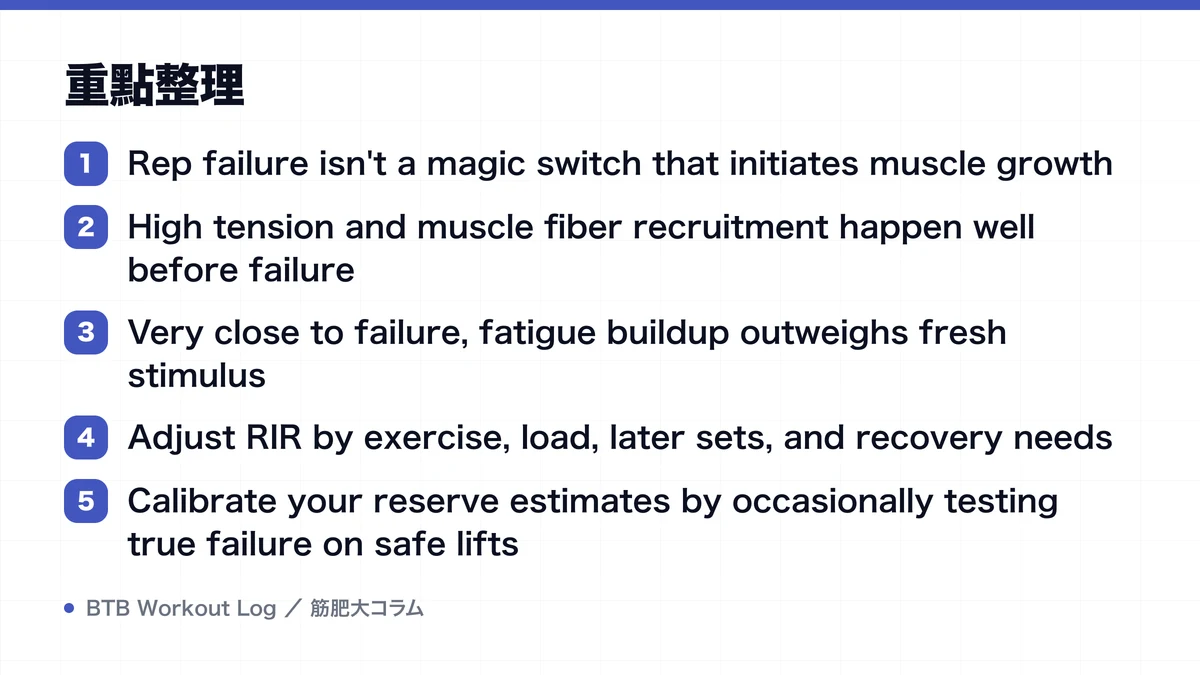
重點整理
- Rep failure isn't a magic switch that initiates muscle growth
- High tension and muscle fiber recruitment happen well before failure
- Very close to failure, fatigue buildup outweighs fresh stimulus
- Adjust RIR by exercise, load, later sets, and recovery needs
- Calibrate your reserve estimates by occasionally testing true failure on safe lifts