
同樣做10次,為什麼肌肉肥大效果卻不一樣?你的10次真的練到位了嗎
10次不是刺激強度的指標,而是你停止時的反覆次數。即使同樣是10次,限界前的餘力、負荷、動作質量和目標肌肉的運用方式不同,產生的肌肉肥大刺激也會不同。
區分開始:不要把10次時接近極限的組和還能做5次但故意停在10次的組混為一談。
「做10次就有相同刺激」的直覺哪裡出了問題
10次左右在大多數動作中易於保持姿勢,適合安排肌肉肥大訓練組。但容易操作不等於10這個數字本身有特殊效果。次數只有結合負荷和努力程度才有意義。
某個重量做10次就達到極限,這10次是RIR 0,即「還能做1次也做不了」。反之,能做15次的重量卻在10次停下,就是RIR 5。兩者的訓練日誌都寫著10次,但距離極限的距離卻很大。同一個人也會出現第1組10次是RIR 4,疲勞後第4組10次是RIR 1的情況。
常見的誤解是先決定次數範圍就能自動統一強度。實際上「用8到12次」的指示還不夠。除了決定做多少次,還要指定保留多少次的餘力,否則從熱身組到極限組都混在一起。根據次數決定負荷時,也要確認在目標次數時還剩多少餘力。
差異的關鍵:第10次時離極限有多近
肌肉不是數著反覆次數來改變生長反應的。肌纖維發揮足夠的力量,隨著組的進行動員必要的運動單位,承受導致肌肉肥大的機械性張力。高負荷在早期就需要較大的力量,輕負荷則隨著疲勞累積、接近極限時動員才增加。
RIR(Reps in Reserve,還能做多少次)在實踐中近似這種差異。10次完成時RIR 1到3,一般視為容易操作的硬組範圍。RIR 5以上時,根據目標和整體計畫而定,單獨作為工作組刺激可能較小。到達RIR 0刺激雖然更大,但姿勢容易變形,對後續組的疲勞也增加。
不過「只有最後幾次有效」這樣固定計算也過於簡化。接近極限與肌肉肥大的關係存在範圍,並非每組都要練到失敗。關鍵是表面上的10這個數字外,在恢復範圍內重複足夠的努力程度。把RIR強度管理和極限訓練的效果和代價分開思考,更容易判斷10次的含義。

使用重量不同,10次要求的力量和疲勞也不同
即使以相同RIR完成10次,不同動作或負荷下的組性質也不完全相同。高負荷時單次發揮力量大,易於適應筋力和掌握高重量技術,但對關節和姿勢要求較高。低負荷時容易積累更多反覆,但接近極限需時較久,局部灼燒感或呼吸困難往往先成為限制。
研究總體表明,組的努力程度相同時,相對廣泛的負荷範圍都能促進肌肉肥大。這不表示「負荷無所謂」。比如能做25次的輕重量停在10次,餘力仍大,不能與10次接近極限的重量相提並論。選擇輕負荷時,確認是否達到充足努力程度更加重要。
跨動作比較次數也要謹慎。深蹲100 kg做10次和腿部伸展機50 kg做10次,使用肌群、穩定性、動作幅度和全身疲勞都不同。不要只用次數判斷「哪個更重」,而應根據各動作的角色選擇合適的負荷範圍。負荷範圍特性整理在高重量和高次數的運用會更實用。
相同重量、相同10次,動作條件改變比較就失效
Even with identical weight and RIR, how the target muscle is challenged shifts with form. Ten clean, controlled reps through a full range of motion differs fundamentally from ten reps where you shorten your range and use body momentum to grind through the final reps. The latter isn't worthless, but if you're tracking progress against last session, you need to distinguish between strict reps and assisted ones.
Setup variations matter too. Bench angle, grip width, foot placement, and back positioning all change the load distribution between target and supporting muscles—same ten reps, different stimulus. A drastically slowed tempo changes the time under tension and available weight, making it a separate condition from normal-tempo reps. Slower isn't automatically better; what counts is maintaining speed consistent enough to compare reps meaningfully.
Rest intervals and exercise order slip past most lifters. Ten reps after three minutes of rest feel nothing like ten reps after sixty seconds—fatigue at the start is completely different. Skimping on rest to hit ten reps can leave you too depleted for quality work in later sets. For session-to-session comparison, keep your rest and ordering roughly constant. How you structure your intervals feeds into this too—see the breakdown on rest timing.
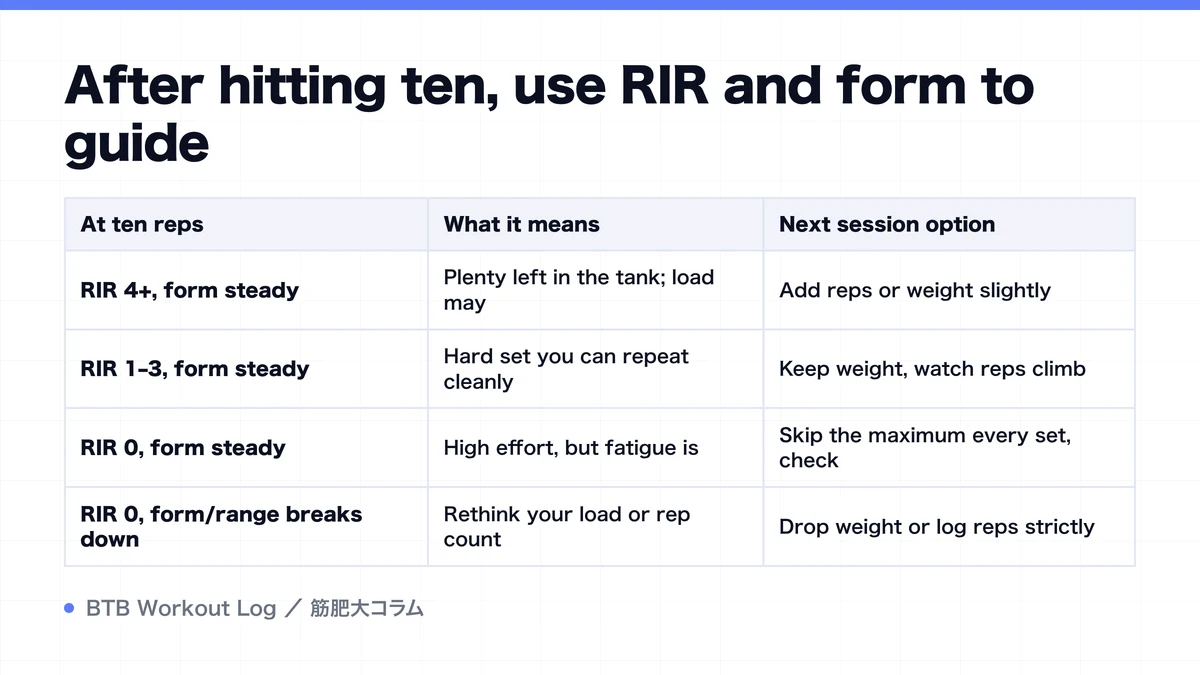
After hitting ten, use RIR and form to guide your next move
Once you've completed ten reps as a working set for muscle growth, don't just tick the box—use how you finished to inform next time. Here's how to read it:
| At ten reps | What it means | Next session option |
|---|---|---|
| RIR 4+, form steady | Plenty left in the tank; load may be too light | Add reps or weight slightly |
| RIR 1–3, form steady | Hard set you can repeat cleanly | Keep weight, watch reps climb |
| RIR 0, form steady | High effort, but fatigue is substantial | Skip the maximum every set, check recovery |
| RIR 0, form/range breaks down | Rethink your load or rep count | Drop weight or log reps strictly |
This table doesn't make or break a program off one set. RIR is subjective estimation, and when you're new to a lift, the margin of error is wide. On safer machine movements, occasionally test your actual max reps to calibrate your "two reps left" feel. You don't need to chase failure on free weights.
Sleep, food, soreness, and fatigue from earlier exercises shift rep counts too. Don't adjust weight after a single ten. Watch the trend over a few sessions in matching conditions. If RIR tanks across multiple sets, check whether your total sets and rest fit your recovery, not just the weight itself.
Turn reps into loadings for your next session
In practice, pick a rep range and target RIR per exercise, then lock down your form cues. If you're aiming for 8–12 reps at RIR 1–3, and you hit ten at RIR 3, try eleven next time at the same weight. Hit ten at RIR 0? Either stabilize the quality at that weight or dip the load slightly.
Log at minimum: weight, reps, RIR per set. On key lifts, jot down rest duration, range of motion, and any form changes. If the same weight goes from RIR 0 to RIR 2 while keeping ten reps, you've gotten stronger even though the rep number stayed flat. Conversely, if you're shortening your range to hold ten, that's not real progress even if the log looks the same.
Once you hit your rep range top with target RIR and steady form, nudge the weight up next. To spin the 漸進性過負荷 properly, don't mix in different exercises or conditions—track trends under identical setup. Reps aren't the goal themselves; they're your data point. That's what logging is for.
常見問題
- Should I avoid ten reps entirely for muscle growth?
- No. Ten reps or so is practical for most lifts. The mistake is judging a set by the number alone; lock in target RIR, form, and range instead. If ten reps lands you in RIR 1–3, it's a solid choice.
- Is it better to hit ten reps on every set at the same weight?
- Not required. Later sets build fatigue, so hitting the same ten at the same load gets harder—that's normal. Rather than chop your range to preserve ten, keep your target RIR and form, then log what actually happened: ten, nine, eight. That's data you can compare.
- How do I nail my RIR estimate after the set?
- Log the same lift and form repeatedly, and occasionally hit max reps on safer machines to check your prediction. If next session's reps jump higher than expected, you probably had more room than you thought last time. Calibrate over weeks, not single sessions.
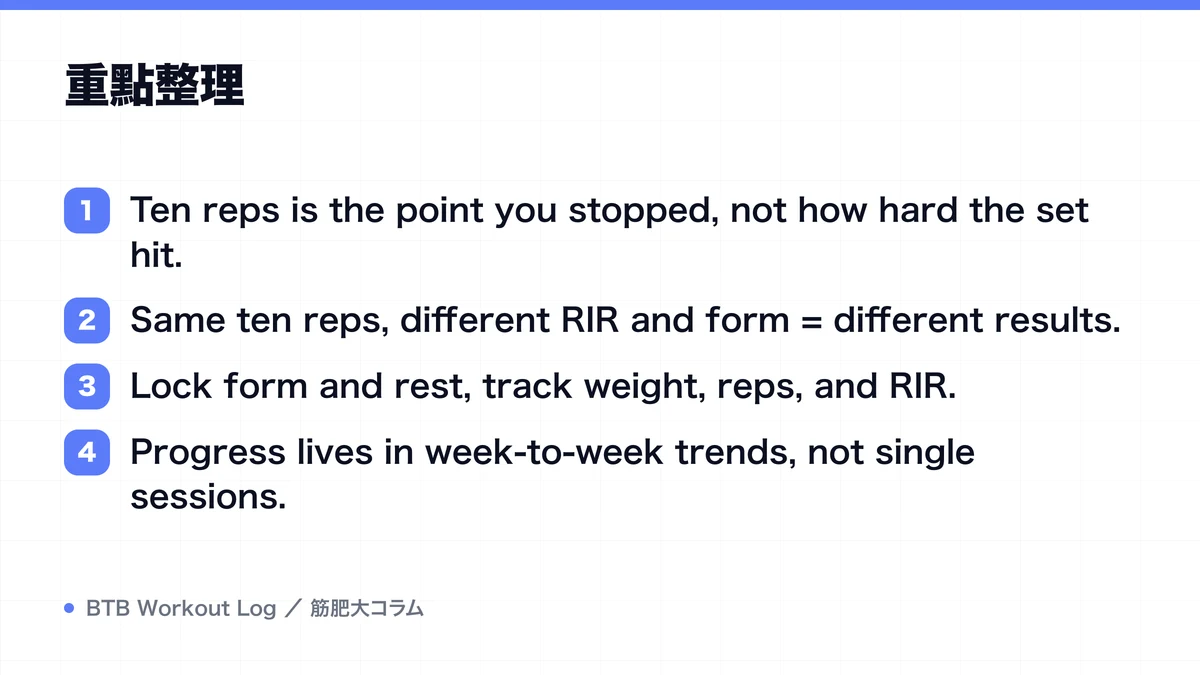
重點整理
- Ten reps is the point you stopped, not how hard the set hit.
- Same ten reps, different RIR and form = different results.
- Lock form and rest, track weight, reps, and RIR.
- Progress lives in week-to-week trends, not single sessions.
參考文獻
- Low- vs High-load Resistance Training for Strength and Hypertrophy: Meta-analysis
- Resistance Exercise Load Does Not Determine Training-mediated Hypertrophic Gains in Young Men
- Training to Repetition Failure or Non-failure: Systematic Review and Meta-analysis
- Proximity-to-Failure and Muscle Hypertrophy: Systematic Review with Meta-analysis
- Repetitions in Reserve Is a Reliable Tool for Prescribing Resistance Training Load