
停滯是怎麼發生的?不是突然有一天出現,而是肌肉肥大逐漸停下來的過程
停滯期不是肌肉突然停止反應的現象。身體適應了曾經足夠的刺激,負荷進步放緩,同時疲勞與恢復的制約不斷堆積,導致「無法更新刺激」的狀態持續數週,最終表現為停滯。
單次深蹲少做一次並不代表停滯期開始。區分肌肉肥大本身的放緩與疲勞掩蓋下的假停滯,才能看清實際發生的過程。
先分清:成長停滯 vs 表現停滯
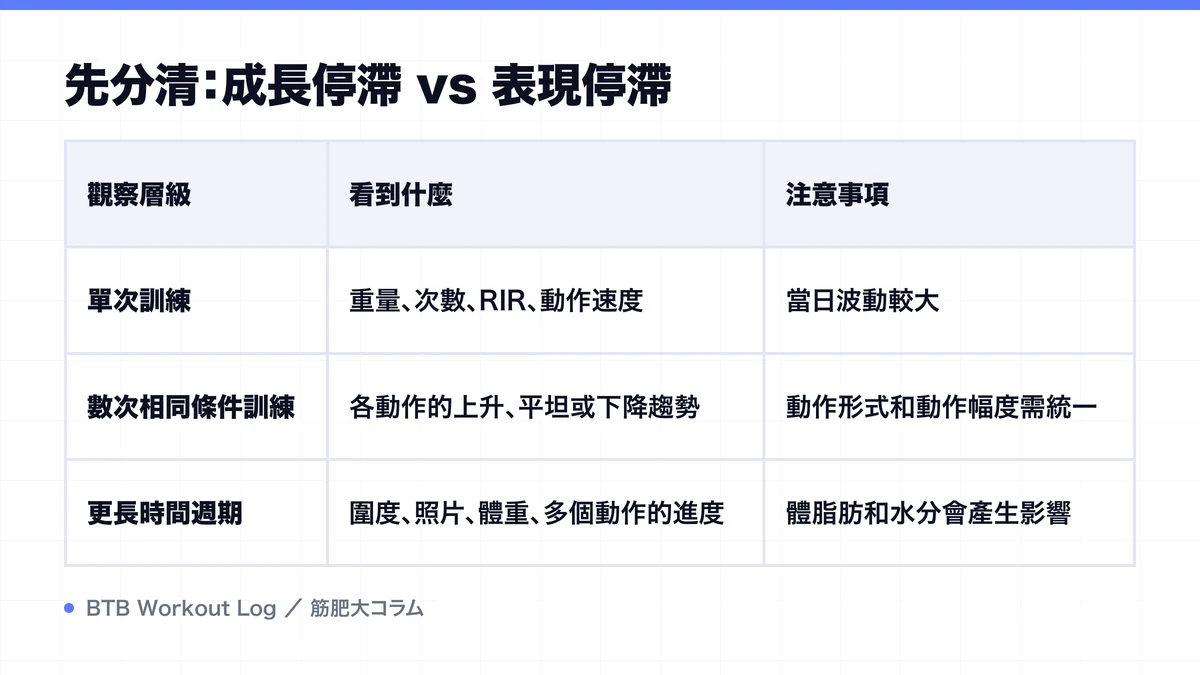
「臥推比上次少做了一次」和「胸肌長期沒有增長」不是同一回事。前者受睡眠、飲食、訓練時間、組間休息、測量誤差等日常變化影響,屬於當下發揮能力。後者涉及肌肉量的變化,需要更長時間尺度的評估。
| 觀察層級 | 看到什麼 | 注意事項 |
|---|---|---|
| 單次訓練 | 重量、次數、RIR、動作速度 | 當日波動較大 |
| 數次相同條件訓練 | 各動作的上升、平坦或下降趨勢 | 動作形式和動作幅度需統一 |
| 更長時間週期 | 圍度、照片、體重、多個動作的進度 | 體脂肪和水分會產生影響 |
因此停滯期是指在可比較的條件下,多項指標持續不上升,而非單次個人紀錄失敗。若只有某一動作停滯,但同一肌群的其他動作或次數仍有進展,那可能是技術停滯或動作專項問題,而非肌肉肥大停滯。保留重量、次數、RIR的記錄,其價值在於透過記錄發現停滯期的過程。
第一階段:相同訓練計畫的相對刺激逐漸減弱
訓練初期,某個重量和組數對身體來說是全新的、足夠大的要求。隨著訓練進行,肌力、動作技術、組間恢復能力改善,同樣的訓練計畫逐漸變得輕鬆。這是進步的象徵,卻也是下一波停滯期的入口。
比如80kg做10次,最初時RIR為1(「還能多做1次」),幾週後變成RIR 3(「還能多做3次」)。外表看起來重量和次數沒變,但對身體的相對難度卻降低了。若保持不變,每組的發揮要求減少,週週累積的刺激也不會增加。
這時需要的就是漸進超負荷。不是指每次都加重量,而是在保持目標動作形式和動作幅度的前提下,在可恢復的範圍內提升次數、重量、組數或訓練頻率。當處方更新速度跟不上身體的適應速度,就會形成適應 → 相同刺激相對變輕 → 難以引發新的適應這樣的循環,成長曲線隨之變平。

第二階段:偏向刺激不足或疲勞過度
難以更新訓練計畫後,停滯期的發展分成兩條路徑。表面上都是「重量或次數停止增長」,但對應的解決方案截然相反。
| 路徑 | 發生的變化 | 結果 |
|---|---|---|
| 刺激不足 | 重量和次數保持不變,RIR反而增加,目標肌肉的硬組也沒增加 | 恢復充足,但對肌肉的新要求不足 |
| 疲勞過度 | 倉促增加組數或力竭組,導致下次訓練前發揮能力未恢復 | 刺激量大,但難以維持高品質反覆和持續進步 |
刺激不足的情況下,訓練計畫沒有更新,肌肉接受不到新的要求。疲勞過度則是因為害怕停滯而過度增加訓練量,或讓每組都做到力竭,結果下一次訓練的重量和次數反而下降。若RIR每次都接近0,多個動作的成績都在下滑,那應該懷疑的是恢復不足而非刺激不夠。力竭訓練是一種有效工具,但不是每組都必須做。
睡眠、進食熱量、心理壓力也會影響這個分岔點。同樣的菜單如果恢復餘力下降,會偏向疲勞過度;反之即使組數多,只要每組都有充足餘力,也會陷入刺激不足。更糟的是主要動作品質下降,卻只增加低品質的額外組數,兩條路徑會同時出現。努力量大和持續更新刺激是兩回事。

Stage 3: Chasing Progress Breaks Your Baseline, Locking in the Plateau
When the weight stops moving, you want to change the exercise, form, range of motion, rep range, and sets all at once. But if you change your baseline every session, you can't tell whether you actually got stronger, just shortened the movement, or simply recovered better. Without consistent markers, you end up choosing adjustments that work against the real problem.
The typical spiral: weight stalls → add more sets → fatigue tanks your reps → assume you're undertrained and push harder. Or the opposite: swap exercises every time you feel off, and you never build enough consistency in one movement to accumulate weight and reps. If you chase numbers by narrowing your range or using momentum, you update the number but not the stimulus to the target muscle. This illusory progress ties directly to why weight alone doesn't measure progress.
What locks in at this stage isn't your body's growth ceiling—it's confusion over whether stimulus or recovery is the bottleneck. Without comparable records, each change you make prevents you from testing the real cause, and the same mistake repeats.
Use Your Log to Pinpoint Which Stage Is Holding You Back
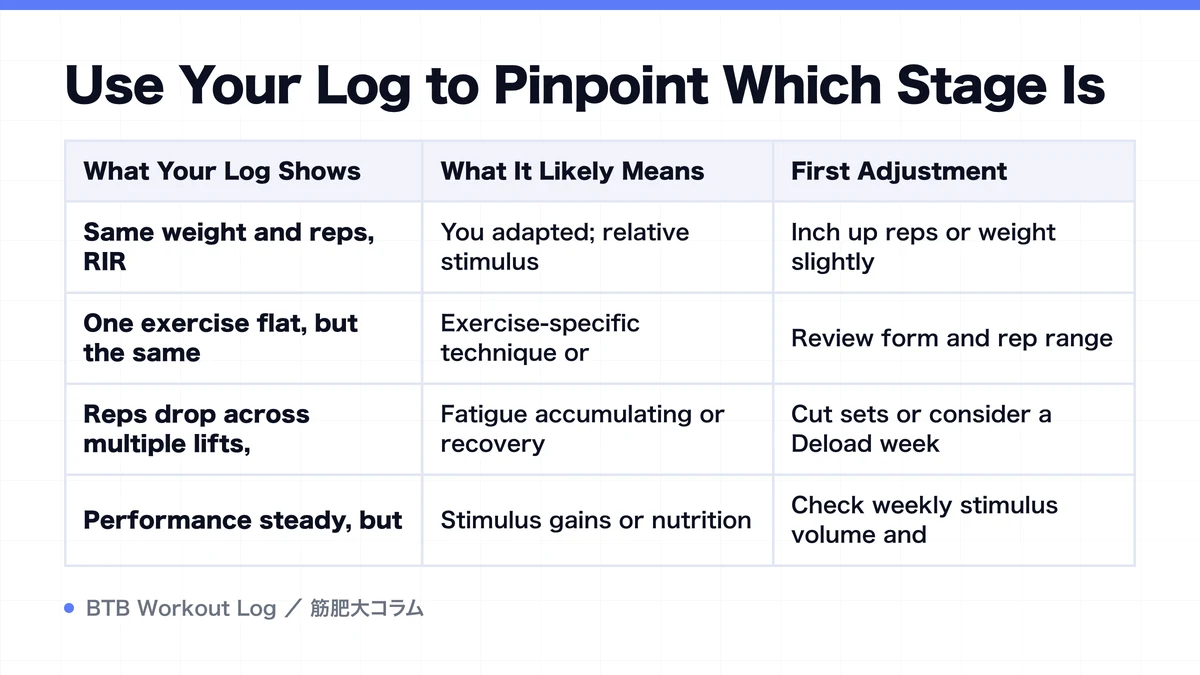
Breaking through a plateau starts not with more stimulus, but with identifying where the chain broke. Compare the same exercise from recent sessions—match not just weight and reps, but RIR, range of motion, rest time, and reason for stopping.
| What Your Log Shows | What It Likely Means | First Adjustment |
|---|---|---|
| Same weight and reps, RIR increased | You adapted; relative stimulus dropped | Inch up reps or weight slightly |
| One exercise flat, but the same muscle group progresses elsewhere | Exercise-specific technique or loading setup | Review form and rep range |
| Reps drop across multiple lifts, RIR also worse | Fatigue accumulating or recovery running low | Cut sets or consider a Deload week |
| Performance steady, but bodyweight and limb circumference stalled long-term | Stimulus gains or nutrition falling short | Check weekly stimulus volume and intake separately |
Make one change at a time. Lock your baseline first, then check the trend over recent sessions and count weekly 硬組 per muscle group, then layer in recovery status. If stimulus is low, nudge reps or weight up slightly; if fatigue is high, pull back the volume. After changing, watch multiple sessions to test your guess. If the numbers don't match your hypothesis, move to the next factor. See plateau causes and fixes for specific strategies.
Workout logging won't directly break a plateau, but it keeps you from confusing undertrained with overfatigued, and it gives you proof to test each change. Errors compound over time—you'll see the drift when you line up the numbers week by week. BTB Workout Log exists to build that lineup.
常見問題
- How many weeks with no progress counts as a plateau?
- There's no one-size-fits-all answer. Don't call it based on one or two off days—compare the same exercise, form, range, and rest over multiple sessions. If weight, reps, and RIR all flat-line or drop together, and the same muscle group isn't moving on other lifts, plateau odds go up.
- If Weight Stops, Does肌肉肥大Stop Too?
- Not necessarily. You can progress if reps climb on the same weight, or if you move more deliberately at the same RIR. Don't judge by one lift's weight alone—look at reps, RIR, range, the whole muscle group's trend, and longer-term changes in circumference and bodyweight together.
- When Plateaued, Should I Just Add More Sets?
- It's an option only if your log shows spare RIR and you're recovering fine but total weekly stimulus is low. If multiple lifts are struggling or fatigue runs high, adding volume will backfire. First separate stimulus deficit from fatigue overload, then adjust just one factor at a time.
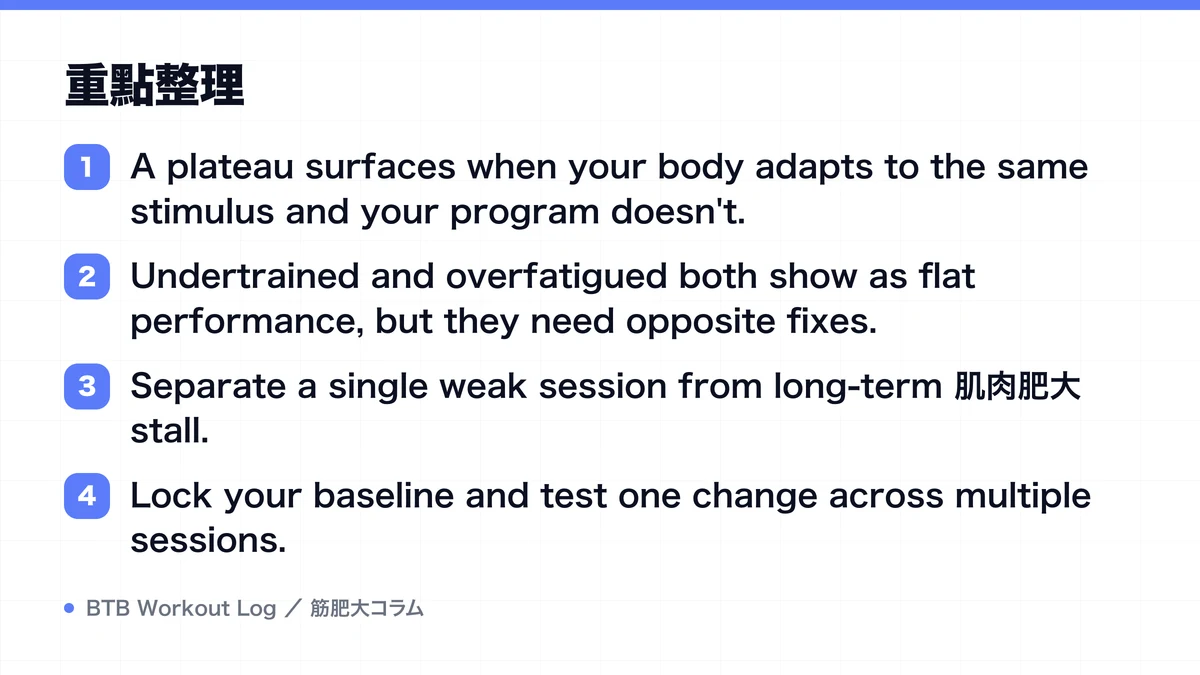
重點整理
- A plateau surfaces when your body adapts to the same stimulus and your program doesn't.
- Undertrained and overfatigued both show as flat performance, but they need opposite fixes.
- Separate a single weak session from long-term 肌肉肥大 stall.
- Lock your baseline and test one change across multiple sessions.
參考文獻
- ACSM Position Stand: Progression Models in Resistance Training for Healthy Adults
- Dose-response Relationship Between Weekly Resistance Training Volume and Muscle Mass
- Resistance Training Volume Enhances Muscle Hypertrophy in Trained Men
- Training to Repetition Failure or Non-failure: Systematic Review and Meta-analysis
- Proximity-to-Failure and Muscle Hypertrophy: Systematic Review with Meta-analysis