「不換菜單肌肉就會適應」是真的嗎?換太頻繁反而停滯的人,都有這個共同點
為了「刺激」肌肉而頻繁改變菜單並非必要。肌肥大需要的不是動作名稱的新鮮感,而是對目標肌肉施加足夠的負荷,並長期持續提高這個負荷。
變化在某些情況下是有幫助的。但與其每次靠直覺全面更換,不如保留可比較的動作,只加入有明確目的的調整,這樣更容易判斷進度。
新鮮刺激的必要性有多正確
持續進行相同的訓練,身體會適應。曾經接近極限的重量變得輕鬆,完成相同次數後還有餘力。如果繼續用相同重量和次數,隨著適應進行,RIR會增加,離極限越來越遠,相對刺激就會減弱。要保持固定的RIR,需要增加重量或次數。RIR指的是每組結束時「還能做幾次」的指標。
到這裡為止,「避免適應」的直覺是成立的。但應對適應不只有更換動作一種方式。用同一個動作多做一次、加重一點點,或在相同負荷下用更穩定的姿勢進行,都是漸進超負荷的形式,能為身體帶來新的課題。菜單看起來一樣,實際刺激卻不同。
而且,適應在肌肥大訓練中不是要避免的失敗,而是我們想追求的成果本身。動作變得熟練,姿勢穩定,負荷更容易作用在目標肌肉上,這些都有價值。不是「適應就失效」,而要判斷在適應的基礎上,當前負荷是否已經不足。
負荷進展、周期化、動作更換是三種不同的操作
「改變菜單」的說法範圍太廣,容易混淆。區分以下三個層級,就能明確知道什麼東西該多常調整。
| 變化層級 | 具體例子 | 主要目的 |
|---|---|---|
| 每組的進展 | 調整重量、次數、RIR、動作幅度 | 在當前動作中推進超負荷 |
| 計劃性的負荷變動 | 重日和高次數日、蓄積期和強度期 | 在時間軸上分配刺激和疲勞 |
| 動作更換 | 槓鈴臥推換成其他按推動作 | 解決疼痛、停滯期、訓練目標或器材的問題 |
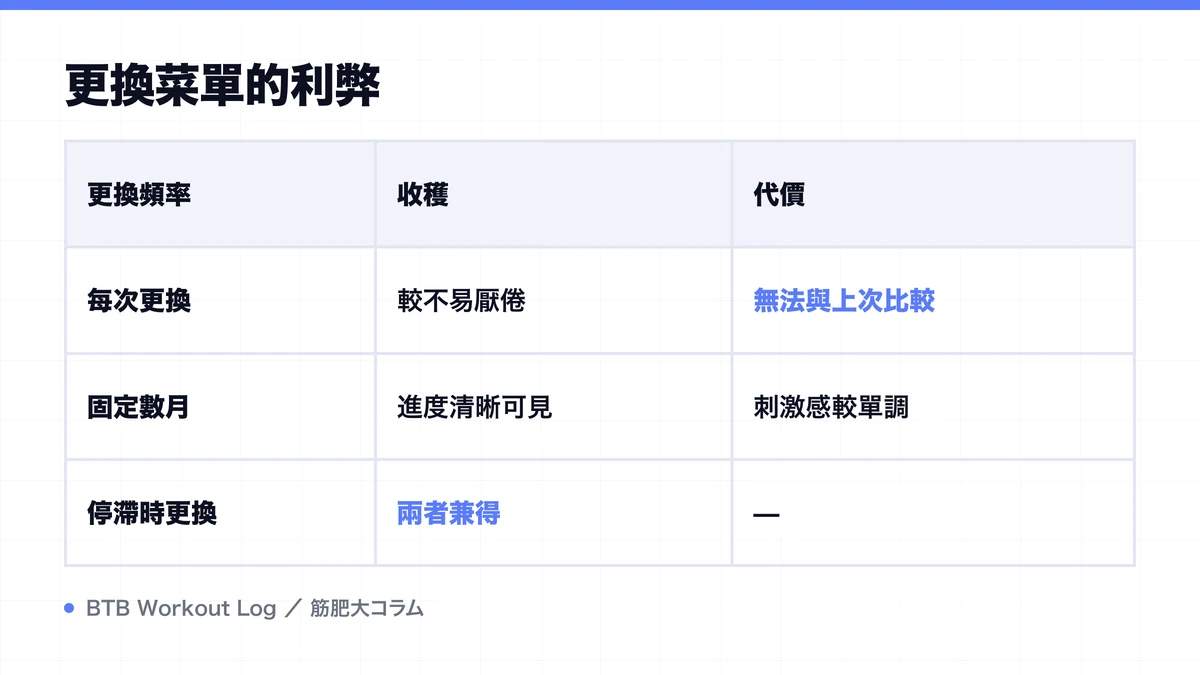
第一層在每次訓練時都可以調整。第二層根據日子或週、訓練塊的目標提前規劃。第三層如果每次都動,和上次的條件變化太大,難以判斷是能力進步還是單純動作難度不同。
也就是說,「變化或固定」不是二選一的問題。保留主力動作作為比較基準,在其內部進行負荷和次數的進展,本身就是一種變化。思考每週相同菜單的利弊時,也要區分動作名稱和實際負荷。
周期化研究不支持隨意全面更換動作
美國運動醫學會的漸進模型指出,為了持續適應,需要進行漸進式阻力訓練,並為經驗者提供計劃性運用變化負荷的思路。一般來說,根據目標和經驗程度調整負荷、次數、組數、頻率等,是訓練設計的基礎。
周期化的系統評論和元分析顯示,當訓練總量相同時,周期化對最大肌力往往更有利,但對肌肥大而言,與非周期化沒有明顯差異。這裡的周期化主要指計劃性改變強度或容量。與每週全面更新所有動作的「驚嚇肌肉法」不同。
從這個結果不能說變化不必要,也不能說只有固定菜單是對的。一般來說,單靠周期化強度或容量不一定能額外增加肌肥大。肌肥大和最大肌力不是同一回事,參與者的經驗和研究期間也不同,無法從研究中得出統一的交換週期。計劃性比較應該在固定菜單與動作輪換的討論中處理。
新鮮感容易被當成效果的證據
嘗試新動作時,平常較少有感的部位可能會明顯充血,甚至出現強烈的肌肉痠痛。由於使用的重量和次數也與原本的動作不同,很容易讓人覺得「終於練到以前沒用上的肌肉」。這種體驗也讓「訓練動作換得越勤,肌肉成長越快」的說法聽起來很合理。
不過,新動作帶來的明顯感受,部分也可能只是因為身體還不熟悉這套動作。前幾次訓練的次數增加,不一定代表肌肉量突然變多,也可能只是你學會了動作軌跡與正確發力。反過來說,重量較輕也不代表刺激一定較弱。在比較條件尚未一致之前,很難把數字的變化直接解讀為肌肉肥大增加或減少。
肌肉痠痛也是同樣的道理:它可以是做了不熟悉動作的訊號,卻不能直接證明長期肌肉肥大的效果更好。這和肌肉越痠痛,訓練效果就越好的迷思一樣,當下強烈的感受總是特別搶眼;相較之下,同一個動作多做1次這類小幅進步就顯得平淡。正是這種感受上的落差,讓隨機更換訓練動作顯得格外有吸引力。
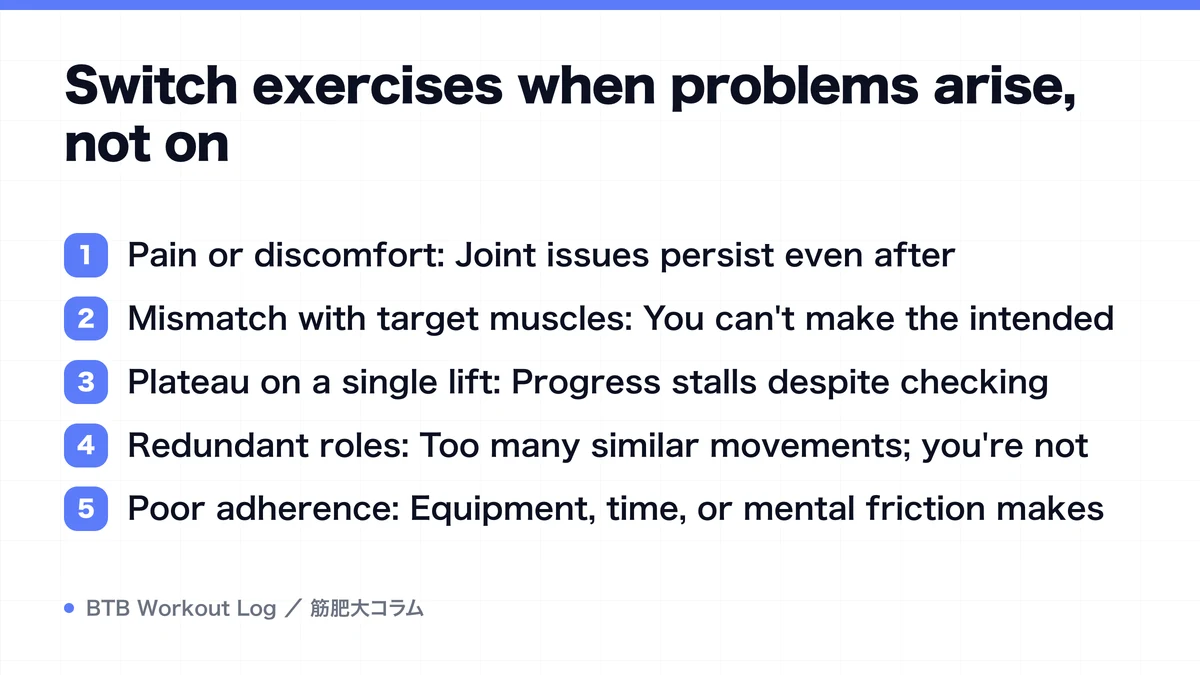
Switch exercises when problems arise, not on a fixed schedule
Simply hitting a four-week mark doesn't justify swapping exercises. If your main lifts are progressing, you're pain-free, driving tension into the target muscles, and recovering well, there's sound reason to keep them. Dropping a lift that's working means losing the technique you've built and the comparison data you've collected.
That said, consider a change if any of these hold true:
- Pain or discomfort: Joint issues persist even after adjusting load or form.
- Mismatch with target muscles: You can't make the intended muscles the limiting factor, even with solid execution.
- Plateau on a single lift: Progress stalls despite checking 恢復, RIR, and volume.
- Redundant roles: Too many similar movements; you're not addressing gaps in range of motion or muscle length.
- Poor adherence: Equipment, time, or mental friction makes it hard to stick with.
Frame it this way, and a substitution becomes a targeted fix, not random stimulus chasing. If your total output is dropping, exhaust fatigue and nutrition before blaming boredom with the exercise. The diagnostic process mirrors managing 停滯期—test one hypothesis per symptom, methodically.
Make it a small experiment you can actually compare
When you need to change an exercise, don't overhaul your entire program at once. Swap in just one alternative with a similar role. For example, if a chest press bothers your joints, keep your weekly set volume and other chest work the same — just switch to a different press with a different grip or equipment. By narrowing the variables you alter, you'll see more clearly whether the change actually solved the problem.
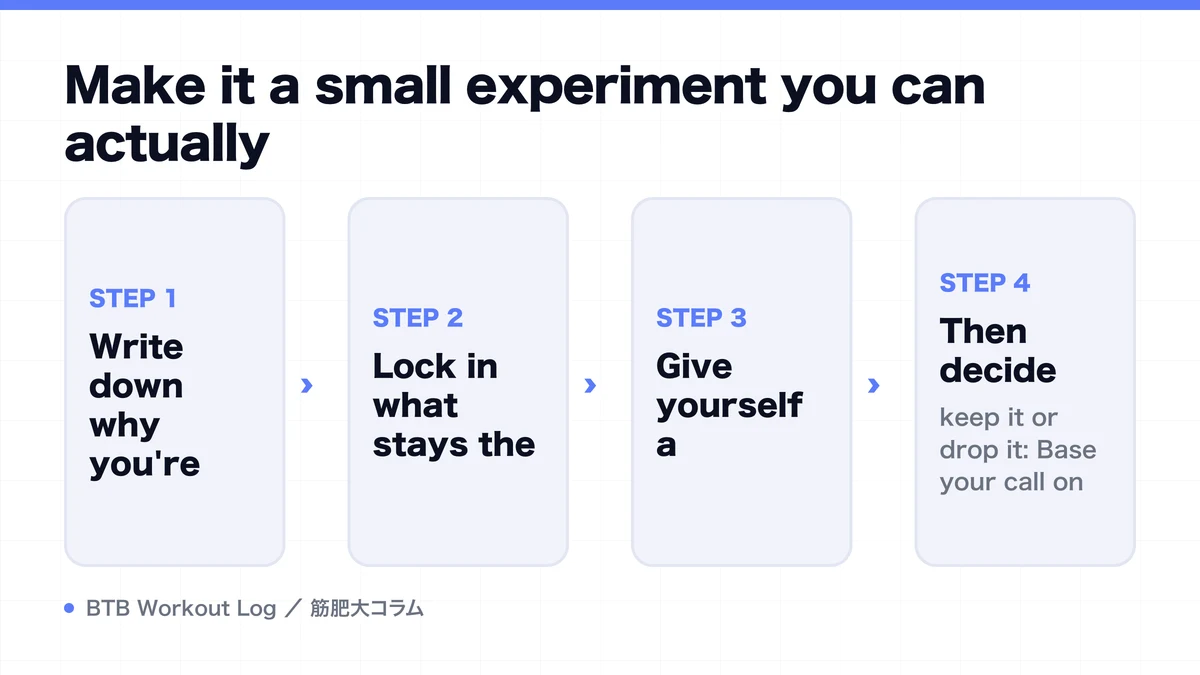
- Write down why you're changing: Pick one specific issue you want to fix — pain, a 停滯期, lack of progress on a target — and stick to it.
- Lock in what stays the same: Keep your target muscle, weekly set count, RIR, exercise order, and other factors as consistent as possible.
- Give yourself a learning window: Don't judge success or failure on day one. Observe long enough for technique and loading to stabilize.
- Then decide: keep it or drop it: Base your call on changes in pain, reps, weight, how well you feel the target muscle, and 恢復.
Whether you can manage 漸進超負荷 while switching exercises is the real question behind testing exercise changes and progressive overload. The truth is: without multiple data points under the same conditions, your confidence in any judgment falls fast. To claim a change actually worked, you need a baseline from before the change. BTB Workout Log lets you pull those pre-change numbers directly into your notes.
Don't change for the sake of novelty. Keep the parts that let you track progress, and only introduce the changes that matter. That way you won't get swept up in chasing freshness, and you'll have real feedback to carry into your next decision.
常見問題
- How many weeks should I stick with the same training program?
- 沒有統一的時間限制。只要重量、次數和 RIR 持續進展,沒有疼痛,並且能將負荷有效施加在目標肌群上,就可以繼續進行。不要只看時間長度,而是要根據進步、恢復和執行難度的變化來判斷。
- Can I switch exercises if I get bored with them?
- It's reasonable to make changes to maintain consistency. However, avoid swapping out all your exercises at once. Instead, keep your main lifts and rotate only the accessory work. This way you preserve some continuity for tracking progress while still keeping training fresh and engaging.
- 停滯期來臨時,應該先換個動作嗎?
- 先從恢復、RIR、週間組數、動作、營養這幾點逐一檢查。如果其他動作在進步,卻只有特定動作陷入停滯期,即使調整也沒改善,就逐一嘗試改換成功能相近的動作。
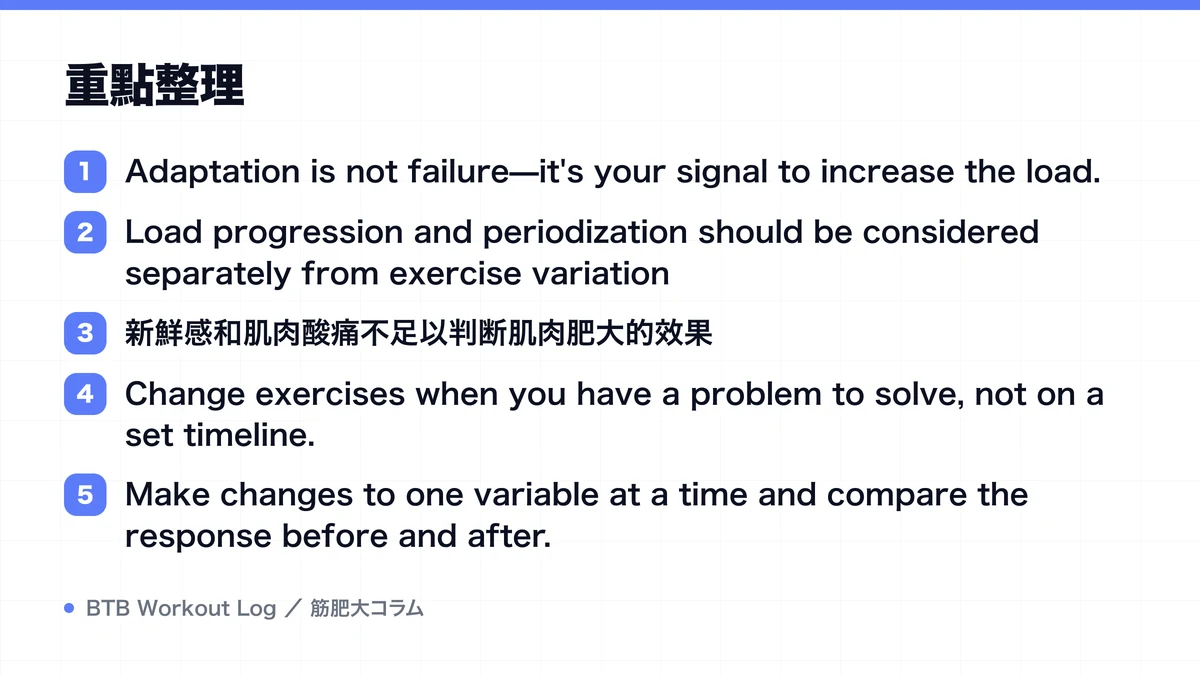
重點整理
- Adaptation is not failure—it's your signal to increase the load.
- Load progression and periodization should be considered separately from exercise variation
- 新鮮感和肌肉酸痛不足以判断肌肉肥大的效果
- Change exercises when you have a problem to solve, not on a set timeline.
- Make changes to one variable at a time and compare the response before and after.