每週都練一樣的菜單,真的不好嗎?在你嫌膩之前,該知道「不要換」的情況
每週重複同一菜單本身不會阻礙肌肉肥大。固定動作、順序和次數範圍時,能力變化更容易對比,也更容易堆積必要的漸進超負荷。
問題不在菜單外觀是否相同,而在於負荷、次數、組的品質都沒變,身體已停止反應卻沒有調整。
「肌肉習慣菜單」的說法有多少根據
持續接受相同刺激時,身體會適應,初期的反應會逐漸減弱。這個直覺有其正確的一面。相同的重量、次數、組數、動作幅度和 RIR 長期不變的話,刺激的相對強度確實容易下降。RIR 是「還能再做幾下」的餘力指標。如果過去 RIR1 的重量現在感覺像 RIR4,那同樣的組對身體來說已經變輕了。
但從這裡推不出「因此應該每週換動作」的結論。身體適應的不是菜單表上的動作名稱,而是實際承受的負荷。同樣是深蹲,如果保持姿勢和動作幅度的前提下,重量或次數增加了,刺激就不同於以往。反過來說,只是換了動作名稱,但目標肌肉受的張力或每週的硬組數幾乎沒變,也稱不上有意義的進展。
對訓練的「習慣」還有一個好處:動作變穩定了。姿勢的變異減少,負荷更容易施加到目標肌群,組與組之間的對比精度就提高了。不要把新鮮感減退和效果消失混為一談。
固定菜單和固定刺激是兩回事
固定菜單保留的是每週對比時需要的「框架」。動作、執行順序、目標次數範圍、動作幅度、休息時間大致相同時,重量或次數的變化就容易被看出來。在這個框架內根據能力來推進負荷,就是漸進超負荷。
| 每週狀況 | 如何判讀 | 下一步行動 |
|---|---|---|
| 同一動作重量或次數增加 | 框架不變,但能力和刺激在進展 | 保持菜單 |
| 相同重量、次數,RIR 更大 | 同樣的工作量有更多餘力 | 在目標範圍內推進負荷 |
| 數字相同但動作幅度或反彈變差 | 表面維持,對比條件已崩壞 | 調整姿勢或重量 |
| 連續多週出現數字下降且恢復不佳 | 需檢查疲勞、訓練量、營養等 | 找出根本原因 |
每次都增加重量固然好,但增加次數或用更從容的方式完成相同工作也是進步。放棄「每次增重才算超負荷」的誤解後,就能在同一菜單內看出細微變化。
反之,每週選不同動作也不會自動增加刺激。對比基準一直變動的話,重量變化到底是來自肌力提升、動作難度差異,還是單純習熟就難以判斷。固定反而成了測量進度的實驗條件,不是停滯。
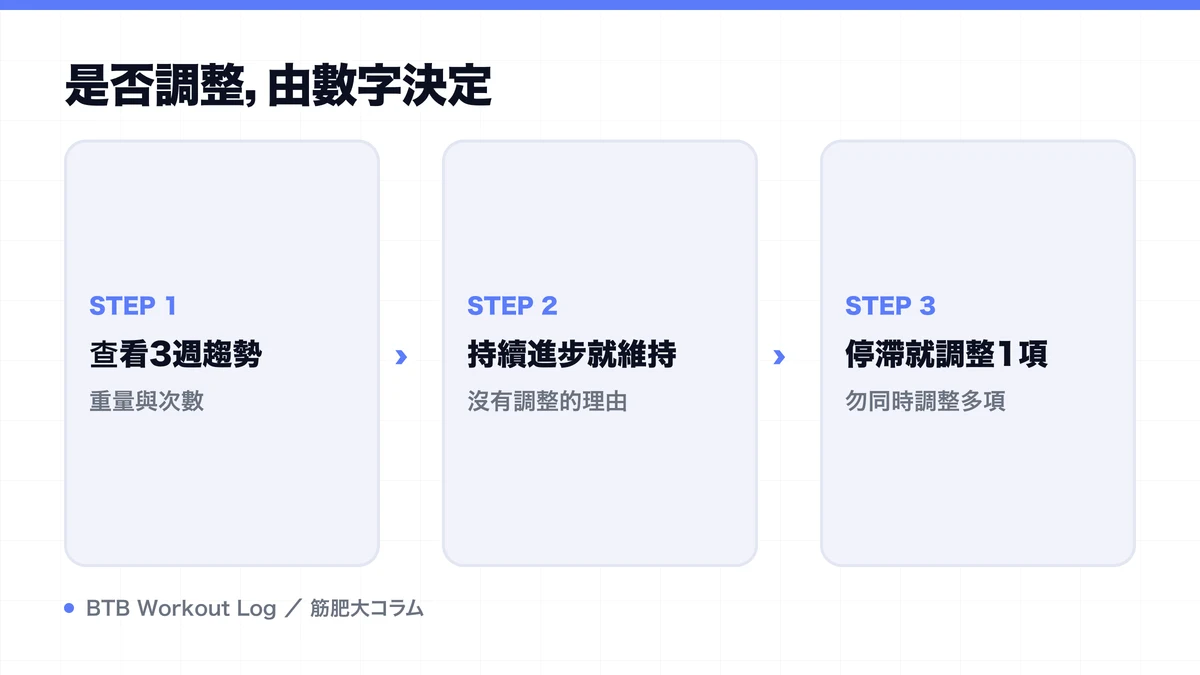
週期化研究並未主張「每週必須換動作」
When discussing program changes, periodization research is often cited as justification. Periodization is a planned variation of load, reps, sets, and other variables over set periods—not the same as completely swapping exercises weekly. You can periodize while keeping the same main lifts, simply alternating between heavy phases and higher-volume phases.
Systematic reviews and meta-analyses of research controlling for total training volume show periodization favors 1RM strength gains but may not provide clear advantages for 肌肉肥大. This doesn't mean "variation is pointless" or "fixed routines are always best." When designing a 肌肉肥大 program, consider not just novelty but also stimulus on target muscles and sustainable total volume.
Additionally, periodization in research includes load and volume variation, and actual programs differ by participant experience and study duration. There's no universal timeline for exercise rotation. What matters in comparing fixed routines to exercise rotation isn't freshness—it's progress, fatigue, time efficiency, and individual differences. See fixed routine vs. exercise rotation comparison.
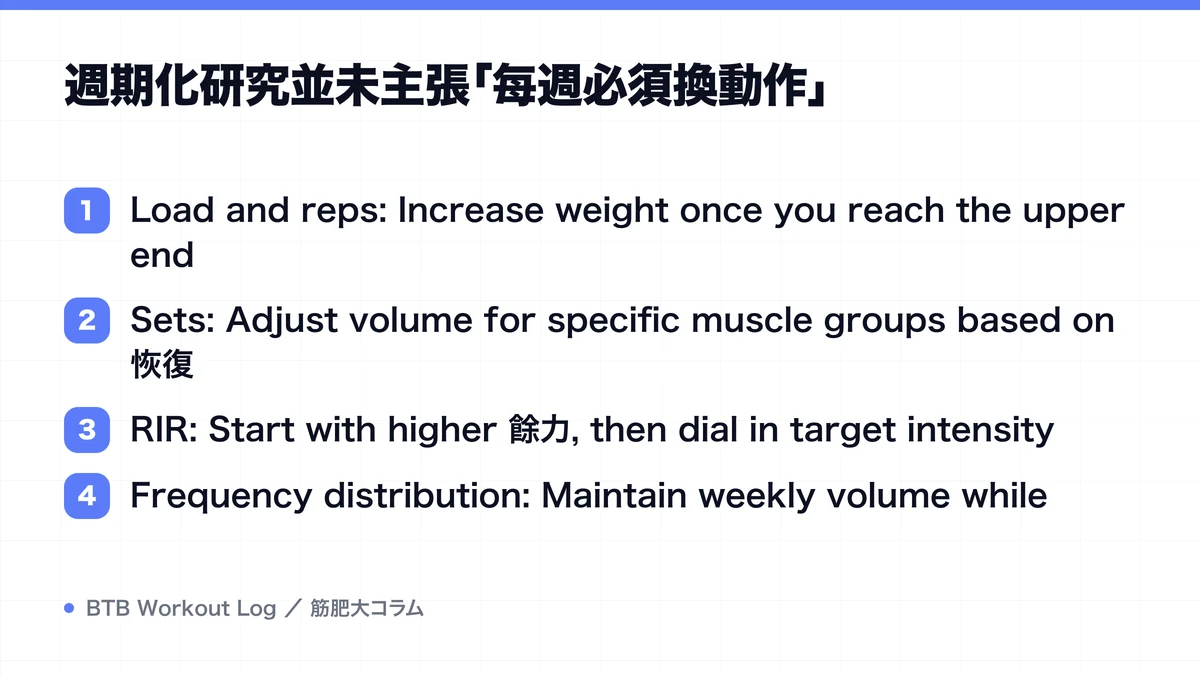
What you can change while keeping the same exercises
- Load and reps: Increase weight once you reach the upper end of your 次數範圍.
- Sets: Adjust volume for specific muscle groups based on 恢復 and progress.
- RIR: Start with higher 餘力, then dial in target intensity over the weeks.
- Frequency distribution: Maintain weekly volume while adjusting set quality per session.
It's not a binary choice between fixed routines and varied ones. You can keep a structural template and systematically adjust only the variables that need it.
Why new exercises feel more effective
New exercises trigger strong muscle soreness, pump, and localized fatigue from unfamiliar movement patterns. This "different sensation" is obvious and makes fixed routines look stale while new exercises seem to restart growth. But immediate feel is different from 肌肉肥大 over weeks or months.
Changes made during 停滯期 also create confusion. When you swap exercises, you often simultaneously reduce weight, cut sets, find a pain-free path, and regain motivation. If numbers improve after, the gain may not be from the new exercise—it could be fatigue clearing or better loading mechanics on the target muscle.
That said, boredom genuinely undermines focus and consistency for some people, and planned variety helps them stay engaged. Enjoyment is a real factor in long-term adherence. But separating "variety for morale" from "variety for greater 肌肉肥大 stimulus" clarifies your next decision.
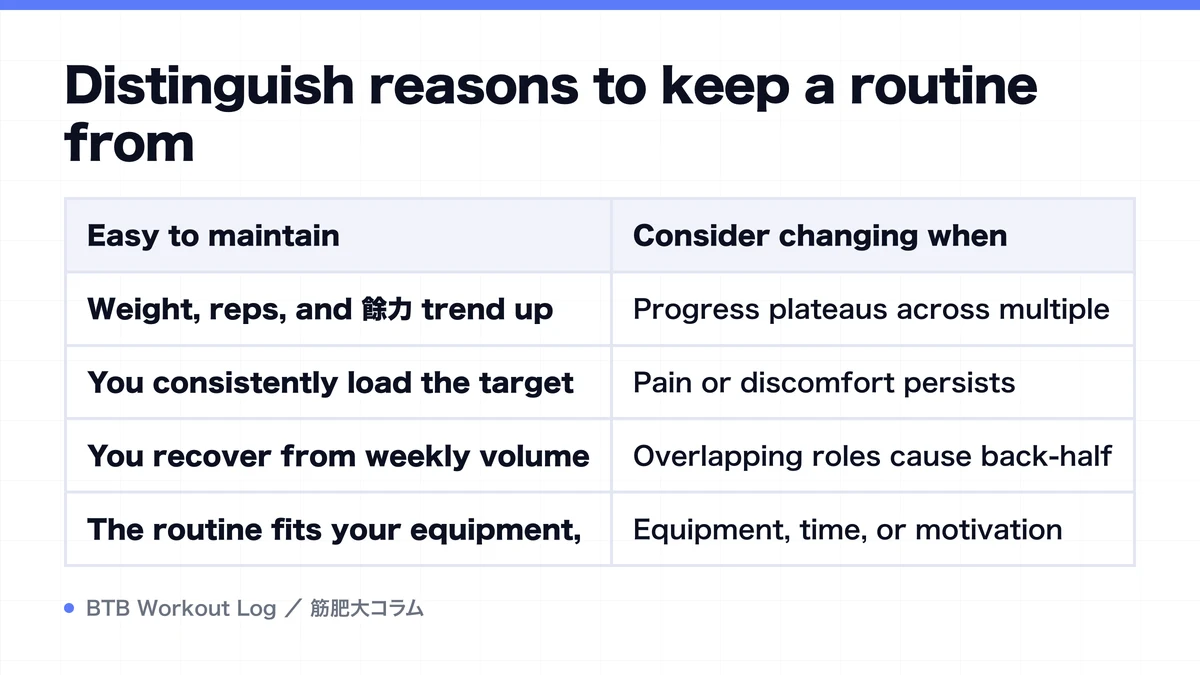
Distinguish reasons to keep a routine from reasons to change it
Don't change mechanically by the calendar. Assess whether the current program is working. You don't need to overhaul everything for a single weak session—weight, reps, and feel fluctuate daily due to sleep, nutrition, prior activity, or measurement error.
| Easy to maintain | Consider changing when |
|---|---|
| Weight, reps, and 餘力 trend up under the same conditions | Progress plateaus across multiple sessions and other factors don't shift it |
| You consistently load the target muscles well | Pain or discomfort persists despite technique adjustments |
| You recover from weekly volume and maintain set quality next session | Overlapping roles cause back-half sets to degrade |
| The routine fits your equipment, time, and motivation | Equipment, time, or motivation makes it unsustainable |
When changing, first identify the problem in one sentence: "Hard to target upper chest," "Knee discomfort in squats," "Back-half sets fall apart." This narrows your fix. If your only reason is "might adapt to stimulus," check your load, reps, RIR, and weekly volume progression first.
Make minimal changes: swap one assistance exercise while keeping main lifts, adjust only 次數範圍, or cut only sets. Changing everything at once obscures what actually worked. This principle connects to why too many exercises blur progress and the link between exercise count and 肌肉肥大—keeping comparison points intact.
Run a fixed routine as a growth benchmark
In practice, you keep your main lifts and baseline conditions consistent over periods of weeks, then compare by matching the weight, reps, RIR, and 動作幅度 across each set. For example, if you're targeting 8–12 reps on a lift, you accumulate reps at the same weight while maintaining your target RIR; when you hit the upper limit, you increment the load slightly. After increasing, you start again from the lower end of the range. Even though your program sheet stays the same, the stimulus updates as your capacity improves. Conversely, if multiple sessions show a drop at the same conditions, check your weekly set volume, sleep, nutrition, rest intervals, and RIR alignment before swapping exercises. If all lifts decline together, the issue is 恢復; if only one stalls, suspect technique or exercise fit. A fixed reference point lets you pinpoint exactly where the 停滯期 is. Using your records as decision material makes it easier to tell whether the same program is just inertia or steady progression. Whether to keep the same routine comes down to one thing: are the numbers moving? BTB Workout Log is where you keep that evidence. Changing the program is a tool, not proof of growth. If you're progressing within the same framework, keep it. Change only the parts with a clear problem. Run it this way, and you use consistency and variation as partners, not opponents.
常見問題
- How many weeks can you stick with the same program?
- There's no fixed time limit. You can continue as long as weight or reps climb with the same form, 動作幅度, and RIR; pain and 恢復 are normal; and the program fits your life. Look at multiple sessions before deciding to change, not just one bad day.
- If your muscles adapt to the stimulus, do you have to change exercises to keep growing?
- You don't have to swap exercise names. With the same lift, if you advance weight, reps, set count, and RIR to match your capacity, the stimulus stays fresh. When numbers flatline and 恢復 or load tweaks don't restart progress, then consider a change.
- If you hit a 停滯期, should you rebuild your entire program?
- First, separate whether the 停滯期 is across all lifts or just one. If all, check 恢復 and weekly volume; if one lift, check technique and exercise fit. Change only the variables that are broken. Rebuilding everything obscures which fix actually worked.
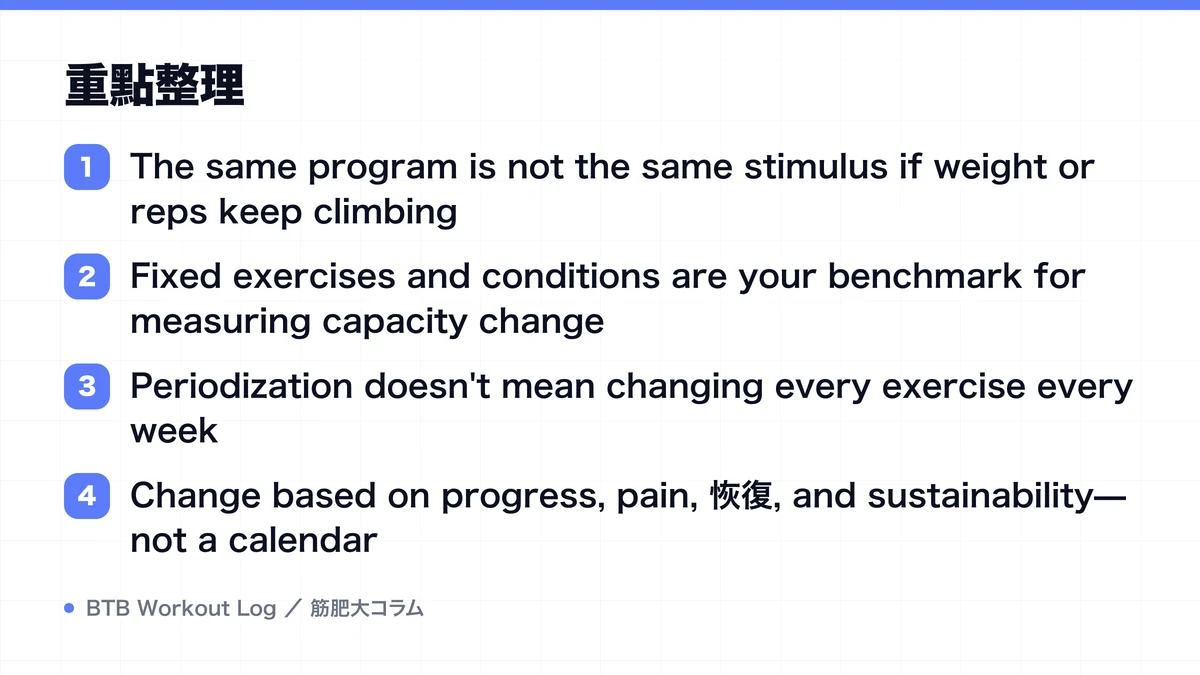
重點整理
- The same program is not the same stimulus if weight or reps keep climbing
- Fixed exercises and conditions are your benchmark for measuring capacity change
- Periodization doesn't mean changing every exercise every week
- Change based on progress, pain, 恢復, and sustainability—not a calendar
參考文獻
- ACSM Position Stand: Progression Models in Resistance Training for Healthy Adults
- Periodization, Strength and Muscle Hypertrophy: Systematic Review and Meta-analysis
- Linear vs Daily Undulating Periodized Training and Hypertrophy: Meta-analysis
- The Influence of Frequency, Intensity, Volume and Mode of Strength Training on Whole Muscle Cross-sectional Area in Humans