
How Many Weekly Sets Actually Build Muscle? | Breaking Down the "Answer" From a Meta-Regression of 67 Studies
Bottom line: the more sets you do per week, the more muscle and strength you gain — but returns diminish, and for strength they flatten out fast. Frequency has an effect of its own on strength, while for hypertrophy it's mostly a tool for distributing your weekly volume.
That's the verdict of the most comprehensive meta-regression on training dosage to date. In this article we unpack the paper and translate it into how you should manage your weekly set count.
The study: a meta-regression pooling 67 studies and 2058 lifters
The paper is by Pelland and colleagues, published in 2026 in Sports Med, one of the field's leading journals. The group — from the Zourdos muscle physiology lab at Florida Atlantic University — pooled 67 intervention studies totalling 2058 participants and modelled how weekly set volume and weekly frequency relate to hypertrophy and strength gains using multi-level meta-regression.
Individual studies differ in participants, duration and design, so no single one can tell you how many sets to do. The value of this paper is that it puts a large body of research onto one axis and draws the dose-response curve itself. The models were also adjusted for intervention duration and training status, which takes the analysis a step beyond simple averaged comparisons.
The clever part: rethinking how a set is counted
The other novel contribution is how the authors counted sets. Every set was classified as either a direct set — one that trains the measured muscle as a prime mover, like a pressdown for the triceps — or an indirect set, where the muscle assists in a compound lift, like the triceps in a bench press.
They then built three competing models: counting each indirect set as a full set, counting it as 0.5 of a set (the "fractional" method), or not counting it at all. The fractional method fit the data best.
In other words, the bench presses on your chest day are doing about half a set's worth of work for your triceps — and counting them that way explains growth better than any alternative. Your weekly set count per muscle changes a lot depending on how you count, so when you estimate your own volume, include the indirect work from compound lifts.
Result 1: more sets, more growth — with diminishing returns
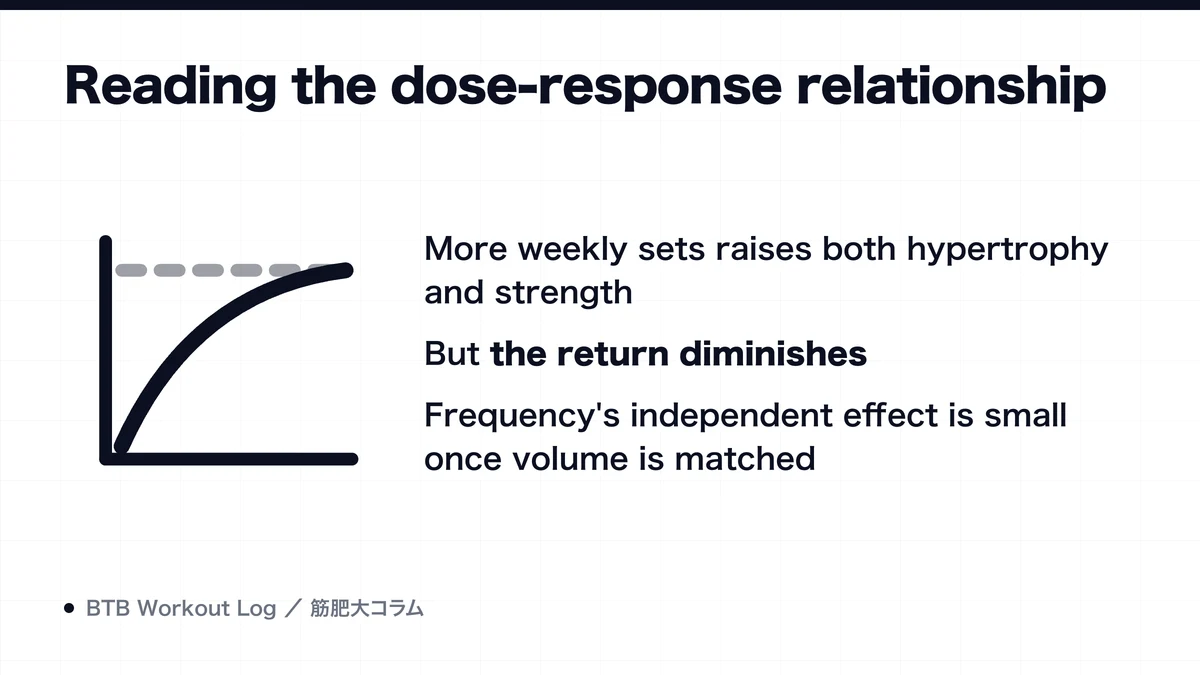
Now the main event. The posterior probability of a positive slope — more weekly sets leading to more hypertrophy and more strength — was 100% for both outcomes. The core relationship "more volume, more gains" is firmly supported.
Both curves, however, showed diminishing returns. The first few sets buy you the most, and each added set contributes less than the one before. The flattening was considerably more pronounced for strength, where a relatively modest number of sets captures most of the available gains.
Hypertrophy keeps responding at higher volumes. But since the curve keeps flattening, more is not automatically better: recovery capacity and time are real costs, and deciding how high to push is where practical judgement comes in.
Result 2: frequency means completely different things for size and strength
On how many days per week to train, the conclusions split by goal.
For hypertrophy, once volume was equated, the independent effect of frequency was compatible with being negligible. With the same weekly sets, how you split them across days doesn't seem to change muscle growth much. Treat frequency as a way to distribute your weekly sets so each one is done well.
Strength was the opposite: the posterior probability that gains increase with frequency was 100% (again with diminishing returns). Heavy lifting is a skill as much as a muscular feat, and practice frequency itself pays off. If strength is your goal, touching the same lifts more often has independent value.
In practice: manage weekly sets per muscle group
Translated into day-to-day training, the paper boils down to three points.
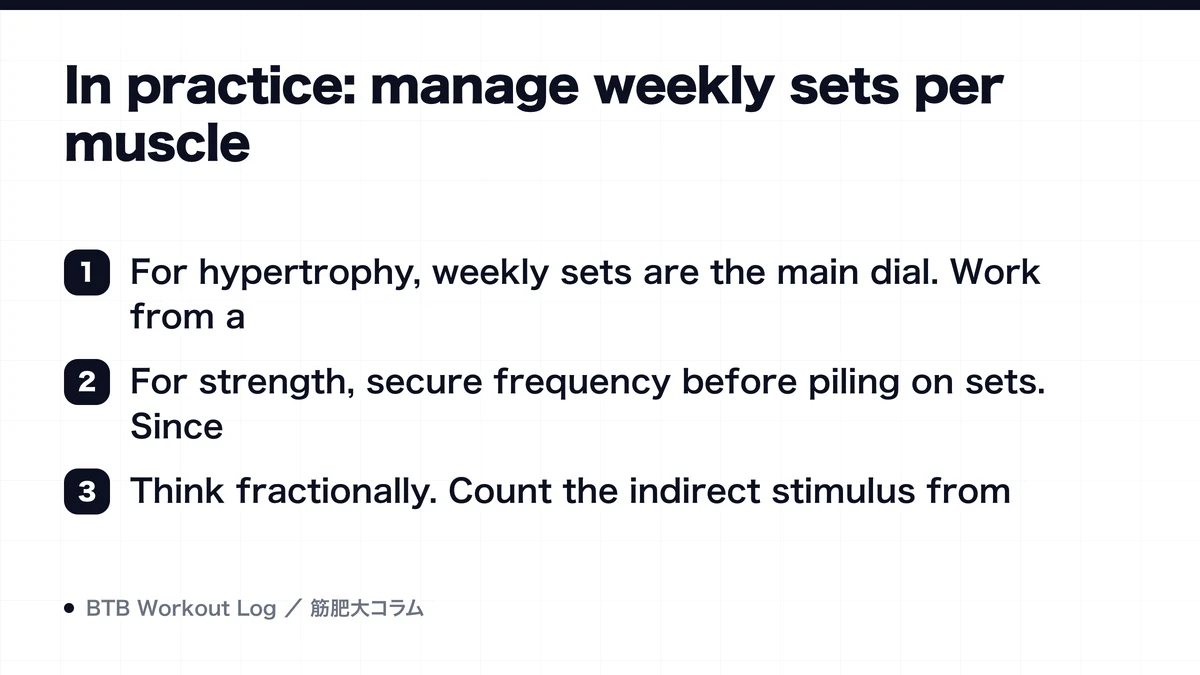
- For hypertrophy, weekly sets are the main dial. Work from a base range of 10–20 sets per muscle per week and adjust based on progress and recovery. Given diminishing returns, add sets only after you've confirmed a plateau at your current volume.
- For strength, secure frequency before piling on sets. Since few sets capture most of the gains, practising the same lifts several times a week is the efficient layout.
- Think fractionally. Count the indirect stimulus from compound lifts towards each muscle's volume. Your arms may be getting far more work than the "few direct sets" you think they are, via all your pressing and pulling.
Every one of these strategies rests on the same foundation: records. Within a session you chase progressive overload set by set; across the week you track total sets per muscle. That two-level accounting doesn't work from memory.
Putting this paper to work in BTB Workout Log
Applying this research comes down to one thing: knowing your weekly set count per muscle group and moving it deliberately. But recalling every lift's prime movers and assisters while hand-tallying weekly totals is not something anyone keeps up.
BTB Workout Log aggregates your weekly sets per muscle group and per muscle automatically — just log your training. Each exercise is linked to the body parts and muscles it trains, and the breakdown shows where your compound lifts are doing their work — essentially this paper's direct/indirect set idea turned into a screen.
Your previous weight and reps for each exercise are shown right where you log, so set-to-set progressive overload takes no guesswork. Watch your volume on the weekly trend, and when progress stalls, turn the dial up one notch. The app turns dose-response management into an everyday habit (see how to choose a workout log app).
FAQ
- Do these conclusions apply to beginners?
- The models were adjusted for training status and intervention duration, so the direction of the findings applies to beginners too. That said, beginners grow on less volume, so it's most efficient to start with a modest set count and add gradually once progress slows.
- So are more sets always better?
- Gains do keep rising with volume, but returns diminish while recovery cost and session time rise linearly. If you're progressing at your current volume, there's no need to add. Confirm a plateau first, then add a set or two at a time.
- What should I prioritise for strength?
- Frequency over extra sets. Practising the same lifts several times a week, with weight left in reserve, builds strength efficiently — partly because it also trains the skill of lifting.
Key takeaways
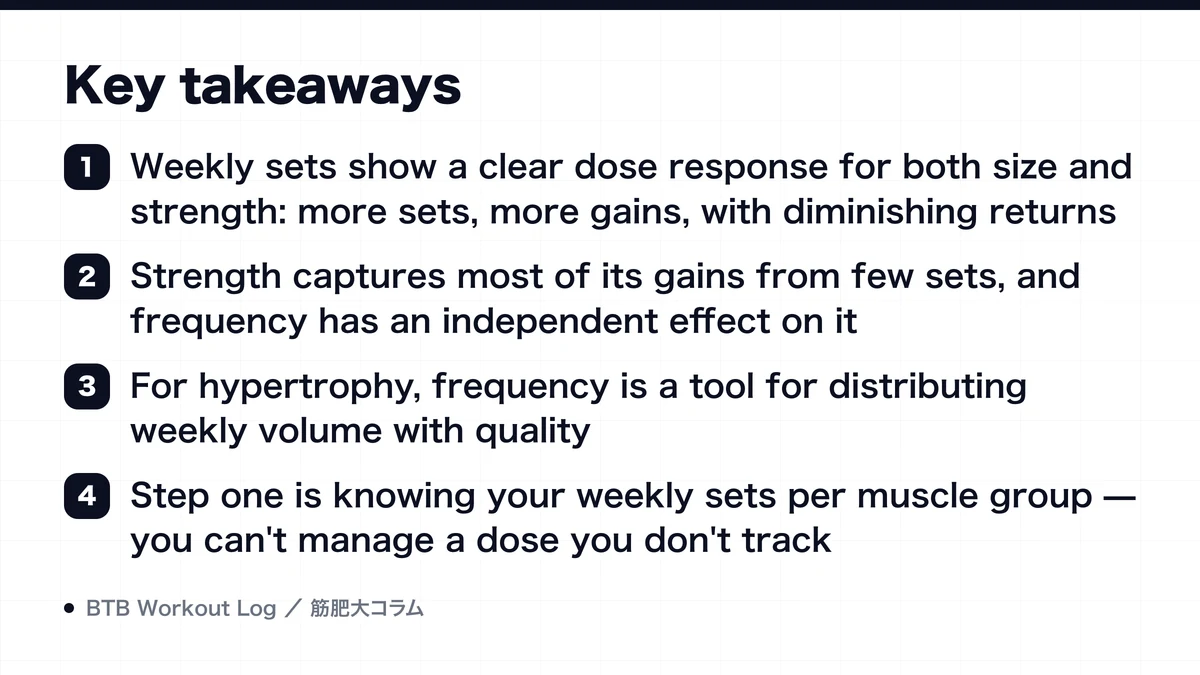
- Weekly sets show a clear dose response for both size and strength: more sets, more gains, with diminishing returns
- Strength captures most of its gains from few sets, and frequency has an independent effect on it
- For hypertrophy, frequency is a tool for distributing weekly volume with quality
- Step one is knowing your weekly sets per muscle group — you can't manage a dose you don't track
References
- The Resistance Training Dose Response: Meta-Regressions Exploring the Effects of Weekly Volume and Frequency on Muscle Hypertrophy and Strength Gains
- Dose-response Relationship Between Weekly Resistance Training Volume and Muscle Mass
- Resistance Training Volume Enhances Muscle Hypertrophy in Trained Men