
What Frequency, Intensity, and Volume Work Best for Hypertrophy? | Reading the Variables Wernbom 2007 Mapped Out
Conclusion: Wernbom 2007 shows not one optimal regimen, but rather the overall picture that muscle hypertrophy can be achieved in multiple ways, given sufficient frequency, intensity, and volume.
Although this is a pioneering paper that addresses the questions of ``how many times a week, how many %1RM, and how many sets'' in the same review, it is not a study that provides thresholds with the same precision as current meta-analyses.
Paper details
| Original title | The Influence of Frequency, Intensity, Volume and Mode of Strength Training on Whole Muscle Cross-sectional Area in Humans |
|---|---|
| Authors | Mathias Wernbom, Jesper Augustsson, Roland Thomeé |
| Journal | Sports Medicine, 37(3), 225-264 |
| Year | 2007 |
| Study design | Comprehensive literature review |
| Participants / scale | Human studies that primarily measured quadriceps and elbow flexor muscles |
| Comparison / methods | Organize frequency, intensity, amount, and exercise style from MEDLINE, SPORTDiscus, CINAHL, etc. |
| Main outcomes | Relationship between rate of change in muscle cross-sectional area and each training variable |
| DOI | 10.2165/00007256-200737030-00004 |
A review that focuses on muscle cross-sectional area rather than muscle strength
Wernbom et al. searched multiple databases for resistance training studies that measured muscle cross-sectional area changes in humans. The main analysis targets are the quadriceps and elbow flexor muscles, organized by frequency, relative strength, number of sets, number of repetitions, and exercise style.
The methods covered include regular dynamic training as well as isometric and isokinetic training. The strength of this paper is that it allows different studies to be viewed from the same perspective.
No single method could be concluded to be superior
The review showed muscle hypertrophy in multiple modalities, including dynamic, isometric, and isokinetic, provided sufficient stimulation was provided. On the other hand, research conditions varied widely, and there was a lack of evidence to conclude that a particular method was consistently superior.
An important suggestion from this is that effectiveness should not be determined solely by the event name or repetition range. You need to look at how much tension was applied to the target muscle, how many sets, and at what frequency.
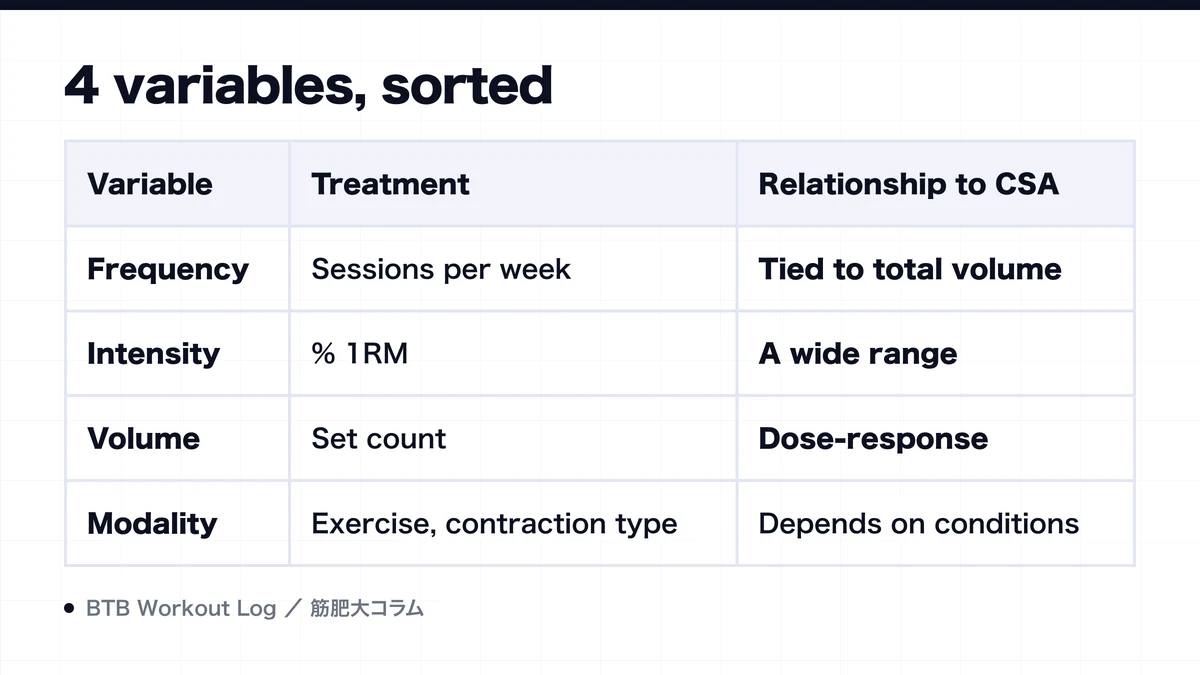
Frequency, intensity, and quantity are not separate
If you increase the intensity, the number of repetitions in one set will decrease, if you concentrate the quantity on one day, the quality of the second half will decrease, and if you increase the frequency, you can spread out the quantity. The three variables are not independent additions.
In practice, first determine the number ofweekly setsthat you can recover from, and then choose a load range that allows you to perform each set safely and with sufficient effort. Increase thefrequencyif it cannot fit in one time or the output in the second half drops.
Why it is not possible to make the numerical value the optimal value as it is
The target studies are uneven in the experience of the participants, the period, and the measurement method, and the subject of analysis is also limited. It is not a pre-registered meta-analysis as in modern times, and uncertainties remain, including publication bias and study quality.
Therefore, it is inappropriate to conclude from this paper that ``twice a week, 80% 1RM, a specific number of sets is optimal.'' Quantitative judgment will be updated in subsequent meta-analysis ofvolumeandload.
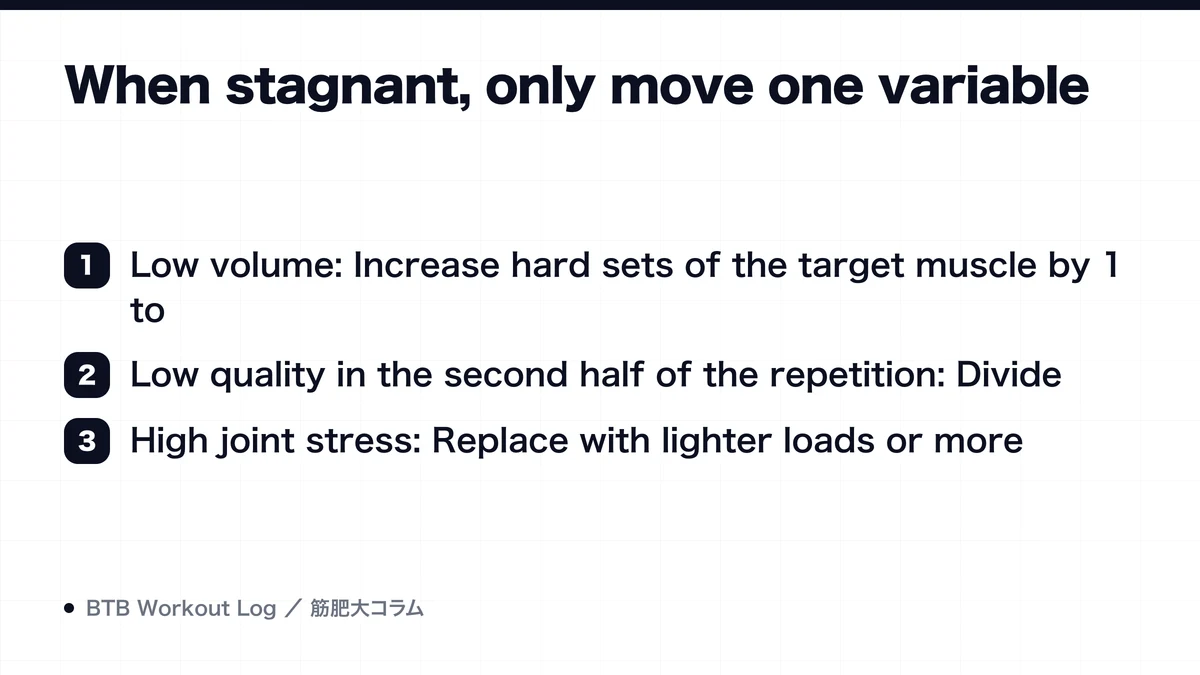
When stagnant, only move one variable
If the current program is increasing the weight and reps, maintain it. If you hit a plateau, check your recovery and change just one of the sets, frequency, or load band.
- Low volume: Increase hard sets of the target muscle by 1 to 2 sets per week
- Low quality in the second half of the repetition: Divide the same total volume on different days
- High joint stress: Replace with lighter loads or more stable exercises
FAQ
- Do you know the optimal number of weekly sets for Wernbom 2007?
- One optimal value is unknown. In studies that capture the overall picture of variables, specific quantities will be adjusted in subsequent meta-analyses and individual logs.
- Which exercise style increases muscle mass the most?
- This review does not demonstrate superiority of a single modality. It is practical to choose based on range of motion, stability, ease of progression, and joint burden.
- Is it worth reading older reviews?
- there is. It is useful as a starting point for systematizing the relationship between frequency, intensity, and amount that current research attempts to answer.
Key takeaways
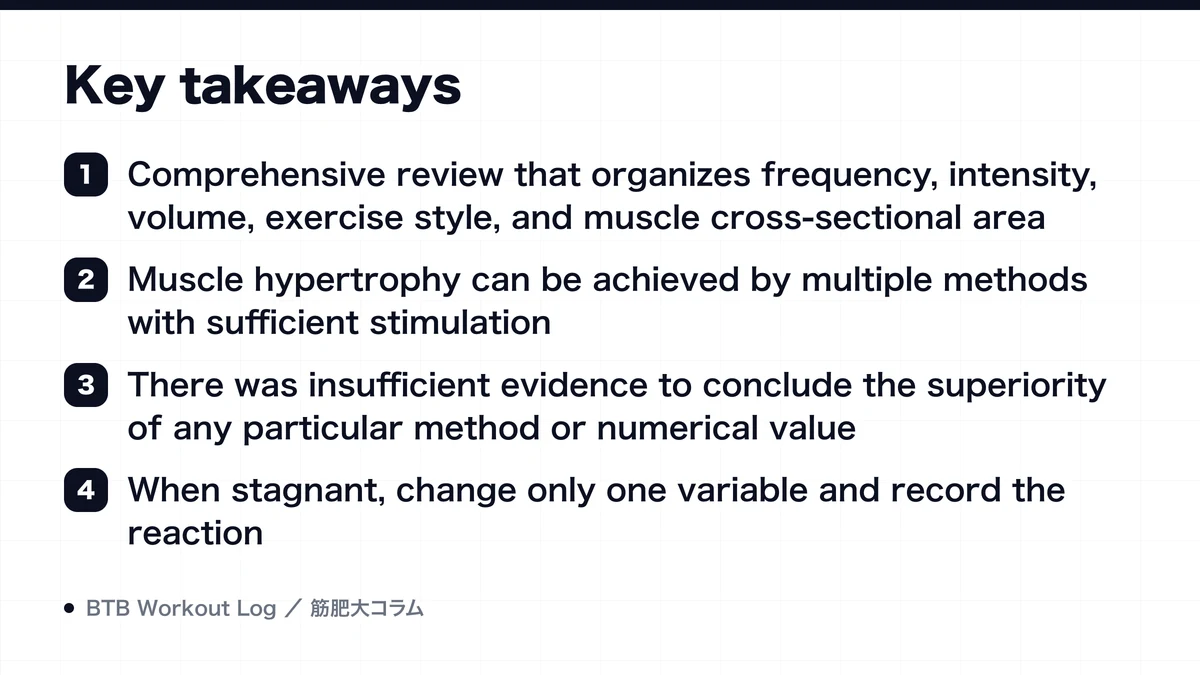
- Comprehensive review that organizes frequency, intensity, volume, exercise style, and muscle cross-sectional area
- Muscle hypertrophy can be achieved by multiple methods with sufficient stimulation
- There was insufficient evidence to conclude the superiority of any particular method or numerical value
- When stagnant, change only one variable and record the reaction