When Should You Increase Training Weight? | The Basics of Progression From the ACSM 2009 Model
Conclusion: If you can exceed your target reps twice or more in a row, increase the weight by 2-10%. This is the most specific progression rule you can take from ACSM 2009.
However, this paper is a standard guideline as of 2009. This does not mean that 8 to 12 reps is the only range for muscle hypertrophy. Use numbers as a reproducible starting point rather than a fixed rule.
Paper details
| Original title | Progression Models in Resistance Training for Healthy Adults |
|---|---|
| Authors | American College of Sports Medicine |
| Journal | Medicine & Science in Sports & Exercise, 41(3), 687-708 |
| Year | 2009 |
| Study design | Position stand (evidence review and practical guidelines) |
| Participants / scale | Resistance training research on healthy adults |
| Comparison / methods | Organize load, volume, frequency, rest, and progression method by experience level and purpose |
| Main outcomes | Strength, muscle hypertrophy, power, muscular endurance, and athletic performance |
| DOI | 10.1249/MSS.0b013e3181915670 |
What kind of paper is ACSM 2009?
This is not a single experiment, but a position stand created by the American College of Sports Medicine based on existing research. From beginner to advanced, we have systematized how to proceed with training variables according to your goals.
The variables of interest are load, reps, sets, frequency, rest, event order, and movement speed. The main issue is not just "how many events to do" but also how to update the stimulus after adaptation.
Main recommendations for beginners, intermediates, and advanced users
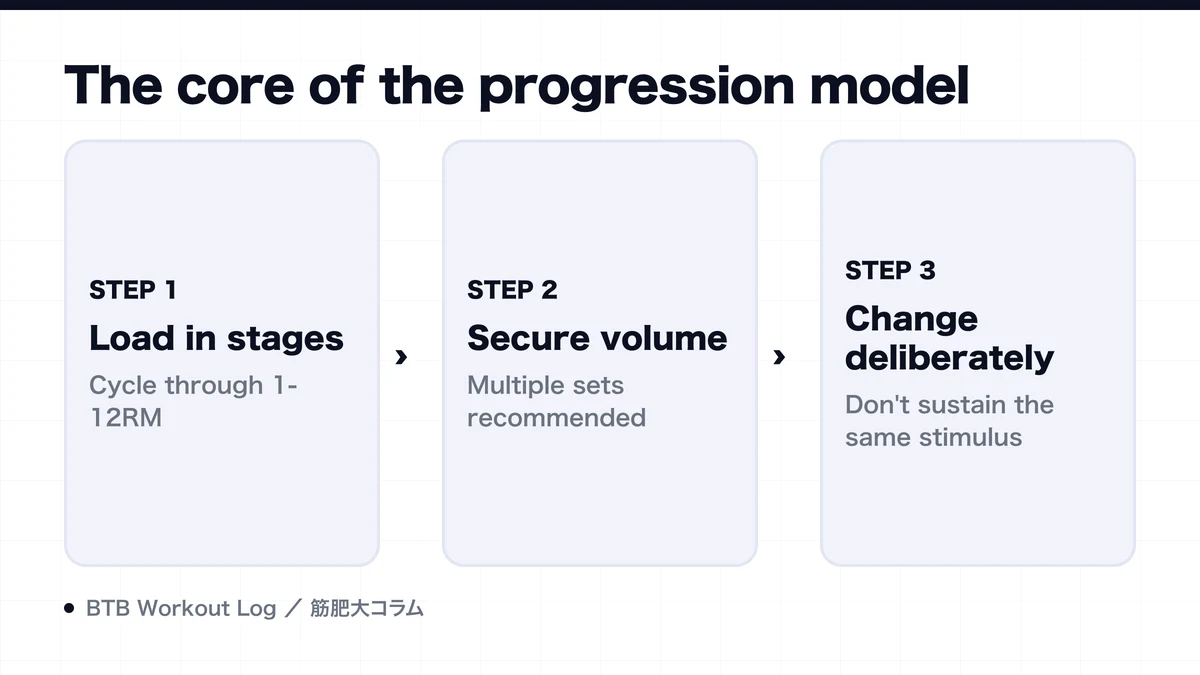
General strength improvement is recommended for beginners to focus on 8-12RM 2-3 days a week, for intermediates 3-4 days a week, and for advanced athletes 4-5 days a week. Experienced users will periodically use a wide range of 1-12RM, with an emphasis on higher weights.
For muscle hypertrophy, multiple sets were used, with a focus on 6-12RM, with 1-2 minutes of rest between sets. This was the standard form at the time, and it does not mean that all conditions must be met at the same time for it to be effective.
2-for-2 rule: When to increase weight
The standard is to increase the load by 2-10% if you can do 1-2 more reps than you set for 2 consecutive times. For example, aim for 8 to 10 reps, and consider increasing the amount once you achieve 12 reps in two sessions using the same form.
It is realistic to raise the weight small for small muscle groups and upper body events, and to raise it large for large muscle groups and lower body events. It is not a failure if your reps drop back to the lower end of the range immediately after lifting the weight.
How to read the 2009 guidelines now
Subsequent research has shown that muscle hypertrophy can occur with sufficient effort from low to high loads. There are also situations where it is advantageous to have a long rest period that allows you to maintain the number of repetitions for the next set, rather than keeping it short and fixed.
So while 6-12RM or 1-2 minutes of rest are useful standards, they are not the only correct answer. Expand to suit the safety of the event, joint condition, time, and strength goals.
5 steps to record in your log
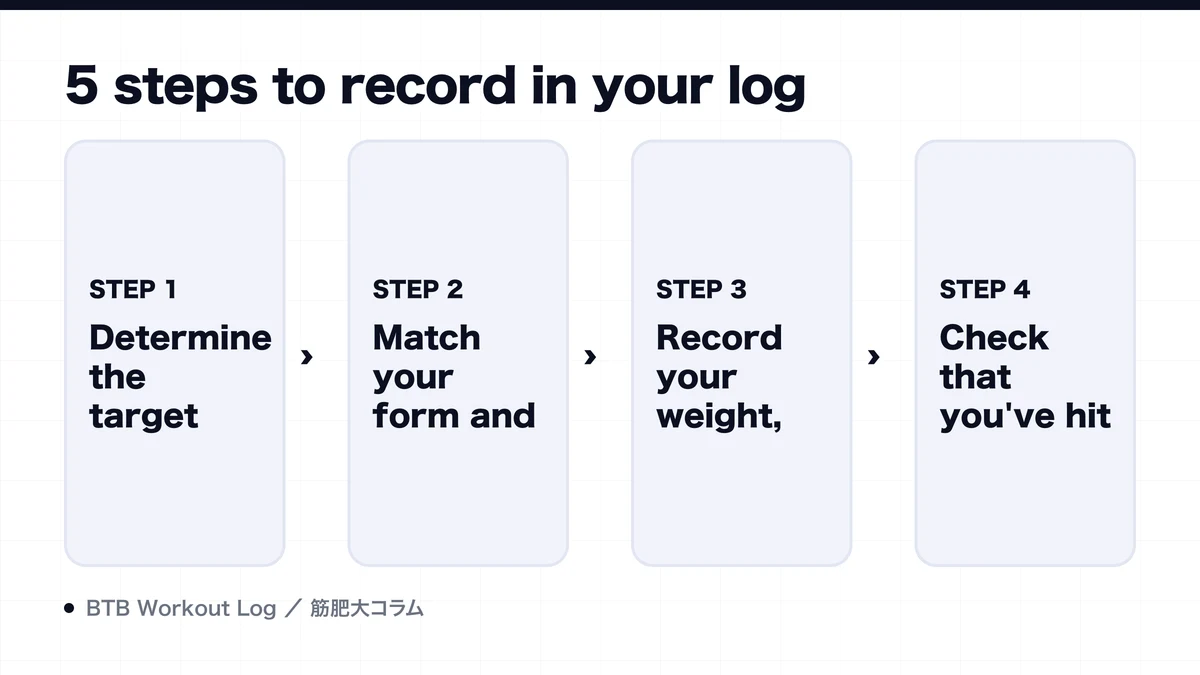
- Determine the target rep range for each event
- Match your form and range of motion for all sets
- Record your weight, reps, sets, and RIR
- Check that you've hit your maximum reps twice
- Increase in the smallest increments and restart from the bottom of your rep band
When you hit a plateau, don't just track your weight.Event composition,Number of weekly sets, frequency, and rest are the constraints one by one.
FAQ
- Do I need to increase weight every time?
- No. Once you have consistently achieved your target number of reps and form, raise the bar. Improvements in repetition and range of motion are also progress.
- What should I choose between 2 and 10%?
- Aim for 2-5% for upper body and small muscle groups, and 5-10% for lower body combined events. Adjust by the minimum increments of the device and the number of drops.
- Will your muscles grow if you do anything other than 8-12 reps?
- Muscular hypertrophy occurs over a wider range of reps. 8-12 reps is a center zone, not a boundary, with great efficiency and manageability.
Key takeaways
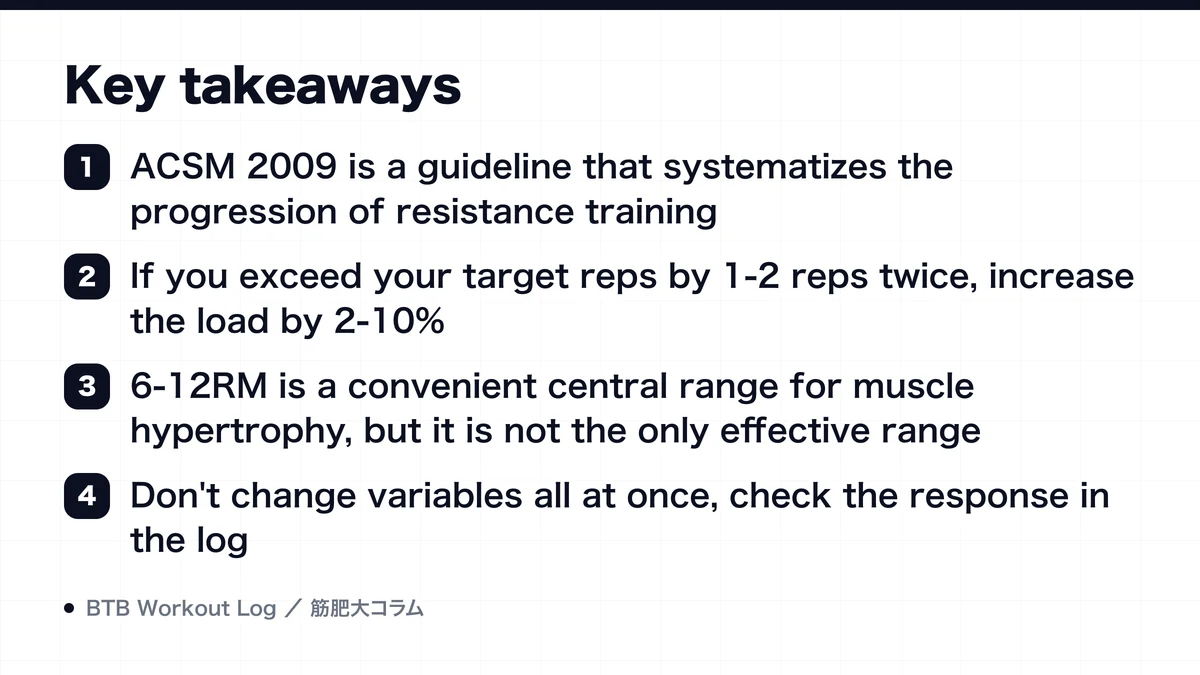
- ACSM 2009 is a guideline that systematizes the progression of resistance training
- If you exceed your target reps by 1-2 reps twice, increase the load by 2-10%
- 6-12RM is a convenient central range for muscle hypertrophy, but it is not the only effective range
- Don't change variables all at once, check the response in the log