
同樣每週10組,為什麼效果卻不同?比組數更重要的「內容」問題
每週10組是訓練量的參考指標,但不保證產生10份相等的刺激。若目標肌的貢獻度、距離極限的遠近、動作品質、組間恢復都不同,同樣的10組也會帶來不同的刺激和疲勞。
造成差異的不只是「多於或少於10」,而是你如何定義1組,以及能否在隔週維持同樣的品質。
每週10組不等於刺激量本身
每週組數是比較計畫、管理增減的便利指標。研究也普遍顯示,每週組數越多,肌肉肥大就越明顯。正因如此,每週組數才成為菜單設計的起點。
但組數只是在計數「你分割了多少次工作」。使用重量、反覆次數、RIR、動作幅度、目標肌、休息時間都不包含在這個數字裡。兩個人都做胸部每週10組,但一人保持目標動作幅度並接近極限反覆,另一人卻留著大量餘力且動作幅度縮短,那麼他們身體接受的刺激就不能視為相同。
常見的直覺是「如果是硬組,每一組都一樣——各占一票」。實際上組不是硬幣,而是條件不同的試次。每週10組的總數標示了計畫的外框,但不能表示內容的充實程度。用重量×次數×組數表示的總負荷量雖然有用,但同樣無法完全表達對目標肌的刺激。
直接組和間接組讓「10」的意義改變
首先要統一的是,你如何定義某肌群的組。彎舉時上臂二頭肌是主動肌(直接組),但划船時它也會輔助出力。5組彎舉加5組划船計作「手臂10組」,跟直接做10組彎舉相比,上臂二頭肌的貢獻度不會相同。
2026年的薈萃迴歸分析檢討了這個問題:將肌肥大測量的肌肉作為主動肌的組分類為直接組,輔助作用的組分類為間接組,不要一律按相同權重計算。這不是「間接組永遠等於0.5個直接組」這種簡化規則。而是研究提示我們:區分各動作的肌肉貢獻度,比起全部統一為1組,能更準確地掌握訓練量。
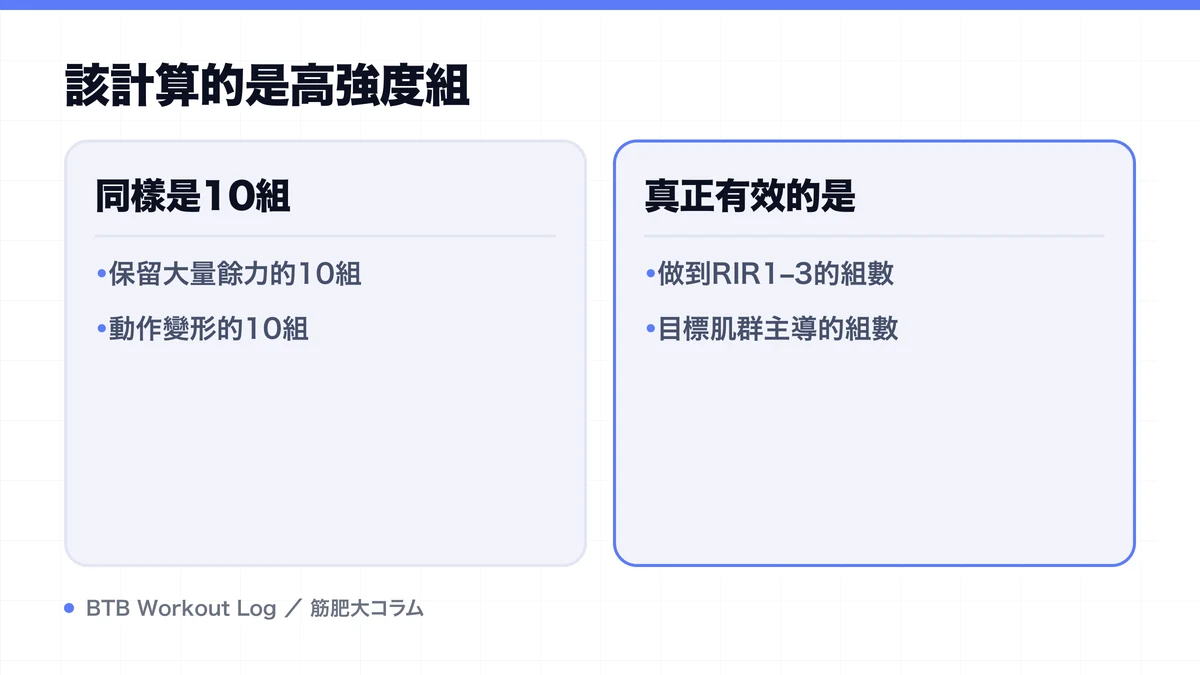
實踐上,分別追蹤直接組和間接組就夠了。胸部按壓同時給胸、三頭肌、前三角肌各加1組然後比較總量,容易高估輔助肌的負擔。先給主動肌記1組,輔助肌的貢獻標記為「間接」。這樣你就能區分表面上的每週10組,和真正讓目標肌主宰的每週10組。
RIR和動作條件決定1組的刺激
接著看的是RIR(Repetitions in Reserve)——還能做多少下前停止。同樣的動作和次數,RIR5停止的組和RIR1停止的組,對極限的接近程度不同。光堆積大量餘力的10組,不會等於以極限前幾下為主的10組。詳細的RIR用法可見RIR指南。
反過來說,每組都做到RIR0、也就是反覆不能,也不會自動提升品質。系統性回顧比較了做到失敗和停在失敗前的訓練,結果沒有顯示反覆失敗在肌肉肥大上總是更優。失敗反覆不是「把普通組變成有效組的開關」,而是同時增加刺激和疲勞的選擇。
另外,就算帳面RIR相同,若你縮小動作幅度、增加反彈、或把負荷從目標肌轉移到其他部位,比較條件就破裂了。RIR在動作和幅度統一時才是有用指標。為什麼單看次數無法決定組的內容,原因和為什麼相同10次卻有不同效果是一樣的。
10組的安排方式改變後半的輸出
Whether you do the same 10 sets in one session or split them 5×2 across the week, the quality can differ. Consolidating into one day means accumulated local fatigue and breathlessness in later sets, making it harder to maintain load, reps, and 動作幅度. Splitting makes it easier to start each session fresh at high output, but adds warm-up time and travel. Training frequency itself isn't magic for acceleration—it's a scheduling variable to execute planned sets under favorable conditions. See the training frequency article for detailed reasoning.
Rest between sets is part of that structure. A study of 21 young trained men doing 7 full-body exercises 3× per week compared 1-minute versus 3-minute rest over 8 weeks. The 3-minute group gained an edge in bench press and back squat 1RM and quadriceps thickness. You can't lock in 3 minutes for every lift from one study, but the point is clear: if shorter rest tanks reps in following sets, 10 identical sets lose quality even if the count stays the same. Base rest on the rest interval guide—long enough to recover your target load, reps, and form for the next set.
When deciding whether to split, compare set 1 against your final set. If reps collapse late, you're cutting load hard to hold form, or your conditioning or grip fails before the target muscle, packing 10 sets together has shrinking returns. Before adding more sets, extend rest or move volume to another day. You'll reproduce the same weekly 10 more reliably.
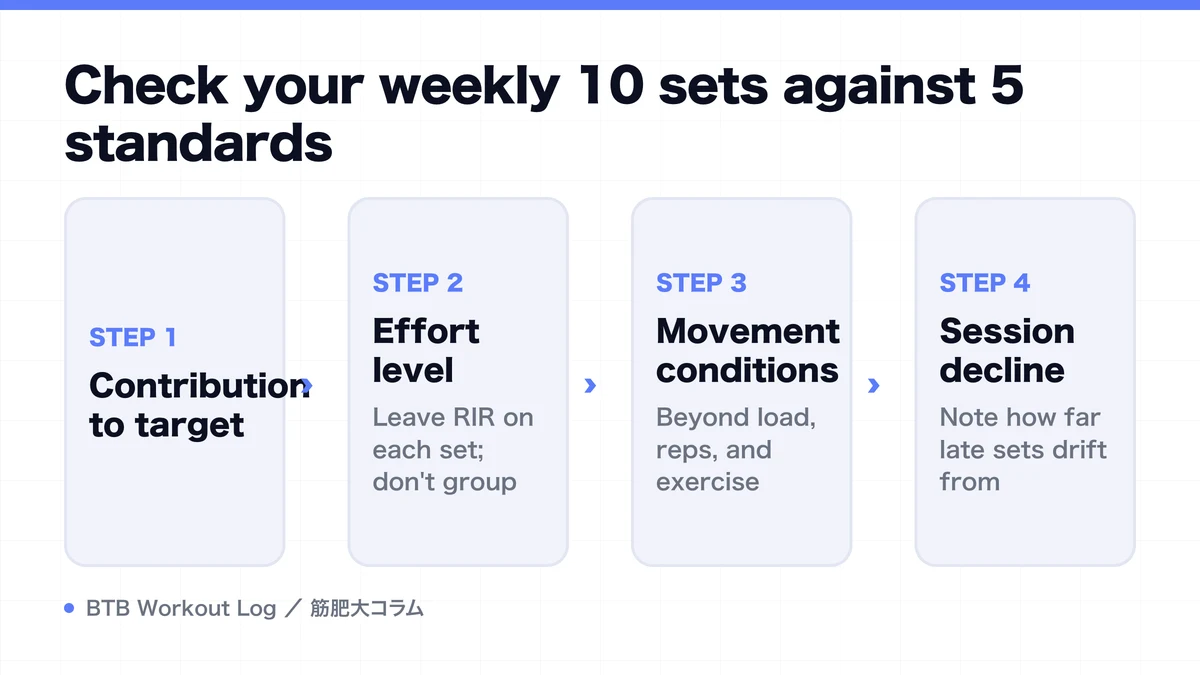
Check your weekly 10 sets against 5 standards
You can't directly measure 肌肉肥大 in the moment. Instead, separate execution conditions from what follows. If 10 sets per week is your baseline, lock in these 5 items across multiple weeks:
- Contribution to target muscle: Distinguish direct sets from indirect ones; fix what counts toward your 10.
- Effort level: Leave RIR on each set; don't group zero-余力 sets with ones near failure.
- Movement conditions: Beyond load, reps, and exercise choice, watch 動作幅度 and form breakdown.
- Session decline: Note how far late sets drift from planned load, reps, and RIR.
- Week-to-week repeatability: Check if reps or load rise at the same RIR and form, or if output stays flat.
If you're adding load or reps at the same RIR and movement quality, you have reason to hold 10. If early sets look solid but late ones fall apart, adjust rest or frequency without changing total volume. If every set carries excess 余力, revisit load or rep targets first. If output drops or 恢復 stalls, consider cutting before adding. For decisions after raising volume, consult the cost of too many sets separately.
Logging exists not to fill a set quota, but to advance the stimulus under matching conditions and confirm you replicate it next week. It's not the number 10 that matters—it's whether you can look back and see what those 10 actually were. BTB Workout Log keeps every set's load and reps.
常見問題
- Should all 10 weekly sets go near failure?
- No. RIR 1–3 is a practical starting point, but going to failure on every set doesn't always outperform. Balance exercise safety, fatigue carryover, and holding form. Match effort level across sets within that range.
- Do compound lifts count helper muscles as 1 set each?
- Split it cleanly: direct sets for the 主動肌, indirect sets for helpers. Record both separately. Don't fix secondary work at zero or one set—adjust it based on primary volume and 恢復.
- If I stall at 10 sets per week with no load or rep gains, should I add more?
- Not right away. First audit RIR, 動作幅度, rest, late-set dips, and 恢復 state. Only after confirming set quality holds across multiple weeks with no progress and spare 恢復 capacity should you consider small additions.
重點整理
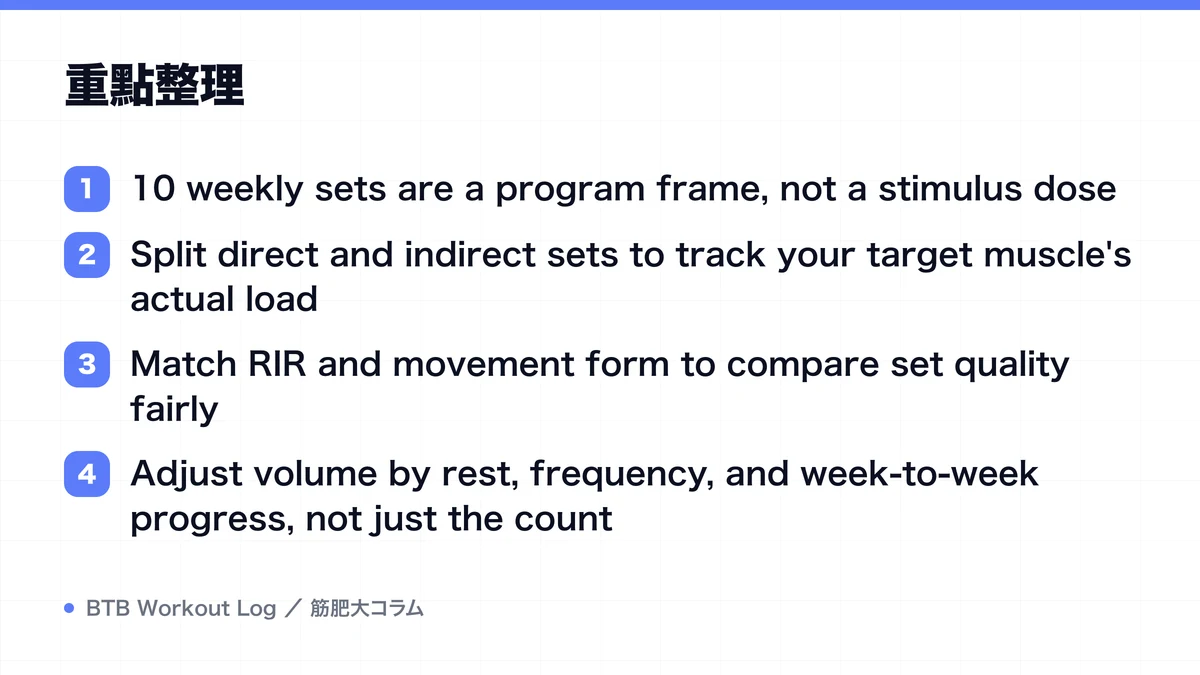
- 10 weekly sets are a program frame, not a stimulus dose
- Split direct and indirect sets to track your target muscle's actual load
- Match RIR and movement form to compare set quality fairly
- Adjust volume by rest, frequency, and week-to-week progress, not just the count
參考文獻
- The Resistance Training Dose Response: Meta-Regressions Exploring the Effects of Weekly Volume and Frequency on Muscle Hypertrophy and Strength Gains
- Proximity-to-Failure and Muscle Hypertrophy: Systematic Review with Meta-analysis
- Longer Interset Rest Periods Enhance Strength and Hypertrophy in Trained Men