
只做1組也能肌肉肥大嗎?忙碌的人適用的「最低限度」訓練量
單靠1組也能產生肌肉肥大的刺激。但「每個動作1組」與「每週每個部位1組」的意義截然不同,對中高級訓練者的成長未必充分。
需要驗證的不是1組這個數字本身能否成立,而是這1組是否真的觸及目標肌肉、在週內重複執行、帶來重量或次數進步的條件是否完備。
首先區分「只做1組」指的是什麼
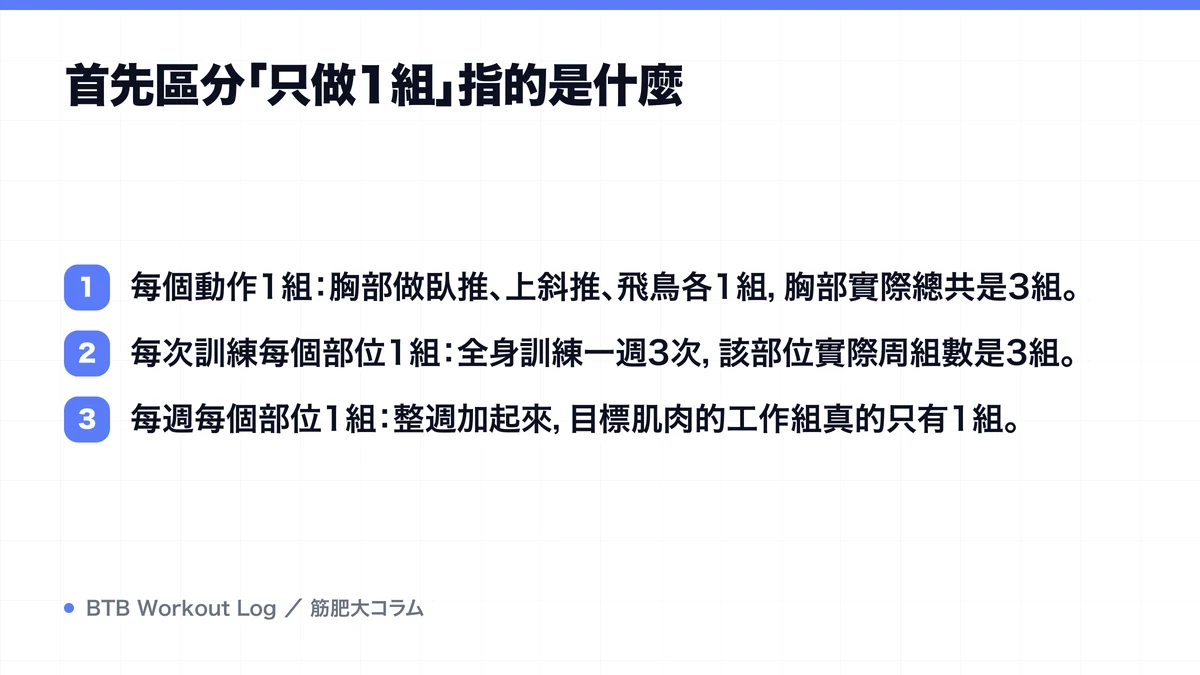
「1組夠不夠」這個問題必須先確定計算單位才能回答。至少有以下3種不同情況:
- 每個動作1組:胸部做臥推、上斜推、飛鳥各1組,胸部實際總共是3組。
- 每次訓練每個部位1組:全身訓練一週3次,該部位實際周組數是3組。
- 每週每個部位1組:整週加起來,目標肌肉的工作組真的只有1組。
此外,熱身或動作確認不能算入「1組」,因為這不能評估肌肉肥大的訓練量。本文討論的是用充足動作幅度、沒有太多餘力完成的工作組。複合動作會牽動輔助肌,不能只看直接訓練動作數量來判斷「手臂只有1組」,必須綜合週內對該部位的直接與間接訓練組數。
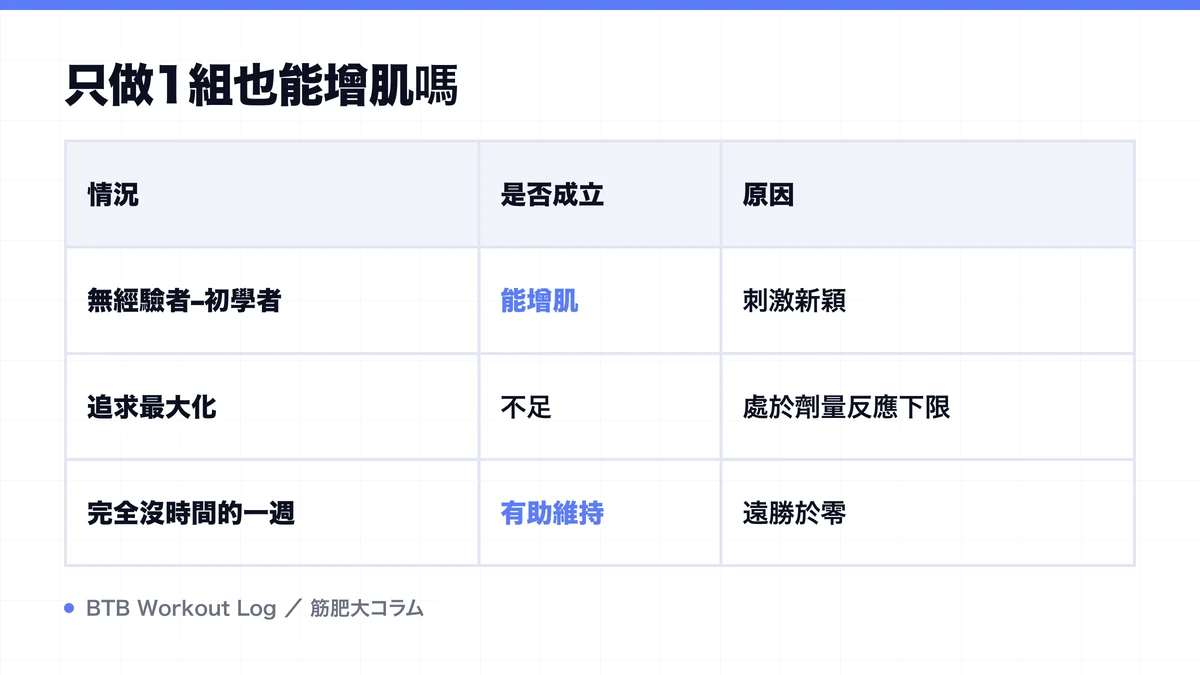
因此本文的答案分兩層:高質量的1組能產生成長刺激,不同於零訓練。但週1組不能定為所有人的最低必要量。開始前需要重新計算自己實際的週訓練量,視為訓練量。
研究顯示的不是最低線,而是劑量反應
針對每週組數的統合分析顯示,訓練量越大,平均肌肉肥大效果越好的劑量反應關係。最新的統合迴歸分析也確認了週組數與肌肉肥大的正相關。但同時也發現邊際遞減效應:增加的組數越多,每額外1組帶來的進步就越小。
從這些結果可以看出,並非「低於某個臨界值無效,超過立刻有效」的非黑即白邊界。低訓練量時也有參與者和肌群能產生反應,但平均上還有增加空間。反過來說,加組也不會按比例線性加快成長。每週組數不是合格/不合格的判斷標準,而是調控刺激機會與恢復成本的變數。
美國運動醫學會的立場聲明也建議用高訓練量的多組訓練來最大化肌肉肥大。這裡的關鍵在於區分「最大化成長」與「用最少量維持進度」。想在短時間內避免無所作為的人,與想在有限時間內獲得最大增肌幅度的人,所需的量標準不同。研究指出集團平均的方向,但還沒有特定所有中級訓練者的共同最低組數。
訓練量越少,每1組越容不得馬虎
當組數降到1組時,這1組對目標肌肉產生充足刺激的概率變得至關重要。如果動作變形、目標肌肉還沒達到限制就被輔助肌或心肺先卡住,「完成了1組」的紀錄與對目標肌肉的實際刺激會脫鉤。需要統一動作選擇、動作幅度、穩定技術、足夠休息,確保每次都在同樣條件下比較。
提高努力度,但每次都力竭不必然
RIR 是「還能做幾下」的估計值。只做1組卻在 RIR5 以上就停下,訓練量和努力度都會偏低。實務上應瞄準 RIR1~3 區間,並記錄動作速度或姿勢開始走樣的時間點便於對比。不過不一定每次都要做到一下都做不出來。統合分析比較了力竭與未力竭的條件,肌肉肥大並不必須以瞬間肌力衰竭為必要條件。詳細的應用方式可參考 RIR 概念詳解和力竭訓練的時機。
為了彌補訓練量不足而使用反彈、部分動作幅度、過度輔助,反而會適得其反。因為比較條件改變了,無法判斷下次重量或次數有沒有進步。採用1組法的首要目標不是最大化痛感,而是能穩定再現對目標肌肉的高努力度。
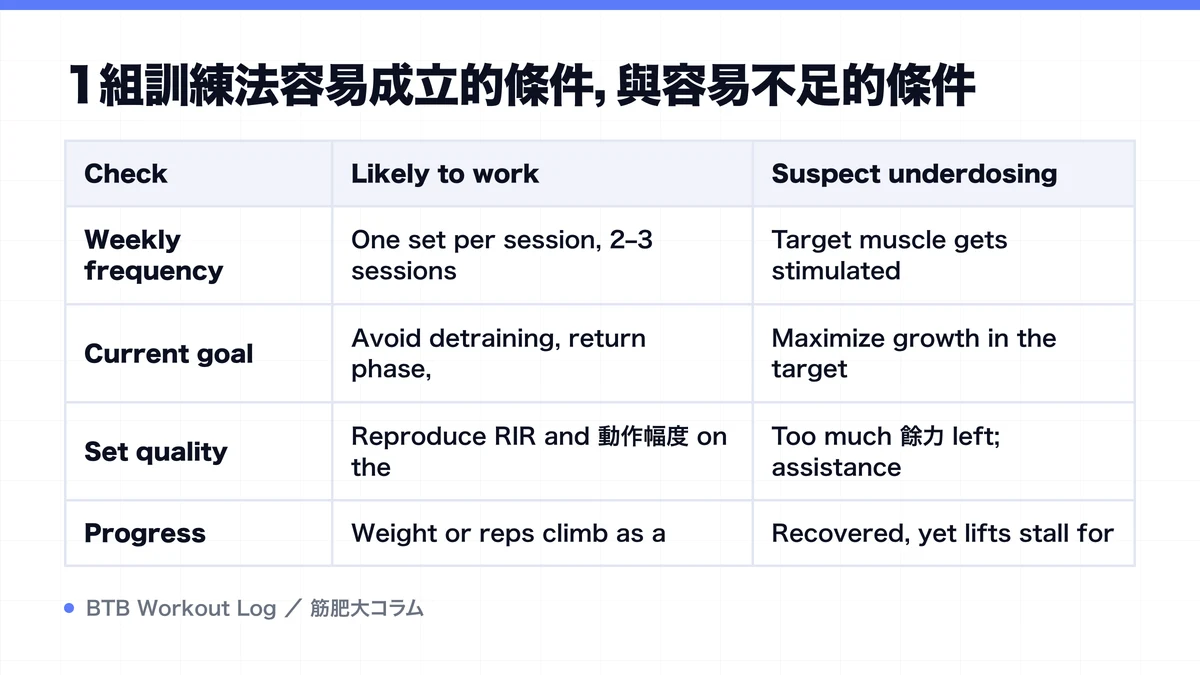
1組訓練法容易成立的條件,與容易不足的條件
A single set means different things depending on when you start and how you distribute it through the week. Instead of a yes-or-no answer, lay out the conditions to judge whether there's a real reason to keep volume low.
| Check | Likely to work | Suspect underdosing |
|---|---|---|
| Weekly frequency | One set per session, 2–3 sessions per week | Target muscle gets stimulated only once per week |
| Current goal | Avoid detraining, return phase, minimal allocation to lower-priority areas | Maximize growth in the target region |
| Set quality | Reproduce RIR and 動作幅度 on the target muscle | Too much 餘力 left; assistance muscles fail first |
| Progress | Weight or reps climb as a multi-week trend under identical conditions | Recovered, yet lifts stall for several weeks |
| Experience | You have logged proof that you respond to low volume | Trained long enough that the same volume no longer drives stimulus |
For example, running a full-body routine three times per week with one set per bodypart keeps you in the gym shorter while hitting each muscle three times weekly. Frequency itself isn't magic—the advantage is that you can divide low weekly volume across multiple sessions, keeping set quality high each time. By contrast, if you train once a week and end chest day with a single bench set, the chance of leaving gains on the table rises. Balance frequency against total weekly volume; see our training frequency guide for more.
If you're intermediate or advanced, remember that heavy prior volume built your strength and technique. Don't mistake weight held immediately after cutting to low volume as proof of continued growth—short-term performance maintenance isn't the same as fresh 肌肉肥大.
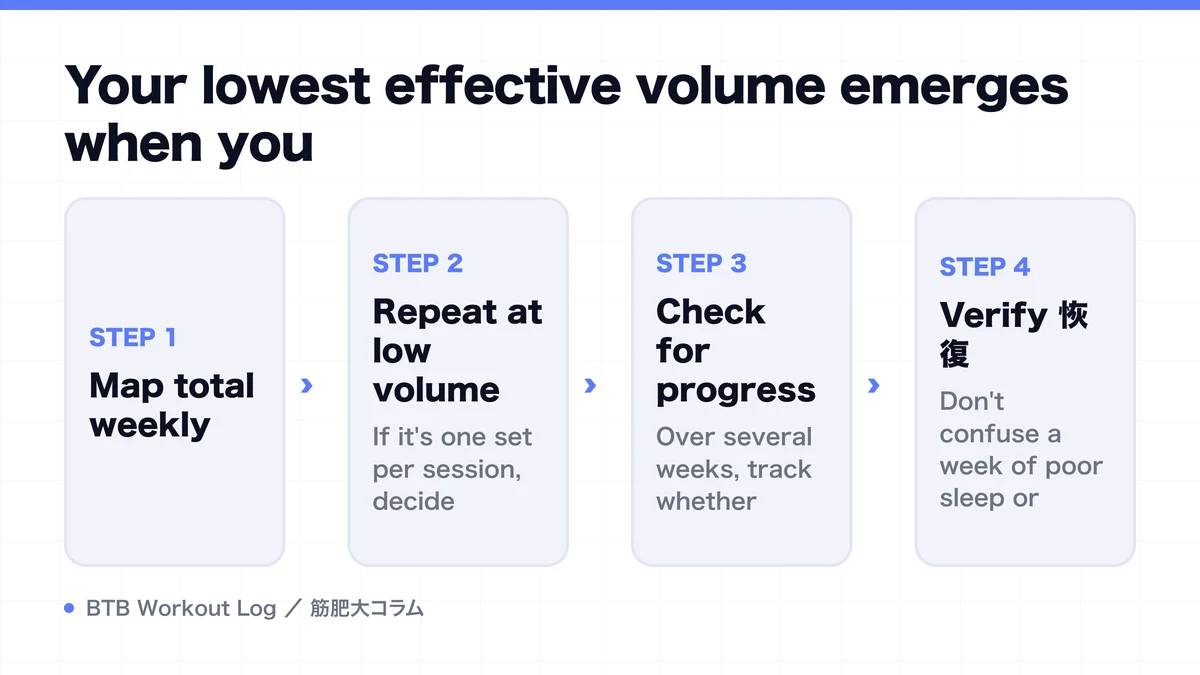
Your lowest effective volume emerges when you cut back, then add sets incrementally while tracking the response
To find your real minimum, test it yourself with your own logs rather than copying someone else's fixed number. But if you change exercise, diet, and frequency all at once, you won't know whether one set matters. Pick one target muscle, then lock in the exercise, 次數範圍, 動作幅度, RIR, and session frequency as much as possible.
- Map total weekly volume: List direct sets plus any indirect stimulus from compound lifts.
- Repeat at low volume: If it's one set per session, decide the weekly frequency and stay consistent.
- Check for progress: Over several weeks, track whether weight or reps climb at the same 動作幅度 and RIR.
- Verify 恢復: Don't confuse a week of poor sleep or nutrition—or pain—with volume insufficiency.
- Add only when stalled: If progress stops but 恢復 is solid, insert just 1–2 extra sets aimed at that muscle.
If weight or reps then climb again and you can recover before the next session, your old dose was probably too low for where you are now. If adding sets doesn't restart progress and only crushes your quality or output in later sets, the problem may lie elsewhere. This hypothesis-testing approach—changing one variable at a time—lets you find the neighborhood of minimal volume that preserves 漸進超負荷.
One set is a starting point, not a permanent floor
如果因為太忙,今天只能做1組,不必認為這1組毫無意義。只要能完成真正刺激到目標肌群的高品質組數,並在同一週內再次訓練,至少就比完全不練更有助於肌肉肥大。無論是時間有限時進行全身訓練,或把訓練量分配給優先度較低的部位,都是可行的選擇。
但如果每個部位長期維持每週1組,卻期待獲得最大程度的成長,就不符合研究顯示的劑量反應關係與多組訓練建議。尤其是中階以上的訓練者,若在動作條件一致的情況下,重量和次數都沒有進步,而且睡眠、營養與疼痛也沒有問題,就該考慮增加訓練量。不要一開始就跳到每週10組,而是先每週增加1〜2組,再觀察身體的反應。
真正該判斷的,不是訓練過程有多痛苦,而是能否在相同條件下持續重現進步。訓練量少但仍有成長,還是因為訓練量太少而停滯,必須觀察數週的變化才能分辨。BTB Workout Log 也能用相同格式記錄低訓練量期間的數據。
常見問題
- Should I take every single set to near failure?
- Leaving large 餘力 behind is important, but going to the point where nothing moves is not mandatory. Aim for RIR 1–3, keep your target muscle, 動作幅度, and form intact, and standardize effort so the set is comparable next time.
- If I do one exercise for one set, three times per week, do I count that as three sets per week?
- If each session is a working set for the target muscle, then yes—basically three sets per week. However, if you hit the target muscle again with a different exercise the same day, or you get indirect stimulus from a compound lift, include those in your actual weekly volume tally.
- How many weeks of no progress before I add sets?
- Don't add sets after a single rough week. Wait until weight and reps won't budge for multiple weeks at the same exercise, 動作幅度, and RIR. If sleep, food, and pain are not the culprit, then add just 1–2 sets aimed at the target muscle and reassess.
重點整理
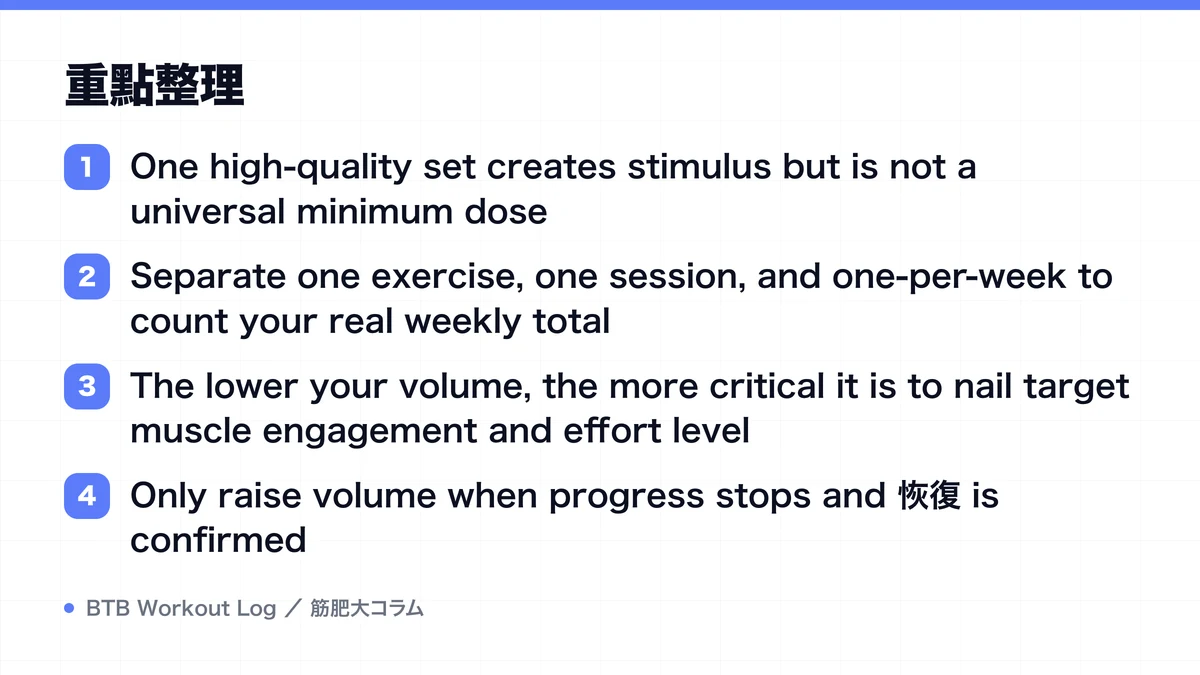
- One high-quality set creates stimulus but is not a universal minimum dose
- Separate one exercise, one session, and one-per-week to count your real weekly total
- The lower your volume, the more critical it is to nail target muscle engagement and effort level
- Only raise volume when progress stops and 恢復 is confirmed
參考文獻
- Dose-response Relationship Between Weekly Resistance Training Volume and Muscle Mass
- The Resistance Training Dose Response: Meta-Regressions Exploring the Effects of Weekly Volume and Frequency on Muscle Hypertrophy and Strength Gains
- ACSM Position Stand: Progression Models in Resistance Training for Healthy Adults
- Training to Repetition Failure or Non-failure: Systematic Review and Meta-analysis