
組數加太多反而適得其反?越努力越練不大的肌肉肥大盲點
增加过多的组数会导致疲劳增长幅度大于额外刺激带来的收益,进而削弱后续组数和下次训练的质量,最终延缓肌肉肥大的进度。
问题不在于"组数多会缩小肌肉"。关键是超出恢复能力范围的训练量会破坏重量、次数和动作的再现性,从而减少整周内能够积累的有效刺激。
The Intuitive Trap of "Adding More Working Sets Means Better Gains"
肌肉肥大與每週組數之間存在平均的劑量反應關係。從組數不足的狀態開始增加,成長機會往往會增加。這在每週組數的概念上是合理的。
但是,不能將第1組和已經疲勞的第10組簡單視為相同的「1組」來累加。對肌肉肥大最有幫助的,是那些能在充分動作幅度下刺激目標肌肉、維持適當負荷和接近極限程度的組數。只是完成次數、負荷從目標肌肉逃逸、動作幅度縮小的組數,即使帳面上增加了組數,也不具備相同的價值。
增加組數的收益並非恆定地線性堆疊,而是初期收益較大,後期每增加一組的邊際效益遞減——這樣理解更符合實際。與此同時,疲勞和訓練時間卻隨著增加而線性增長。當疲勞的增幅超過收益的增幅時,「多做」就開始變得不划算了。
Performance Drops on Additional Sets Within a Session
當硬組堆疊時,除了局部肌肉疲勞,呼吸會變得混亂,握力和姿勢穩定性下降,專注力也會逐漸耗盡。結果就是相同重量下次數變少、瞄準相同次數時動作會改變、主動肌沒動用反而靠輔助肌來完成動作,這些變化會依序出現。
只看 RIR(Repetitions in Reserve,還能做幾次的餘力)然後判斷「接近極限所以有效」是不夠的。疲勞狀態下即使 RIR 1,也可能不是目標肌肉的張力達到極限,而是全身喘氣或輔助肌先力竭。RIR 只有在重量、次數、動作幅度和動作都沒有大幅崩壞的前提下,才是有意義的指標。
用太短的組間休息堆砌組數會讓這個品質下降更快發生。與其按計畫完成組數,不如在主要動作上保持出力水準的休息時間,然後檢視後半的次數下降是否在容許範圍內更重要。如果追加組數必須大幅降低重量、目標以外的肌肉先力竭、不削減動作幅度就無法完成,那這一組可能是在增加疲勞而非刺激。

The Real Sabotage Is Cutting Short Your Next Quality Session
單次訓練的輸出力下滑,不代表整個計畫就失敗了。更重要的是你能否從額外的訓練量中恢復,並在下一次用同樣的動作重現相同的重量和次數。
比如說,你增加了胸部的組數,結果幾天後的臥推中,胸、肩、三頭肌的疲勞仍未消散,導致第一個硬組的表現已經低於上一次,那麼增加的組數實際上是用來換取下一次較低品質的刺激。即使你按計畫完成了每週20組,但後面幾組品質下滑,也拉低了下一次的輸出力,這未必比能夠恢復的每週14組更有利。
這個問題也會發生在複合動作重疊的情況。如果你只把臥推算作胸部的組數,肩推只算作肩部的組數,就會忽視三頭肌和前三角肌所受的間接負荷。應該按肌群檢視每週總量,並區分直接組數和間接刺激。如果集中在一天內會導致品質下降,在增加總量之前,有個選擇是用提升訓練頻率來分散負荷。
反過來說,單純的肌肉痠痛、訓練後感到疲倦,這些感受本身不是減少組數的理由。判斷的依據應該是持續到下一次的表現下滑、跨越多週的停滯期、關節或肌腱的不適感,以及睡眠和動力惡化同時出現。如果疲勞堆積很明顯,就用減少組數或Deload 週來恢復。
Research doesn't treat "more is better" and "no upper limit" as the same thing.
Meta-analyses of weekly volume show a trend toward greater muscle hypertrophy with higher volume than lower volume. A study comparing volume over 8 weeks in 34 trained men also showed advantages for high-volume conditions in some muscle thickness measures. Therefore, reducing to fewer sets out of fear of fatigue isn't rational either.
Conversely, meta-regressions across a broader research base show that while muscle hypertrophy increases with greater volume, the benefit gained from each additional set diminishes over time. This doesn't mean researchers found a universal "maximum set limit" that applies to everyone. Across studies, the subjects, exercises, how sets are counted, proximity to failure, and intervention duration all differ—and individual recovery capacity gets masked by averages.
What's actionable from research isn't the fixed prescription "more volume wins," but rather this direction: there's value in increasing from too little, yet gains don't scale proportionally with volume increases indefinitely. Your personal ceiling isn't determined by the volume number itself, but whether you can sustain both progress and recovery over several weeks at that load.
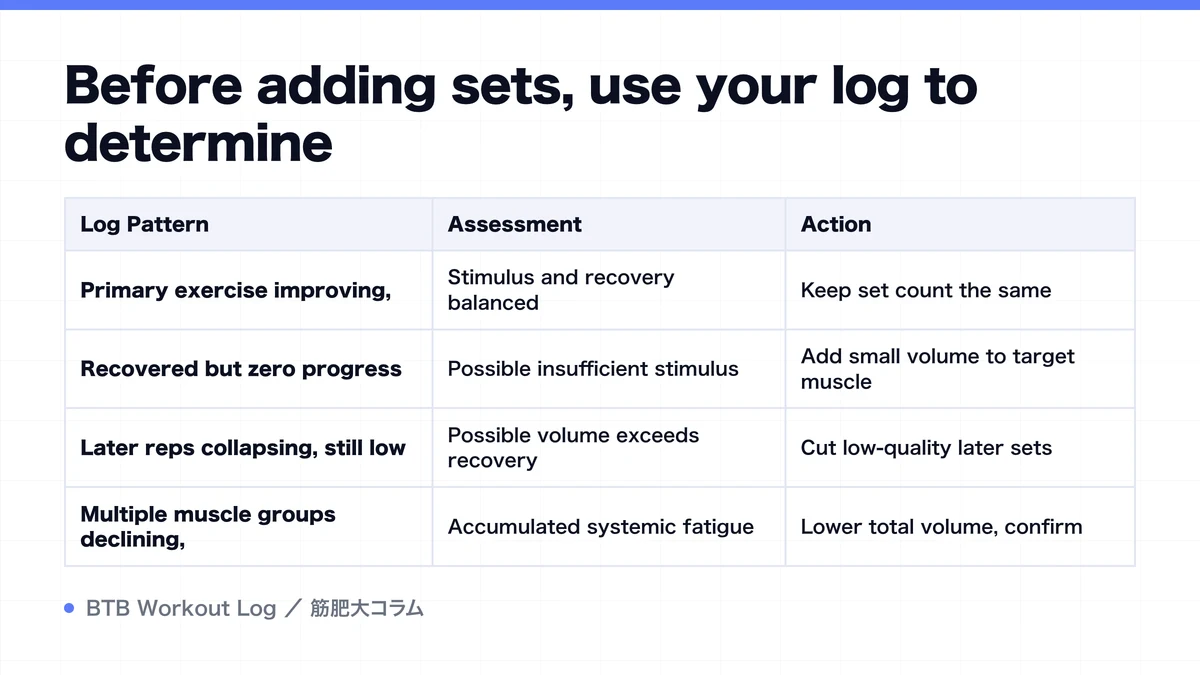
Before adding sets, use your log to determine whether to maintain, increase, or decrease
Don't reflexively add sets when you hit a plateau. Instead, adjust based on trends over several weeks at the same conditions. Start by checking whether your target muscle's primary exercise is showing weight or rep increases. If it is, the current volume is likely providing sufficient stimulus, and there's weak justification for adding more.
| Log Pattern | Assessment | Action |
|---|---|---|
| Primary exercise improving, recovered by next session | Stimulus and recovery balanced | Keep set count the same |
| Recovered but zero progress across multiple weeks | Possible insufficient stimulus | Add small volume to target muscle only |
| Later reps collapsing, still low next session | Possible volume exceeds recovery capacity | Cut low-quality later sets |
| Multiple muscle groups declining, fatigue signs persist | Accumulated systemic fatigue | Lower total volume, confirm recovery |
When adding volume, don't change exercise selection, set count, and RIR all at once. Move only the weekly sets for your target muscle by a small amount. Then, under the same conditions, compare your primary set's weight and reps, the performance drop in later sets, and recovery by the next session. You don't need every set to failure—since training to failure increases recovery cost, keeping that variable stable when you adjust sets makes it easier to isolate what changed.
This judgment requires your actual weight, reps, and sets performed—not what you planned. Optimal sets aren't maximum sets; they're the amount that delivers quality stimulus, recovers, and sustains progress.
「訓練組數越多越好」這句話在什麼範圍內成立?
「訓練組數越多越好」這個觀念,只有在特定範圍內成立。每週只練幾組的肌群,增加組數通常能帶來更多肌肉肥大。劑量反應研究顯示的趨勢,也是在低訓練量區間隨訓練量增加而上升。
問題出在訓練量已經偏高之後。訓練量越大,每多加1組帶來的額外效益就越小,但疲勞成本並不會跟著下降。換句話說,「增加訓練量通常更有利」和「訓練量沒有上限」是兩回事,研究只支持前者在部分範圍內成立。而且研究得出的最佳區間是群體平均值,並未涵蓋每個人的恢復能力、訓練動作與生活壓力。
訓練組數容易被高估,也因為它最好計算。每週訓練組數可以直接記錄,但每組的品質與當下的恢復狀態很難用數字呈現。判斷訓練量是否合適時,別只看「做了幾組」,還要確認每組是否真的讓目標肌群充分出力,以及下次訓練的主要動作能否維持原有的重量與次數。
常見問題
- At how many sets does it become "too much"?
- There's no universal threshold. Recovery capacity varies with exercise, RIR, frequency, indirect stimulus, and training history. If later-set quality and your primary sets drop consistently across multiple sessions, suspect your current volume is too high.
- Should I reduce sets if muscle soreness lingers?
- Don't judge by soreness alone. Prioritize whether you can hit your full range of motion and form, and maintain your previous weight and reps. If sharp pain or joint discomfort appear alongside lasting performance drops, consider cutting volume or taking extra rest.
- When I plateau, should I just add more sets first?
- First check RIR, range of motion, rest periods, frequency, nutrition, and sleep. Once those are stable and you're recovering from your current volume yet still see zero progress over multiple weeks, then conservatively add sets to just the target muscle and compare results.
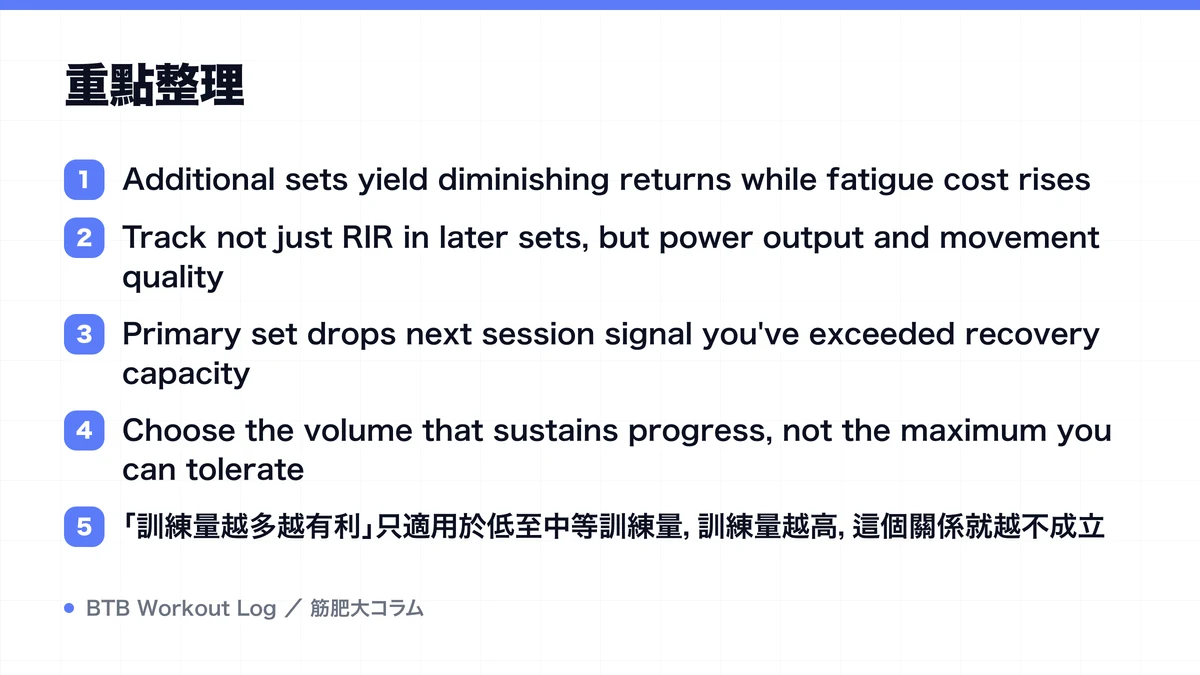
重點整理
- Additional sets yield diminishing returns while fatigue cost rises
- Track not just RIR in later sets, but power output and movement quality
- Primary set drops next session signal you've exceeded recovery capacity
- Choose the volume that sustains progress, not the maximum you can tolerate
- 「訓練量越多越有利」只適用於低至中等訓練量,訓練量越高,這個關係就越不成立
參考文獻
- Dose-response Relationship Between Weekly Resistance Training Volume and Muscle Mass
- The Resistance Training Dose Response: Meta-Regressions Exploring the Effects of Weekly Volume and Frequency on Muscle Hypertrophy and Strength Gains
- Resistance Training Volume Enhances Muscle Hypertrophy in Trained Men
- Training to Repetition Failure or Non-failure: Systematic Review and Meta-analysis
- Proximity-to-Failure and Muscle Hypertrophy: Systematic Review with Meta-analysis