
休息2分鐘 vs 休息5分鐘,哪個更利於肌肉肥大?休太久真的不好嗎
如果2分休憩能保持重量、次數和動作品質,那麼為了肌肉肥大而每次都等5分是沒必要的。反過來,如果高重量動作在2分內下組品質明顯下降,那延長到5分是值得的。
比較的不只是休憩時間本身,還要看之後積累的優質反複次數和整場訓練耗時。與其各種動作統一休憩時間,不如根據出力恢復的實際長度來調整。
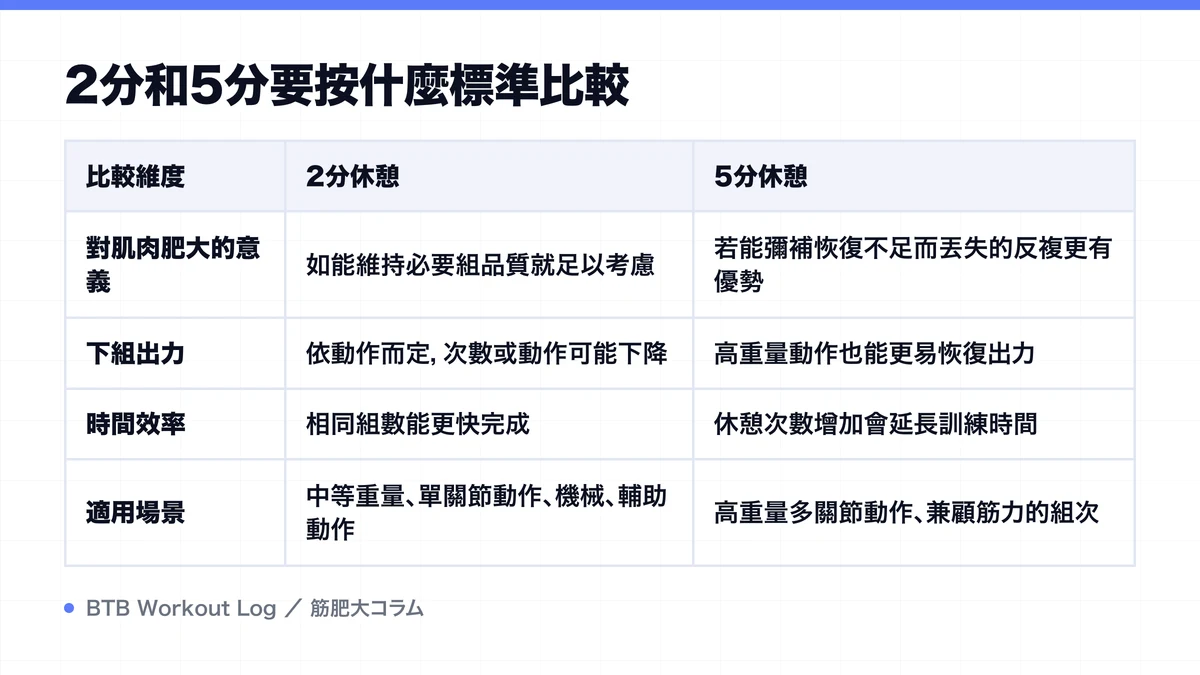
2分和5分要按什麼標準比較
比較肌肉肥大目的的休憩時,「越長越能恢復」、「越短越艱苦」這種判斷還不夠。真正的標準是:能否對目標肌肉堆積優質硬組,並在周為單位持續這種訓練。這裡的硬組是指保持目標動作幅度,RIR大約在1~3範圍內的組次。關於RIR的詳細用法可在RIR指南中確認。
| 比較維度 | 2分休憩 | 5分休憩 |
|---|---|---|
| 對肌肉肥大的意義 | 如能維持必要組品質就足以考慮 | 若能彌補恢復不足而丟失的反複更有優勢 |
| 下組出力 | 依動作而定,次數或動作可能下降 | 高重量動作也能更易恢復出力 |
| 時間效率 | 相同組數能更快完成 | 休憩次數增加會延長訓練時間 |
| 適用場景 | 中等重量、單關節動作、機械、輔助動作 | 高重量多關節動作、兼顧筋力的組次 |
因此比較的問題不是「5分能完全恢復嗎」,而是額外3分鐘能否增加當日有效反複或長期進步。若沒有增加,2分的時間效率更好;若有增加,5分的等待時間就不是浪費。
研究並未證明「5分比2分更能增肌」
休憩時間的常見參考文獻Schoenfeld等人的研究,是訓練經驗者採用1分或3分休憩、進行8週訓練的對比。3分組在筋力和部分肌厚上有優勢。這說明休憩過短會喪失下組工作量,充分休憩反而更佳。
但這項研究不能直接作為「5分比2分更能增肌」的證據。對比的是1分與3分,而非2分與5分。另外,肌厚差異也不是在所有測量部位都一致。這是針對經驗者的單一研究平均結果,每個動作的必要休憩和個體差異仍然存在。
ACSM指南也沒有統一規定休憩時間。在肌肉肥大導向的一般負荷下建議1~2分,而在強調高負荷的筋力訓練中推薦3~5分。這體現了目的和負荷決定休憩的原則。以既有的休憩間隔參考值為出發點,本次2分對5分的選擇需要根據實際組次出力來決定。
2分下降的表現,5分能否恢復
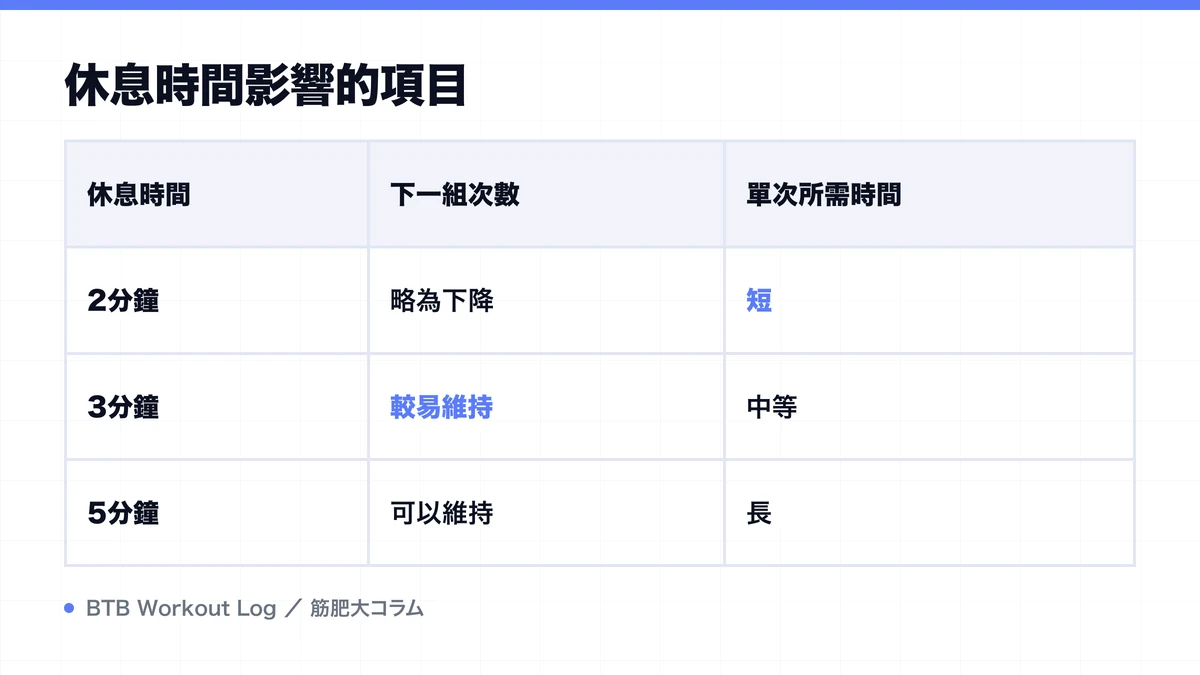
從2分延長到5分才有意義,是當恢復後下組的工作實際改善時。比如同樣重量,第一組做10次,2分後降到6次,5分後回升到9次左右,那額外休憩就有助於維持有效反複。反過來,如果2分內已能用相同動作和目標RIR完成下組,5分的等待不會自動增加肌肉肥大刺激。
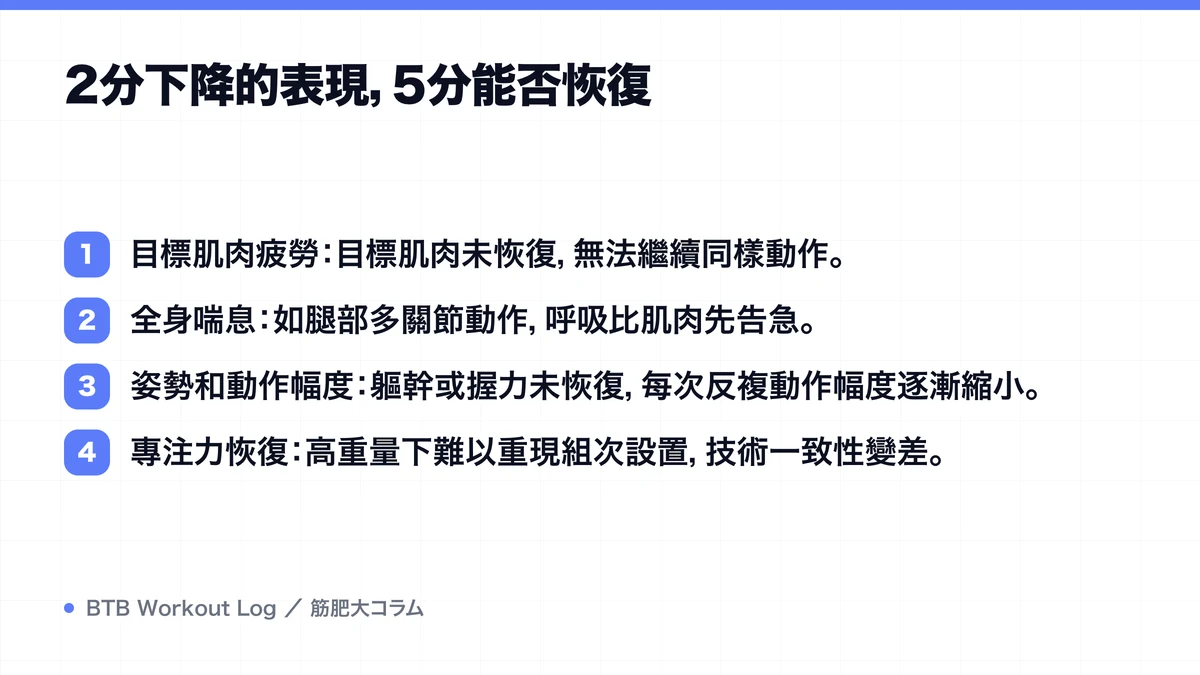
不只看次數,要看什麼限制了出力
- 目標肌肉疲勞:目標肌肉未恢復,無法繼續同樣動作。
- 全身喘息:如腿部多關節動作,呼吸比肌肉先告急。
- 姿勢和動作幅度:軀幹或握力未恢復,每次反複動作幅度逐漸縮小。
- 專注力恢復:高重量下難以重現組次設置,技術一致性變差。
因休憩不足而省略動作的8次,和充分休憩、保持完整動作幅度的8次並不相同。另一方面,即使延長休憩,目標肌肉局部疲勞仍可能存在,出力也沒有變化。重點是看紙面組數之外的內容,比較訓練量的實質。
5分休憩的代價不是每次3分鐘,而是累計訓練時間
The real downside of 5-minute rest isn't hypertrophy—it's session creep. With 3 sets per exercise, you have 2 rest periods. Four exercises at 3 sets each means 8 rest periods; switching from 2 to 5 minutes adds a flat 24 minutes. Add in setup and transitions, and you're cutting accessories, rushing the back half, or training less frequently. That's a separate cost.
But shortening to 2 minutes that tanks your reps, forcing you to add extra sets, isn't time-saving. Compare total time not by "one rest interval" but by however long it takes to finish a quality set. When time is tight, rest longer on main lifts and use 2 minutes for accessories—it's more rational than treating everything the same.
If you want to compress further, alternate between different muscle groups while they recover. But supersets have their own fatigue and equipment overhead, so check the straight set comparison first—make sure you're not just hiding a rest cut.
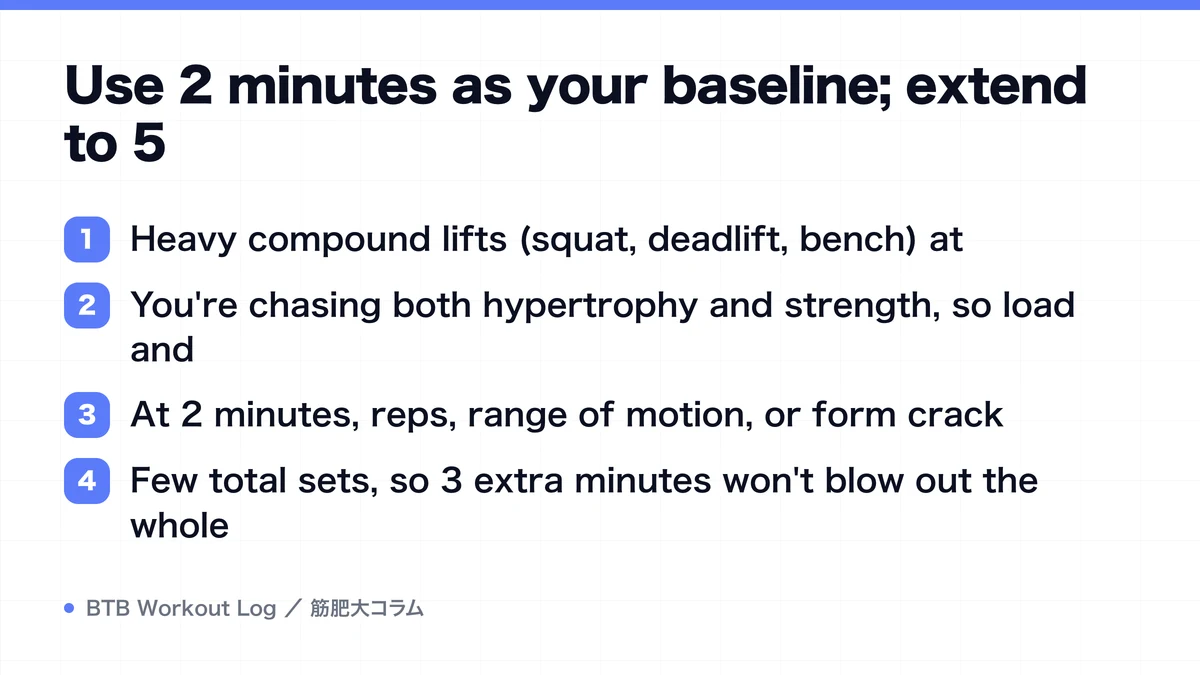
Use 2 minutes as your baseline; extend to 5 only when output drops
In practice, you don't need to lock the whole program into either 2 or 5 minutes. Start with 2 as your baseline, then stretch to 3–5 minutes only for sets where output clearly dips. That keeps both time and quality manageable.
When 5 minutes makes sense
- Heavy compound lifts (squat, deadlift, bench) at low-to-moderate reps.
- You're chasing both hypertrophy and strength, so load and technique consistency matter every set.
- At 2 minutes, reps, range of motion, or form crack noticeably each set.
- Few total sets, so 3 extra minutes won't blow out the whole session.
When 2 minutes works
- Machines or isolation lifts where 2 minutes recovers local output fine.
- Moderate-to-high reps, and breath or setup—not strength—limits the next set.
- Extending to 5 doesn't change reps or form, just adds dead time.
- Hitting your weekly set volume within limited time is the priority.
The same person might rest 5 minutes for squats and 2 for leg curls. Sleep debt, a cut, heat, or training fatigue can all shift recovery speed. Fixed timers build consistency, but don't trash set quality just to hit the clock.
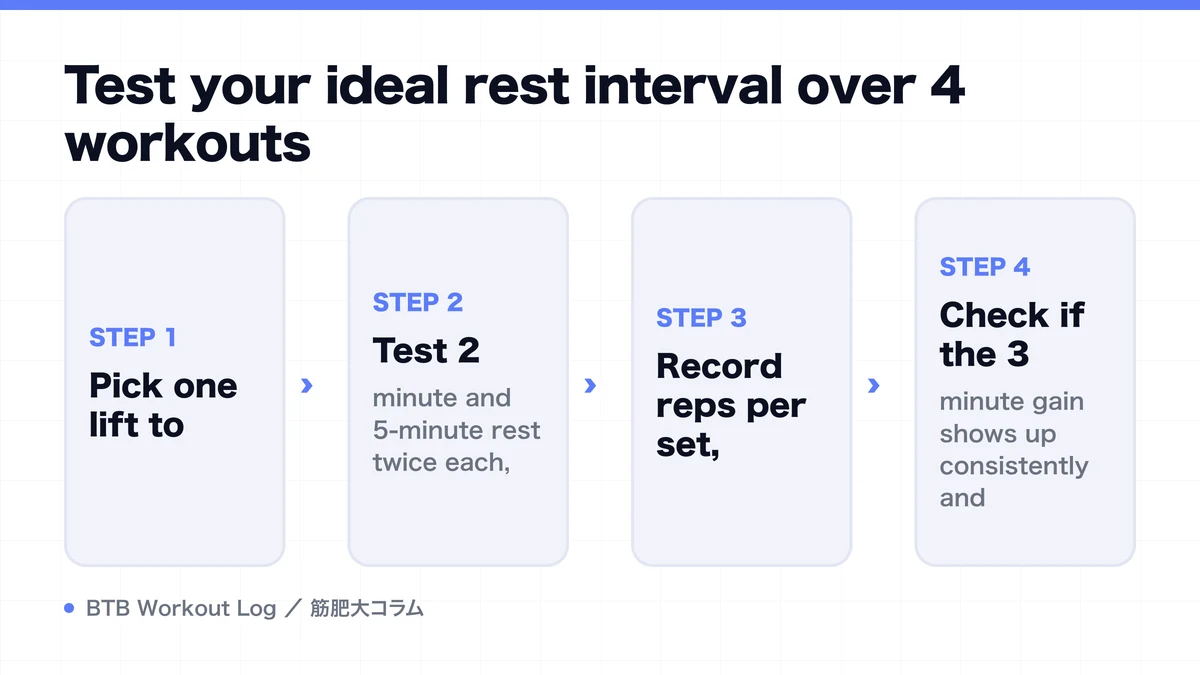
Test your ideal rest interval over 4 workouts
Gut feel gives you "5 felt easy" vs. "2 felt hard." Control conditions and log output and time.
- Pick one lift to compare. Lock in load, sets, rep range, target RIR, and exercise order.
- Test 2-minute and 5-minute rest twice each, on the same day or similar conditions.
- Record reps per set, final-set form, and total session time.
- Check if the 3-minute gain shows up consistently and whether it carries through your remaining work.
If 2 minutes gets the job done and you keep hitting progressive overload, use 2. If only 5 minutes prevents output loss, extend that lift alone. If the gap is fuzzy, try 3 minutes—you're not locked into a binary choice.
Hypertrophy comes from the training after the rest, not the timer itself. Rest is a tuning knob for repeating quality sets.
常見問題
- Does resting 5 minutes blunt muscle stimulus?
- Longer rest alone doesn't weaken hypertrophy stimulus. If 5 minutes lets you hold load, reps, and range, set quality goes up. But on lifts where 2 minutes does the same work, that extra 3 minutes is pure time cost, not benefit.
- Can I just use 2 minutes for everything?
- Yes, if 2 minutes holds your reps and form on every set. On heavy squats or deadlifts where you're breathing hard or technique slides, bump to 3–5 minutes. Prioritize output over uniformity.
- What should I track to figure out which rest interval works for me?
- Use the same load, sets, and target RIR. Log reps per set, range and form hold, and total time. If 5 minutes shows consistent gains, extend it. If no difference, go 2 minutes. That balances hypertrophy and efficiency.
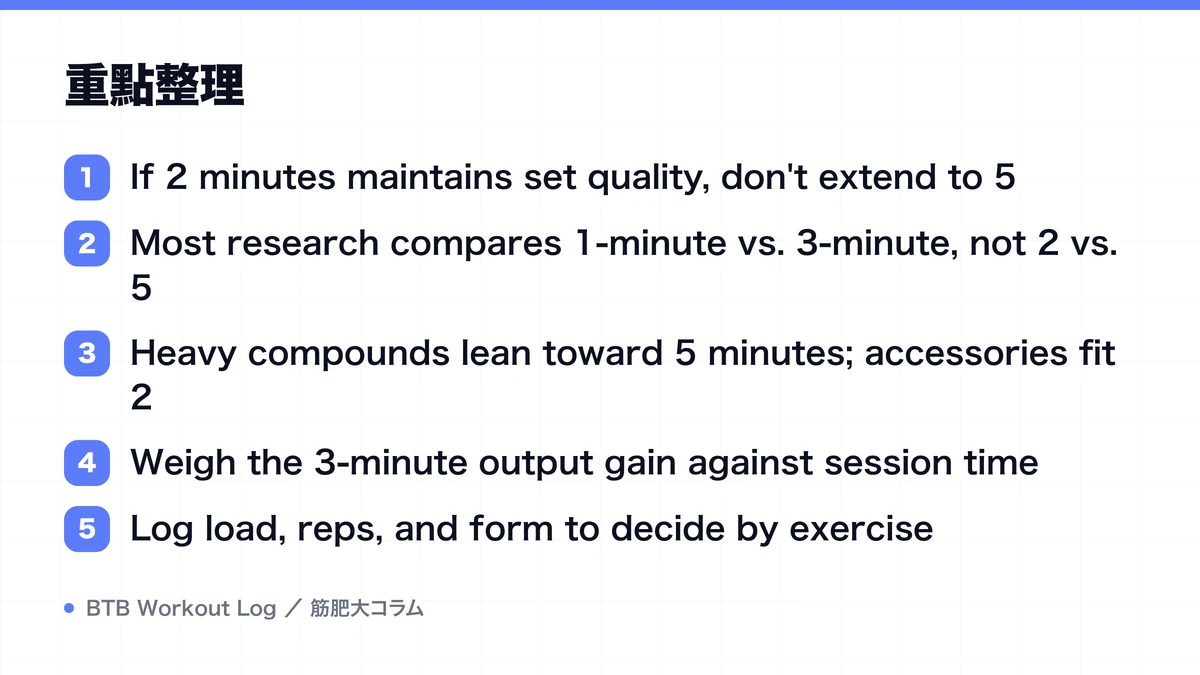
重點整理
- If 2 minutes maintains set quality, don't extend to 5
- Most research compares 1-minute vs. 3-minute, not 2 vs. 5
- Heavy compounds lean toward 5 minutes; accessories fit 2
- Weigh the 3-minute output gain against session time
- Log load, reps, and form to decide by exercise