直落組 vs 超級組,省時間會不會犧牲肌肉肥大效率?
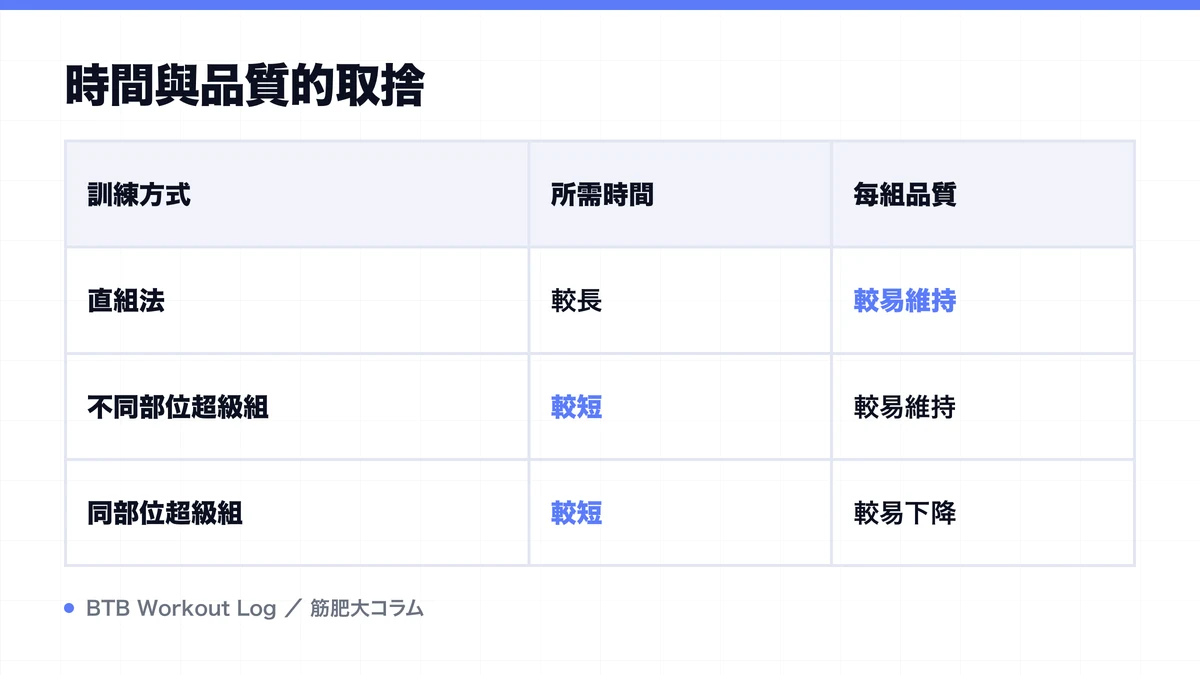
只要每週組數和努力程度保持相同,單純的訓練法選擇不會決定肌肉肥大的勝敗。優先追求高輸出就用直組法;輔助動作在不犧牲組質量的情況下壓縮時間,超級組法更有利。
重點不在短時間內感到疲勞,而在保持目標肌群的反覆次數、動作幅度和 RIR,以及下次訓練是否還能進步。超級組法特別講究配對方式——組合不同會得到截然不同的結果。
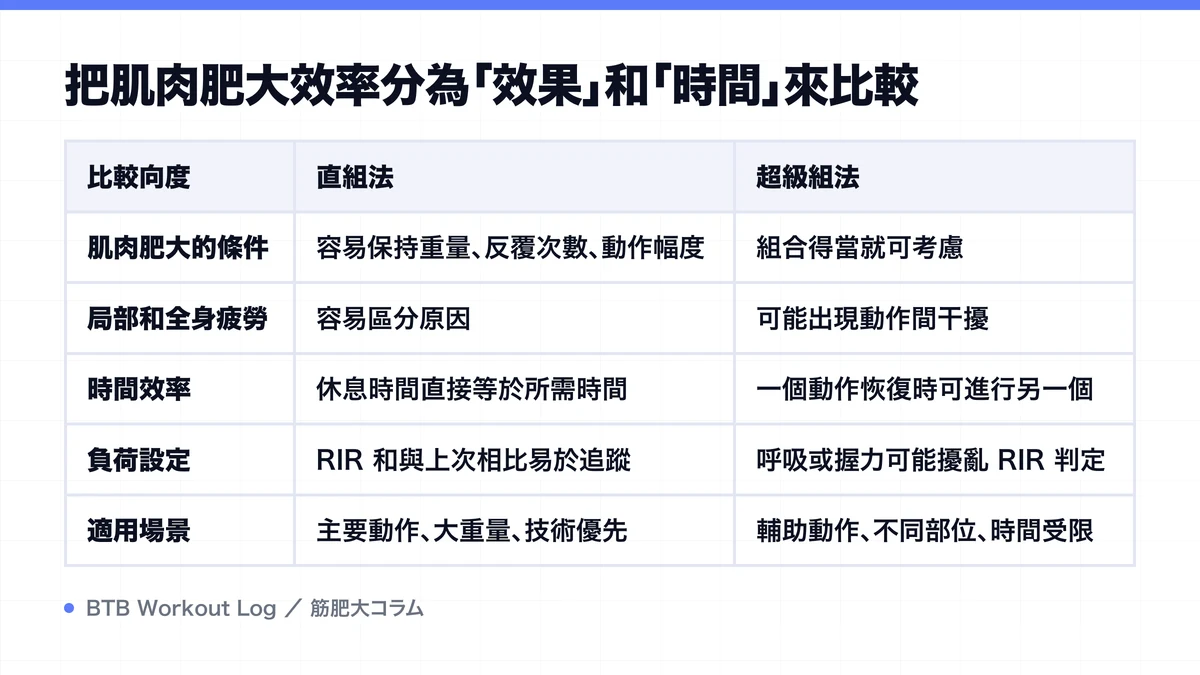
把肌肉肥大效率分為「效果」和「時間」來比較
直組法是完成一個動作,休息規定時間,再按順序完成該動作的各組。超級組法是迅速轉換兩個動作,完成一輪組合後才休息。不只是休息時間長短的區別。
肌肉肥大效率至少有兩層含義。一是幾週到幾個月內增加多少肌肉;二是在有限的訓練時間內完成多少高質量的組。只看前者,直組法因為更容易保持輸出而穩妥;加上後者,超級組法的價值就提升了。
| 比較向度 | 直組法 | 超級組法 |
|---|---|---|
| 肌肉肥大的條件 | 容易保持重量、反覆次數、動作幅度 | 組合得當就可考慮 |
| 局部和全身疲勞 | 容易區分原因 | 可能出現動作間干擾 |
| 時間效率 | 休息時間直接等於所需時間 | 一個動作恢復時可進行另一個 |
| 負荷設定 | RIR 和與上次相比易於追蹤 | 呼吸或握力可能擾亂 RIR 判定 |
| 適用場景 | 主要動作、大重量、技術優先 | 輔助動作、不同部位、時間受限 |
RIR 是「距離極限還能做幾次」的指標。詳細用法見 RIR 指南。比較時不只要湊齊組數,還需讓每組的 RIR、動作範圍和反覆品質都接近。
研究無法單憑訓練法判出勝敗
在考慮肌肉肥大相關條件時,休息時間研究很有參考價值。一項研究讓 21 位年輕、有訓練經驗的男性每週 3 次進行 7 個全身動作,持續 8 週。3 分鐘休息組在臥推和深蹲的 1RM、股四頭肌厚度上都優於 1 分鐘組。這表明短休息若導致下一組功率損失,即使疲勞感更強,也未必對肌肉肥大有利。
另一方面,34 項研究、15 項後設回歸中,有訓練經驗者的研究僅 2 項,但顯示了每週組數與肌肉增長的劑量反應關係。此外,一項涵蓋 15 項研究的中介分析比較了健康成人做到失敗和停在失敗前的訓練方法,結果未發現做到瞬間肌肉衰竭對肌肉肥大有優勢。換句話說,重點不在短時間內造成疲勞感,而在是否能以可恢復的方式累積必要的每週組數和充分的努力程度。
但這些都不是直組法和超級組法的直接對比研究。超級組法也不必然導致同一肌群的休息變短——如果 A 動作和 B 動作交替進行,且 A 到下一個 A 之間有足夠恢復時間,就可以把時間空檔用 B 動作填補。根據現有研究只能說比較條件很重要,無法單從訓練法本身判定優劣。
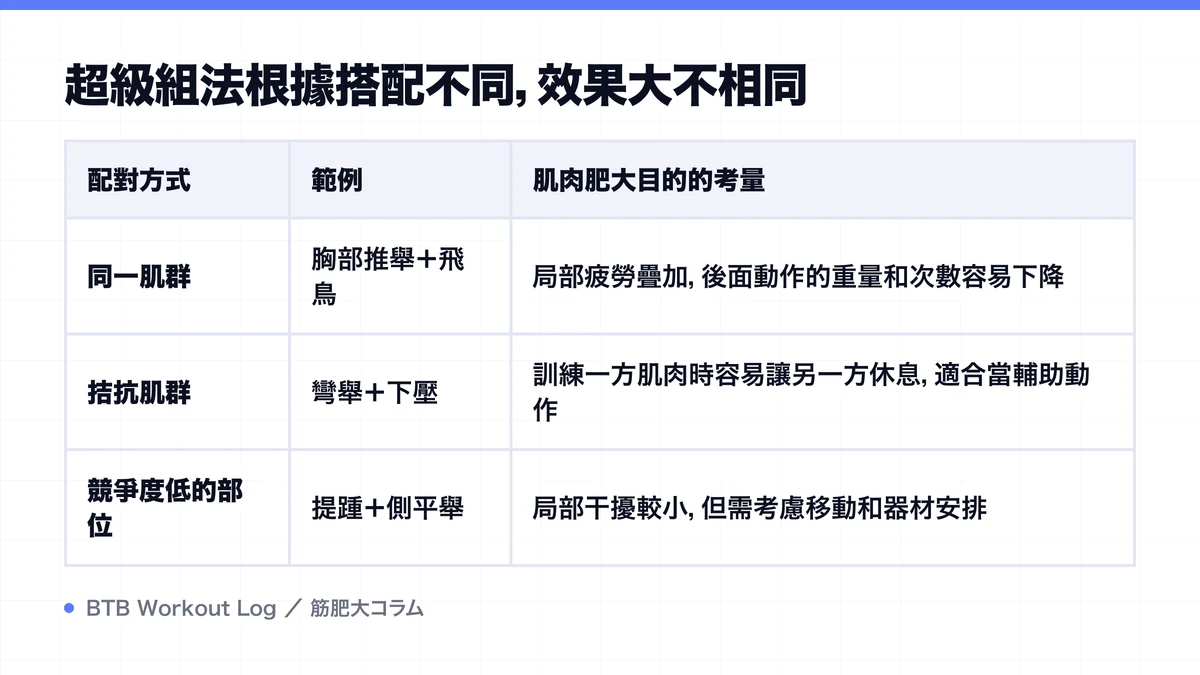
超級組法根據搭配不同,效果大不相同
光靠「上下組合」這個名字,無法判斷疲勞成本。如果是同一肌群連續訓練、相反動作的肌群配對、還是幾乎沒有競爭的部位組合,第二個動作的輸出會差很大。
| 配對方式 | 範例 | 肌肉肥大目的的考量 |
|---|---|---|
| 同一肌群 | 胸部推舉+飛鳥 | 局部疲勞疊加,後面動作的重量和次數容易下降 |
| 拮抗肌群 | 彎舉+下壓 | 訓練一方肌肉時容易讓另一方休息,適合當輔助動作 |
| 競爭度低的部位 | 提踵+側平舉 | 局部干擾較小,但需考慮移動和器材安排 |
同一肌群的配對能在短時間內強力疲勞目標肌肉。但因為第二個動作的負荷會下降,要分清「兩個動作都很累」和「兩個動作品質都高」是兩回事。這種配對適合追求代謝疲勞和肌肉充血的目的,但不足以成為追求進度的主力動作的標準做法。
即使是拮抗肌或競爭度低的部位,干擾也不會完全消失。握力、軀幹穩定、呼吸模式、器材準備都是共用資源。像臥推和划船這類多關節動作,即便目標肌肉不同,全身疲勞仍然很大,沒辦法像彎舉配下壓那樣簡單地省時間。選擇配對方式不能只看肌肉名稱,要看訓練後什麼還沒有恢復。
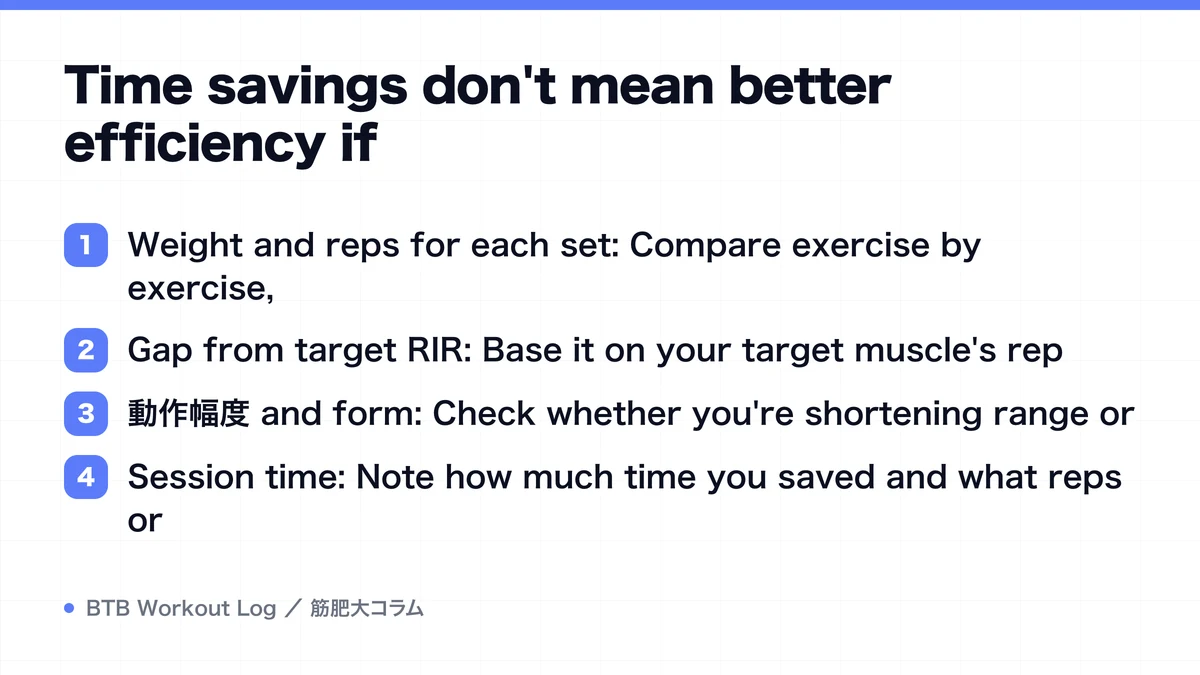
Time savings don't mean better efficiency if you sacrifice output in the process
The advantage of supersets is that you can overlap the rest between two exercises. However, when you factor in moving between stations, waiting for equipment, and changing weights, the actual rest period often doesn't shrink as much as planned. Time efficiency should be measured not by "rest seconds" but by total time from warm-up through your final work set.
Watch out for output drops too. If you're still catching your breath on the second exercise, and your cardiovascular system fails before your target muscle does, the RIR stays the same on paper but means something different. Your grip or core might give out first, forcing you to narrow your 動作幅度 just to hit the rep count. Even if you hold the same number of sets in this state, the volume numbers match but the quality doesn't.
Two things you should always record
- Weight and reps for each set: Compare exercise by exercise, not pair totals.
- Gap from target RIR: Base it on your target muscle's rep limit, not breathing.
- 動作幅度 and form: Check whether you're shortening range or using more bounce, even at the same rep count.
- Session time: Note how much time you saved and what reps or second-exercise quality you lost in return.
If you're cutting assistance work every week due to time limits, a slight output drop might be worth it to hit your required weekly sets with supersets. On the flip side, if time isn't tight and you want to maximize progress on main lifts, there's no reason to give up the stability of straight sets.
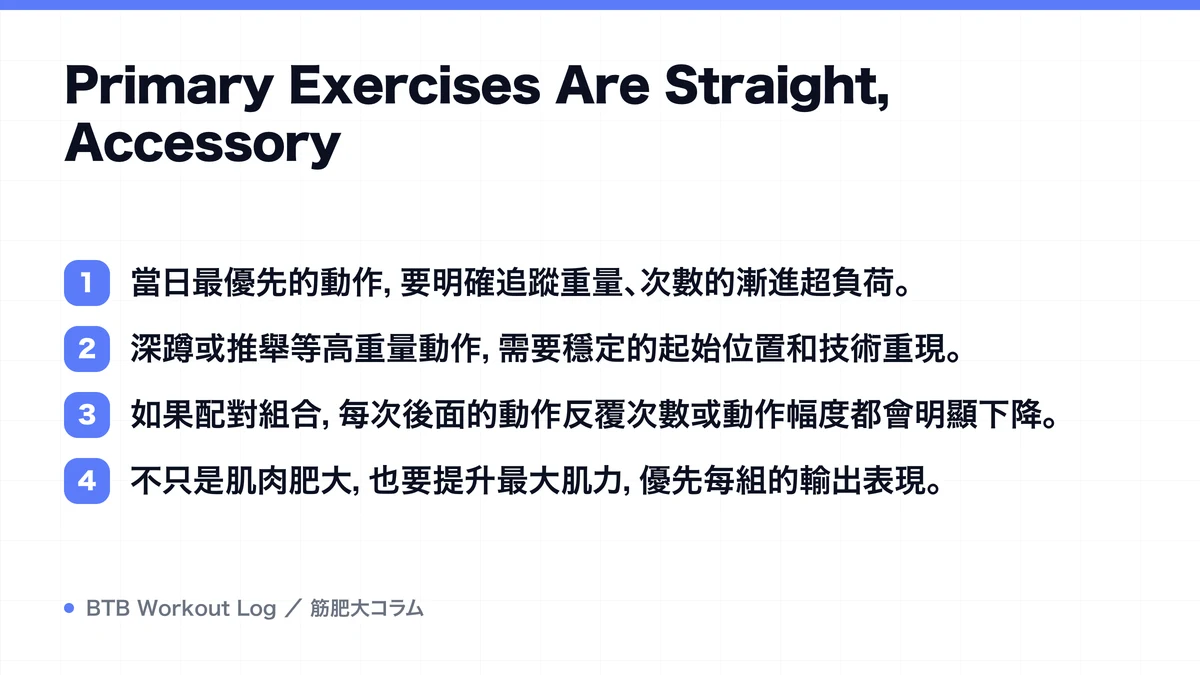
Primary Exercises Are Straight, Accessory Exercises Are Mixed and Matched
在實踐中,與其把整份菜單統一為其中一種方式,不如按優先級區分會更好操作。前1~2個動作用直組法維持輸出和技術品質,後半的輔助動作才改成超級組,這樣就能兼顧肌肉肥大和時間效率。
容易選擇直組法的情況
- 當日最優先的動作,要明確追蹤重量、次數的漸進超負荷。
- 深蹲或推舉等高重量動作,需要穩定的起始位置和技術重現。
- 如果配對組合,每次後面的動作反覆次數或動作幅度都會明顯下降。
- 不只是肌肉肥大,也要提升最大肌力,優先每組的輸出表現。
容易選擇超級組的情況
- 彎舉和下壓等相對競爭較少的輔助動作,容易組合搭配。
- 用穩定的機械或單關節動作,氣喘和軀幹疲勞的影響較小。
- 訓練時間有限,如果能節省時間,就能完成預定的所有組數。
- 從A動作到下一個A動作,實際上能確保必要的恢復時間。
連續鍛鍊相同肌群的配法,應該只在完成優先動作後才當作有限的選項。如果不確定直組法的休息時間該怎麼安排,可以參考2分鐘休息和5分鐘休息的比較,這樣能更清楚地分出為了節省時間可以削減的等待時間,和必須堅守的恢復時間。
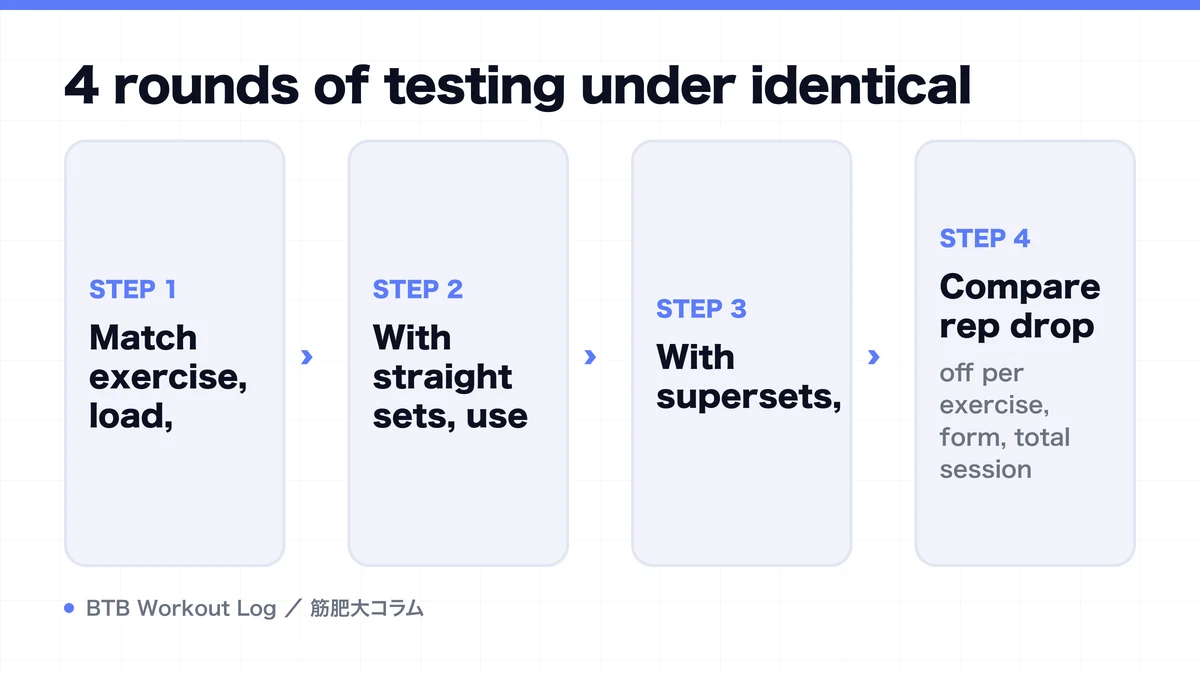
4 rounds of testing under identical conditions to check your time efficiency
Set method compatibility shifts based on gym traffic, equipment placement, exercise order, and cardiovascular capacity. Once you've locked in two candidate exercises, run straight sets and supersets twice each—this prevents single-day variance from skewing the result.
- Match exercise, load, set count, target RIR, 動作幅度, and execution order.
- With straight sets, use standard rest periods and finish each exercise in sequence.
- With supersets, alternate A and B, preserving rest time from one A to the next A.
- Compare rep drop-off per exercise, form, total session time, and progress next session.
If total time shrinks while both exercises maintain reps, RIR, 動作幅度, and show equivalent progress next session, supersets are the more efficient pairing. If only one drops, flip the order. If both drop, extend rest or revert to straight sets. Don't make grinding to failure the benchmark—instead, read the guidelines on failure sets versus RIR and distribute fatigue accordingly.
Your decision should rest on more than "I finished faster today." Weigh both the time saved and the set quality you preserved.
常見問題
- Must supersets eliminate rest entirely between exercises?
- No. You can minimize transition time from A to B, but rest after B and ensure enough recovery time from one A to the next. If reps or 動作幅度 drop, extend the transition or post-B rest—prioritize set quality over the clock.
- Are supersets targeting the same muscle group better for 肌肉肥大?
- They fatigue the target quickly, but the second exercise's load and reps usually drop. Don't make it your standard protocol for tracking main lift progress. Use it as a supplemental option after your priority sets, monitoring 恢復 and weekly volume.
- Can I run everything as supersets on time-limited days?
- Pairing your priority exercises risks losing output and technique due to breathing stress and core fatigue. Instead, perform the heavy main lift straight, then superset only the later, non-competing accessories—you'll save time while still chasing session-to-session gains.
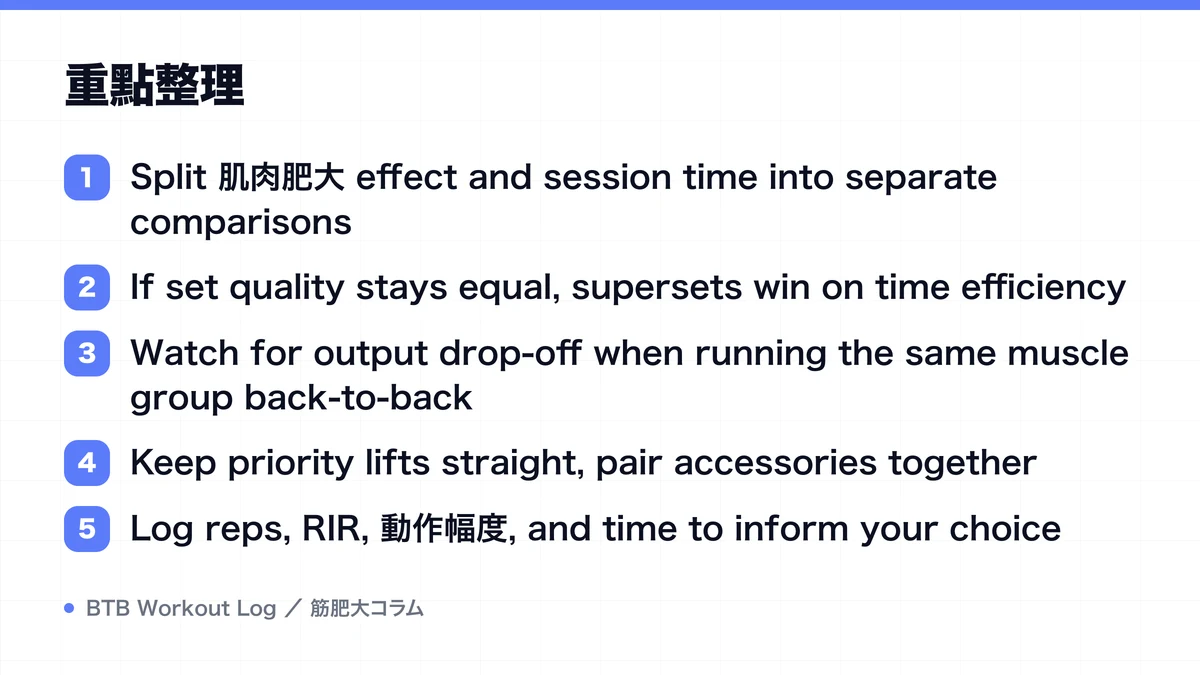
重點整理
- Split 肌肉肥大 effect and session time into separate comparisons
- If set quality stays equal, supersets win on time efficiency
- Watch for output drop-off when running the same muscle group back-to-back
- Keep priority lifts straight, pair accessories together
- Log reps, RIR, 動作幅度, and time to inform your choice