「重量×次數×組數」解釋不了全部肌肉肥大|數字背後的陷阱
重量×次數×組數計算出的總負荷量在追蹤同一動作的進度時很實用,但它不是衡量肌肉肥大刺激的萬能分數。
忽視計算公式未納入的因素——負荷區間、逼近極限的程度、動作幅度、目標肌肉的實際受力——就會陷入「總噸數越多效果越好」的誤區。
重量×次數×組數在計算什麼
這個公式計算的是槓鈴或機械上顯示的外部負荷被移動了多少次。比如80kg做8次3組,總和是1,920kg。下次同樣動作、同樣設定、同樣幅度完成80kg的9次3組,就變成2,160kg。計算簡單,能把進度濃縮成一個數字,所以它成為「訓練量」最常見的代表值。
到這裡都很實用。如果比較條件基本相同,總負荷量的增加表明重量、次數或組數中至少有一項提升了。它是回顧種目內工作量的有用輔助指標,也是現有訓練量管理使用總負荷量的原因所在。
但這個數字並未直接測量肌肉受到的刺激。當你把「記錄的外部負荷」和「目標肌肉實際受到的有效刺激」當成同一回事時,公式就超出了它的適用範圍。
總負荷量相同,組的內容卻完全不同
即使總負荷量相同,以下條件的差異也會改變肌肥大的前提。
- 負荷區間:100kg做少次數的組與輕重量多反覆的組,總負荷量可能一樣,但所需反覆次數和疲勞性質完全不同。
- RIR:RIR表示「還能做幾次」的餘力。相同的50kg×10次,但一個人已達極限,另一個人還能做5次,相對努力度就不一樣。
- 動作幅度與姿態:即便重量和次數相同,移動的範圍、反動程度、輔助肌的參與方式改變了,目標肌肉的受力就不會相等。
- 動作與器材:深蹲的1,000kg加腿彎舉的1,000kg,也算不出各肌群分別承受了多少負荷。不同機械之間的表示重量含義也未必一致。
極端案例中,單純加入大量輕重量熱身組就能提高總負荷量,但這與肌肥大刺激增加沒有關係。反過來,若為了嚴格控制動作幅度和姿態而總負荷量暫時下降,也不能直接判斷刺激減弱了。輕負荷的訓練效應需要按輕重量也能造成肌肥大的原因另外思考。

研究裡的「訓練量」也不是單一指標
負荷比較研究顯示,低負荷和高負荷都做到極限時,肌力提升傾向高負荷更有利,但肌肥大在較寬的負荷區間內可能相當。Mitchell等人的研究也發現,不同負荷和組數構成下,肌量增加沒有明確的組間差異。因為樣本和週期有限,單一研究無法下結論,但這說明外部重量和計算上的總負荷量無法單獨為肌肥大排序。負荷選擇應該更理性地考慮,像高重量與輕重量的比較那樣,同時納入肌力、時間和疲勞。
另一方面,訓練量與肌肥大的劑量反應關係的統合分析中,主要指標是每週組數。也就是說研究上,「訓練量」也不總是指重量×次數×組數。各肌群的每週組數容易掌握處方量,總負荷量容易掌握種目內的實績。兩者回答的是不同的問題。
此外,「做到極限總是更好」這樣的簡單關係也沒有證據支持。逼近極限與肌肥大的關係存在不確定性,相同總負荷量也不能消除努力度差異。研究的平均值是判斷參考,但不足以把單一公式變成普遍適用的換算式。
計算越簡單的數字,越容易被當成原因
這個誤解之所以產生,不是因為總負荷量是個爛指標,而是因為它容易計算,而且確實與實際進度部分重合。同一動作如果保持姿態的前提下重量或次數增加,總負荷量通常也會增加,與肌肥大進展往往並行。
但並行移動的數字未必就是全部原因。如果為了不停提升總負荷量而持續加組,反而損害了後期輸出和下次恢復,那麼數字雖然漂亮,訓練計畫的品質卻下降了。週內變更動作導致當週總噸數下降,也不能直接比較變更前後的優劣。
把所有東西合併成一個總和便於管理,但隱藏了哪個肌群、以多少餘力、用什麼動作來完成訓練的細節。「能夠統計」和「能夠解釋」的混淆,正是總負荷量被過度神聖化的根源。
For muscle growth: read total load across three levels
You don't need to abandon total load. Narrow the comparison window and combine it with other metrics.
- Check prescribed volume per muscle group: Start by counting hard sets each week. A set counts when the target muscle is under sufficient tension and you're not leaving excessive slack. Don't treat all sets as equal—look deeper at why the same 10 weekly sets can produce different outcomes.
- Track performance within the same exercise: Keep exercise, equipment setup, form, range of motion, and rest intervals as constant as possible, then trace weight and rep progression. Within this frame, total load becomes a useful reference. Judge by trend over several weeks, not a single session swing.
- Layer set quality and recovery signals: Check each set's RIR, loading on the target muscle, recovery until the next session, and performance drop-off. If total load went up but RIR increased, form got sloppy, or next session reps fell, that's not pure progress.
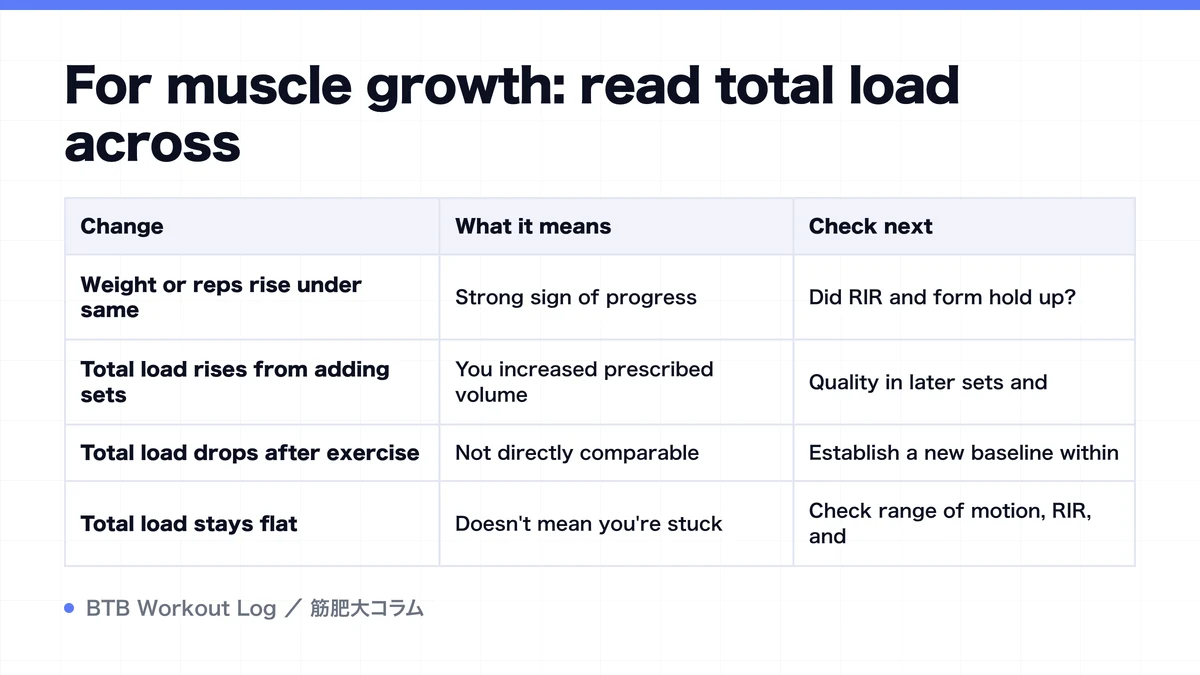
| Change | What it means | Check next |
|---|---|---|
| Weight or reps rise under same conditions | Strong sign of progress | Did RIR and form hold up? |
| Total load rises from adding sets only | You increased prescribed volume | Quality in later sets and recovery next session |
| Total load drops after exercise swap | Not directly comparable | Establish a new baseline within the new exercise |
| Total load stays flat | Doesn't mean you're stuck | Check range of motion, RIR, and weekly hard set trend |
Match your comparison conditions before you add numbers
Add sets not because total load is low, but when you're handling your current hard sets steadily, recovering well, and weight or reps haven't budged for several weeks under identical conditions. Conversely, if total load is climbing but form is breaking down, RIR is worsening, or fatigue lingers into the next session, you have room to dial back the pace.
A single number like "20 tons this week across all exercises" is less useful than a breakdown: chest got how many sets, what's bench press doing at the same settings, and what was your RIR level? That granular record drives the next call. Total load only means something within a single exercise. BTB Workout Log separates exercise-by-exercise trends from weekly hard set counts by muscle group.
Total load summarizes what you handled under consistent conditions. It doesn't independently predict how much muscle you'll build. Respect that boundary and you keep a useful formula without becoming a slave to the numbers.
常見問題
- Do I need to track total load?
- Yes, it's worth recording. Within the same exercise, setup, form, range of motion, and rest scheme, it's a solid supporting metric to summarize weight and rep progress. The key is not comparing totals across different exercises or sets from vastly different load zones as if they were equal growth scores.
- Which comes first—total load or weekly hard sets?
- Use weekly hard sets per muscle group when adjusting prescription, and weight·rep progress plus total load when tracking an individual exercise. Layer RIR, range of motion, form, and recovery state onto both. Never base a volume increase or cut on a single number.
- Is a week with lower total load bad for muscle growth?
- A single week's dip doesn't tell you much. Exercise swaps, Deload weeks, range-of-motion improvements, fatigue, and set count shifts all lower the number. Only when the same-exercise performance stays down for weeks and RIR and recovery also deteriorate do you revisit fatigue and programming.
重點整理
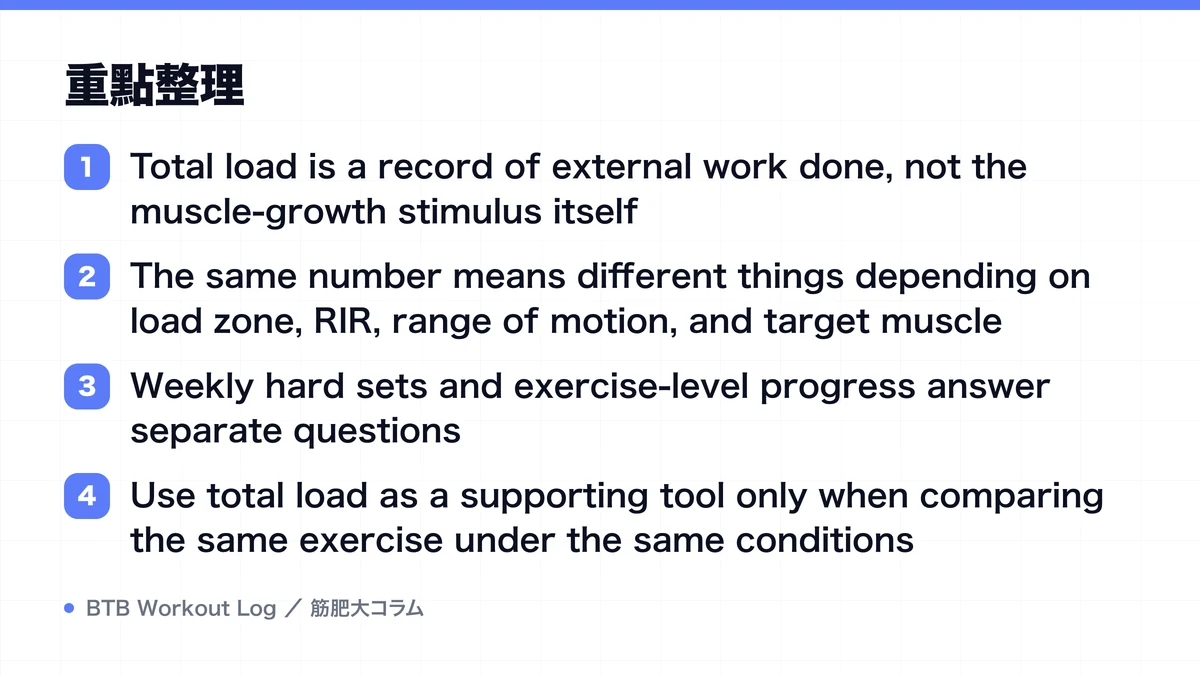
- Total load is a record of external work done, not the muscle-growth stimulus itself
- The same number means different things depending on load zone, RIR, range of motion, and target muscle
- Weekly hard sets and exercise-level progress answer separate questions
- Use total load as a supporting tool only when comparing the same exercise under the same conditions
參考文獻
- Resistance Exercise Load Does Not Determine Training-mediated Hypertrophic Gains in Young Men
- Low- vs High-load Resistance Training for Strength and Hypertrophy: Meta-analysis
- Dose-response Relationship Between Weekly Resistance Training Volume and Muscle Mass
- Resistance Training Volume Enhances Muscle Hypertrophy in Trained Men
- Proximity-to-Failure and Muscle Hypertrophy: Systematic Review with Meta-analysis