用輕重量也能讓肌肉肥大,為什麼?「不重就沒意義」只是個誤解
輕重量也能讓你在充分反複並接近極限的情況下,因疲勞導致更多運動單元參與,給肌纖維施加足以引起肌肉肥大的張力。
高重量從一開始就要求很大的力量,但不是製造肌肥大刺激的唯一方法。低負荷可以通過反複次數和努力程度來逼近所需的刺激。
外在重量和肌纖維承受的張力並非同一回事
「要把肌肉練大必須舉重物」這個直覺有其正確之處。因為移動重槓鈴從第一下開始就需要很大的力量,容易快速徵召許多運動單元。但是槓片的重量只是刺激的代理指標,不是刺激本身。
肌肉肥大的關鍵要素之一是活躍的肌纖維在發力時承受的機械張力。同樣的20kg,因為動作、姿態、動作幅度、槓桿條件、個人最大肌力而異,每條肌纖維的負荷都不同。反過來說,即使外在負荷很輕,如果經過多次反複力量下降,完成剩餘反複所需的相對要求就會提高。
因此不能只看重量範圍來判斷「有效無效」。比較高負荷和低負荷結果時,除了高重量和高次數的取捨,還需要納入組訓在哪裡停止、目標肌肉是否能穩定動作等因素。
輕重量組訓中,疲勞會逐漸增加肌纖維的參與
輕重量組訓發生的變化,第一下和最後幾下並不相同。根據一般運動單元動員原理,力量需求低時,低閾值、抗疲勞能力較差的運動單元會優先工作。前期如果力量餘裕很大,那些沒參與的高閾值運動單元也還在待命。
- 前期:所需力量小,相對較少的運動單元就能移動重量。
- 中期:工作中的肌纖維開始疲勞,為了維持同樣的重量和動作,需要追加更多運動單元。
- 後期:舉起速度變慢,隨著極限靠近,越來越廣泛的肌纖維參與發力。
也就是說,低負荷能用許多反複和逼近極限來彌補單次外在負荷的微小。高重量是「從一開始就高要求」的方法,輕重量是「透過疲勞提高相對要求」的方法。兩者最終都能成為給活躍肌纖維重複施加張力的路徑。
有的說法把組訓末端的反複叫「有效反複」,但其實並未確定只有最後幾下才能促進成長。在實踐中,不如用RIR(還能做幾下的餘力)來管理接近極限的程度,這樣的判斷更容易重複執行。肌纖維動員是重要的解釋,但光是動員並不能決定長期肌肥大,還需要充足的組訓量和恢復。
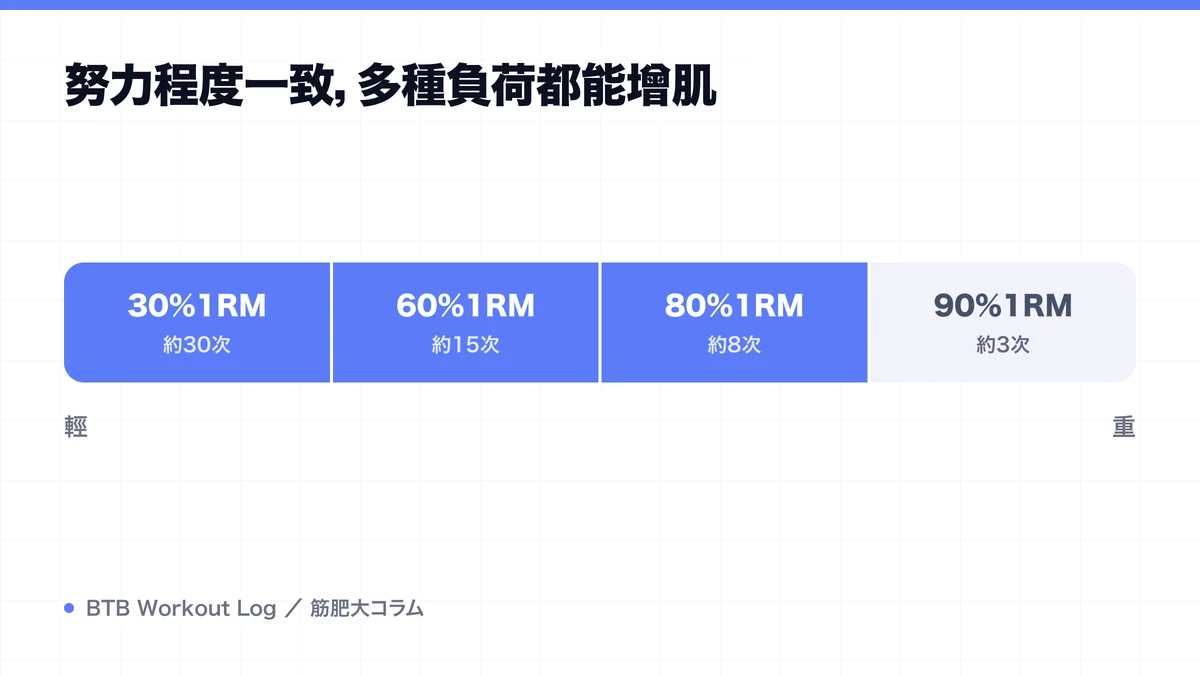
低負荷和高負荷肌肥大接近,關鍵是努力程度相同
在所有組訓都做到反複不能的條件下,低負荷也會產生接近高負荷的肌肥大傾向。這不是說「30%就自動有效」,而是輕重量也反複進行、達到充分努力程度的結果。研究內容在Mitchell等人的低負荷研究介紹中也能確認。
Schoenfeld 等人的多項研究統合分析也顯示,低負荷和高負荷的肌肥大差異很小,但最大肌力則高負荷側更容易進步。在上肢和下肢都發現,採用隨意疲勞的條件下,外在負荷差異對肌肥大的影響很小。這不是說遺傳和生理反應才最重要,但確實符合重量不是決定肌肥大反應唯一因素的事實。
研究結果也有差異。受試者的訓練經歷、介入期間、肌厚或斷面積的測量方法、組訓量的統一方式都會改變估計值。因此不是「再輕的重量都和高重量完全相同」,而應該理解為即使一般性低負荷,只要努力程度足夠也能引起肌肉肥大。
把輕重量變成肌肥大組訓的三個條件
1. Don't stop too far short of failure
Light loads make early demands low, so if you leave a large safety margin and stop prematurely, the set ends before additional motor units can be recruited. Practically speaking, RIR 1–3 works as a reasonable target, but you don't need to train to failure every set. High-rep ranges make it easy to misjudge where failure lies, so occasionally test actual limits on safe isolation exercises to recalibrate your RIR feel. Taking sets to failure is a tool for maintaining judgment accuracy, not an obligation to use every session.
2. Keep tension on the target muscle
If you shorten range of motion to hit your rep target, add momentum, or shift work to other muscles, the numbers go up but the stimulus stays the same—or drops. With low loads and high reps, breathing strain or local burn often becomes the stopping point before the target muscle actually fails. You need to distinguish between fatigue in the target muscle itself and simply deciding to stop because it's uncomfortable.
3. Progress—don't just stay light
Repeating the same light weight for the same reps builds excess capacity over time, and relative stimulus drops. Once you hit the top of your target rep range, either add a small amount of weight, increase reps with the same load, or complete all sets with perfect form and full range of motion—apply progressive overload under comparable conditions. Light loads aren't a "stay comfortable" method.
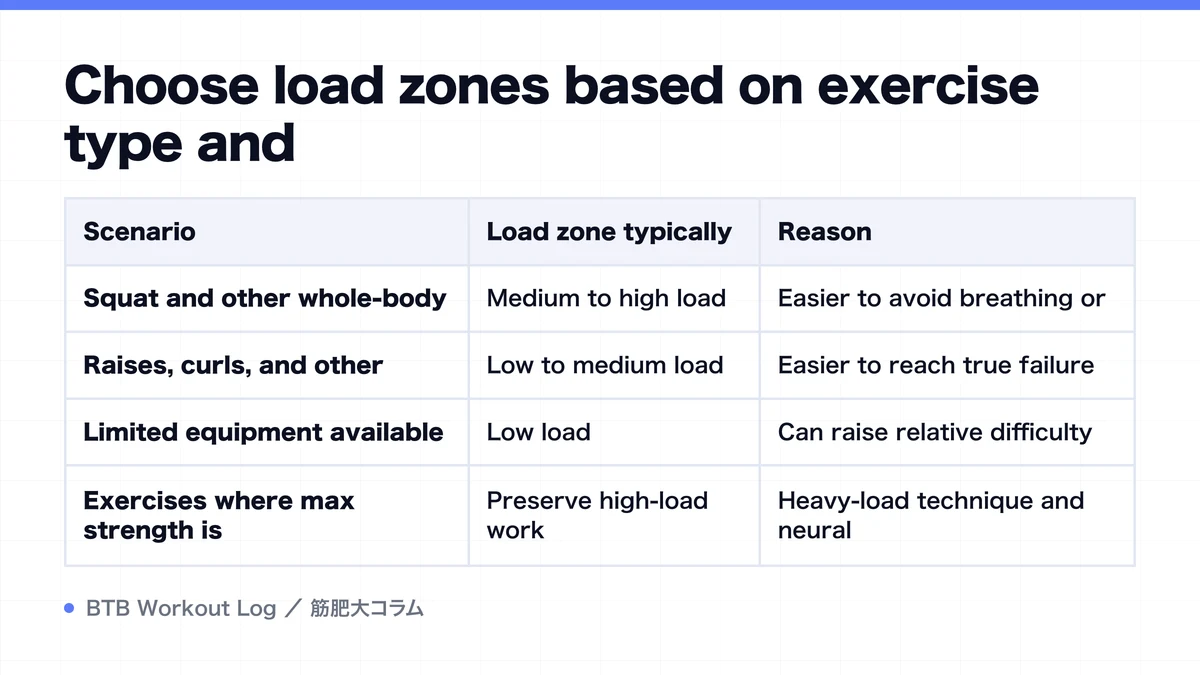
Choose load zones based on exercise type and goal
The fact that light loads build muscle doesn't mean you should use light loads for every exercise. Load selection depends on total systemic fatigue, time available, technical demands, local fatigue tolerance, and whether you're prioritizing max strength too.
| Scenario | Load zone typically preferred | Reason |
|---|---|---|
| Squat and other whole-body exercises | Medium to high load | Easier to avoid breathing or postural breakdown before the target musculature reaches failure |
| Raises, curls, and other single-joint movements | Low to medium load | Easier to reach true failure while maintaining tension on the target muscle |
| Limited equipment available | Low load | Can raise relative difficulty through higher reps and unilateral variations |
| Exercises where max strength is also a priority | Preserve high-load work | Heavy-load technique and neural adaptation have specific requirements |
If you adopt low loads, set a target rep range—say 15–25 reps—and record weight and reps for each set while maintaining the same form and range. Once you hit your top rep number while maintaining your target RIR, bump the weight by the smallest increment and reset reps. This way, light loads still let you track progress. Rep ranges aren't the goal themselves; they frame how you adjust load consistently. For other approaches, see rep ranges for muscle growth.
If you can step up in weight after extending reps on a light load and still maintain movement quality, you've confirmed that your load selection is driving real progress.
輕重量確實不利於肌肉肥大的情況
輕重量同樣能促進肌肉肥大,但這種說法也有說對的地方:使用輕負荷,卻在還有餘力時就結束組數。大重量即使保留一些餘力,肌肉承受的張力仍相對較高;輕負荷則越早在力竭前停下,越容易在未充分動員肌纖維的情況下結束。
輕負荷之所以沒有效果,通常是因為你用以下方式結束組數:做到目標次數就停、覺得吃力就停,或為了避免動作變形而提早從容收手。問題都不是輕重量本身,而是離力竭不夠近。
此外,低負荷在實務上也有缺點。每組耗時較長,心肺或握力容易比目標肌群更早達到極限;而且使用0.5kg的增量時,進步不容易看出來,判斷是否達成漸進超負荷往往只能依靠次數。如果要使用輕重量,就必須理解這兩點,並把每組停止的原因也記錄下來,再據此判斷是否適合。
常見問題
- How light can you go and still build muscle?
- There's no hard cutoff, but research shows muscle growth occurs even around 30% 1RM if you push close to failure. Extremely light loads drive up rep counts and discomfort, so breathing or focus often fails before the muscle does. Pick a range where you can consistently reach challenging fatigue.
- Do you have to train to failure every set with light loads?
- No, failure every set isn't required. But light loads don't build much stimulus if you leave too much in reserve, so aim for RIR 1–3 as a default. Occasionally testing true failure on safe isolation moves helps you recalibrate your RIR judgment during high-rep sets.
- Does strength improve with light loads alone?
- Strength can improve, but 1RM typically rises faster with heavier loads. Even if hypertrophy is your main goal, keeping some high-load work on primary lifts preserves your max strength capability and skill with heavy weight. Use low loads on accessory work instead.
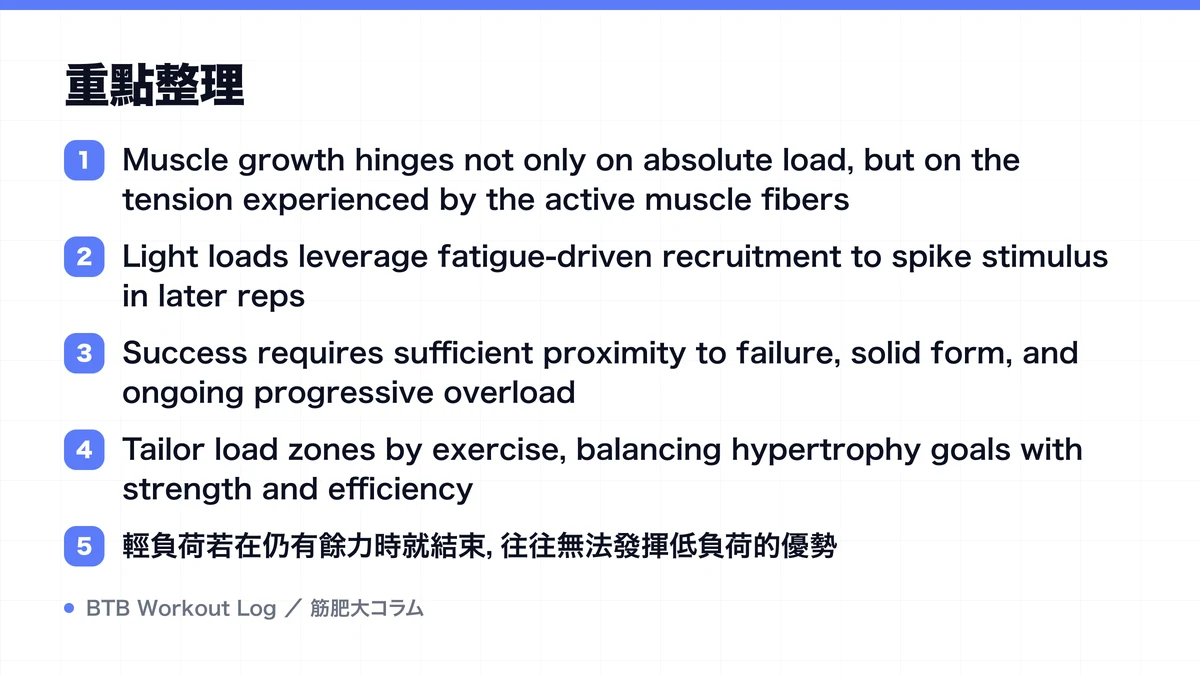
重點整理
- Muscle growth hinges not only on absolute load, but on the tension experienced by the active muscle fibers
- Light loads leverage fatigue-driven recruitment to spike stimulus in later reps
- Success requires sufficient proximity to failure, solid form, and ongoing progressive overload
- Tailor load zones by exercise, balancing hypertrophy goals with strength and efficiency
- 輕負荷若在仍有餘力時就結束,往往無法發揮低負荷的優勢