
60分鐘內的訓練能帶來肌肉肥大嗎?在你耗一整天泡健身房之前先看這篇
60分內完全可以達到足夠的肌肉肥大。但效果不在於60分這個數字本身,而在於能否將必要的每週硬組分散安排,同時保護主要動作的休息時間和組數品質。
需要檢驗的不是「訓練是否在時間內結束」,而是在時間限制下,目標肌肉是否維持了足夠的工作量和數週間的進度。60分不是肌肉肥大效果的分界線。
怎樣才算「60分也足夠」
訓練時間不能直接反映肌肉受到的刺激強度。同樣是60分鐘,等器材等待長的那天、為了趕進度而縮短休息導致次數下降的那天、按計劃穩定完成的那天,內容差異很大。只看汗量、充血感和疲勞程度無法判斷是否充分。
60分課程的合格標準是,目標肌肉每週分配到的硬組能以計劃的重量、次數、動作幅度和 RIR 持續重複。硬組指的是在保持正確動作前提下充分接近力竭的組數,RIR 是「還能做幾次」的餘力估算。熱身組或技術確認的輕組不能和肌肉肥大專用組相同對待。
此外還要保證後半動作不失手,訓練間隔內恢復充分,並在數週內逐漸增加重量或次數。因此評估週期不是單次60分鐘,而是整週和下次訓練前。時間縮短但這些條件保持不變就是充分的;反之如果每次都要刪除多個主要組數,那就是不足。
研究支持的是內容設計,不是「60分」這個時間
現有研究沒有直接對比60分和90分來確立普遍的時間界限。我們能確認的是每週訓練量、訓練頻率、組間休息與肌肉肥大的關係。因此應該驗證既知變數能否在60分內滿足,而不是武斷地宣稱「60分最優」。
每週組數與肌肉增長通常呈現量效關係。但這不代表越多越好無限有利,也不代表每個人都需要固定的組數。如果現有工作量已能帶來進度,就不必為了填滿時間而加組。反之,如果進度停滯但恢復還有餘力,可以考慮逐步增加每週組數。
頻率研究表明可以將每週總量分散在多個訓練日。如果60分無法消化全部內容,不如先考慮把相同的每週組數拆到不同日期,這樣能更好地保護每組的輸出品質,而不是盲目縮短休息。關於休息間隔,對有經驗的舉重者進行的研究對比了1分鐘和3分鐘,3分鐘條件在肌力和部分肌厚上更有優勢。時間有限也不是縮短主要動作休息時間的理由。

60分應該先分配框架,而不是急著縮短動作
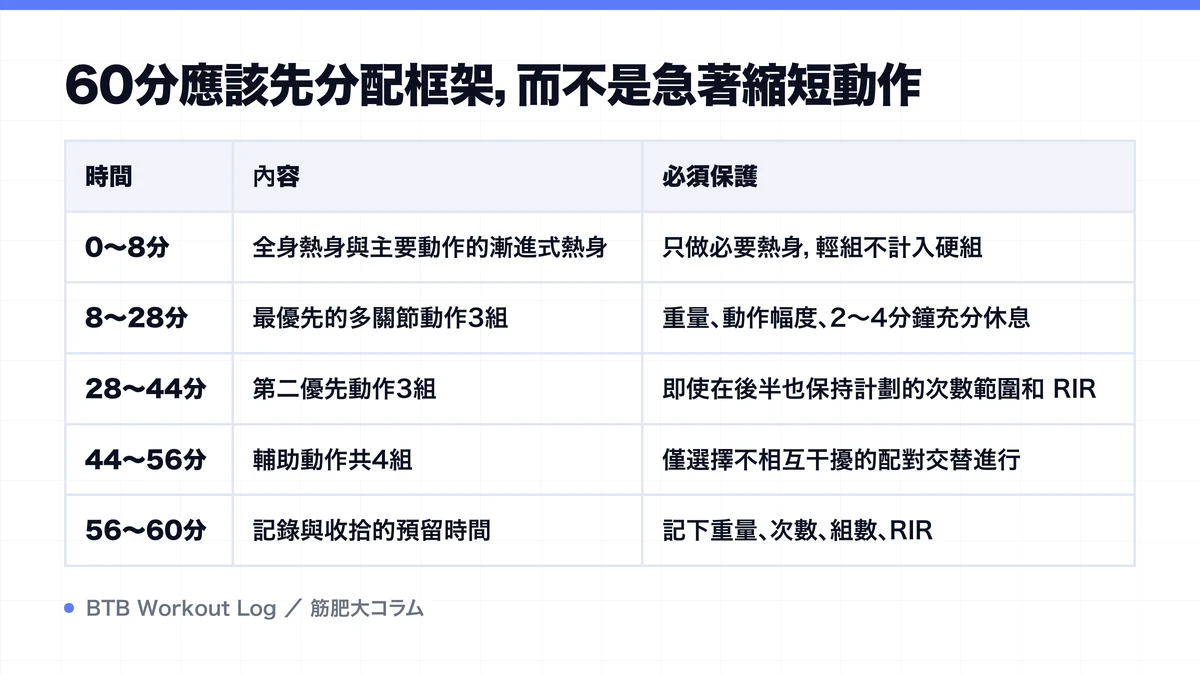
要讓60分計劃成立,得在開始前明確優先順序和時間框架。下面是假設每次10個硬組的分配方案,不是對所有人的規定。要根據動作難度、健身房擁擠度、使用重量和周內訓練頻率調整。
| 時間 | 內容 | 必須保護 |
|---|---|---|
| 0〜8分 | 全身熱身與主要動作的漸進式熱身 | 只做必要熱身,輕組不計入硬組 |
| 8〜28分 | 最優先的多關節動作3組 | 重量、動作幅度、2〜4分鐘充分休息 |
| 28〜44分 | 第二優先動作3組 | 即使在後半也保持計劃的次數範圍和 RIR |
| 44〜56分 | 輔助動作共4組 | 僅選擇不相互干擾的配對交替進行 |
| 56〜60分 | 記錄與收拾的預留時間 | 記下重量、次數、組數、RIR |
關鍵不在於快速完成複合動作。若要節省時間,應該砍掉動作間的轉移、重複的輔助動作和無謂的加組。用超級組時要小心,如果兩個動作爭奪相同肌群或呼吸、握力等資源,會拖累其中一方的品質。選擇方法要參考直線組與超級組的對比,主要動作建議單獨進行。
60分內實現足夠肌肉肥大的四個條件
- 不要把一週的訓練量全塞進單次訓練:先決定各肌群的每週硬組數,而不是單次訓練時長。如果60分鐘內做到後半段就開始走樣,可參考訓練頻率與每週組數的關係,在維持總量不變的前提下,把部分組數移到其他訓練日。
- 固定訓練優先順序:把想加強的肌群,以及需要追蹤重量、次數的主要動作排在前半段。與其增加功能相近的動作,不如用少數幾個能穩定重現的動作追蹤進步,也能減少準備和移動器材的時間。
- 依動作調整休息時間:高重量的多關節動作應等到下一組的輸出恢復後再開始;穩定的單關節動作則可在不影響品質的範圍內縮短休息。像是所有動作一律休息1分鐘,可能會讓你以主要組的表現為代價,換取在60分鐘內完成訓練。
- 合理分配力竭:多數組維持在RIR1〜3左右,只在安全的輔助動作最後幾組做到失敗,就比較不會因前半段累積過多疲勞,拖垮後續所有組的表現。不過,適合的RIR範圍也會隨負荷和動作而改變,因此還要同時觀察動作品質能否穩定重現,以及是否比上次進步。
每週練3次的人,可能需要在單次訓練中安排較多內容;每週練4〜5次的人,則更容易把訓練分散到較短的時段。不過,提高頻率也會增加通勤和準備的總時間,因此未必能替整體生活省下時間。安排訓練時,要同時考量單次60分鐘的限制,以及一週實際能投入的總時間。

Clinging to 60 minutes can backfire in certain situations
Sixty minutes is a useful ceiling, but making it your goal can wreck program design. If you only train once or twice a week and need to hit multiple muscle groups each session, taking proper rest between sets often pushes you past 60 minutes. The same applies on days with lengthy warm-up ramps for heavy work, form drilling or rehab phases, or in crowded gyms with long equipment waits.
Red flags include: skipping the same priority lift every session due to time, reps crashing hard in the second half after rushed rest, shrinking range of motion, or hitting breathing and grip limits before the target muscle. If weight and reps keep dropping session to session even after you finish your plan, you're either packing too much or not recovering enough.
First, cut low-priority exercises. Next, shift sets to other days. If you still can't fit necessary volume, extend the limit. Conversely, if you're hitting planned quality and volume in under 60 minutes and still progressing, don't add work just because the clock has room. The belief that longer is better and the belief that 60 minutes is sacred both put time above content—they're the same trap from different angles.
Judge your 60-minute program over four weeks
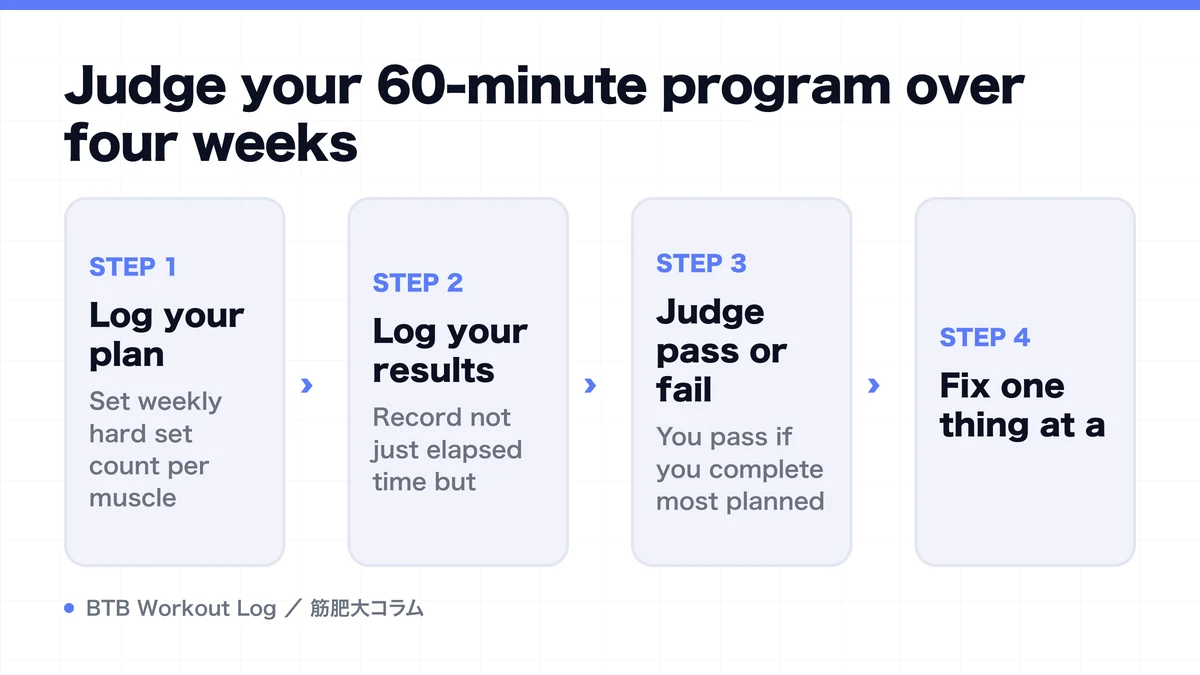
Practically speaking, lock in your 60-minute version for about four weeks and compare it to your pre-shortening baseline. Match your exercise selection, weekly frequency, and target rep ranges as closely as possible; avoid changing multiple variables alongside time. Look for a pattern across multiple sessions, not just the first week's hot or cold streak.
- Log your plan: Set weekly hard set count per muscle group, priority lifts, target sets per exercise, and rest guidelines.
- Log your results: Record not just elapsed time but completed sets, load, reps, RIR, and range of motion.
- Judge pass or fail: You pass if you complete most planned main sets, hold or gain weight or reps under matched conditions, and recover fully by next session.
- Fix one thing at a time: If it failed, try this order—remove duplicate exercises, move sets to other days, adjust accessory pairings, and adjust rest last.
Using your log as evidence means you're measuring whether progress repeats after the cut, not just the feel-good rush of a shorter session.
常見問題
- Can I sufficiently train my whole body three times a week at 60 minutes each?
- Yes. Rotate priority muscle groups each session and distribute your weekly hard set budget across all three days. You don't need to hit every muscle group equally each time. If reps or range of motion slip late in sessions, move sets to another day or cut duplicate exercises.
- How long should I rest between sets to fit everything into 60 minutes?
- Don't lock all exercises to the same rest interval. Let priority compounds fully recover until your next set output returns. With stable isolation work, shorten rest as long as you keep your load, reps, range, and RIR intact. Prioritize set-to-set repeatability over the clock.
- What should I cut if I can't finish my planned sets in 60 minutes?
- First, drop low-priority exercises with overlapping roles and any extra sets with no clear purpose. Next, move weekly sets to another day and pair only non-competing accessories. Cutting rest or range on main lifts first tends to trade time for lost set quality.
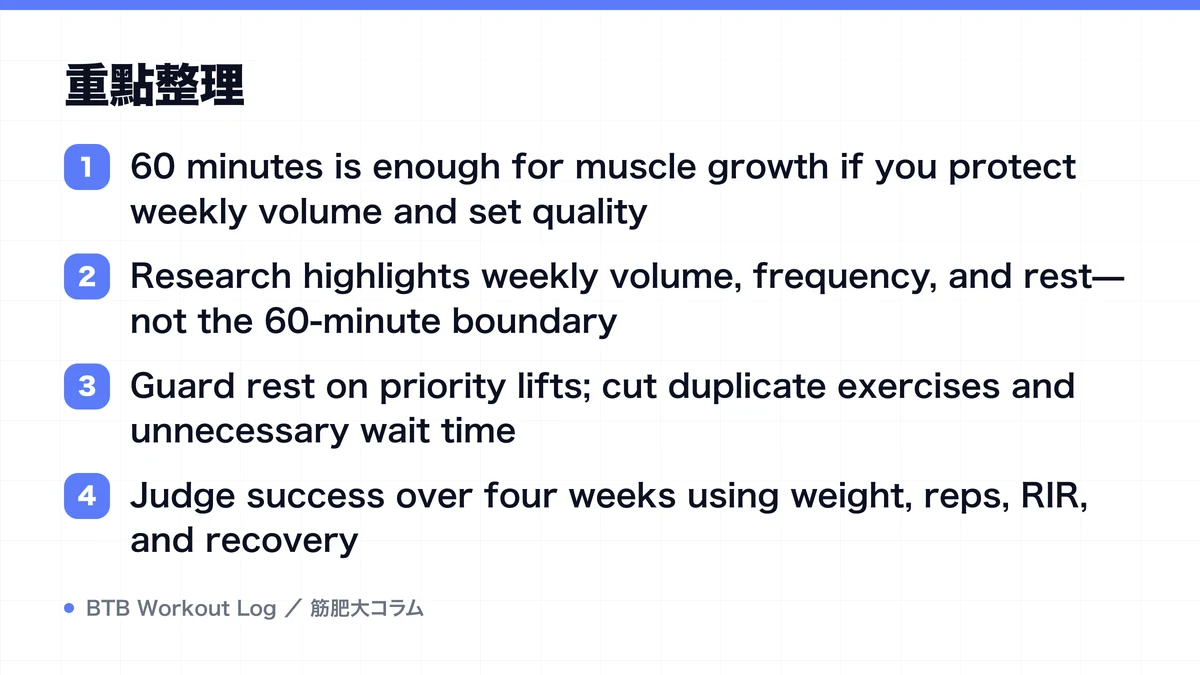
重點整理
- 60 minutes is enough for muscle growth if you protect weekly volume and set quality
- Research highlights weekly volume, frequency, and rest—not the 60-minute boundary
- Guard rest on priority lifts; cut duplicate exercises and unnecessary wait time
- Judge success over four weeks using weight, reps, RIR, and recovery
參考文獻
- Dose-response Relationship Between Weekly Resistance Training Volume and Muscle Mass
- Resistance Training Volume Enhances Muscle Hypertrophy in Trained Men
- Resistance Training Frequency and Muscle Hypertrophy: Systematic Review and Meta-analysis
- Longer Interset Rest Periods Enhance Strength and Hypertrophy in Trained Men