
단백질을 섭취하면 근육에서 무슨 일이 일어날까? 근단백질 합성을 쉽게 설명
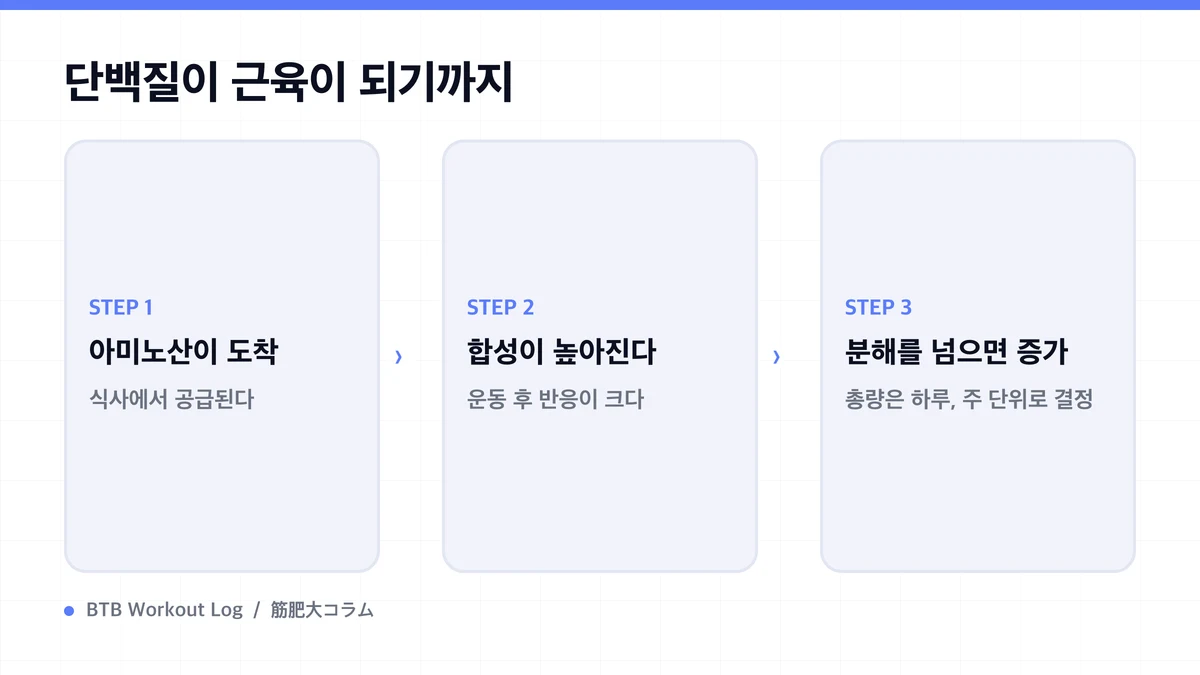
단백질을 섭취하면 소화로 생긴 아미노산이 근육에 전달되어 합성의 재료가 되는 동시에 근단백질을 만드는 반응을 촉진합니다. 하지만 한 번의 섭취로 근육이 바로 증가하는 게 아니라, 합성이 분해를 상회하는 짧은 시간을 여러 번 거듭해야 비로소 근비대로 이어집니다.
"프로틴이 근육으로 변한다"는 단순한 이야기가 아닙니다. 섭취부터 장기적 근비대까지 중간 과정을 빠뜨리지 않고 추적해봅시다.
1단계: 단백질은 아미노산까지 분해된다
고기, 생선, 계란, 유제품이나 프로틴에 함유된 단백질은 수많은 아미노산이 연결된 큰 분자입니다. 그대로 근섬유로 운반되지 않고, 위와 소장에서 펩타이드와 아미노산으로 분해된 후 소장에서 흡수됩니다. 식후에 혈중 아미노산 농도가 높아지는 건 이 과정을 거쳐 사용 가능한 재료가 순환계로 들어가기 때문입니다.
흡수된 아미노산의 전부가 근육이 되는 건 아닙니다. 소화기관이나 간에서도 사용되며, 효소와 호르몬을 포함한 다양한 단백질 합성, 에너지 대사에도 쓰입니다. 그 가운데 근세포로 취한 아미노산이 근단백질을 조립하는 재료 풀에 추가됩니다.
특히 체내에서 충분히 만들 수 없는 필수아미노산은 식사로 공급받아야 합니다. 근육을 공장에 비유하면, 섭취한 단백질은 완성품이 아니라 각 공정에서 활용되는 부품 공급입니다. 필요량 개념은 근비대에 필요한 단백질량에서 다루고 있으므로, 여기서는 공급 후 일어나는 반응으로 나아갑니다.
2단계: 아미노산은 재료이자 합성 개시의 신호다
혈중에서 근세포로 아미노산이 들어오면, 단순히 재료의 재고가 늘어나는 게 아니라 세포는 "합성에 쓸 영양이 왔다"고 감지합니다. 그 입력 중 하나로 중요한 게 필수아미노산인 류신입니다. 류신 증가는 영양 상태와 운동 자극 등 복수의 정보를 통합하는 mTORC1이라는 신호 경로의 활성화에 관여합니다.
mTORC1은 근육 자체가 아니라 단백질을 만드는 장치에 개시 지시를 전달하는 조절자 역할입니다. 활성화되면 유전 정보를 읽어 새로운 단백질을 조립하는 "번역"의 개시가 쉬워집니다. 즉 인과 순서는 단백질 섭취→아미노산 증가→영양 감지→번역 장치 활성화입니다.
자주 쓰이는 "류신이 스위치를 켠다"는 표현은 편리하지만, 켜짐과 꺼짐으로만 결정되는 기계가 아닙니다. 류신만 있어도 사슬을 끝까지 조립하는 데 필요한 다른 필수아미노산이 부족하면 재료가 멈춥니다. 또한 근력 운동에 의한 기계적 자극과 식사에 의한 영양 입력은 별개의 경로에서 합쳐집니다. 신호만 있거나 재료만 있는 어느 한쪽도 근비대에 필요한 반응 전체를 설명할 수 없습니다.
3단계: 리보솜이 아미노산을 배열해 근단백질을 만든다
합성 지시를 받으면 세포 내 리보솜이 설계 정보인 메신저RNA를 읽고 지정된 순서대로 아미노산을 연결합니다. 이렇게 액틴, 마이오신 등 근원섬유를 구성하는 단백질을 포함해 새로운 근단백질이 만들어집니다. 이 단위 시간당 생성 속도를 근단백질합성(MPS)이라 합니다.
MPS가 올라갔을 때 일어나는 건 손상 부위 메우기만이 아닙니다. 일상적으로 바뀌는 단백질 갱신, 훈련에 적응하기 위한 구조 재편성도 포함됩니다. 그래서 근육통의 강도와 MPS를 같은 것으로 취급할 수 없습니다. 근육통이 강하지 않아도 합성은 일어나고, 반대로 근육통이 강하다고 해서 합성분이 모두 새로운 근량이 되는 것도 아닙니다.
여기가 급성 반응과 장기 적응을 나누는 지점입니다. 한 끼 후 MPS가 높아지는 건 "만드는 속도가 빨라졌다"는 뜻이지만, 그 측정값만으로는 몇 개월 뒤 근비대 정도가 결정되지 않습니다. 근력 운동의 자극부터 장기 적응까지 전체상은 근력 운동으로 근육이 커지는 흐름과 연결되어 있습니다.
4단계: 근육이 증가하려면 합성과 분해의 차이로 결정된다
Muscle constantly breaks down old protein while simultaneously building new protein. The difference between synthesis and breakdown over a given period is your net muscle protein balance. When synthesis exceeds breakdown, the balance is positive; when it doesn't, it's negative. A single meal creates only a small, temporary positive balance, but by repeating training and eating over time, those positives accumulate and your muscle fiber cross-sections grow larger.
Resistance training elevates MPS and primes muscle to respond more readily to amino acids afterward. Protein intake supplies the raw materials and nutrient signals at that moment. So it's not "training versus protein"—they play different, complementary roles. Diet alone won't produce the specific adaptations training creates, and training without enough material won't allow those adaptations to accumulate.
This response doesn't have a fixed time window; the first 30 minutes after training isn't your only chance. That said, training doesn't mean you can skip eating for the next day. Rather than obsessing over narrow timing windows, the more practical approach is to secure adequate protein throughout the day and place normal meals both before and after training. You can review timing research in our amino acid timing guide.
Why BCAA and leucine alone can't complete the synthesis response
If leucine is the critical nutrient sensor signal, you might think BCAA alone would suffice. But BCAA consists of just three amino acids—leucine, isoleucine, and valine—and doesn't contain all the essential amino acids needed to build muscle protein. Even if the signal to start synthesis fires, without all the amino acid building blocks required, the synthesis reaction can't sustain itself properly.
Complete protein sources from food or whey supply not just leucine but all the other essential amino acids together. That's why adding isolated BCAA isn't a priority for people already hitting their daily protein target through normal meals. The supplement hierarchy aligns with this, as covered in our muscle-building supplement priority guide.
Similarly, protein doesn't keep raising MPS indefinitely the more you consume. Once a meal triggers sufficient synthesis, extra amino acids don't accumulate in muscle tissue at the same rate—they're used by other tissues and metabolic processes instead. The practical sequence is: first ensure your daily total isn't short, divide it across multiple meals without forcing it, then use protein powder for convenience. This order matches the underlying mechanism.
Practice: Stop chasing MPS directly; confirm the conditions for sustained stimulus and supply
MPS can be measured in research but isn't something you can track daily through feel, home scales, or muscle soreness. You can't estimate synthesis rate from post-shake pump, daily weight swings, or DOMS. In practice, replace the invisible link in this chain with conditions you can control and measure yourself.
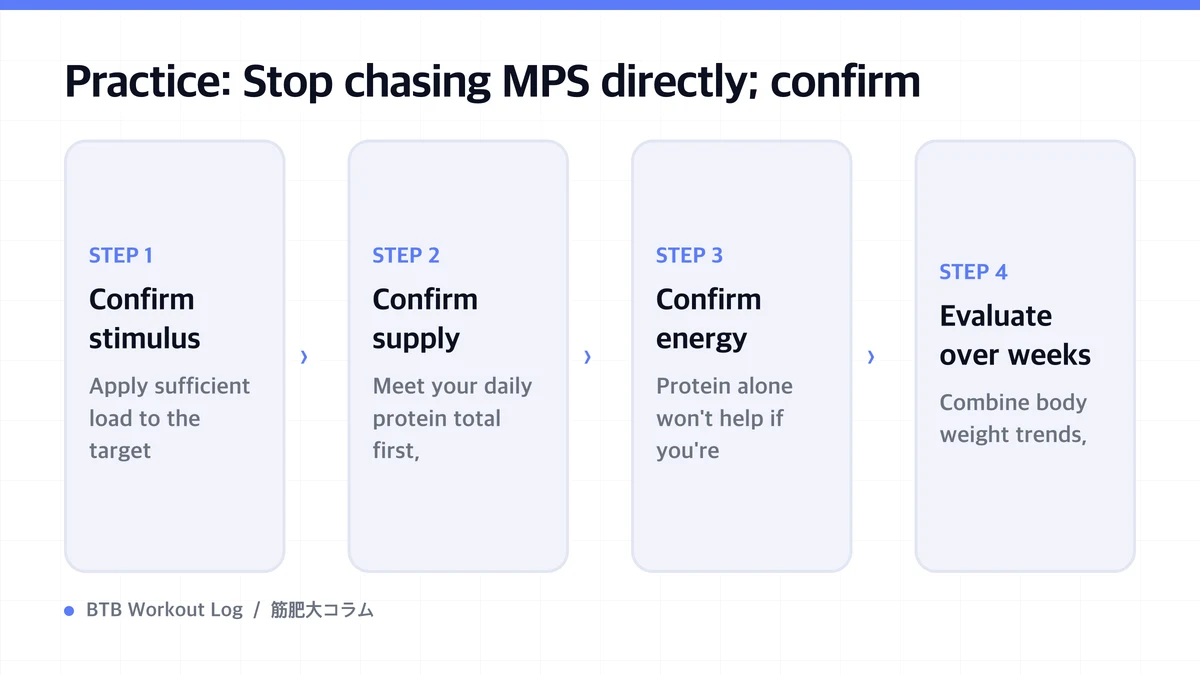
- Confirm stimulus: Apply sufficient load to the target muscle and track progress in weight, reps, or sets under the same conditions.
- Confirm supply: Meet your daily protein total first, then spread it across meals without dumping it all into one.
- Confirm energy: Protein alone won't help if you're running a prolonged, severe calorie deficit.
- Evaluate over weeks: Combine body weight trends, circumference or photos, and training performance under identical conditions—don't judge from single days.
If intake is genuinely short, adding more food or powder has room to help. If you're already sufficient, before increasing further, revisit 점진적 과부하, effective set volume per muscle group, and 회복 to pinpoint the next bottleneck. During a 감량, factor in not just protein but how calorie deficit constrains 근비대 as well.
Protein isn't a standalone command for 근비대—it's the material and signal that responds to the adaptive demands created by training. Rather than "Did I drink it?", ask "Am I repeating the required stimulus, supply, and 회복?" That's how you translate an invisible response like MPS into actual decisions.
자주 묻는 질문
- How many hours does muscle protein synthesis continue after eating protein?
- The magnitude and duration depend on meal size and quality, recent training, age, and training experience. Rather than trying to pin down a fixed window, prioritize meeting your daily total and distributing it across multiple meals consistently.
- If I don't drink protein right after training, do I miss the muscle protein synthesis window?
- Missing the first 30 minutes doesn't shut down the response entirely. Ensuring adequate protein across your meals before and after training takes priority. If you trained fasted, eating reasonably soon after makes practical sense rather than delaying for hours.
- If muscle protein synthesis is high, will muscle growth be proportionally large?
- A single acute MPS spike doesn't predict long-term 근비대 by itself. You need to evaluate the net balance between synthesis and breakdown, training stimulus quality, daily total intake, and 회복 stacked over weeks.
정리
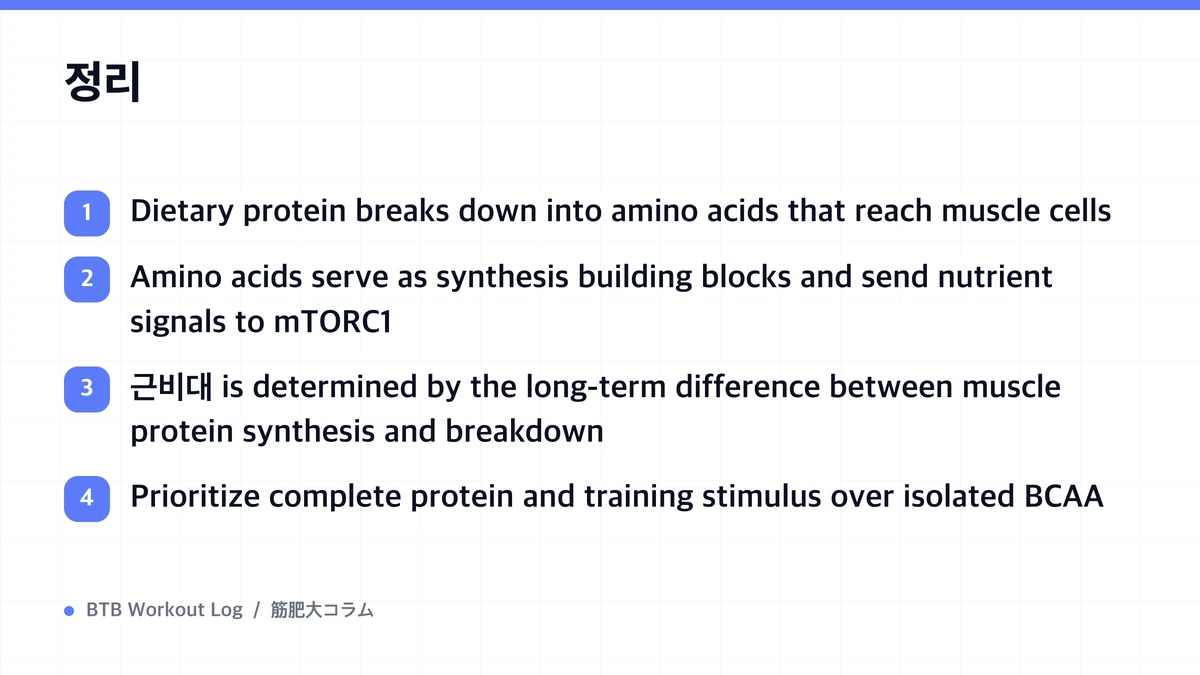
- Dietary protein breaks down into amino acids that reach muscle cells
- Amino acids serve as synthesis building blocks and send nutrient signals to mTORC1
- 근비대 is determined by the long-term difference between muscle protein synthesis and breakdown
- Prioritize complete protein and training stimulus over isolated BCAA
참고문헌
- Mixed Muscle Protein Synthesis and Breakdown After Resistance Exercise in Humans
- Branched-chain Amino Acids and Muscle Protein Synthesis in Humans: Myth or Reality?
- Protein Supplementation Augments the Adaptive Response of Skeletal Muscle to Resistance-type Exercise Training
- Protein Supplementation and Resistance Training-induced Gains: Meta-analysis