
健身頻率加倍,肌肉肥大卻沒有變快?「練得越多長得越快」的誤區
Simply adding frequency doesn't automatically increase your weekly effective work or the quality of each set. When weekly sets stay the same, frequency's main role is redistributing stimulus across more days.
Growth speed doesn't jump up the moment you add calendar days. For some lifters, spreading work improves quality; for others, recovery gaps or schedule chaos makes progress harder to sustain and replicate.
The flaw in "more training sessions = more growth opportunities"
If you bump chest from once weekly to three times weekly, it looks like you've tripled your growth stimulus. But training frequency here means how many times per week you train the same muscle group—not how many days you hit the gym. And when assessing muscle growth, you can't ignore total weekly sets alongside frequency alone.
Say you did chest for 12 sets on Monday, then spread 4 sets each across Monday, Wednesday, and Friday. Frequency tripled but weekly sets stayed at 12. Compare that to doing 12 sets each session—now frequency went up *and* weekly volume jumped from 12 to 36 sets. You can't credit higher frequency if the second example outperforms; volume changed too.
A second blind spot: session count and quality stimulus count aren't the same. Grinding out extra days while fatigued from the previous session, losing load or reps or range of motion, doesn't guarantee you added high-quality work. What matters isn't calendar frequency—it's how many times you can chase progress in a recovered state.
When weekly volume is held constant, frequency's add-on effect shrinks
Frequency research splits because some studies change frequency and volume together, while others hold weekly volume steady. A 2016 meta-analysis suggested twice weekly might outperform once weekly, but couldn't conclusively say whether three times weekly beats twice.
A later 2019 meta-analysis including more studies found that when total weekly volume is equated, any muscle growth difference between high and low frequency is statistically small or negligible. A 2026 meta-regression also confirmed frequency's independent effect on muscle growth is minor. Study populations, measured sites, and training experience all vary, so you can't blanket all people as identical. Still, the claim "more sessions mean proportionally faster growth" lacks solid backing.
This isn't saying frequency is pointless. Research is isolating the independent effect of splitting the same workload across more or fewer days. On the gym floor, raising frequency lets you spread a dense single session, which often improves the quality of later sets and fits life schedules better. Frequency's real value isn't magic multiplication of stimulus—it's making the necessary work repeatable in better condition.
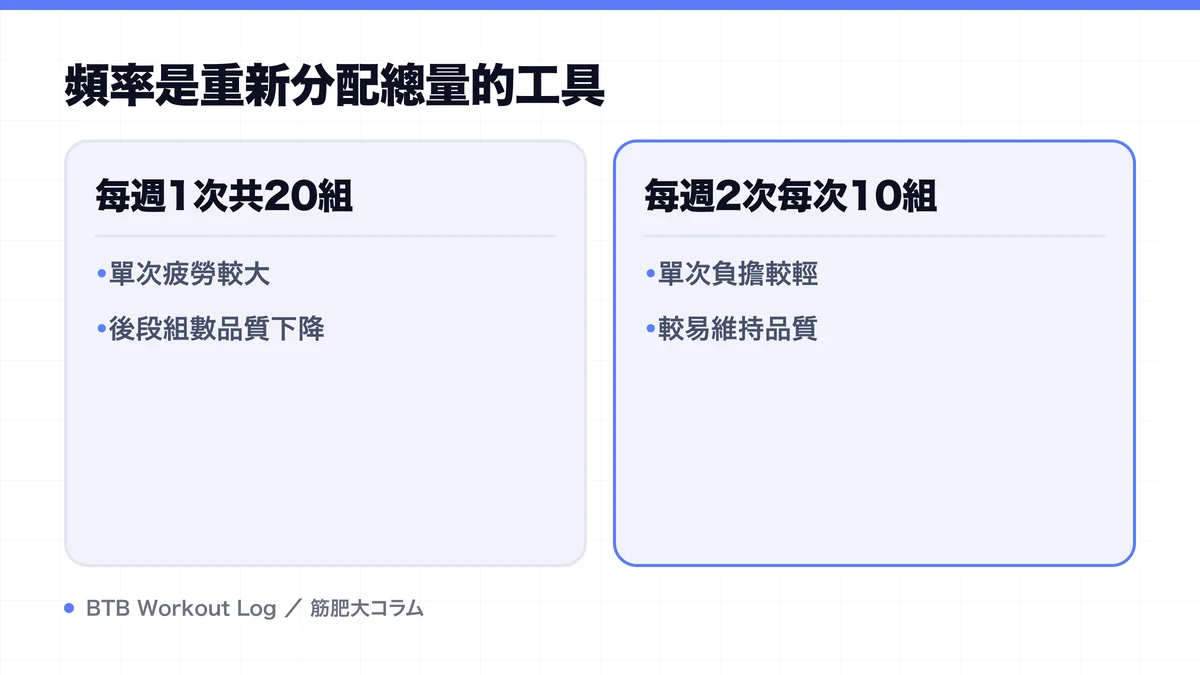
Raising frequency changes distribution and quality more than total stimulus
Twelve weekly sets in one session builds up local fatigue in later sets of the same muscle group. Split into 6 sets twice weekly, and many lifters maintain load, reps, and range of motion through to the end of each session. The advantage isn't inherent to high frequency—it's that spreading lets you execute your existing weekly sets at higher quality.
Yet spreading doesn't always boost quality. You might fatigue the triceps and shoulders hard on a pressing day, then train chest when they're still trashed. Or splitting lower body into more days spreads lumbar stress across consecutive days. Your RIR (how many reps in reserve you had left) falls short of plan; you hit the same load but grind out fewer reps. Even a "short" session isn't truly recovered if follow-up work suffers.
If you add sets every time you add a day, your weekly hard sets climb too. Weekly volume and muscle growth trend together, but each added set doesn't pay out the same—your recovery capacity and exercise choices shift your effective window. Changing frequency while also changing total volume makes it impossible to pin down what drove the result, win or lose.
Who should increase frequency and who should hold steady
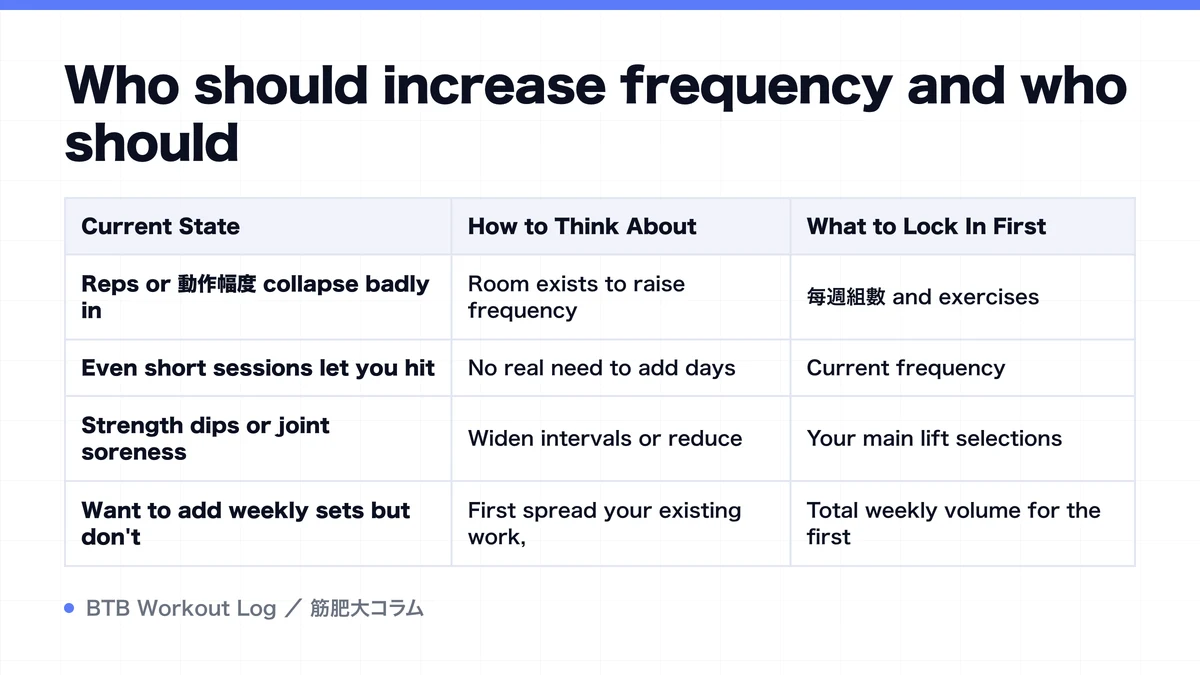
The real question isn't "how many times per week is ideal"—it's whether you're executing your current 每週組數 at high quality with the existing split. Here's how to break it down so your purpose becomes clear:
| Current State | How to Think About Frequency Change | What to Lock In First |
|---|---|---|
| Reps or 動作幅度 collapse badly in the second half of a session | Room exists to raise frequency and spread sets across more days | 每週組數 and exercises |
| Even short sessions let you hit or beat last week's loads | No real need to add days | Current frequency |
| Strength dips or joint soreness lingers until the next session | Widen intervals or reduce overlapping exercises | Your main lift selections |
| Want to add weekly sets but don't have daily time | First spread your existing work, then add small amounts later | Total weekly volume for the first 2–3 weeks |
The same logic applies when switching your 分離訓練. Moving from 3 days of 全身訓練 to 5 days of splits doesn't automatically raise frequency per muscle group. Count gym days, frequency per muscle, and direct vs. indirect sets as separate numbers. Presses, rows, and squat variations load multiple muscles at once, so don't assume low direct-exercise volume means you need more reps just because the count looks small.
If you're growing on once per week, set quality stays solid, and it fits your life, don't change just because the number seems low. Conversely, if you're cramming too much into one day and the back half becomes a grind, you may improve by splitting the same total without adding volume.
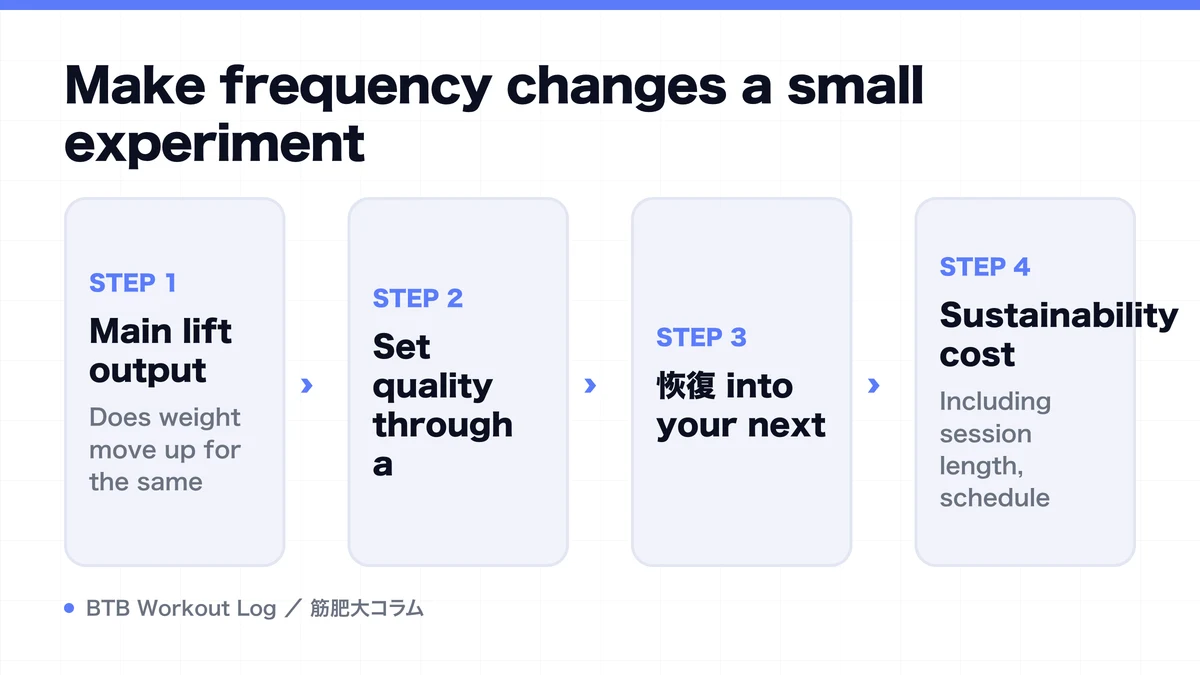
Make frequency changes a small experiment with 每週組數 held constant
When raising frequency, spend the first 2–4 weeks keeping 每週組數, main exercises, target 次數範圍, and RIR as stable as possible—shift only the distribution. If you go from 12 chest sets in one day to two days, simply do 6 and 6 first. Don't add sets the moment you create a new training day; that ruins the comparison.
Four metrics to track before and after the shift
- Main lift output: Does weight move up for the same reps, or do reps go up at the same weight?
- Set quality through a session: Do 動作幅度 and form hold until the end, and do you land where you planned with RIR?
- 恢復 into your next session: When you train the same muscle again, is there no obvious output dip from warm-up onward?
- Sustainability cost: Including session length, schedule disruptions, and sleep impact—can you actually repeat this split week after week?
If later sets improve in freshness after raising frequency, and weight or reps climb week to week, that split is working. If output drops across sessions and 恢復 stalls before the next stimulus, revert frequency, widen rest days, or cut indirect volume first. Don't decide by soreness alone; use multiple weeks of logs to spot the trend.
The app doesn't pick your optimal frequency for you. Use it to track whether a distribution change actually improved set quality and progress. Any frequency shift needs one check: did your weekly total stay the same? BTB Workout Log records 每週組數 per muscle group exactly for this reason.
提高訓練頻率後,每週組數會如何變化?
所謂「提高頻率」,實際上可能包含兩種性質完全不同的調整。一種是維持每週總組數不變,只重新分配到不同訓練日;另一種則是維持每次訓練量,同時增加每週總量。如果把兩者混在一起,就永遠無法判斷頻率本身的效果。
假設某部位原本每週練1次,共12組,改成每週2次、每次6組,總量並沒有改變。改變的是單次訓練中疲勞累積的方式,因此更容易維持後半段組數的訓練表現。相反地,如果某部位原本每週2次、每次6組,又多加第3個訓練日,把總量提高到18組,這測試的就不是頻率,而是透過增加訓練量來增肌。
正確順序是先固定每週總量,再將組數分散到不同訓練日,觀察單次訓練後半段使用的重量與完成次數是否改善。如果表現確實提升,恢復也跟得上,這時才進一步評估是否還有增加總量的空間。兩者同時調整,不論進步還是停滯,都無法判斷真正原因。
常見問題
- Will I build muscle if I only train each area once per week?
- Once per week works if you hit your required 每週組數 at good quality and weight or reps are climbing. If the second half of a session falls apart or you can't fit the volume in time, split it across two days without adding total sets—that's often worth it.
- What frequency should I start with for 肌肉肥大?
- Most people balance 每週組數 and 恢復 well by hitting each muscle around twice per week. But there's no fixed rule. Some grow on once per week; others do better spreading small amounts across three sessions. Adjust by set quality.
- Can I raise both frequency and set count at the same time?
- Doing both at once makes it impossible to isolate what drove the result. Lock 每週組數 first, shift distribution only for 2–4 weeks, then check output and 恢復. Once spread volume is solid and progress keeps going, add a small increment of sets as a separate, isolated change.
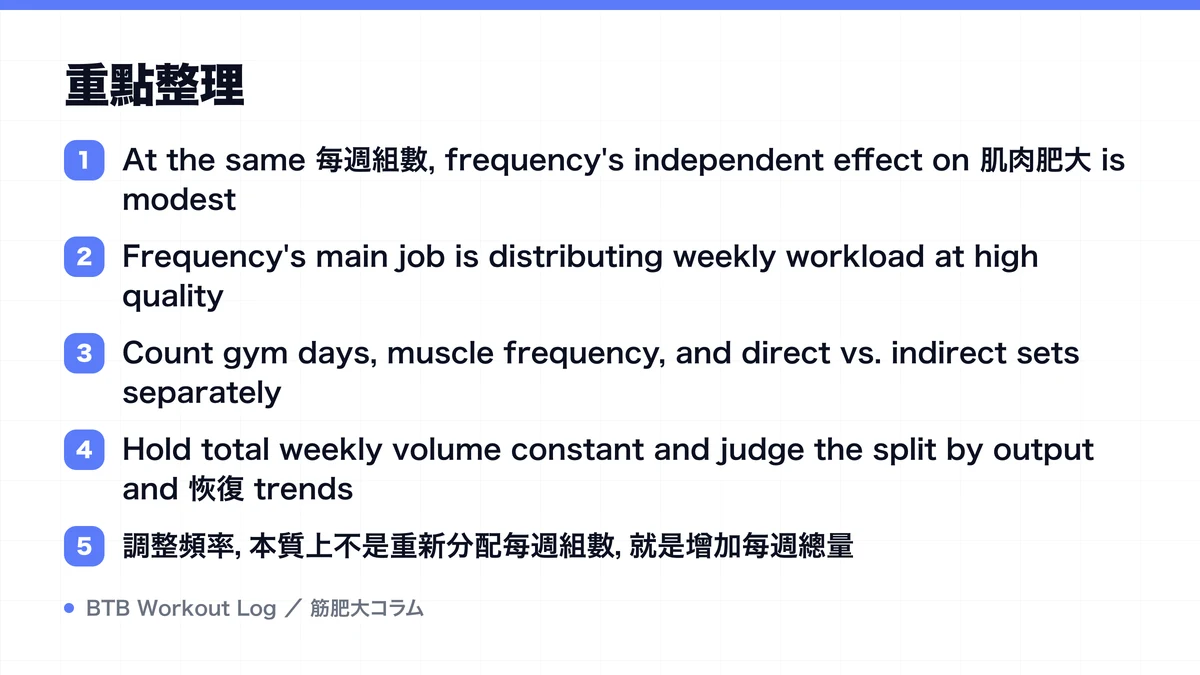
重點整理
- At the same 每週組數, frequency's independent effect on 肌肉肥大 is modest
- Frequency's main job is distributing weekly workload at high quality
- Count gym days, muscle frequency, and direct vs. indirect sets separately
- Hold total weekly volume constant and judge the split by output and 恢復 trends
- 調整頻率,本質上不是重新分配每週組數,就是增加每週總量
參考文獻
- Resistance Training Frequency and Muscle Hypertrophy: Systematic Review and Meta-analysis
- The Resistance Training Dose Response: Meta-Regressions Exploring the Effects of Weekly Volume and Frequency on Muscle Hypertrophy and Strength Gains
- Effects of Resistance Training Frequency on Muscle Hypertrophy: Systematic Review and Meta-analysis
- Dose-response Relationship Between Weekly Resistance Training Volume and Muscle Mass