
PPL vs 上下分離,哪種更適合你?肌肉肥大訓練法怎麼選才不會選錯
Four days a week? Upper-lower split is easier to structure. Six days, run short? PPL fits naturally. If weekly total and effort level per set match, the split name alone won't decide your muscle growth.
What matters is whether you can execute the required sets with high output, and whether you'll actually complete every session. When conditions are truly equal, your best choice becomes clear.
Five Conditions to Lock in Before Comparing PPL and Upper-Lower
PPL divides training into three splits: Push (chest, shoulders, triceps), Pull (back, biceps), and Legs. Upper-lower alternates two splits: Upper and Lower. Despite sounding different, both are just containers for distributing your weekly training volume across multiple days.
To compare fairly, lock in at least these five variables:
- Weekly hard sets per muscle group: the total weekly count of sets where your target muscle is the main actor and you reach your target RIR
- Effort level: keep RIR (reps in reserve) targets similar between both splits
- Exercises and range of motion: don't load one split with more exercise variety or longer movement ranges
- Progression: increase weight, reps, or set count consistently over time on both
- Execution rate: the percentage of planned sessions you actually complete
Ignore these conditions and you'll compare "6-day PPL" to "4-day upper-lower" and mistake frequency or volume differences for split differences. Start by checking whether both designs deliver similar quality work to the same muscle groups.
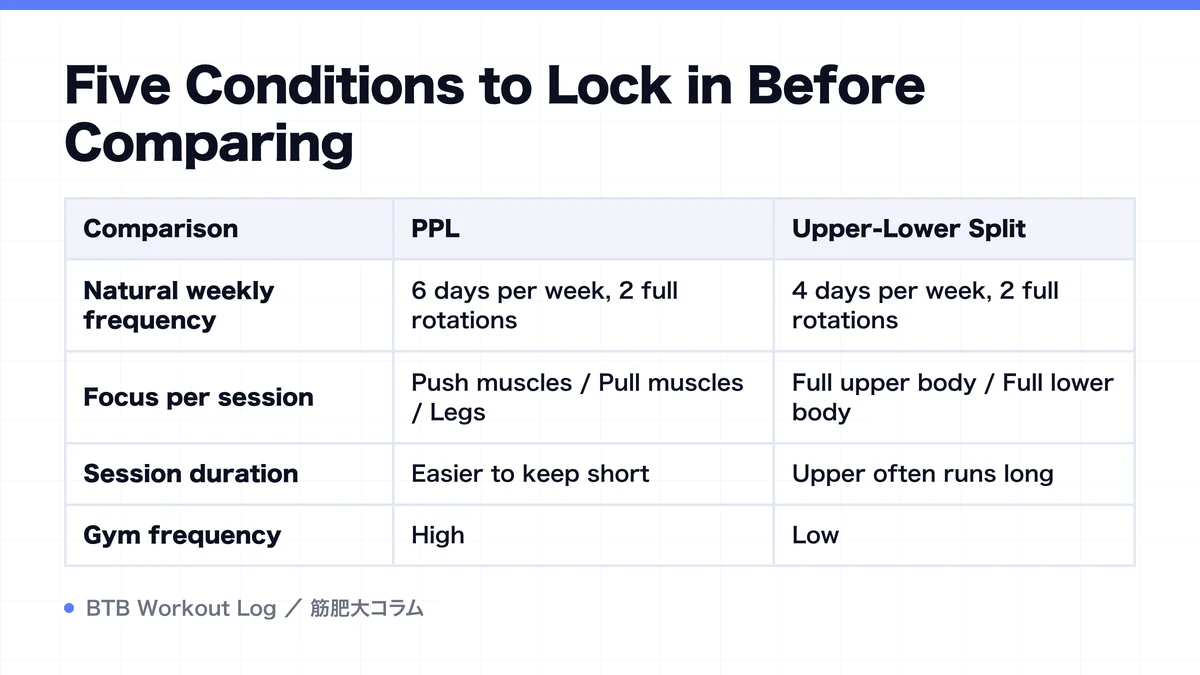
| Comparison | PPL | Upper-Lower Split |
|---|---|---|
| Natural weekly frequency | 6 days per week, 2 full rotations | 4 days per week, 2 full rotations |
| Focus per session | Push muscles / Pull muscles / Legs | Full upper body / Full lower body |
| Session duration | Easier to keep short | Upper often runs long |
| Gym frequency | High | Low |
| Impact of missing a session | One muscle group easily skipped if you train fixed days | Easier to catch up by shuffling the order |
Hypertrophy Comes from Weekly Volume, Not Split Name
Research directly pitting PPL against upper-lower doesn't show one consistently outperforming the other. The broader evidence shows: when weekly volume is equal, changing training frequency produces minimal differences in average hypertrophy. Recent meta-regressions suggest frequency itself has limited hypertrophy benefit, while weekly set count shows a clear dose-response relationship with muscle growth.
So if 6-day PPL puts 12 total hard sets on your chest on Monday and Thursday, versus 4-day upper-lower doing 12 sets on Tuesday and Friday—and if exercise selection, RIR, range of motion, and progression rate match—don't expect the split name to create a big difference. Frequency isn't independent magic; it's a variable for distributing total volume into units where your effort stays high. See training frequency for detailed research, and 每週組數 for how to count sets correctly.
But "same volume on paper" isn't enough in practice. If your Upper session crushes reps early but shoulder and arm reps crater by the end, those late sets don't have the same quality as they would on their own PPL day. Conversely, if you skip 6-day PPL multiple times monthly, your actual volume will lag behind upper-lower. The split that wins is the one you execute with high consistency and genuine effort—not the one that looks better on a spreadsheet.

PPL Spreads Fatigue Better; Upper-Lower Saves Travel Time
PPL's main strength is splitting upper-body work into Push and Pull. You group chest presses, shoulders, and triceps on one day, then place back and biceps on another, making it easier to limit exercise count per session. If you're someone who struggles with localized fatigue when doing presses, rows, and arm work all in one day during an Upper session, PPL tends to maintain better output across each lift.
That said, PPL isn't fatigue-free either. Shoulder presses after bench press, or triceps work—these all tap the same pressing muscles, so later exercises don't automatically stay high-quality. If you cram quads, hamstrings, glutes, and calves into Legs, that day becomes just as long as a Lower session in upper-lower split. It's not the PPL label itself that improves recovery; you need to manage local fatigue through exercise order and sets per session.
Time efficiency splits into two angles. Duration inside the gym tends to be shorter with PPL, suiting people who can reliably find 45–60 minutes. Total weekly time commitment, including travel, changing, and warmup usually favors upper-lower split at four sessions per week. If someone can do 75–100 minutes per session but can't commit to six days weekly, recommending a short PPL won't boost actual adherence.
Missed sessions matter too. On a fixed-day PPL, skipping Pull can leave your back with a long gap until the next stimulus. Pushing remaining days forward helps spread it out, but day-to-day mapping shifts. Upper-lower split requires fewer total sessions and is simpler to reshuffle—just cycle Upper then Lower. If your work or home schedule changes often, you should weigh consistency and ease of returning to training as major factors.
Load setting works for both splits, but tracking differs
There's no fundamental advantage in freedom to set weight and rep ranges. On PPL, your first-week Push can use heavy presses; second week can use medium-to-high reps. Upper-lower split lets you program Upper A heavier and Upper B more volume-focused. Lower can shuffle squat and hinge priority between A and B. Both let you train the same muscles twice weekly while spreading stimulus and joint stress.
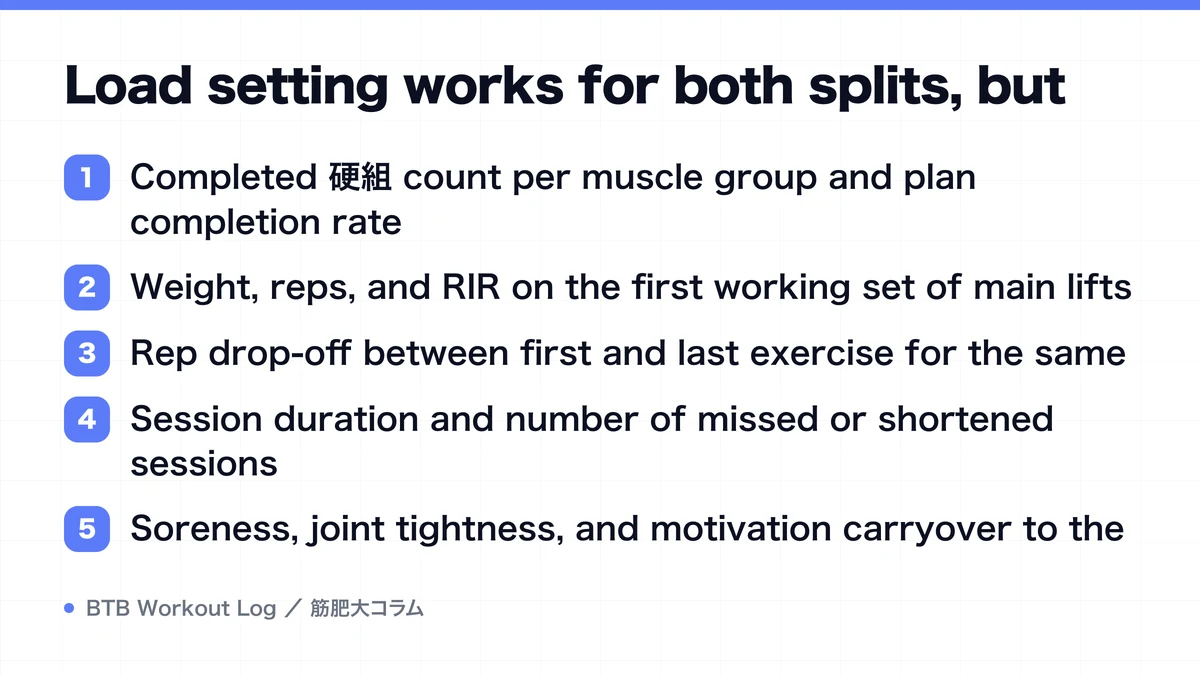
The real difference shows up in your training data. Track the following for at least 4–6 weeks, split by split:
- Completed 硬組 count per muscle group and plan completion rate
- Weight, reps, and RIR on the first working set of main lifts
- Rep drop-off between first and last exercise for the same muscle
- Session duration and number of missed or shortened sessions per week
- Soreness, joint tightness, and motivation carryover to the next session
Say you're on upper-lower split and only later Upper exercises like lateral raises and curls stall, while main presses and rows keep climbing—before switching everything to PPL, try reordering exercises. Conversely, if rep drop-off persists even after reordering, splitting into Push and Pull becomes justified. If PPL doesn't deliver gains either, first check your six-day adherence rate and total volume per muscle group; don't count simply adding frequency as a win.
Data is a tool to compare output and adherence before and after switching—not something that decides your split for you.
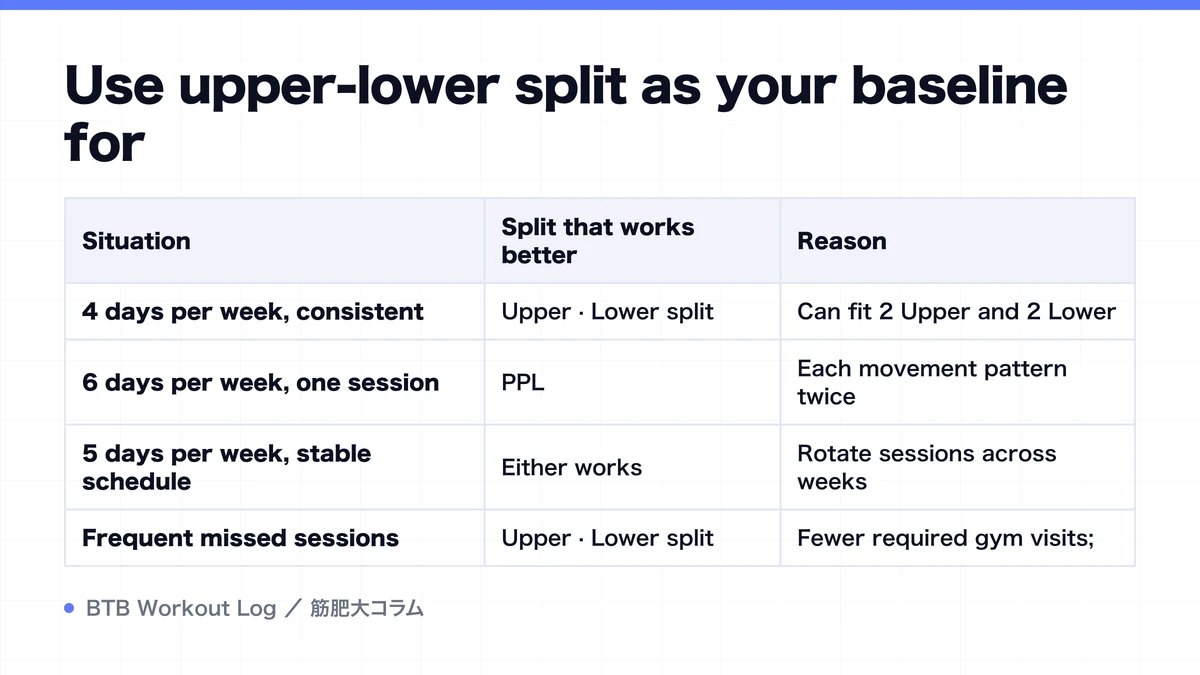
Use upper-lower split as your baseline for four sessions per week, PPL for six
| Situation | Split that works better | Reason |
|---|---|---|
| 4 days per week, consistent | Upper · Lower split | Can fit 2 Upper and 2 Lower sessions without strain |
| 6 days per week, one session shorter | PPL | Each movement pattern twice weekly while spreading upper body work |
| 5 days per week, stable schedule | Either works | Rotate sessions across weeks rather than fixing to calendar days, or combine PPL with Upper/Lower |
| Frequent missed sessions | Upper · Lower split | Fewer required gym visits; rotating sessions makes up imbalances faster |
| Upper session runs too long, late sets drop off | PPL | Split upper body into Push and Pull, reducing total exercises per session |
With 3 days per week, neither split works naturally. PPL fixed to 3 days means each pattern hits once weekly. Alternating Upper → Lower → Upper one week, then Lower → Upper → Lower the next gives each side an average of 1.5 sessions weekly, but creates week-to-week imbalance. If stuck with 3 days, revisit comparing 3-day full-body vs. split routines.
At 4 days, start with Upper · Lower split as your base, then check whether your Upper session runs too long. At 6 days, start with PPL as your base, then monitor for increased missed sessions and joint fatigue. At 5 days, you don't need to reset your rotation every Monday—PPL or Upper/Lower can flow continuously across the calendar. You don't have to squeeze the same pattern into every 7-day block.
After choosing, run your split for 4–6 weeks without drastically changing weekly set volume. If main lifts progress, late-set rep drops stay within tolerance, and you complete most planned workouts, that split is working. Conversely, if you're regularly going over time, missing sessions, or seeing sustained output drops in the same muscle groups, it's time to switch. PPL vs. Upper · Lower is best decided not by general theory, but by how much high-quality work volume you actually completed.
常見問題
- Is there a difference in muscle-building results between PPL and Upper · Lower split?
- If you match weekly 硬組 count per muscle group, RIR, exercise selection, 動作幅度, and progression between the two, a significant gap from split design alone is unlikely. In practice, PPL at 6 days versus Upper · Lower at 4 days differ in adherence and late-set output, so pick whichever lets you maintain high-quality total volume.
- Which is better for 5 days per week: PPL or Upper · Lower split?
- Both work. You can rotate PPL continuously without resetting to the calendar week, or combine 3 PPL days with 2 Upper · Lower days. Count the interval between each muscle group and weekly 硬組, then choose a layout where the same body part doesn't have two high-fatigue sessions back-to-back.
- Should I switch to PPL if my Upper · Lower Upper session runs too long?
- Don't overhaul everything immediately. First try moving priority lifts to the start of the session, moving arm work to a separate day, and cutting overlapping exercises. If rep drops and time overruns persist, splitting upper body into Push and Pull via PPL becomes a logical choice.
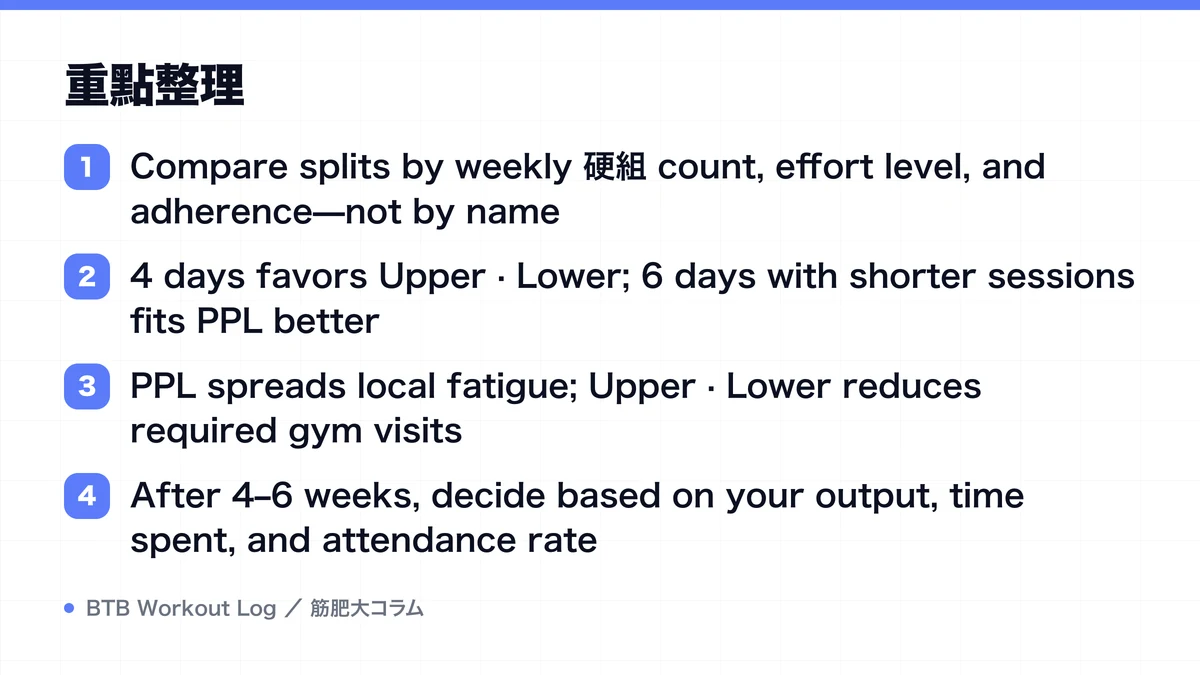
重點整理
- Compare splits by weekly 硬組 count, effort level, and adherence—not by name
- 4 days favors Upper · Lower; 6 days with shorter sessions fits PPL better
- PPL spreads local fatigue; Upper · Lower reduces required gym visits
- After 4–6 weeks, decide based on your output, time spent, and attendance rate
參考文獻
- Resistance Training Frequency and Muscle Hypertrophy: Systematic Review and Meta-analysis
- The Resistance Training Dose Response: Meta-Regressions Exploring the Effects of Weekly Volume and Frequency on Muscle Hypertrophy and Strength Gains
- Dose-response Relationship Between Weekly Resistance Training Volume and Muscle Mass