只做1個動作胸也能變大嗎?幫沒時間的人驗證胸大肌訓練
單靠一個動作確實能增大胸肌。但前提是這個動作能充分刺激胸肌,且你能維持高質量的每週組數與持續漸進超負荷。
需要檢驗的是兩個問題:「能否成長」和「能否最大化胸部全面發展」。前者是可能的,但後者則取決於角度刺激的不均勻分佈,以及肩膀和三頭肌是否會更先到達極限。
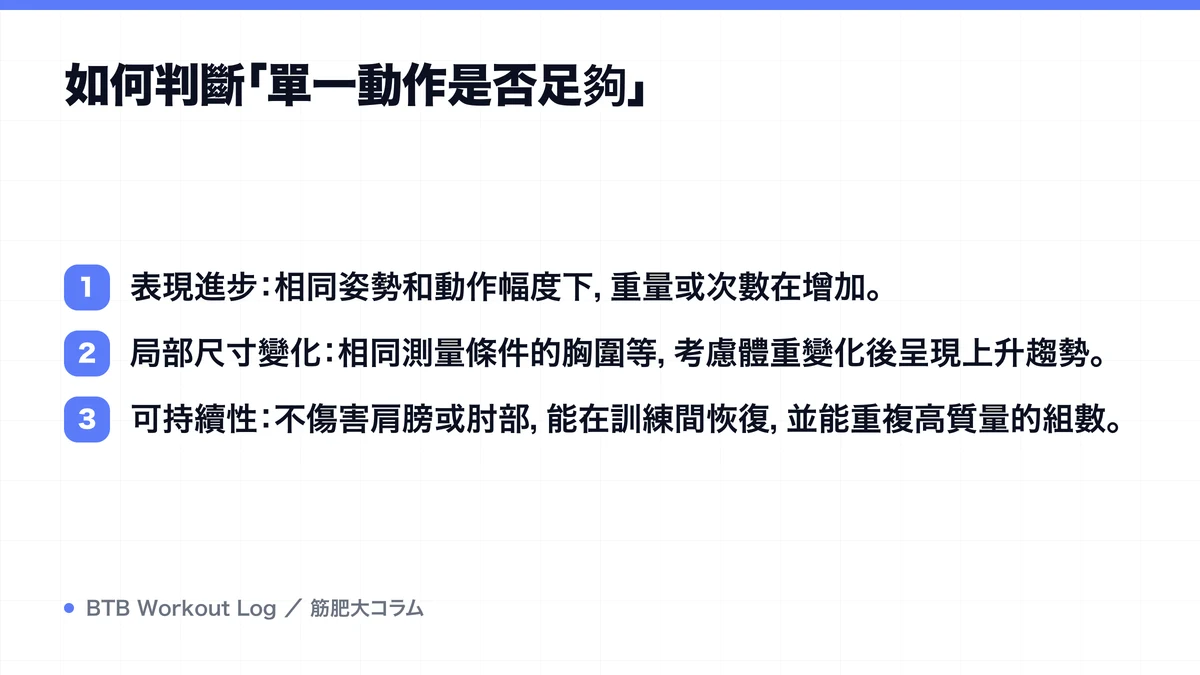
如何判斷「單一動作是否足夠」
這裡說的單一動作,指的是器械、平凳角度、握法、動作幅度基本固定的一個動作模式。如果平凳臥推和上斜臥推輪流使用,即便器械相同,刺激條件也不同,不能算作「單一動作」。
此外,單純肌肉充血或肌肉酸痛強烈,不足以判定「胸肌變大」。至少應追蹤8至12週,並在相同條件下檢查以下三項:
- 表現進步:相同姿勢和動作幅度下,重量或次數在增加。
- 局部尺寸變化:相同測量條件的胸圍等,考慮體重變化後呈現上升趨勢。
- 可持續性:不傷害肩膀或肘部,能在訓練間恢復,並能重複高質量的組數。
單一指標改善還不夠確定。比如增重期間的胸圍增加,也可能包含脂肪或背部的變化。多個指標朝同一方向發展,才能提升「單一動作也能成長」判斷的可信度。
肌肉肥大取決於組數的質量,而非動作種類數量
肌肉肥大的刺激來自於為目標肌肉提供充分張力的組數積累,並在恢復中重複這個過程。阻力訓練量和肌肉肥大之間存在平均劑量反應關係,但這不意味著增加動作種類就更有利。如果能用單一動作維持足夠的每週胸部組數,就沒有理由因為「只有一個動作」而認定失敗。每週組數的概念可參考每週硬組的做法。
另一方面,在可參考的研究中,並沒有在總組數和努力度相同的前提下,對「胸部單一動作」與「胸部多動作」進行長期直接比較的證據。較為恰當的做法是綜合每週組數、限界距離、角度刺激相關的研究,再通過實際訓練過程驗證成立條件。
但要注意,不能把熱身組或保留大量餘力的組數也算進去來湊數。RIR代表「還能做的次數」估計,實踐中多數組數控制在RIR 1至3範圍內,能在向胸肌施加充分努力的同時保持可重複性。不必每組都訓練到完全力竭,而且沒有明確證據表明力竭訓練比非力竭訓練在肌肉肥大上更優越。統一努力程度的方法可參考RIR使用指南。
另一個條件是進度。如果長期重複相同重量、相同次數、相同幅度,刺激不變,那麼單一動作還是五個動作都會停滯。需要在設定的次數範圍內增加次數,達到上限後小幅增加重量,以可比較的方式實現漸進超負荷。
胸部需要檢查「刺激偏差」和「提前疲勞的肌群」
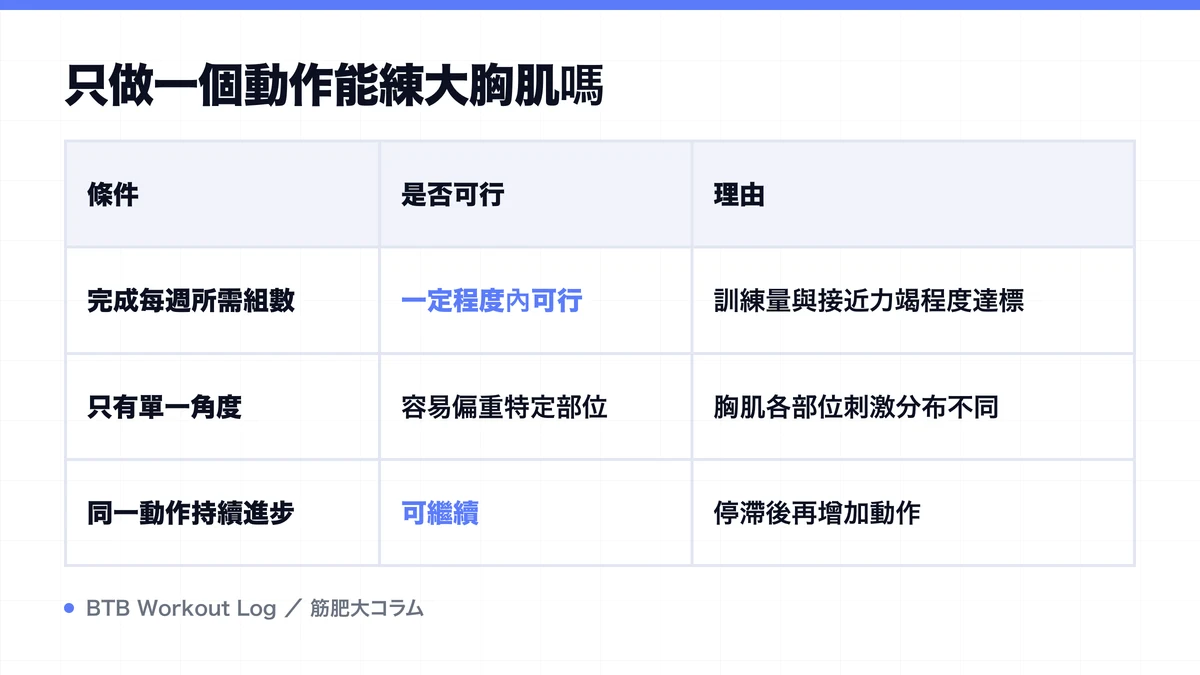
胸大肌看似一塊肌肉,但鎖骨側和胸骨側的纖維走向不同。對比平凳和45度上斜臥推的研究發現,胸大肌內強烈激活的區域會隨角度改變。不過這是單次肌肉活動的測試,並未直接證明增加角度就能產生更大的長期肌肉肥大效果。但這足以說明不應假設單一角度能完全相同地刺激整個胸部。
單一動作較容易成立的情況是:能用無痛的大幅度動作,胸肌在拉伸位置有充分伸展,組數後期能以胸肌出力下降結束。反之,如果三頭肌、前三角肌、姿勢穩定性或握力每次都先到達極限,就難以將整個組數視為對胸肌的有效刺激。關鍵不在動作名稱,而在於發現自己身體的限制因素。
堅持單一動作也有優勢。技術變得穩定,容易測量進度,減少熱身和換器械的時間。但負荷集中在同一關節角度,組數品質下降時也無法轉換動作來補償。不應把「不增加動作數量」當成目標,而應像考慮動作數量與成長的關係那樣,按每組的功能來思考。
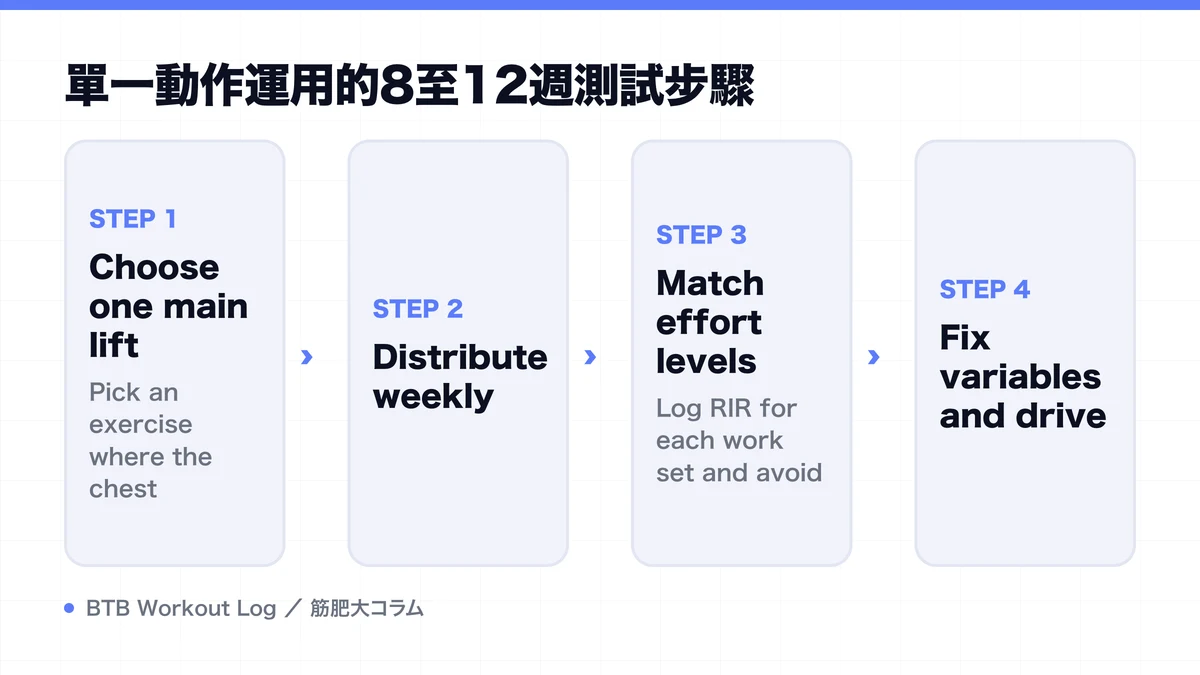
單一動作運用的8至12週測試步驟
- Choose one main lift: Pick an exercise where the chest becomes the limiting factor, you can replicate pain-free 動作幅度 each session, and load adjustments are straightforward. Free weights aren't mandatory.
- Distribute weekly volume: Base your target 每週組數 on what your chest can currently recover from, then spread the work across roughly two sessions per week instead of loading everything into one day. If reps or 動作幅度 drop significantly toward the end of the week, first reduce sets per session.
- Match effort levels: Log RIR for each work set and avoid both sets that feel too light and taking every set to complete failure. Control fatigue by, for example, only pushing one final set near failure each week.
- Fix variables and drive progress: Don't frequently change bench angle, grip, tempo, or 動作幅度—keep conditions identical and increase either load or reps. If you increase reps by shortening range, that doesn't count as progress.
- Reassess after 8–12 weeks: Look at performance, chest changes, and joint health together. If pain appears or the chest isn't the limiting factor, adjust before the 8–12 weeks is up.
For example, twice per week with 3–5 work sets per session is a reasonable starting point, but actual volume depends on your training age, effort, and 恢復 capacity. Don't treat the numbers as a fixed formula; start with a range that keeps set quality high throughout the week.
Single-exercise work pairs well with detailed logging because there are fewer variables to compare.
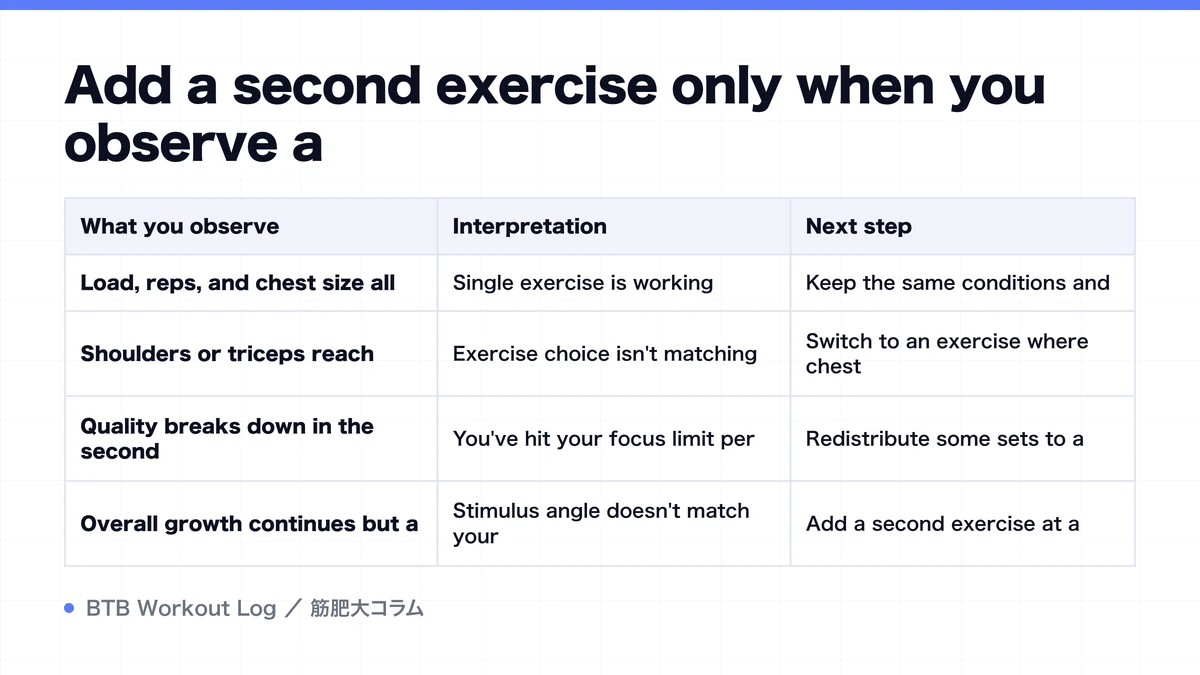
Add a second exercise only when you observe a specific gap
| What you observe | Interpretation | Next step |
|---|---|---|
| Load, reps, and chest size all trending up with no pain | Single exercise is working | Keep the same conditions and continue |
| Shoulders or triceps reach failure before chest | Exercise choice isn't matching your goal | Switch to an exercise where chest is the limiting factor |
| Quality breaks down in the second half of your weekly sets | You've hit your focus limit per movement | Redistribute some sets to a different exercise |
| Overall growth continues but a priority area (e.g. upper chest) stays unchanged | Stimulus angle doesn't match your goal | Add a second exercise at a different angle |
| Shoulder or elbow discomfort keeps recurring | This exercise isn't sustainable long-term | Switch to an exercise using different equipment or mechanics |
When you add a second exercise, don't just pile on extra sets; first reassign some of your existing sets. This way you keep total volume roughly constant while isolating whether the angle or stability change actually moved the needle. Keep the main lift as your comparison anchor and use the second lift purely to fill the gap you identified.
For bigger-picture chest programming, see chest 肌肉肥大 training. Whether to stick with bench press alone is covered in bench press only for chest. While you're making progress with one exercise, there's no reason to add more—but once you spot a real gap, a second lift has clear value.
常見問題
- If I'm training chest with just one exercise, what should I pick?
- Choose an exercise where the chest is the main limiting factor, you can repeat a large pain-free 動作幅度 consistently, and you can adjust load in small increments. Don't limit yourself to barbells—dumbbells and 機械 both work. Pick something you can track progress on over 8–12 weeks under identical conditions.
- Will the upper chest grow if I only do flat-bench movements?
- Yes, it gets stimulated, but research shows that bench angle shifts the excitement distribution within the pectoralis major. If everything is growing but the upper chest isn't progressing as a priority, either make incline your main lift or redirect some sets to a steeper angle.
- How long should I wait without progress before adding a second exercise?
- Use 8–12 weeks as a baseline to track load, reps, and chest changes under the same form, 動作幅度, and RIR. Consider a second exercise only if multiple metrics stall even after fixing 恢復 and load. If joint discomfort or pre-exhaustion of secondary muscles appears, change sooner.
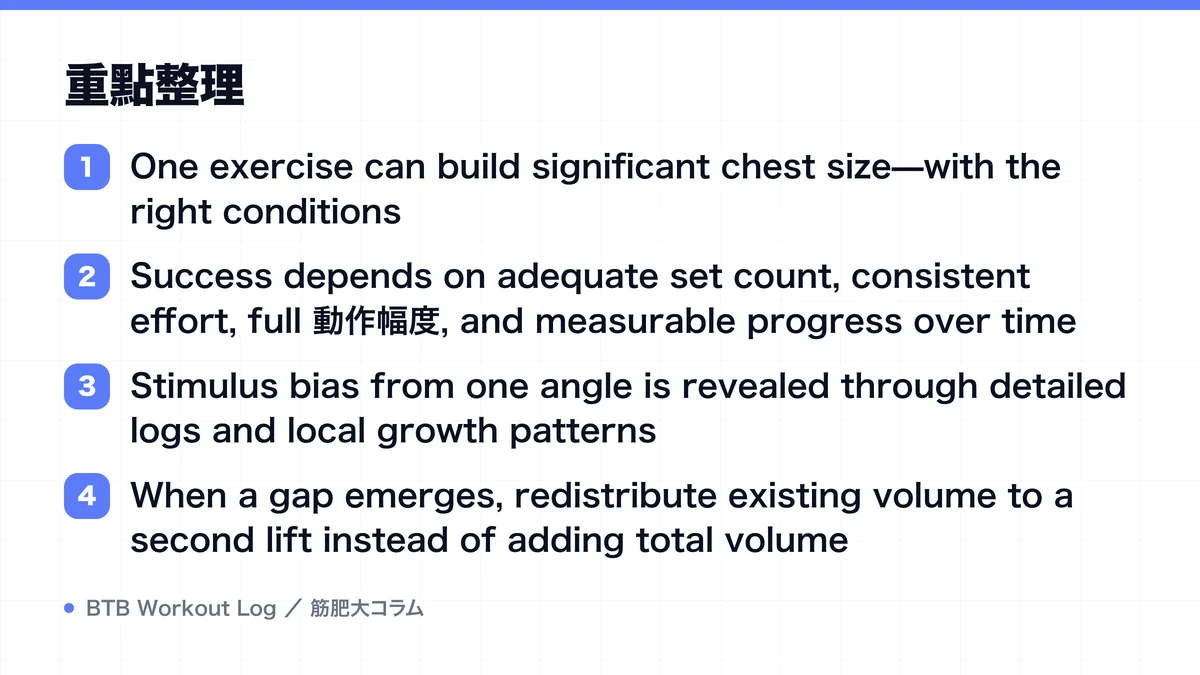
重點整理
- One exercise can build significant chest size—with the right conditions
- Success depends on adequate set count, consistent effort, full 動作幅度, and measurable progress over time
- Stimulus bias from one angle is revealed through detailed logs and local growth patterns
- When a gap emerges, redistribute existing volume to a second lift instead of adding total volume