
每週只能練3天,該選全身訓練還是分離訓練?肌肉肥大不吃虧的選擇方式
每週3次時,以全身訓練為初期設定比較合理。但若全身訓練會導致後期動作輸出下降,或想在特定部位分配更多組數,分離訓練的方式能讓你更高效率地完成每週的訓練量。
應該比較的不是訓練方式的名稱,而是用相同的每週組數,哪種方式能穩定完成並持續增加重量和次數。
在比較全身訓練和分離訓練前,先統一條件
全身訓練是在一次訓練中涵蓋腿、胸、背等主要肌群的組織方式。每週3次時,每個肌群容易接受2~3次刺激,每次的組數也能分散。而分離訓練則是依日期區分訓練對象,如上半身·下半身,或Push·Pull·Legs(PPL)的組織方式。若想全面比較分割訓練的各種類型,可參考分割訓練的比較。
公平比較的關鍵是統一每個肌群的每週組數、每組的努力程度、以及動作幅度。若只讓全身訓練的胸部每週12組、分離訓練每週6組,比較的就不是方式的差異,而是訓練量的差異。這裡的比較標準有以下5個:
| 比較軸 | 確認事項 |
|---|---|
| 肌肉肥大 | 能否在不降低品質的前提下完成所需的每週組數 |
| 疲勞 | 局部疲勞和全身疲勞能否在下次訓練前恢復 |
| 時間 | 包括準備在內,能否在可用時間內完成 |
| 負荷設定 | 重量、次數、RIR能否重現並持續進步 |
| 生活適配 | 缺席或改期時訓練是否會產生失衡 |
在這些條件下,比較的就不是「哪種方式更強」,而是「在自己的限制條件下,哪種方式更容易創造進步」。

肌肉肥大由每週刺激量和組的品質決定,而非訓練方式的名稱
從訓練頻率研究的統計來看,當每週訓練量相同時,單純增加頻率對肌肉肥大的額外收益並不明顯。頻率不是一個獨立的魔法變數,而是決定每週組數如何分配到各個訓練日的變數。包括研究解讀方法在內的詳細內容可參考訓練頻率。
全身訓練的優勢在於,例如胸部的組數分散到周一·周三·周五,每次都能在相對新鮮的狀態下進行。對於一天內集中訓練導致後期次數或動作幅度下降的人來說,分散的效果最明顯。相反,若每週組數較少且能在一天內保持輸出,分離訓練也能充分完成相同的訓練量。
要注意的是為了增加接觸頻率而盲目添加輕量組。RIR表示「還能做的次數」,沒有達到目標RIR的組,即使同樣是1組,刺激程度也會不同。先保持當前的每個肌群的每週組數,只改變組數配置,就能更清楚地判斷方式的差異。
因此即使全身訓練是平均起點,肌肉肥大效果也不是全身訓練永遠更優。若全身訓練每次後期動作都下降,那麼與其維持名義上的高頻率,分散訓練來保持品質更加合理。

疲勞和時間效率取決於一天的集中度,而非總訓練量
全身訓練能分散各肌群的局部疲勞,但若在同一天排列深蹲、推舉、划船、鉸鏈動作,全身疲勞和動作轉換的時間會增加。每次都高強度進行的設計容易導致疲勞在周五前累積。對策是調整日常重點——周一優先腿部、周三優先推舉、周五優先拉動——在全面鍛煉的同時改變每天的重點。
分離訓練能針對特定部位,所需器材少,訓練流程容易建立。但若把胸部的所有組數集中在胸部日,後期會因相同肌群的局部疲勞而出現次數下降。即使單次訓練時間縮短,若每週總組數相同,總時間消耗不一定會大幅減少。
每週3次時,缺席抗性也成為差異點。全身訓練即使休息1次,該週多數肌群仍能得到2次刺激。若採用周一推舉·周三拉動·周五腿部的3分割,缺席周五會導致下次腿部訓練延至下週。對於日程易變的人,全身訓練更適合;對於能穩定安排日期且想提高單次集中度的人,分離訓練更適合。
疲勞不應只看肌肉痠痛程度。要觀察同樣的動作·同樣條件下重量或次數是否下降、是否在達到目標RIR前動作崩潰、關節是否持續不適等輸出變化。
每週3次時,有2種容易追蹤進度的組織方式
Full-Body Training: Rotate Priority with A, B, C Days
Hit all major muscle groups Monday, Wednesday, and Friday, but shift the lead exercise and set distribution each session. For example, A emphasizes squat patterns, B emphasizes pressing, and C emphasizes pulls and hinge movements. Don't just repeat the same exercises at the same intensity across all three days. Instead, reduce sets on non-priority lifts to preserve output quality in the second half of each workout while maintaining frequency.
When training the same lift multiple times per week, you don't need to fix the weight. Vary your approach: one heavy day, one moderate day, one rep-extension day—then track progress within each condition. Use the RIR framework to set intensity. This way, on a fatigued day, you're not forced to chase the same load.
Split Training: Consider Upper/Lower Alternation Instead of Pure 3-Way
Three days per week doesn't have to mean PPL. Alternate upper and lower body: Week 1 runs upper-lower-upper, Week 2 runs lower-upper-lower. Each body part gets three sessions every two weeks, averaging 1.5 times per week. Since volume fluctuates week to week, track it over 14 days, not just seven. This hybrid works if full-body sessions run too long but you don't want each muscle group only once per week.
If you run PPL on Monday, Wednesday, Friday, each body part trains roughly once per week. Even so, if you maintain set quality through the final exercises and see load or reps improve the following week, the split works. The key is consistency: don't swap exercises constantly. Record the same lift under the same conditions so you can verify progressive overload.
Regardless of structure, what matters isn't completing sets—it's achieving tension through full range of motion with real effort, then proving you can handle more in the same conditions next time. Overhaul your exercise selection every time you switch templates, and you'll never know what actually worked.
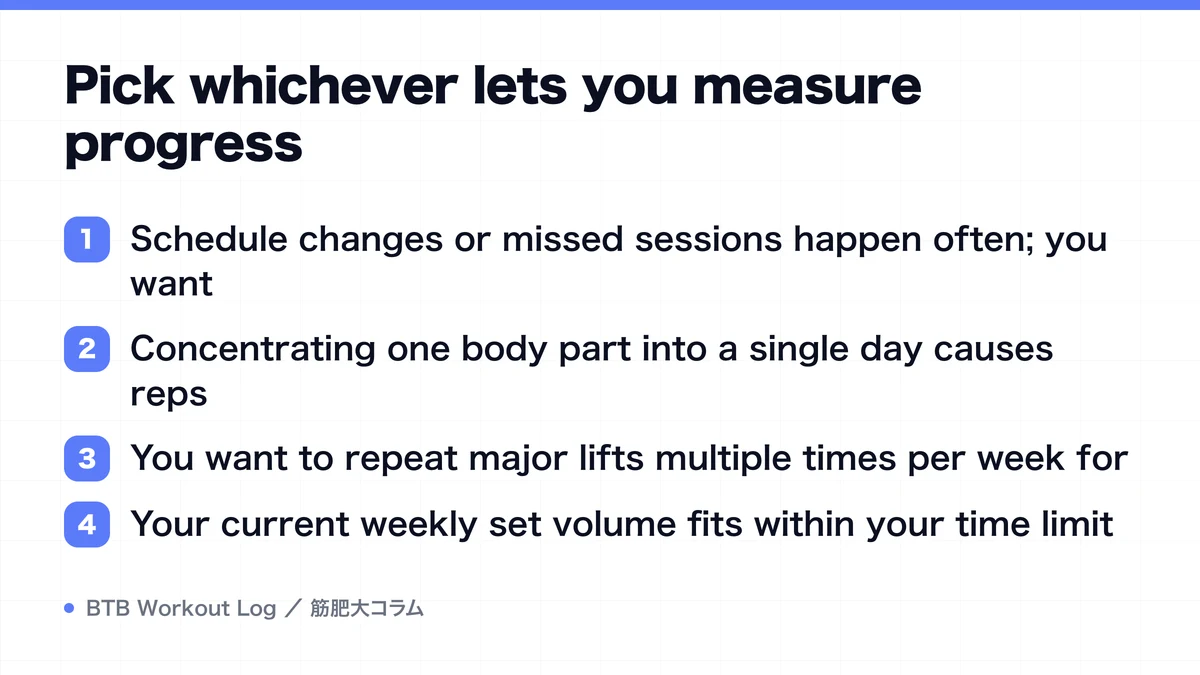
Pick whichever lets you measure progress after four weeks
If most of these apply, start with full-body training:
- Schedule changes or missed sessions happen often; you want to avoid skipping entire muscle groups
- Concentrating one body part into a single day causes reps to drop in later sets
- You want to repeat major lifts multiple times per week for motor practice
- Your current weekly set volume fits within your time limit when spread across three days
If most of these apply, a split is worth trying:
- Full-body workouts balloon in exercise count, and your priority lift always comes last
- You need to give one or two body parts extra volume while maintaining others
- You have a hard time cap and need to narrow your focus
- You can lock in your training days and reschedule missed sessions if needed
When switching, keep weekly set totals and main exercises as similar as possible. Change only the split for four weeks and compare. Look at load, reps, and RIR on your first effective set versus your last one, total session time, and recovery to the next session. If full-body always sees the final exercise tank, adjust the order or try a split. If a split causes later sets to degrade, move some to a separate day.
For this comparison, logged history beats memory. A good default is: start with full-body for three days, then shift to upper/lower or PPL if the recovery or output demands change. That way you're not locked into one format.
常見問題
- Can the same muscle group recover if I train it every session in full-body?
- You don't need to go all-out every time. Shift the emphasis and set count from day to day, then verify load and reps return under identical conditions. If recovery stalls, lower volume or effort per session before cutting frequency.
- Can I build muscle on PPL if each body part trains only once per week?
- Yes. Each muscle group only needs to hit the minimum effective weekly set total—executed cleanly—with progress from week to week. Just watch for two things: output drop in later sets after concentrating work into one day, and the risk that a missed session means an entire body part vanishes for the week.
- When should I switch from full-body to a split?
- When a specific body part repeatedly loses load, reps, or range of motion in the back half of your full-body session, and reordering exercises doesn't fix it. Keep your weekly set total and main lifts the same, try a split, and compare your four-week log to see if set quality improves.
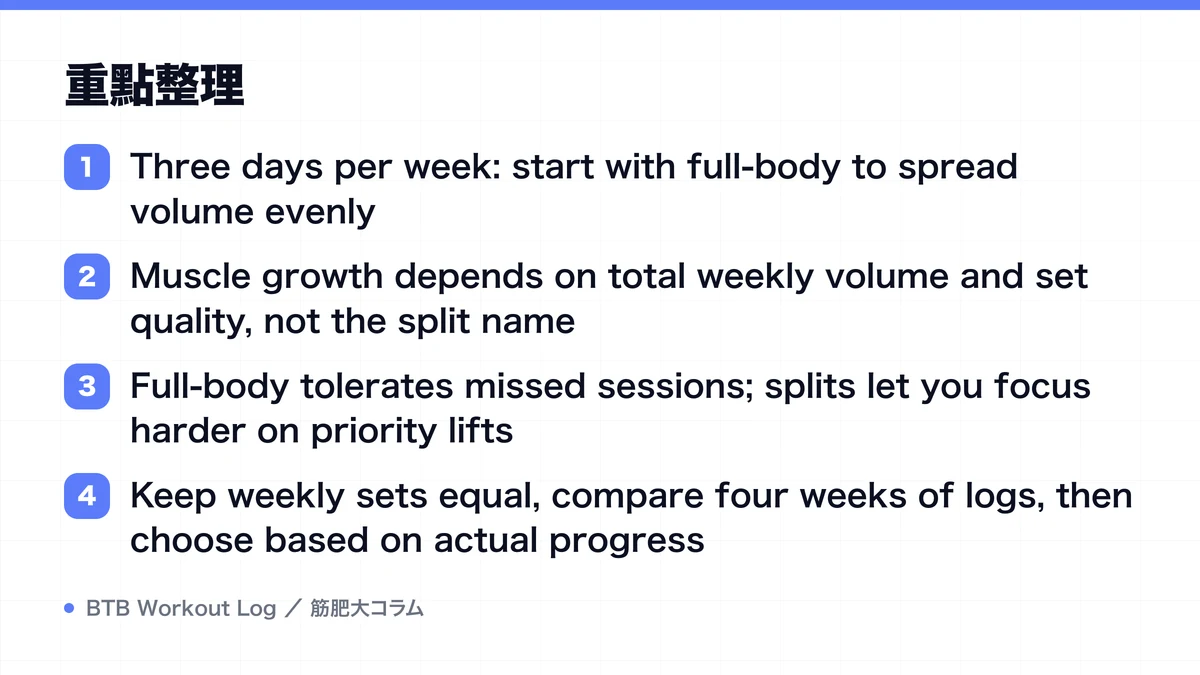
重點整理
- Three days per week: start with full-body to spread volume evenly
- Muscle growth depends on total weekly volume and set quality, not the split name
- Full-body tolerates missed sessions; splits let you focus harder on priority lifts
- Keep weekly sets equal, compare four weeks of logs, then choose based on actual progress
參考文獻
- Resistance Training Frequency and Muscle Hypertrophy: Systematic Review and Meta-analysis
- The Resistance Training Dose Response: Meta-Regressions Exploring the Effects of Weekly Volume and Frequency on Muscle Hypertrophy and Strength Gains
- Dose-response Relationship Between Weekly Resistance Training Volume and Muscle Mass
- Effects of Resistance Training Frequency on Muscle Hypertrophy: Systematic Review and Meta-analysis