
「每次都加重量=漸進超負荷」是誤解|越認真的人越容易陷入的陷阱
每次加重是实现漸進超負荷的一种手段,但不是定义本身。真正的本质是根据身体适应进展,长期调整重量、次数、组数等因素。
如果先把增重当成硬指标,容易为了「数字进步」而牺牲动作幅度、形式和RIR。看的应该不是杠铃上的铁片数量,而是在相同条件下的表现变化和可恢复刺激的演进。
加重的想法在多大程度上是对的
增加外部负荷是实现漸進超負荷最直观的方法。如果你用相同的动作幅度和形式、相同的次数和RIR,从80kg进阶到82.5kg,那很可能说明你确实变得更强了。RIR是「还能做多少次」的指标,RIR 2意味着距离力竭还剩大约2次。
对新手来说,动作熟练度和神经系统适应都很快,每次训练都能加重。这种线性进行简洁明了,不容易产生判断困惑。但这是因为每次都有进步空间才加得上,并不是加重这个动作本身能保证肌肉肥大。随着训练经验增加,适应速度会放缓,继续保持相同的增重节奏就不现实了。
所以加重不是要放弃的指标。如果你追求力量提升,它特别重要。误解从「条件相同的加重」被替换成「不管条件的每次加重」开始出现。
加了重不等于刺激进步
漸進超負荷是根据身体适应来推进刺激的思路。先加重然后凑数字是两回事。比如上次你80kg做8次、RIR 2、动作幅度标准,这次却用82.5kg只做6次、RIR 0、幅度变浅。杠铃是重了,但次数、力竭程度、动作条件全变了,不能简单地说这是肌肉肥大方向上的进步。
单看重量不够是因为决定刺激和疲劳的变量不止一个。看起来加重成功,但如果动作形式让目标肌肉躲过负荷、动作幅度变短、代偿动作增多,那就不能说针对肌肉的刺激强了。
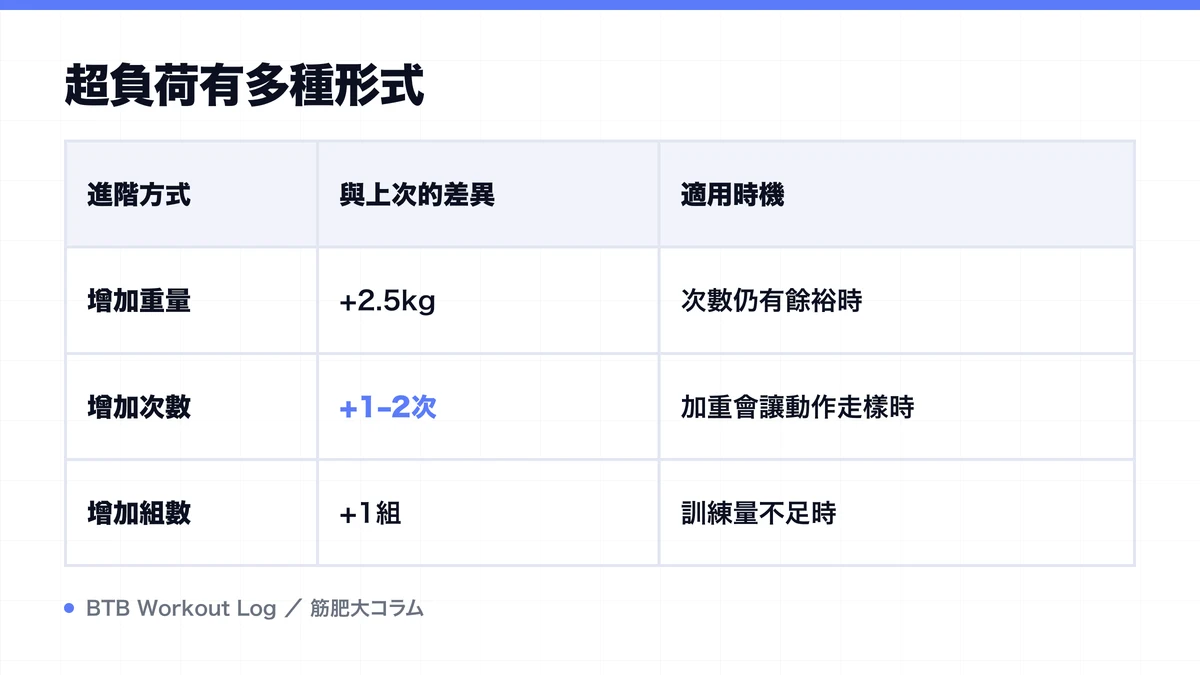
| 纸面上的变化 | 容易被认为是进步的条件 | 需要注意的地方 |
|---|---|---|
| 重量增加 | 次数、RIR、幅度、形式都保持一致 | 用反弹或缩短幅度可能只是数字上升 |
| 次数增加 | 重量和动作条件一致 | 不同距离力竭的组难以直接对比 |
| 组数增加 | 每组质量保持,周期内能恢复 | 后面的组质量下降就容易纯粹增加疲劳 |
| 成绩维持 | 在高疲劳期或减脂期等条件更严苛的阶段 | 要与常规期的长期停滯期区分看待 |
关键不是「每次有没有某个数字上升」,而是在可对比的条件下,你的训练能力如何变化。
研究没把「每次增重」列为必要条件
ACSM的进行模型是这样的:当你用现有重量连续两次训练都超过目标次数1~2次后,才增加2~10%的负荷。这里的顺序是先确认适应,再加重——不是每次机械地加片。增加幅度有范围是因为根据动作类型、训练经验、所用重量,合适的增量刻度不一样。
Schoenefeld等人2017年的元分析统计了全程做到力竭的研究,低负荷和高负荷对肌肉肥大的效果差不多。但1RM力量进步则高负荷更有优势。这不是说重量无用,而是说重和肌肥大刺激强不能画等号。从力量特异性考虑,练习用更重的重量有明确价值。
另一项2022年的元分析对比了总容量相同但有无周期性负荷变动的情况,周期变动对1RM力量有利,但肌肉肥大没看出明确差异。即便每周或每天改变重量,只要长期设计合理,肌肉肥大也能进行。比起单次训练的加重,更要看数周到数月的刺激、总量和恢复的组合。
这些研究不是说「怎么练都一样」。对象、动作、力竭方式、容量平衡方法不同,结果都可能变。但这也说明不了「每次必须加重」是漸進超負荷的必要条件。
How progressive overload got reduced to 'add weight every session'
Weight is objective—success or failure shows up instantly. It's easier to watch one fact: plates added. Easier than evaluating reps, RIR, form, range of motion, and weekly set volume together. The clarity of linear progression, standard in strength programs, sometimes bleeds into the entire hypertrophy block.
But actual performance fluctuates day to day. Sleep, recovery from the last session, nutrition, time of day, warm-up—any of these shift how the same weight feels. Adding load on a heavy day just to follow the schedule invites RIR misses or form breakdown. Writing off one off day as regression or one good day as muscle gain both rush to judgment.
Equipment increments fuel the confusion. Jump from 20 kg dumbbells to 22 kg, and load increases 10% per side. Feels small in your head; it's a big jump for an intermediate. Failing to add weight every session isn't weak will—sometimes the equipment step is just larger than your adaptation. Turn weight PRs into a scorecard of discipline, and you'll rack up needless failed sets.
In practice, decide the conditions for adding weight before you start
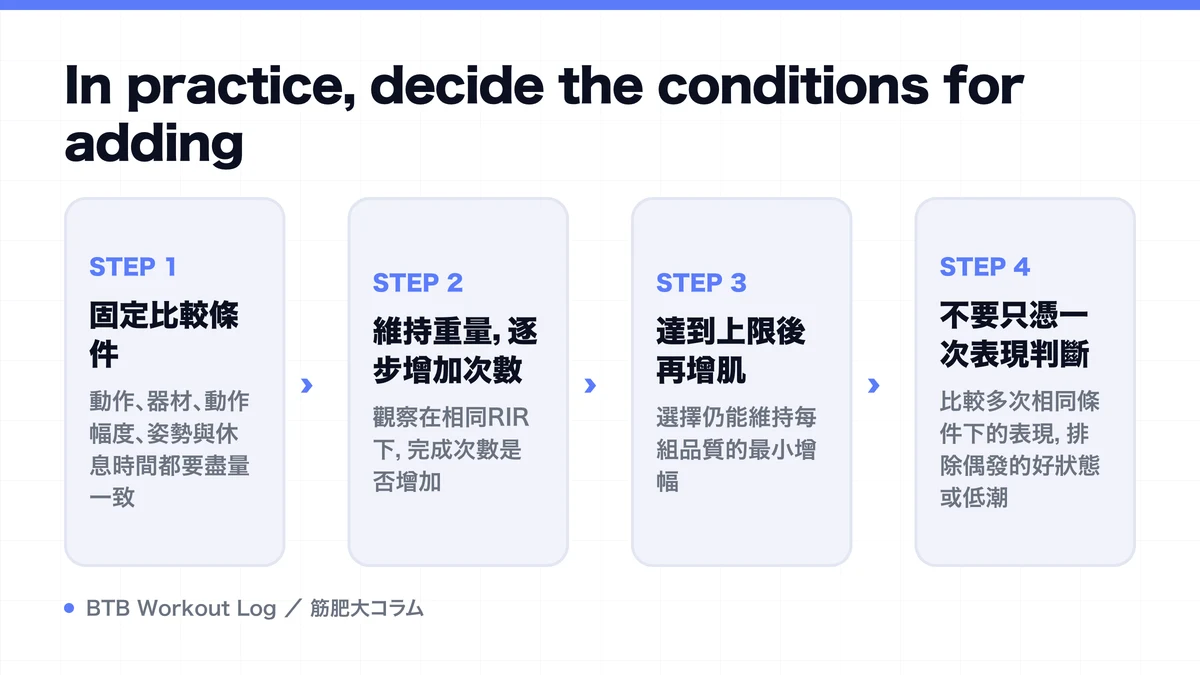
不要每次都直接加重,而是先訂好達成什麼條件才加重。最實用的方法,是把次數範圍和RIR搭配使用。假設目標是8〜12次、RIR 1〜3,就先確認所有組數都能以相同姿勢和動作幅度做到接近次數上限,而且仍符合目標RIR,再以最小幅度增肌。增肌後,次數回到範圍下緣,本來就是計畫的一部分。
- 固定比較條件:動作、器材、動作幅度、姿勢與休息時間都要盡量一致。
- 維持重量,逐步增加次數:觀察在相同RIR下,完成次數是否增加。詳細概念也可參考為什麼次數同樣重要。
- 達到上限後再增肌:選擇仍能維持每組品質的最小增幅。
- 不要只憑一次表現判斷:比較多次相同條件下的表現,排除偶發的好狀態或低潮。
RIR的估算不可能完全精準,但Lovegrove等人的研究顯示,年輕的男性初學者在臥推和硬舉的3次、5次與8次組中,選擇相當於1 RIR的負荷時,具有高度的重測信度。由於研究對象有限,結果不能直接推廣到所有人;不過一般來說,除了重量與次數,也記錄每組結束時的餘力,更容易在相同條件下回顧表現。如果你還不熟悉RIR,可以偶爾在同一動作中比對預估值與實際做到力竭的次數,再據此校正判斷。
如果重量和次數連續數週都沒有進展,先別急著加組數,應先檢查疲勞程度、休息時間、動作穩定性與能量攝取。若刺激不足,增加組數確實是一個選項;但在恢復不足時繼續堆高訓練量,只會讓停滯期更加嚴重。
Progressive overload lives in the arc, not the session
Logs become clear when you read them at three scales. At the set level: weight, reps, RIR, range. Over several workouts: are reps or total reps climbing under the same conditions? At the program level: hard sets per muscle group, fatigue, bounce-back after a Deload week. One weight bump is just the first record. Real progressive overload shows up in the second and third view.
Holding ground matters too. During a cut, a rough sleep stretch, the tail end of a high-volume block—if you keep the same range and RIR while conditions worsen, you've defended your ability. Flip it: conditions are good, but multiple metrics flatline for weeks. Time to break the plateau. Don't redesign the whole program because one session missed a PR.
Logs don't build muscle. They keep you from mixing up when to add, when to hold, when to redesign. A week where weight didn't move is still overload if reps or set volume climbed. BTB Workout Log keeps all three in one place.
Not whether you added a plate this time, but whether the same conditions yield more work over months, and whether you can recover from it. That's when you're actually running progressive overload.
常見問題
- If the same weight sticks for weeks, did progressive overload fail?
- Not instantly. Reps or total reps climbing at the same form, range, and RIR is progress. If weight, reps, and RIR all sit flat across multiple sessions and recovery looks solid, then examine sets, exercises, and program design.
- Dropping weight in a Deload week—doesn't that undo progressive overload?
- Not necessarily. A Deload blunts the stimulus to shed fatigue, setting up high-quality training after. A temporary load dip can fit inside a long-term plan if ability and stimulus climb in the weeks or months that follow.
- Is progressive overload automatic if I add sets without adding weight?
- Adding sets can boost stimulus, but not automatically. Each set has to hold enough effort and form quality, and you have to recover. If recovery lags or later sets fall apart, fix rest and distribution before piling on volume.
重點整理
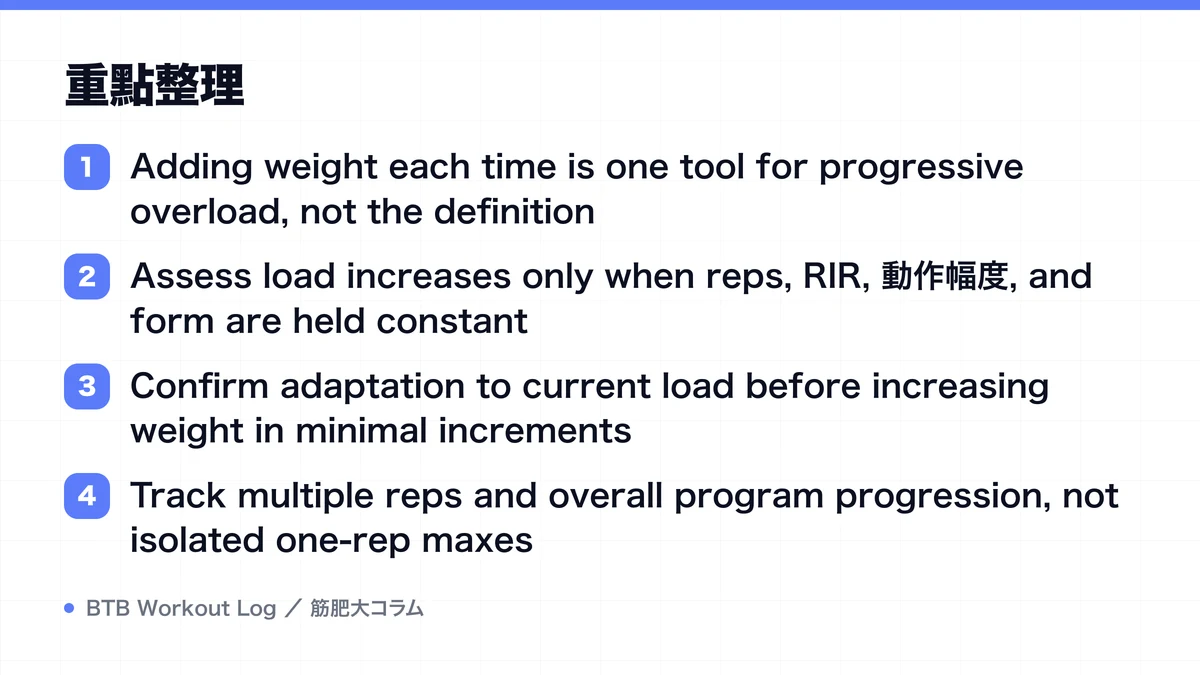
- Adding weight each time is one tool for progressive overload, not the definition
- Assess load increases only when reps, RIR, 動作幅度, and form are held constant
- Confirm adaptation to current load before increasing weight in minimal increments
- Track multiple reps and overall program progression, not isolated one-rep maxes