「越重越有利於肌肉肥大」不一定對|用研究檢驗大重量信仰
高重量是肌肉肥大的重要工具,但越重不代表肌肥大刺激越大。在保證充分努力度、穩定動作、恢復可行的前提下,按種目選擇便於操控的重量更為理性。
將最大肌力進步和肌肉增長分開來看,就能清楚看出高重量何時有利,何時降低重量反而能為目標肌群累積更高品質的組訓練。
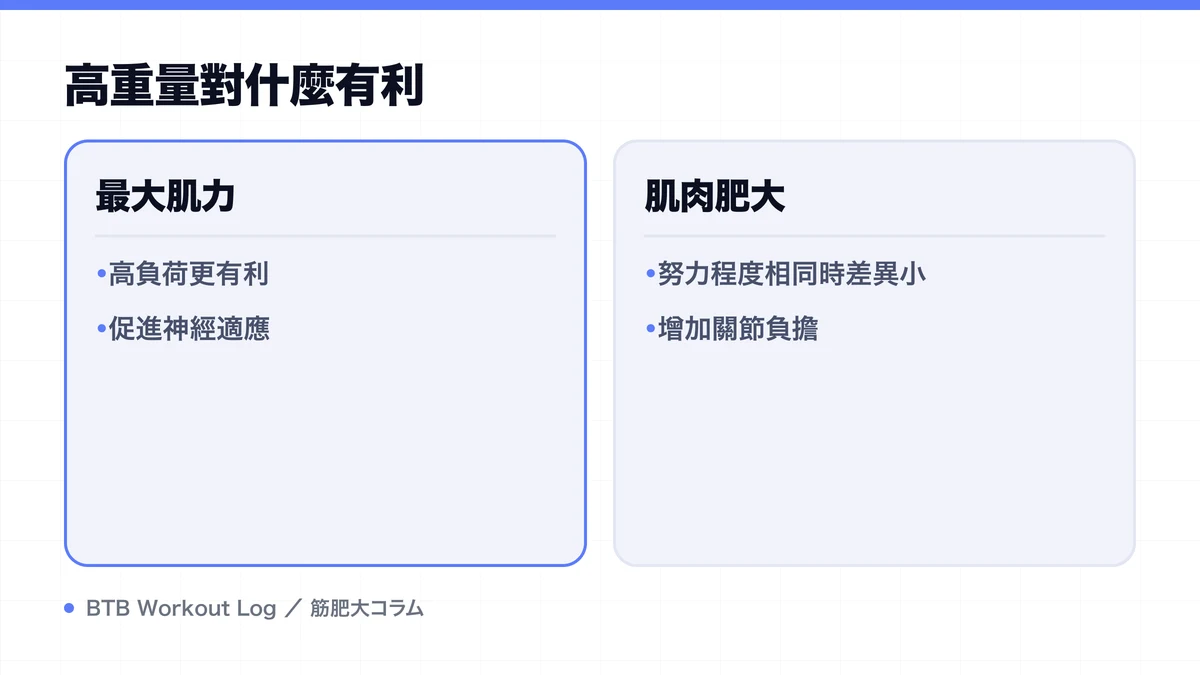
「高重量是優勢」這個想法在哪些方面是正確的
高重量確實有明確的價值。首先,提升接近1RM的舉重能力,也就是最大肌力,需要實際操作重重量。穩定重槓鈴的技術和短時間內發揮強大力量的能力存在負荷特異性,輕重量組訓練無法充分鍛鍊這些能力。
其次,高重量組從第一次反覆就需要強大的力,不必像低負荷組那樣積累多次反覆就能達到高努力度,還能縮短組的時間。對於深蹲、臥推、划船這類姿勢穩定、增重後仍能保持目標肌肉受力的動作,高重量是兼顧肌力和肌肉肥大的實用選擇。
另外,能在相同反覆次數、相同RIR、相同動作幅度下操控比過去更重的重量,是明顯的進步標誌之一。RIR表示組結束時「還能做幾次」,RIR 2表示離力竭還有約2次。條件一致的增重說明訓練能力提升了。
問題在於從「肌力需要高重量」「增重是進步」的結論跳躍到任何種目都越重越能肌肥大的一般化論述。能選高重量和該常選高重量是兩回事。
肌肉肥大刺激不是由盤片重量單獨決定的
肌肉肥大的關鍵不在外部重量本身,而在於活躍的肌纖維受到充分張力,反覆執行這樣的組訓練,然後從刺激中恢復。高負荷在早期就需要強大的力;低負荷則隨著接近力竭,起初未參與的運動單位被動員,最後反覆達到高努力度。機制和實現條件不同,但這正是寬幅度負荷範圍內都能引發肌肉肥大的原因。
這個觀點是高重量與高反覆的比較的核心論題。但「輕重量也可以」不等於「輕鬆停止也沒關係」。負荷越輕,到力竭的反覆數越多,如果RIR保留太多就可能無法達到充分努力度。輕重量為何能促進肌肉肥大的答案不是無條件的低負荷優越性,而是包含充分努力度的整體組訓練。
反之,越重也不會自動成為優質組。增加重量的後果可能是動作幅度縮小、動作反彈增加、輔助肌肉或姿勢穩定比目標肌肉更先達到極限、每組反覆數過少導致日常表現波動大等。即便3次才能完成的重量也能引發肌肉肥大,但不需要將所有肌肥大組都推向這個領域。詳細條件另見3次反覆高重量的檢驗。
重量只是刺激變數之一。忽視反覆次數、RIR、動作幅度、動作品質、組數、休息、頻率而單純按kg排列組的價值是不合理的。
研究未顯示「越重就越能肥大」的線性關係
A 2017 meta-analysis by Schoenfedl and colleagues examined studies that classified low load as ≤60% 1RM and high load as >60% 1RM. The findings showed minimal differences in muscle hypertrophy between groups, while 1RM strength gains favored the high-load condition. Importantly, the studies used protocols that drove each set to temporary failure—not simply performing the same reps with lighter weight. The takeaway is straightforward: "when effort is controlled, the load range that produces hypertrophy is broad." This does not mean load and intensity are irrelevant.
Mitchell's 2012 study on young men's knee extension also revealed no between-group difference in quadriceps hypertrophy after 10 weeks when comparing 30% 1RM for 3 sets versus 80% 1RM for 1 or 3 sets, all taken to failure. A 2025 study in healthy young men using barbell curls and knee extensions showed similar hypertrophy trends when subjects performed either 30–40% 1RM or 70–80% 1RM to failure. Research across different age groups consistently points in one direction: load alone does not determine hypertrophy magnitude.
That said, these average findings cannot be mechanically applied to every lifter and every exercise. The precise proximity to failure that researchers achieve in controlled settings is harder to replicate in daily training, and individual tolerance for high-rep breathlessness and discomfort varies widely. Outcomes change with different subjects, measurement sites, exercises, and timeframes.
What research challenges is not heavy load itself, but the oversimplification that "heavier always means more hypertrophy." Even when average hypertrophy is similar, strength gains, time investment, joint stress, and workout sustainability differ significantly. In practice, the best choice depends on your goal and the lift.
Why heavy weight looks like the scorecard for muscle gain
Load is the easiest number to track. You see immediately whether you added a plate, but hypertrophy unfolds over weeks or months—never in a single session. This time lag makes it tempting to treat short-term strength progress as hypertrophy itself.
The correlation between muscle size and strength reinforces the mistake. Larger muscle provides a bigger foundation for force production, but 1RM depends on far more than just mass: technique, neural adaptation, range of motion, and familiarity with the implement all matter. Conversely, when rep ranges or exercises change, hypertrophy can progress without immediately showing up in a specific lift's 1RM. Two variables that correlate should not be treated as one phenomenon.
Heavy weight also delivers a psychological sense of "serious work." Pre-set tension, hard bracing, slowing bar speed—these create palpable effort. By contrast, a set with moderate weight, strict form, and high-quality reps close to failure looks tame on paper. Yet appearance and emotional satisfaction don't directly measure stimulus to the target muscle.
Add the mistake of treating every session's weight increase as 漸進超負荷, and suddenly dropping load looks like regression. In reality, if you've changed the exercise, expanded range of motion, tightened form, or adapted for a heavy fatigue day, a lower kg reading alone says nothing about lost capacity.
In practice, select a rep range you can repeat, not the heaviest weight you can lift
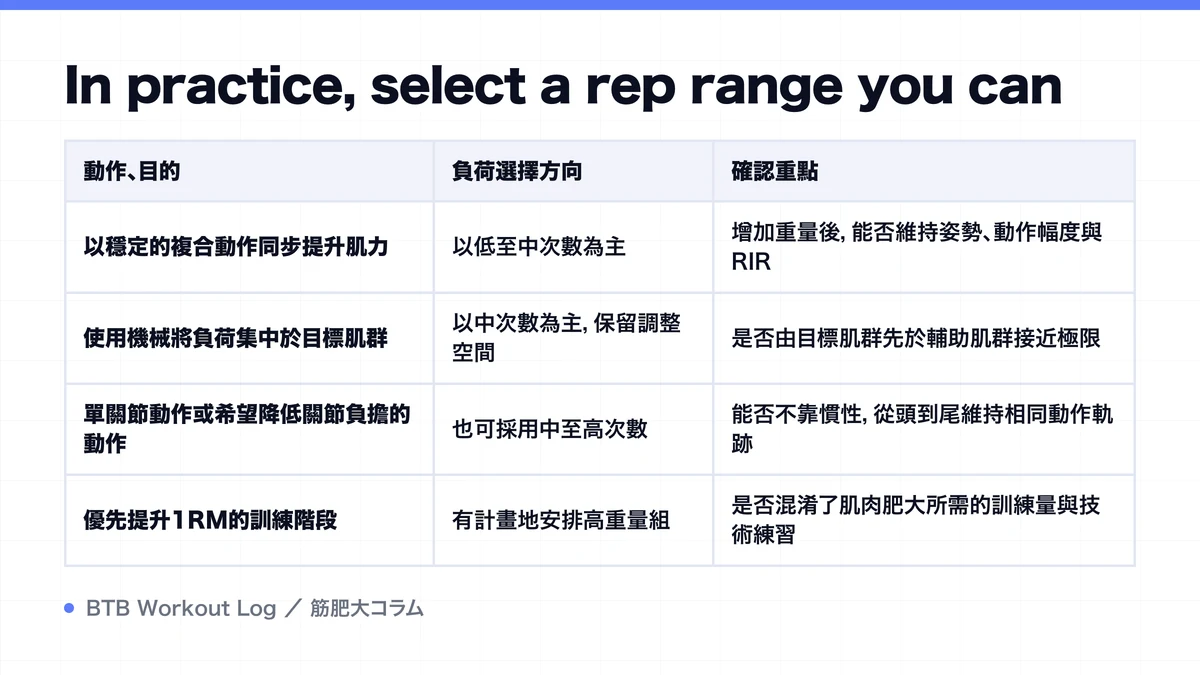
選擇負荷時,重點不是「最多能拿幾kg」,而是能否用目標肌群完成高品質反覆,並在下次訓練繼續挑戰進步。先針對每個動作,找出能穩定維持姿勢與動作幅度,且容易判斷目標RIR的次數範圍。雖然沒有絕對正解,但依照以下方式區分用途,會更容易安排訓練。
| 動作、目的 | 負荷選擇方向 | 確認重點 |
|---|---|---|
| 以穩定的複合動作同步提升肌力 | 以低至中次數為主 | 增加重量後,能否維持姿勢、動作幅度與RIR |
| 使用機械將負荷集中於目標肌群 | 以中次數為主,保留調整空間 | 是否由目標肌群先於輔助肌群接近極限 |
| 單關節動作或希望降低關節負擔的動作 | 也可採用中至高次數 | 能否不靠慣性,從頭到尾維持相同動作軌跡 |
| 優先提升1RM的訓練階段 | 有計畫地安排高重量組 | 是否混淆了肌肉肥大所需的訓練量與技術練習 |
例如,做側平舉時每次加重都讓慣性與斜方肌參與增加,就先降低重量,以固定軌跡累積次數,訓練表現會更容易比較。相反地,如果做胸推超過15次後,心肺已經吃不消,胸肌還沒接近極限就無法集中注意力,可以稍微加重並降低次數。別把高重量或低重量當成信條,應根據每個動作實際遇到的限制調整。
也要事先訂好加重條件。當你以相同動作幅度、姿勢、休息時間與目標RIR,做到設定次數範圍的上限,下次就以最小增量加重。如果加重後連下限次數都無法維持,就退回原本的重量,繼續增加次數。這不是避開高重量的方法,而是讓漸進超負荷與動作品質同步提升的方法。
Load choice is validated by what happens in the next set and over the following weeks
You can't judge load adequacy from a single top set. For the same exercise, align weight, reps per set, RIR, 動作幅度, form breakdown, and rest periods before deciding. If only the first set at a new weight succeeds but subsequent sets drop sharply in reps and you can't maintain 硬組 volume across the week, the choice deserves reconsideration for 肌肉肥大 goals.
Over 2–4 weeks, check three things: First, did reps increase at the same weight and RIR? Second, after heavier loading, did you preserve your target 次數範圍 and movement quality? Third, are joint irritation or output loss until the next session unchanged or growing? If both heavy and light settings drive progress, choose by preference, schedule, or exercise fit. If progress stalls with only one, that data narrows your best load range.
The purpose of tracking isn't to celebrate heavy weight—it's to verify whether a weight change produced high-quality reps and sustained progress.
For lifts where you also want 最大肌力 gains, keep heavy load; for exercises where target-muscle feel or joint stress becomes problematic, shift toward moderate-to-higher reps. Don't lock all exercises into one weight philosophy—split by goal and data. That's the practical escape from the "heavier is always better" bias.
常見問題
- Which is better for 肌肉肥大: 5 reps or 12 reps?
- Both work for 肌肉肥大 if you maintain sufficient effort and movement quality. Five reps lean toward 最大肌力 as well; 12 reps keep rep count easier to achieve. Pick based on exercise stability, joint load, RIR judgment clarity, and how many reps you hit in follow-up sets.
- Can light weight for 30 reps trigger the same 肌肉肥大 as heavy weight?
- If you push near failure, maintain movement quality in the target muscle, 肌肉肥大 can occur. High reps feel breathless and hot fast, though—you stop earlier and RIR judgment gets fuzzy. Average equivalence doesn't mean easy 30 reps work the same way. Don't misread the data.
- If my lift weights are climbing, is my load correct?
- Strong sign of progress, but weight alone doesn't confirm it. Verify reps, 動作幅度, form, and RIR stayed constant while load rose. If momentum or assistance muscle involvement grew, stimulus to the target muscle may not have advanced—check follow-up sets and track the trend over weeks.
重點整理
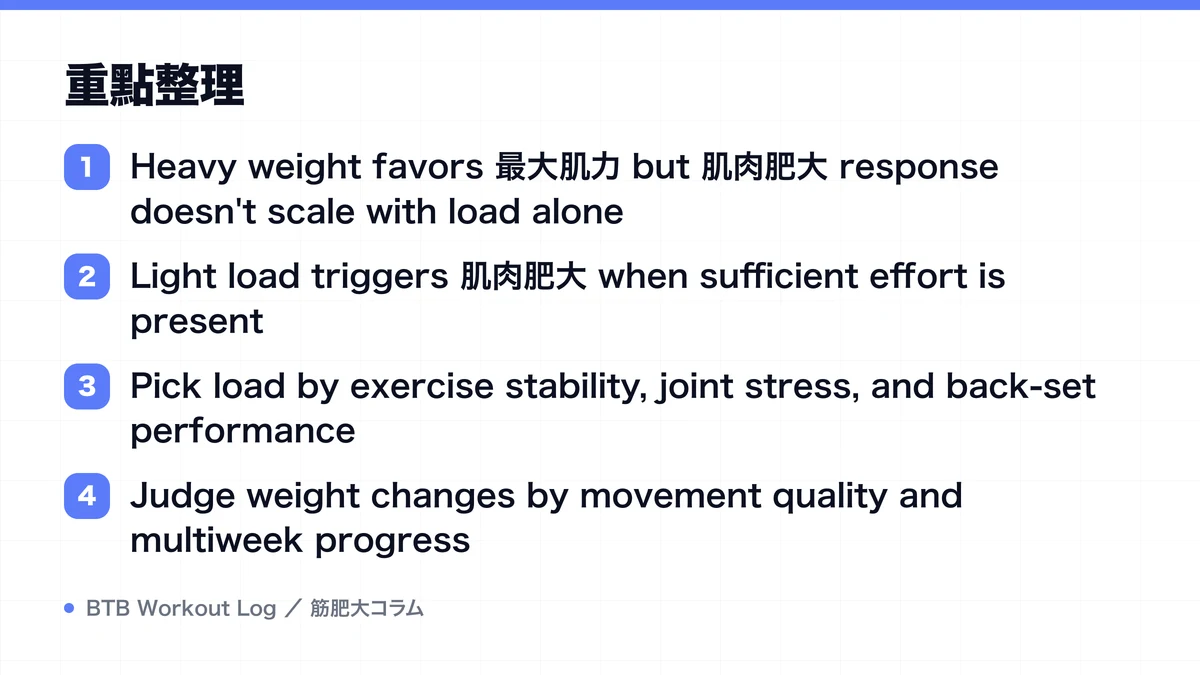
- Heavy weight favors 最大肌力 but 肌肉肥大 response doesn't scale with load alone
- Light load triggers 肌肉肥大 when sufficient effort is present
- Pick load by exercise stability, joint stress, and back-set performance
- Judge weight changes by movement quality and multiweek progress