
只能做3次的大重量也能肌肉肥大嗎?追重量的人該知道的效率問題
只能做3次的高重量也能够导致肌肉肥大。需要发挥大力量的3次本身足以产生充分刺激,但由于单组重复次数少,必须通过多组或中等次数组来补充每周的训练量。
需要验证的不只是「3次是否有效」。还要分别考虑是否每组都需要用真正的3RM,以及作为增肌的主力动作是否值得花时间和体力。
先要区分「只能做3次」和「做3次就停」
3RM是指在一定的动作形式和动作幅度下能做3次,但做不了第4次的重量。如果第3次就达到力竭,RIR为0,即剩余可做次数为零。相反,如果能做5次的重量只做3次停止,那组的RIR就是2,虽然都是3次,但并非真正的3RM。
混淆这个区别会导致从「进行了3次高重量」的训练记录中无法判断真实刺激和疲劳程度。热身的3次、RIR2结束的工作组、3RM测试都是不同的概念。这里要确认的是3RM级外部负荷是否能用于增肌,而不是做一组3次就足够了。
整个负荷范围的对比在高重量和高次数的运用中讨论。本次我们关注得更窄,看低次数端的3次时成立的条件。
高重量3次产生刺激的原理,以及研究能说明的范围
使用高重量时,从第一次重复开始就需要产生大的力量。如果目标肌肉能在充分的肌长和动作幅度下发挥力量,即使只有3次的短组,也能对肌纤维施加高张力。次数少本身不是刺激为零的原因。
Schoenfeld等人2017年的荟萃分析汇总了低负荷和高负荷条件下都做到力竭的组,肌肉肥大的变化基本相当,最大肌力则高负荷占优。但这项分析的高负荷定义很宽泛,是1RM的60%以上。虽然支持高负荷也能增肌的方向,却并未表明3RM是最优的。对3RM这种狭窄条件的适用还需要留有余地。
ACSM的立场声明指出,中高级训练者可周期性使用1-12RM,但强调增肌应重视6-12RM,推荐高训练量的多组训练。也就是说3RM不是禁忌、不是有效范围外,但也不是增肌的标准主阵地。实际应用中,把它作为次数范围内的低次数枠是合理的。
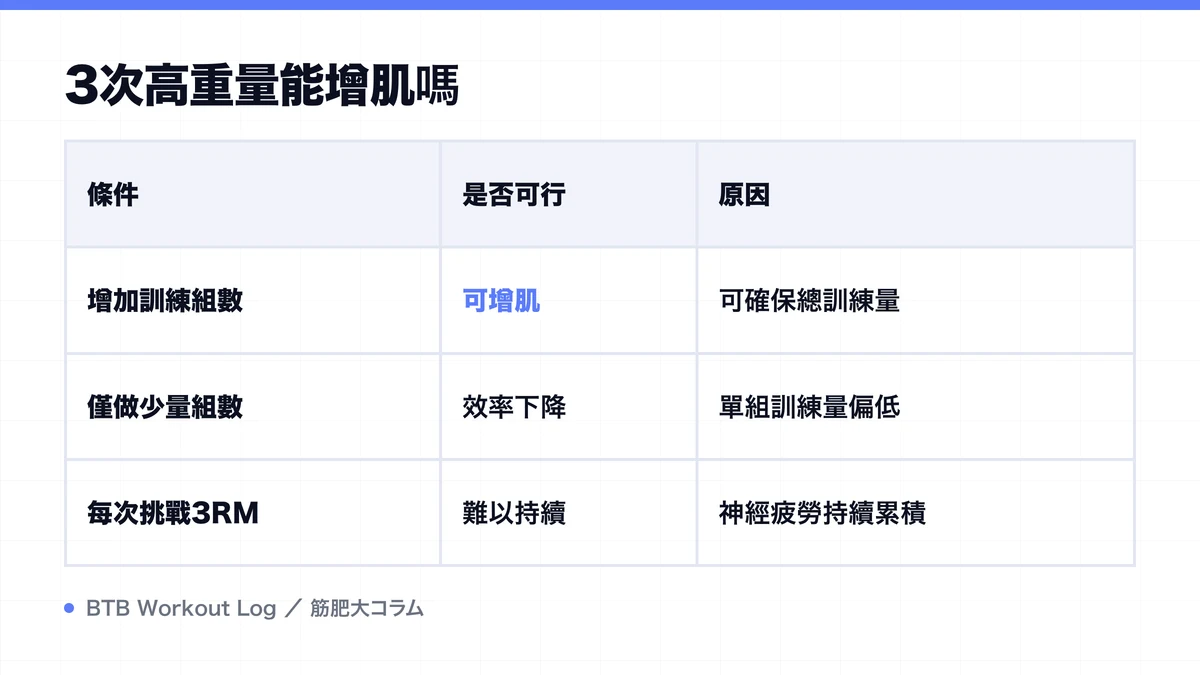
比起反复做真正的3RM,要把刺激转化为每周训练量
真正的3RM第3次时达到RIR0,所以每组都是力竭组。但荟萃分析对比了力竭和非力竭的条件,在肌肉肥大和肌力获得上都没有显示每次都必须做到力竭。如果要持续进行3次工作组,保留1-2次的余力会更容易保持动作形式和下组的输出一致。这种情况严格来说不是3RM,而是「3次RIR1-2的高重量组」。
另一个要点是总量。3次做3组也只有9次重复,少于同动作的8次3组。虽然重量×次数本身不能完全比较不同负荷带的刺激,但仅凭1-2组少次数组就认为取代了通常的每周增肌训练量,这样想得太快了。除了高重量框架外,要单独设置中等次数的缓冲组,或在周内其他日期保证训练量。
高重量组间需要更长的恢复时间。如果休息过短导致下组的次数或动作幅度下降,选择重量的优势就难以发挥。以3-5分钟为起点,根据能否在下组中重现相同的技术和RIR来调整休息时间。判断的关键是分开记录训练量和组间休息。
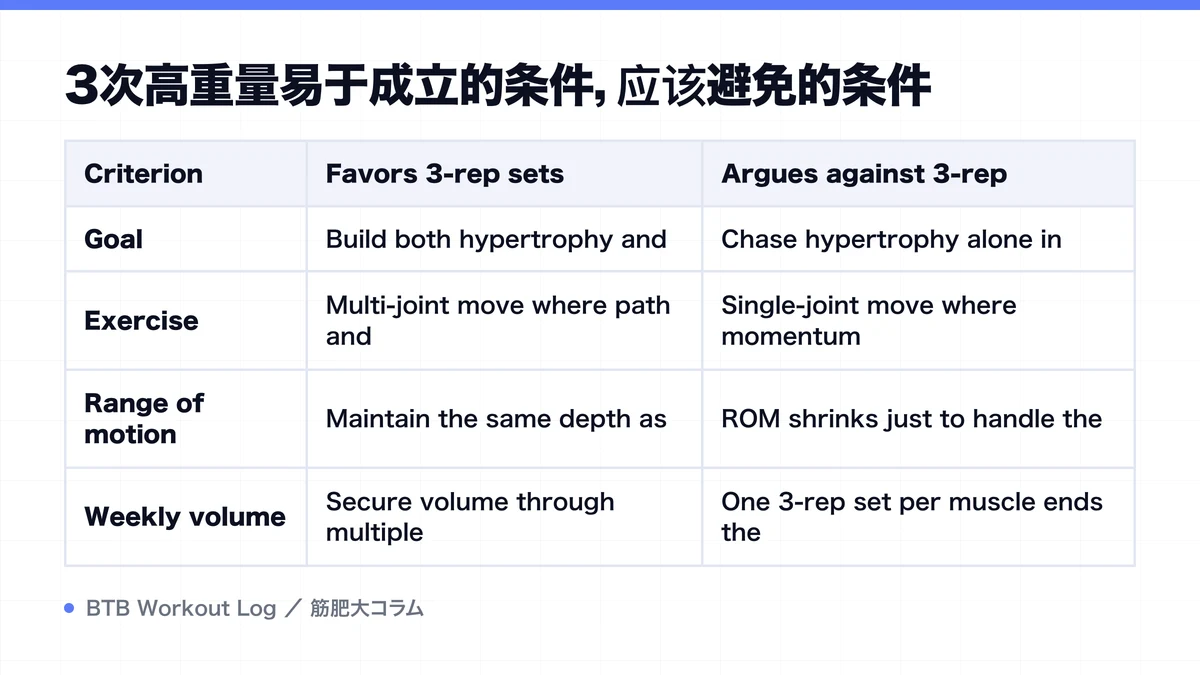
3次高重量易于成立的条件,应该避免的条件
Whether 3-rep sets deliver hypertrophy hinges on two factors: the physiology itself, and whether you can replicate the stimulus consistently within the exercise.
| Criterion | Favors 3-rep sets | Argues against 3-rep sets |
|---|---|---|
| Goal | Build both hypertrophy and maximum strength | Chase hypertrophy alone in minimal time |
| Exercise | Multi-joint move where path and posture lock in at high load | Single-joint move where momentum or synergists determine success |
| Range of motion | Maintain the same depth as medium-rep work | ROM shrinks just to handle the weight |
| Weekly volume | Secure volume through multiple sets or other rep ranges | One 3-rep set per muscle ends the workout |
| Recovery | Subsequent sets and next session output stay intact | Joint discomfort or technical breakdown recurs |
In exercises like bench press and squat—where whole-body stability is easy to maintain—low-rep work also builds maximum strength. But chasing 3RM with lateral raises or curls tends to end in postural collapse or swinging rather than target-muscle fatigue, making progress opaque. Even machines count as candidates if they fix movement parameters under heavy load, but "machines are safer" is a blanket claim that doesn't hold water.
There's no reason to tolerate pain just to hit 3 reps. Heavy weight isn't a prerequisite for hypertrophy—it's a tool you use when it fits your goal and exercise. Nothing more.
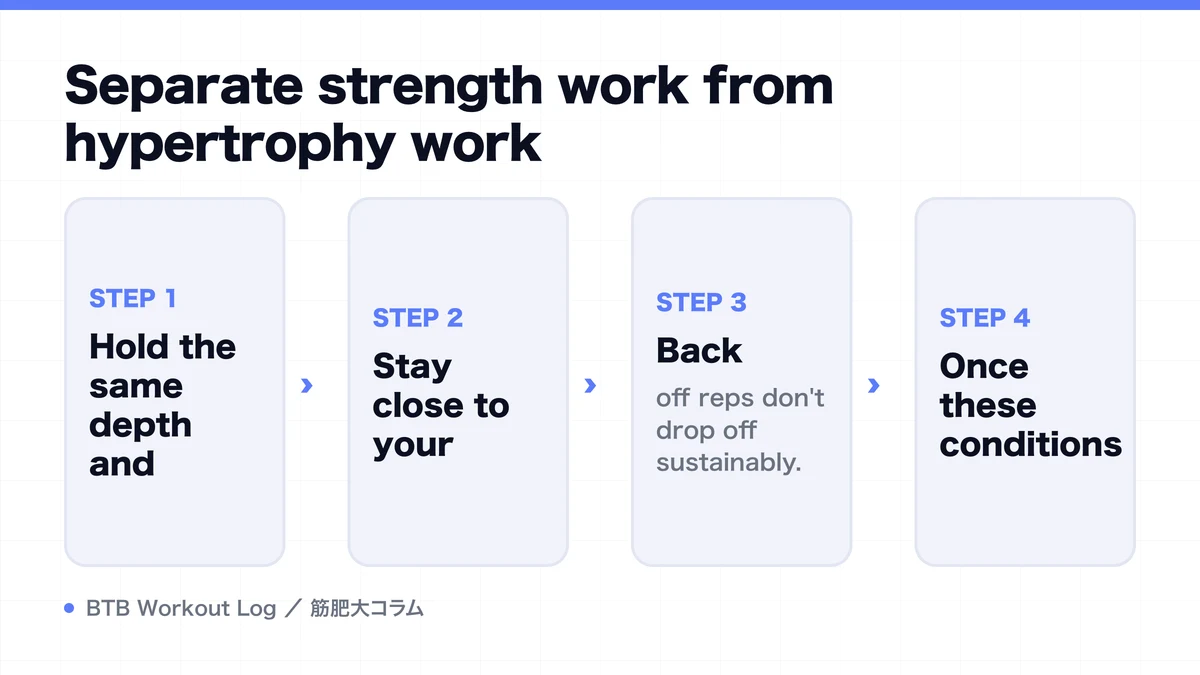
Separate strength work from hypertrophy work for cleaner execution
To run both hypertrophy and heavy-load proficiency, divide roles within the same session. For example: open with 2–4 sets of 3-rep heavy work at RIR 1–2, then drop the load and run 2–4 back-off sets of 6–10 reps. This is a starting template, not a rigid prescription for every lift. Rather than bloat total weekly sets, redistribute your existing volume between a heavy frame and a medium-rep frame.
Set progression rules upfront
- Hold the same depth and 3 reps across every heavy set.
- Stay close to your target RIR all the way to the last set.
- Back-off reps don't drop off sustainably.
- Once these conditions hold over several sessions, add weight in the smallest increment you can.
If you add load just because you hit 3 reps, you'll mistake ROM loss and approaching RIR 0 for progress. Only when weight, reps, RIR, and ROM align do you have a true apples-to-apples comparison of 漸進超負荷. If you're new to RIR estimation, practice it first with light and medium loads before bringing it into your heavy frame.
If hypertrophy is your sole goal and 3-rep sets demand long rest, forcing you to skip planned weekly volume, switching back to 5–10 reps isn't retreat. It's smarter to pick a rep range where fewer sets and less time deliver repeatable stimulus to the target muscle.
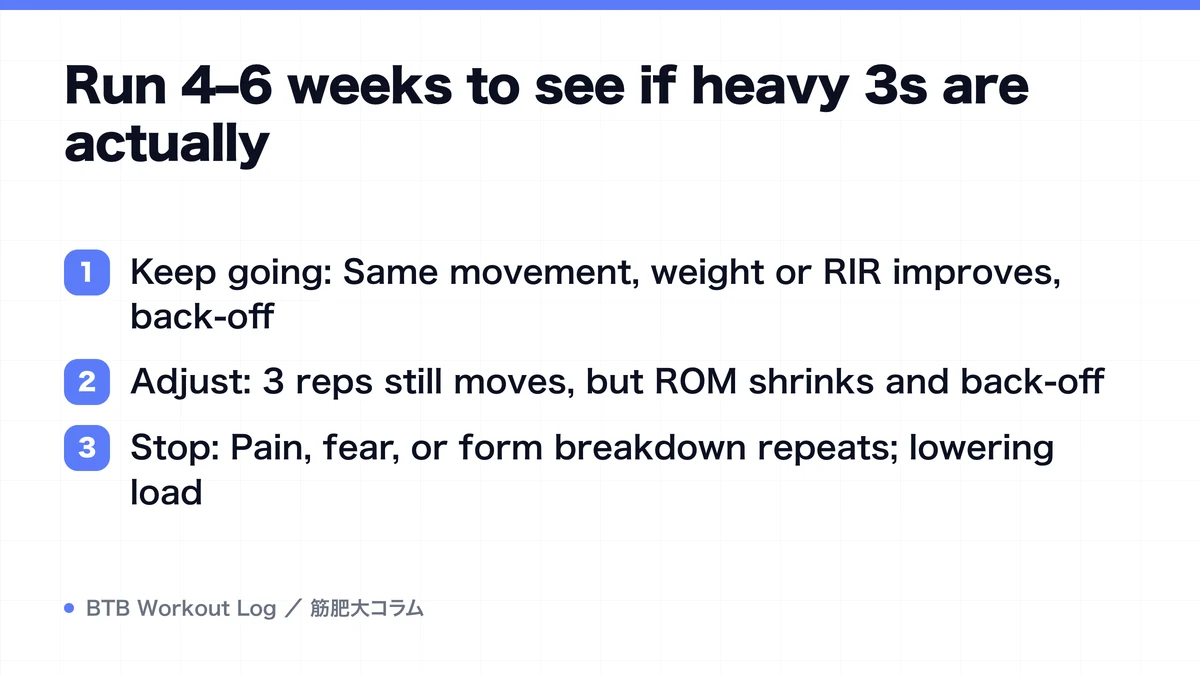
Run 4–6 weeks to see if heavy 3s are actually usable for you
One strong session or intense fatigue won't tell you if 3-rep sets fit your training. Pick one heavy-load–appropriate exercise, hold frequency, back-off sets, food, and sleep constant, and test for 4–6 weeks. Log each time: weight, reps, and RIR of the heavy sets; ROM; rest intervals; output of follow-up sets; and joint feel.
- Keep going: Same movement, weight or RIR improves, back-off output and next session drive stay solid.
- Adjust: 3 reps still moves, but ROM shrinks and back-off reps or next session output decay.
- Stop: Pain, fear, or form breakdown repeats; lowering load doesn't fix it.
Short-term strength jumps include neural adaptation, not proof of muscle growth. Still, whether your output climbs under identical conditions while you hold weekly hypertrophy volume tells you whether to keep the heavy frame. Over months, body composition and photos support the data.
3RM-level work can drive hypertrophy, but the win condition isn't "I lifted something heavy"—it's "I repeated the right stimulus to the target muscle, week after week, at planned volume."
常見問題
- Do I have to hit a true 3RM every session?
- No. In ongoing work sets, it's smarter to stay at a weight you can do for 3 at RIR 1–2. That keeps form and follow-up set output consistent. Save true 3RM tests for dedicated test days.
- How many 3-rep sets do I need if I'm after hypertrophy?
- No fixed number. It depends on current weekly volume, how much the move contributes to the target muscle, and the quality of follow-up sets. Don't expect 3-rep sets alone to meet volume needs. Combine them with medium-rep back-offs or other-day volume to hit your weekly target.
- Can I use heavy 3s for single-joint moves?
- Technically yes, but momentum, shortened ROM, and joint stress tend to be why the set ends—not target-muscle fatigue. That makes it tough to build into a main protocol. Machines that lock the path solid can work, but only if you can actually reproduce the movement in the target muscle.
重點整理
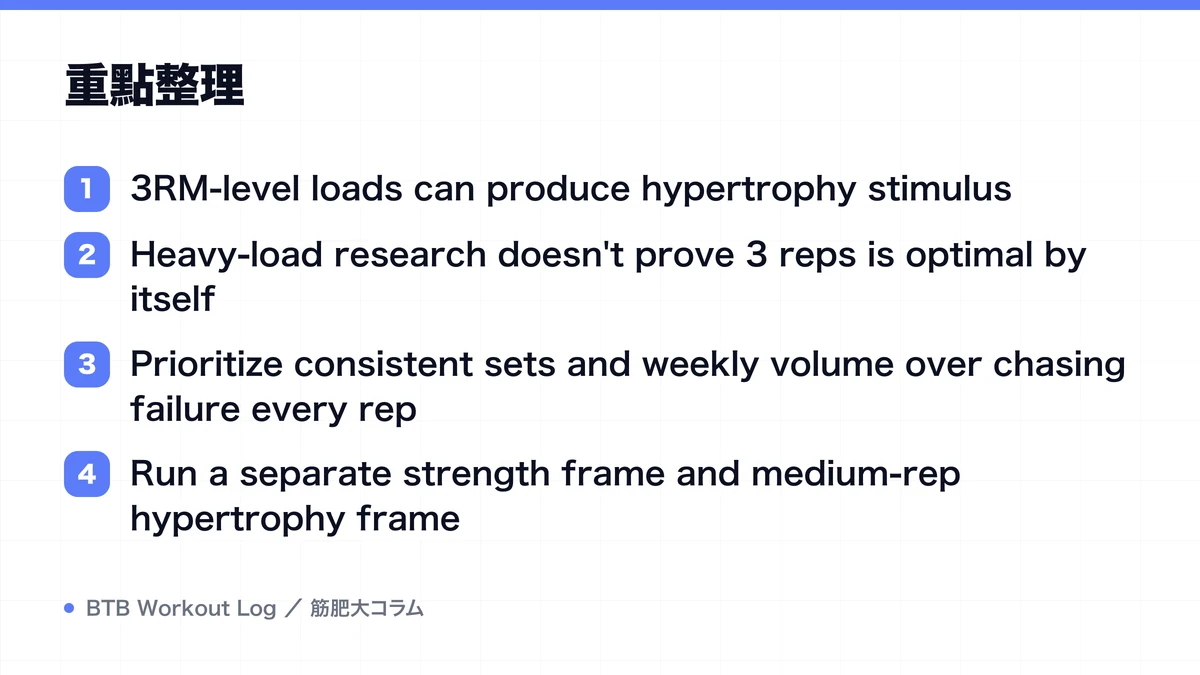
- 3RM-level loads can produce hypertrophy stimulus
- Heavy-load research doesn't prove 3 reps is optimal by itself
- Prioritize consistent sets and weekly volume over chasing failure every rep
- Run a separate strength frame and medium-rep hypertrophy frame