只靠「比上次多做1次」就能肌肉肥大嗎?驗證最簡單的進階方式
Matching load, form, range of motion, and RIR—then stacking one extra rep each time—becomes an effective method for muscle gain. But one more rep on the bar doesn't guarantee growth by itself.
Reps aren't the stimulus itself. They're a marker that you handled the same challenge at a higher standard than before. Only when you decide what stays constant and when you jump to heavier weight does the system become repeatable.
Testing the claim: "one more rep means more muscle"
When you stretch the same weight from 8 reps to 9 reps, you've at least improved your capacity in that exercise. This is a manageable form of progress when structuring 漸進超負荷. You can set targets even in small increments where you can't add plates, and success or failure becomes clear each session.
But rep count isn't a direct measure of 肌肉肥大. A single rep difference moves with sleep, nutrition, set order, rest periods, and daily motivation. Reps go up just from getting efficient with the movement. Conversely, even if muscle has grown slightly, a fatigued day might give you fewer reps than last time. So a single "plus one" isn't proof of growth—it's an observation point for tracking trends over weeks.
What we're really asking isn't whether you can mechanically add one rep every session. The question is whether hitting the upper limit of your rep range with consistent form, then increasing the load once you hit that ceiling, actually works as a progression strategy for 肌肉肥大. On that question, the answer is yes.
Five conditions that make "same weight, one more rep" comparable
To use session-to-session change as evidence, lock down the variables. If reps went 10 to 11 but you squatted shallower, added bounce, or rested longer, you can't call it proof the muscle handled a harder task.
| Variable | What to check | If it drifts |
|---|---|---|
| Load and equipment | Weight, machine, machine settings | Log it as a separate condition |
| Form and 動作幅度 | Momentum, depth, end position | Don't count as a rep PR |
| RIR at finish | How many reps left in tank | Note the difference in effort |
| Rest and set order | Rest duration, exercise sequence | Factor in the condition change when reading |
| Counting method | Per set or total reps | Don't shift the rule mid-block |
RIR (Reps In Reserve)—"how many reps were left when you stopped"—matters most. If last session was 10 reps at RIR 3 and this week is 11 reps at RIR 0, the one-rep gain might just be that you pushed harder today, not that you got stronger. Both at RIR 2 makes the comparison solid. The RIR foundation is in the RIR guide.
Across multiple sets, you don't need every set to add one rep. If sets of 10, 9, 8 (27 total) become 10, 9, 9 (28 total), that's still a one-rep increase in total volume. Tracking the drop-off per set also tells you whether the first set inflated while the later sets fell apart.
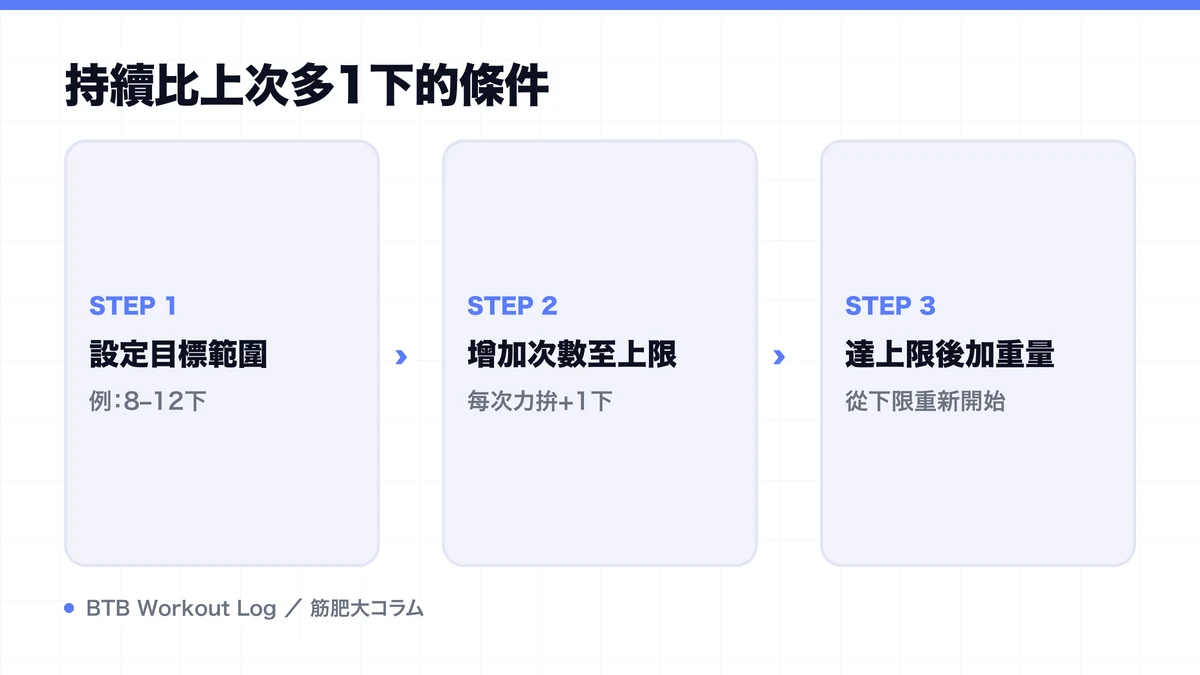
Research backs the progression model, not the "one-rep rule" itself
Muscle growth hinges on working hard, repeating, and gradually handling more work over time. If you do one extra rep at the same weight and same RIR, you've completed more reps while staying equally close to failure. That's solid ground to advance the stimulus.
ACSM's resistance training progression model supports increasing load once you comfortably exceed your target rep range. It doesn't mandate one rep per session, but it does align with the strategy of adding reps first, then weight. This is the backbone of intelligent progression.
Meta-analyses on load show muscle gain isn't locked to heavy weight alone—sufficient effort across a wide range of loads drives growth. So adding reps within a set range does create a growth opportunity. However, staying light with large RIR and barely bumping reps doesn't count as sufficient stimulus. Proximity to failure has to move too.
And strength or rep gains involve factors beyond muscle: technique, movement economy, condition of the day all shift. That's why we don't grade single sessions—we look at how stable records over 4–8 weeks move under matched conditions. If reps bounce around but the baseline climbs, the system is working.
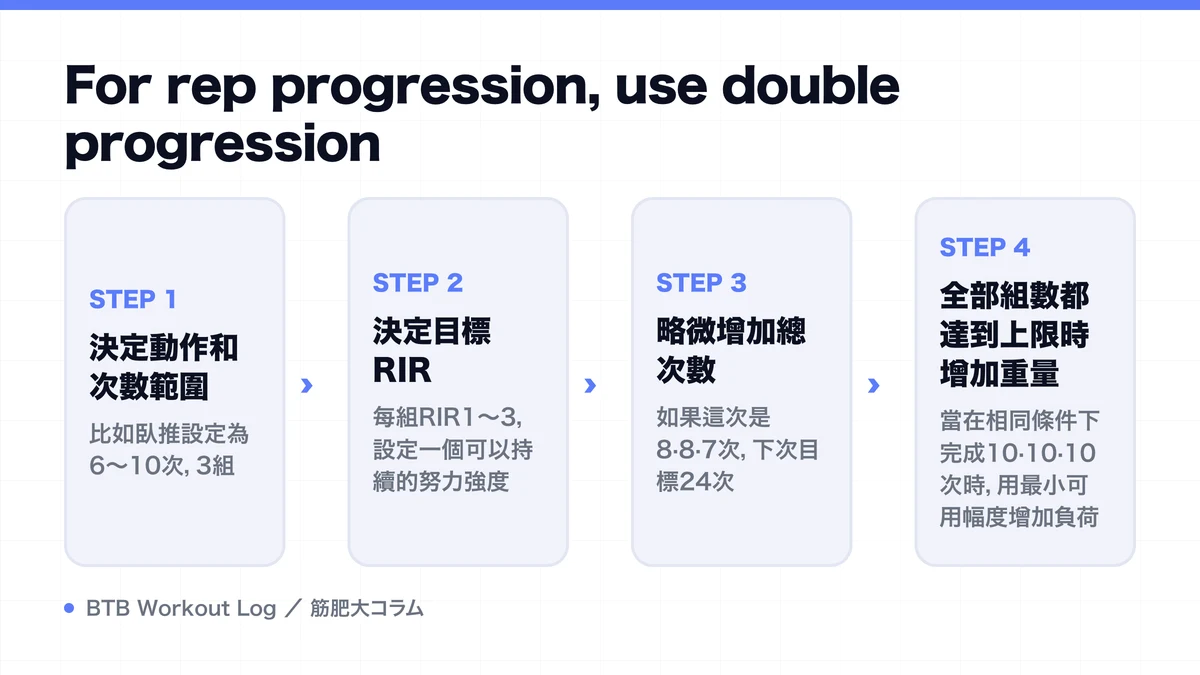
For rep progression, use double progression
在實踐中,盲目增加次數不如將次數範圍和重量進階結合起來更好管理。這個方法叫雙重進階。
- 決定動作和次數範圍:比如臥推設定為6~10次,3組。
- 決定目標RIR:每組RIR1~3,設定一個可以持續的努力強度。
- 略微增加總次數:如果這次是8·8·7次,下次目標24次。增加的位置可以在任何一組。
- 全部組數都達到上限時增加重量:當在相同條件下完成10·10·10次時,用最小可用幅度增加負荷。
- 允許重量增加後次數回到下限附近:加重後即使掉到7·7·6次也不算失敗,而是新範圍的起點。
用這個方法,次數增長和重量增長會輪流出現。加重後次數暫時下降,但長期目標是在更重的負荷下回到同樣的次數帶。如果你不確定該先動重量還是次數,本文中的重量增加與次數增加的比較可以幫你判斷。
「加1次」是目標而非硬性規定。如果為了擠出最後一次而破壞動作、縮小動作幅度或借助訓練夥伴,那就變成另一個問題了。沒能增加次數的日子,用相同的RIR重現相同的次數,這樣的記錄同樣有參考價值。
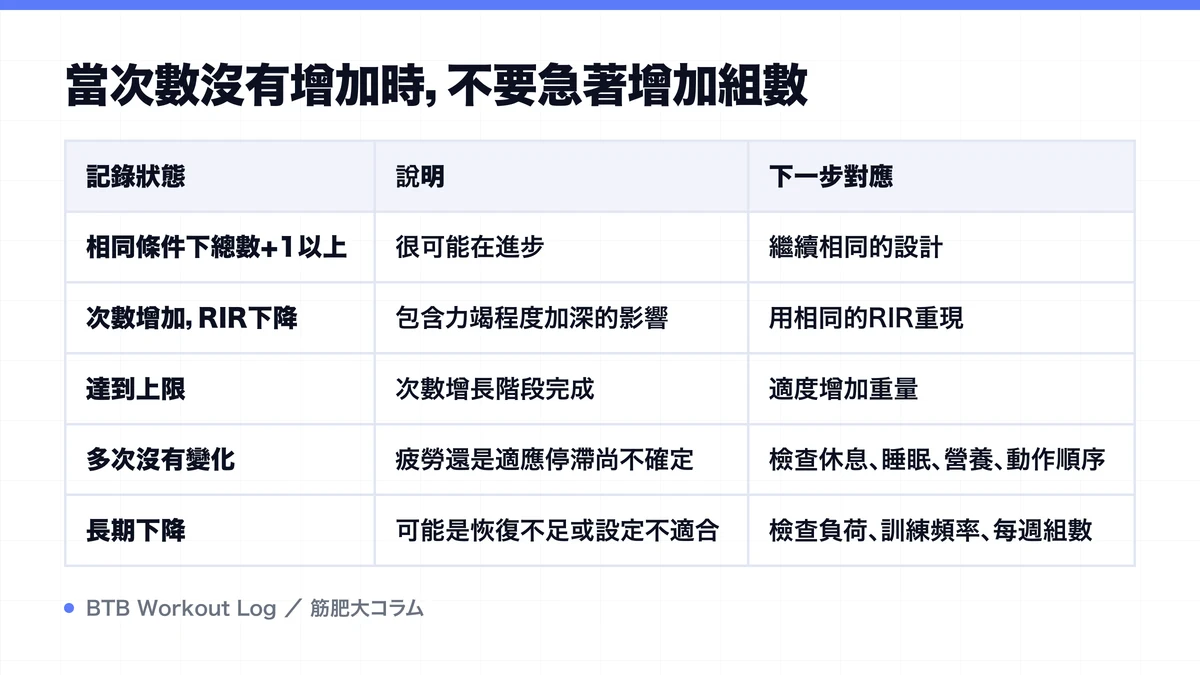
當次數沒有增加時,不要急著增加組數
進階訓練者每次訓練同一個動作時,不是每次都能進步。一次沒有增加次數,不能馬上判定肌肉肥大停止了。要區分日常波動和真正的停滯期,先將同一動作的2~4次記錄排列比較。
| 記錄狀態 | 說明 | 下一步對應 |
|---|---|---|
| 相同條件下總數+1以上 | 很可能在進步 | 繼續相同的設計 |
| 次數增加,RIR下降 | 包含力竭程度加深的影響 | 用相同的RIR重現 |
| 達到上限 | 次數增長階段完成 | 適度增加重量 |
| 多次沒有變化 | 疲勞還是適應停滯尚不確定 | 檢查休息、睡眠、營養、動作順序 |
| 長期下降 | 可能是恢復不足或設定不適合 | 檢查負荷、訓練頻率、每週組數 |
一看到停滯就增加每週組數,如果原因是疲勞會讓情況變糟。首先要確認休息時間是否充分,體重和睡眠是否大幅下降,其他動作的成績有沒有也在下降。如果恢復沒有問題,只有目標動作停滯了多次,那就考慮更小的重量刻度、改變次數範圍或調整組數配置。
某些動作加重會破壞姿勢,在這種情況下,就算達到上限也不要無限增加次數,而是在保持速度和動作幅度固定的前提下設定新的範圍。每次只改變一個變數,這樣下次記錄就能看出效果。停滯的整體判斷邏輯和停滯期確認步驟相同。
肌肉肥大是否真的發生,要靠一組記錄而不是單次來確認
這個進行方式是否有效,要用4~8週的訓練塊來判斷。至少記錄重量、每組次數、RIR,以及關於動作品質和動作幅度的簡短備註,然後看同一動作的趨勢。如果測體重、圍度或拍照,要在相同條件下進行,作為輔助指標。
你要看的不是「每次都漂亮地+1」,而是在相同的RIR和動作品質下,總次數在增加,最終即使增加重量也能回到同樣的次數帶。如果這個循環持續,而且能對目標肌肉施加預期的刺激,那麼「比上次多1次」就是肌肉肥大訓練足夠實用的進階規則。
應用程式本身不會導致肌肉肥大,它的作用是讓你更容易做相同條件的比較和調整負荷。要實行「比上次多1次」,你需要在當下知道上次是多少次。BTB Workout Log 可以為每個動作顯示上次的數據。
常見問題
- 每一組都必須比上次多1次嗎?
- 不必須。3組只要總次數增加1次就可以算是進步。如果每組都要同時多1次,很容易前面力竭太深導致後面動作品質下降,所以應該優先保持相同的RIR和動作品質。
- 增加到多少次時應該加重?
- 先針對各個動作決定次數範圍,當所有工作組都以相近的 RIR 達到上限時,就是該增重的時機。用最小幅度來增加重量,次數回到範圍下限附近是正常的進展。
- 如果一段時間沒有增加次數,說明肌肉肥大停止了嗎?
- 單看一個動作幾次沒有進度還判斷不了。要檢查睡眠、營養、休息、動作順序、其他動作的成績,並排列數次相同條件下的記錄。當長期全體下降時,才考慮調整恢復、負荷或每週組數。
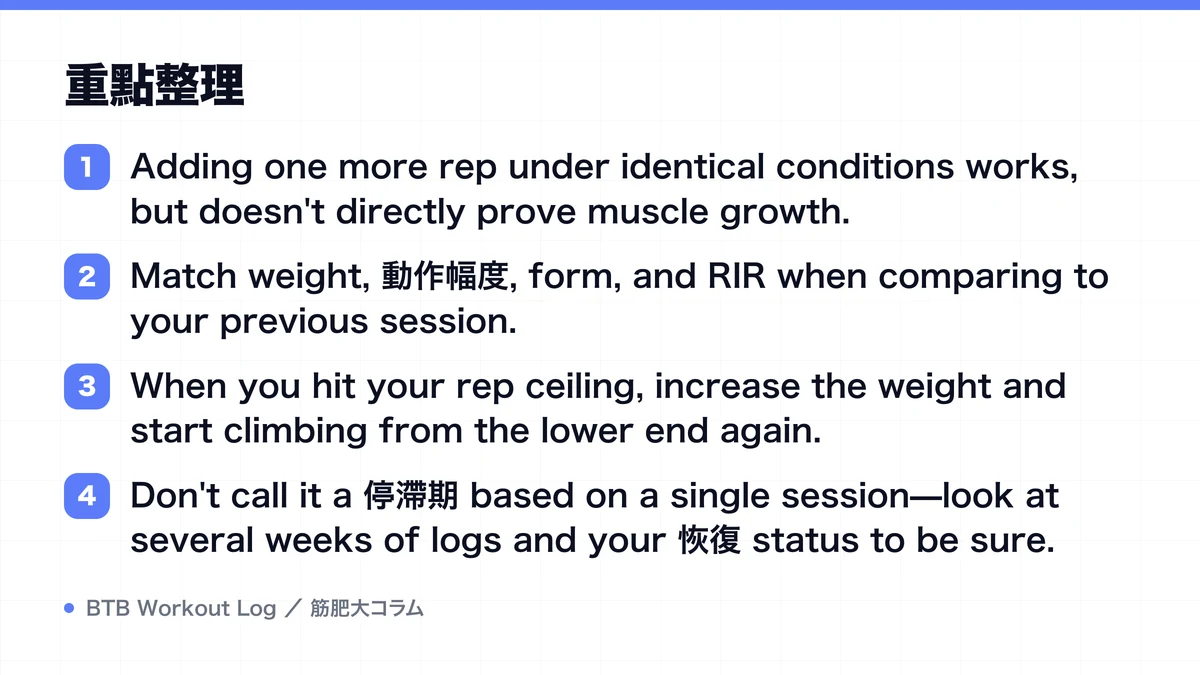
重點整理
- Adding one more rep under identical conditions works, but doesn't directly prove muscle growth.
- Match weight, 動作幅度, form, and RIR when comparing to your previous session.
- When you hit your rep ceiling, increase the weight and start climbing from the lower end again.
- Don't call it a 停滯期 based on a single session—look at several weeks of logs and your 恢復 status to be sure.
參考文獻
- ACSM Position Stand: Progression Models in Resistance Training for Healthy Adults
- Low- vs High-load Resistance Training for Strength and Hypertrophy: Meta-analysis
- Resistance Exercise Load Does Not Determine Training-mediated Hypertrophic Gains in Young Men
- Proximity-to-Failure and Muscle Hypertrophy: Systematic Review with Meta-analysis
- Repetitions in Reserve Is a Reliable Tool for Prescribing Resistance Training Load