
只增加重量就能讓肌肉肥大嗎?只追重量的人容易踩到的陷阱
重量增加是重要的進度指標,但單靠它無法判斷肌肉肥大的刺激是否充分。同一重量在不同次數、餘力、動作幅度、技術和週組數下,肌肉接收到的刺激完全不同。
該看的不是槓鈴上的數字本身,而是在條件一致的前提下,目標肌肉做了多少功,以及這份刺激是否在可恢復的範圍內逐週累積。
「變重就能長肌肉」的直覺盲點
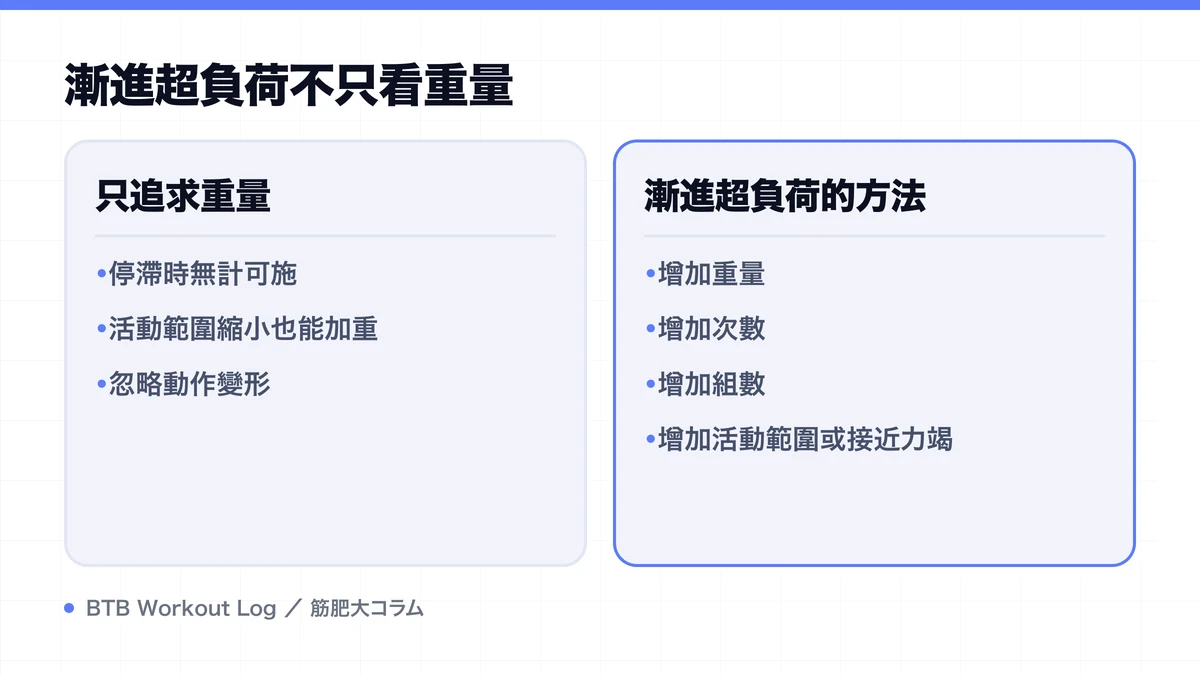
使用重量容易量化、易於記錄。若這個月比上月在相同條件下舉起更重的重量,肌力和動作適應進步的可能性確實存在。因此追求重量進度本身沒有問題,問題在於把「重量增加」直接當成「目標肌肉刺激增加」的證據。
比如臥推增加5kg,但你停止了完整下放、臀部離開了凳子、用了更多反彈力、組間休息變長,那就不是相同條件下的進步。靠動作技巧讓重量增加對競技表現有幫助,但不代表胸肌做了更多功。相反地,重量不變的情況下,如果同樣的技術下次數增加,或能保持更完整的動作幅度,進度可能就在發生。
漸進超負荷不是「每次都加片」,而是長期逐步提高身體的要求。重量是操控這個要求的工具之一,不是唯一的計分項。
外部重量和肌肉實際承受的刺激不等於
槓鈴上的重量是外部負荷,肌肉實際發力受關節角度、力矩臂、動作速度、輔助肌參與程度等影響。不同動作即使都是50kg,對目標肌肉的負擔也無法比較。同一動作只要動作幅度或技術改變,負荷位置和肌肉使用方式就會改變。
從肌肉肥大角度看,關鍵是讓受到足夠張力的肌纖維在組的後期被充分動員。這裡用到RIR(Reps in Reserve,還能做幾下的餘力)。100kg舉5下RIR5和80kg舉10下RIR1這兩組不能光用重量判高下:前者發力大但餘力多,後者重量輕但反覆次數逼近極限。關於RIR的用法可以參考餘力強度管理會更清楚。
比較低負荷和高負荷的統合分析顯示,只要組的努力度一致,寬廣的負荷範圍都能造成肌肉肥大,但最大肌力進步傾向於高負荷有利。也就是說,重量是肌肉肥大的有力工具,但「越重肥大刺激越大」不是簡單的正比關係。負荷區間的選擇可參考高重量和高次數的應用。
肌肉肥大的進度不能只看一個數字
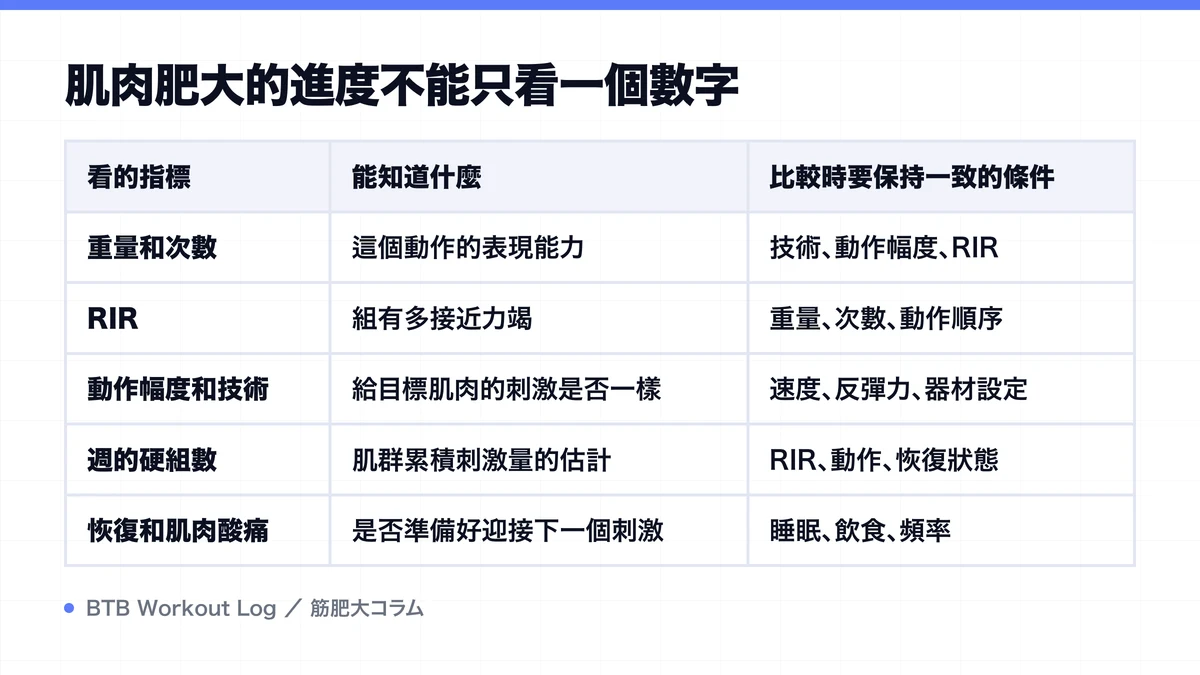
看重量外的數字不是為了找方便的理由,而是要區分什麼保持不變、什麼改善了。以下指標各自回答不同的問題。
| 看的指標 | 能知道什麼 | 比較時要保持一致的條件 |
|---|---|---|
| 重量和次數 | 這個動作的表現能力 | 技術、動作幅度、RIR |
| RIR | 組有多接近力竭 | 重量、次數、動作順序 |
| 動作幅度和技術 | 給目標肌肉的刺激是否一樣 | 速度、反彈力、器材設定 |
| 週的硬組數 | 肌群累積刺激量的估計 | RIR、動作、恢復狀態 |
| 恢復和肌肉酸痛 | 是否準備好迎接下一個刺激 | 睡眠、飲食、頻率 |
比如80kg從8下進步到9下,重量相同但表現能力提升。但如果第9下的動作幅度不完整,就不算是條件一致的進步。反過來,80kg還是8下,但RIR從1變成3,代表這個重量有了餘裕。下一次可以選擇增加次數或在技術沒有下滑的前提下加重。重量和次數的關係可參考用反覆次數決定負荷。
急著只加重量,刺激比較就失效了
When you make weight increases your only goal each session, your body finds the most efficient way to hit that target. You add momentum, shorten your range of motion, shift load to stronger assistance muscles—not from weakness, but because that's how the neuromuscular system naturally adapts. The problem isn't the choice itself; it breaks the consistency you need to actually measure muscle growth.
The other trap is dropping reps or total sets when you chase the weight up. If you were hitting 10 reps for 3 sets and you force the weight higher, ending with 4, 3, and 2 reps, your target muscle gets fewer total repetitions to work with. Using heavy weight isn't wrong—the question is whether you can sustain the training volume your goal demands. Weekly stimulus can't be judged by load × reps × sets alone, but you should check whether you're accumulating recoverable 硬組. That reasoning leads into volume management strategy.
On the flip side, keeping the weight the same is not automatically the right answer either. If the same load, reps, and RIR drag on for weeks unchanged, the stimulus becomes familiar and progress stalls. The real question isn't "don't raise weight"—it's whether you can raise weight while keeping your form comparable and your work volume intact.
Increase weight only when conditions are met
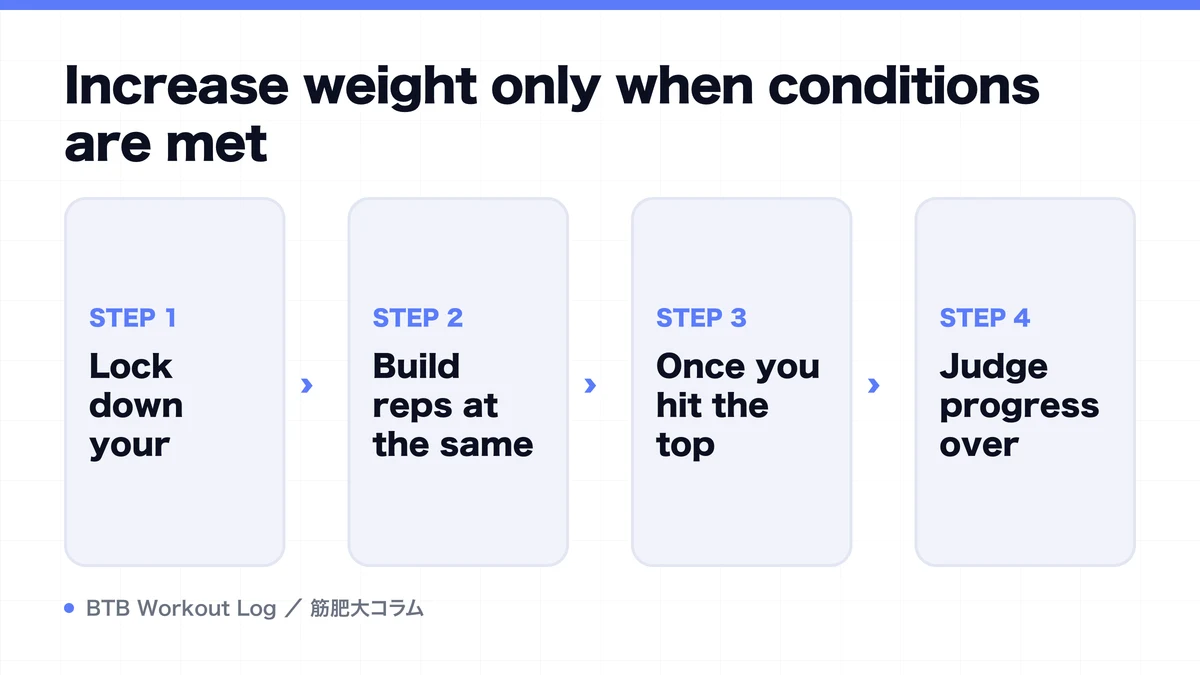
In practice, double progression—moving weight, reps, and RIR together—works best. Set a 次數範圍 and target RIR for each lift, then follow this order:
- Lock down your comparison conditions: equipment setup, 動作幅度, form, rest between sets, exercise order—keep them consistent.
- Build reps at the same weight: hold your target RIR and watch whether each set climbs toward the top of your rep range.
- Once you hit the top rep consistently with good form, add weight conservatively: increase the load only enough that you can hold the bottom of your range and maintain form.
- Judge progress over weeks, not single sessions: fluctuation from sleep or exercise order isn't 停滯期—don't panic at one off day.
Say you're targeting 8–12 reps at RIR 1–3. When all your sets approach 12 reps with solid form, try the next weight. Dropping back to around 8 reps after a jump is expected. If you fall below that and your form breaks at RIR 0, you went up too much. Either accumulate more reps at the old weight or use smaller plates.
If nothing moves for weeks, you don't automatically push weight higher. First check whether 每週組數 is too low, fatigue too high to recover, rest too short between sets for quality, or body weight, food, and sleep are staying consistent. Fixing a weight 停滯期 is its own strategy.
Record the conditions you need to compare, not just the weight
If your log only shows numbers, you can't explain why progress stopped or why it moved. Record at least the weight and reps for each set; for important lifts, jot down RIR or form changes too. Track 每週組數 per muscle group and you can separate whether one lift gained weight from whether your whole program built stimulus.
Evaluate not "did I add kg this week" but whether weight or reps climbed over several weeks at the same conditions, whether you held your RIR target, and whether you can keep stacking 硬組 each week while recovering. Weight sits at the center of that judgment, but not alone. That's how you dodge both reckless increases and false 停滯期.
Training is what builds muscle, but a log structured so you can actually compare tells you whether to go heavier next time.
有時,「能做幾次」比「舉了多少kg」更能反映進步
重量代表外加負荷,次數則顯示你能用這個負荷反覆完成多少次。同樣是80kg,做6次就停下來,和能完成9次相比,肌肉完成的總工作量以及距離極限的程度都不同。只看重量欄,這些差異完全不會被記錄下來。
記錄次數還有另一個實際好處。槓片只能以2.5kg為單位調整,但次數可以一次一次增加。即使還不到加重的時機,只要在相同重量、相同RIR、相同動作幅度下多做1次,就能明確記錄為進步。越能透過細小幅度確認自己持續前進,就越不容易誤以為進入停滯期。
要避免誤判,比較時必須統一重量、RIR、動作幅度和休息時間。延長休息後多做的1次,或縮短動作幅度後多做的1次,只代表條件改變,並不代表能力提升。簡單來說,當你能在多組訓練中達到目標次數範圍的上限,就以最小幅度加重,再回到該範圍的下限。
常見問題
- If weight keeps going up, does that mean muscle growth is on track?
- Yes, if it's rising in the same exercise, 動作幅度, form, and RIR—that's solid progress. But weight climbs from better technique, momentum, or a shorter range too. Cross-check reps, 每週組數, and target-muscle conditions as a longer-term pattern.
- Does muscle stop growing if weight doesn't budge?
- Not necessarily. Adding reps at the same load, finishing reps with more 餘力, or solidifying 動作幅度 and form all count as progress. But if every marker stalls for weeks, revisit volume, fatigue, and nutrition or sleep.
- When exactly should you increase weight?
- When you hit the top of your 次數範圍 for multiple sets while keeping your target RIR and steady form. Go up just enough to land at the bottom of your range with good movement; if reps collapse or form breaks, dial it back.
重點整理
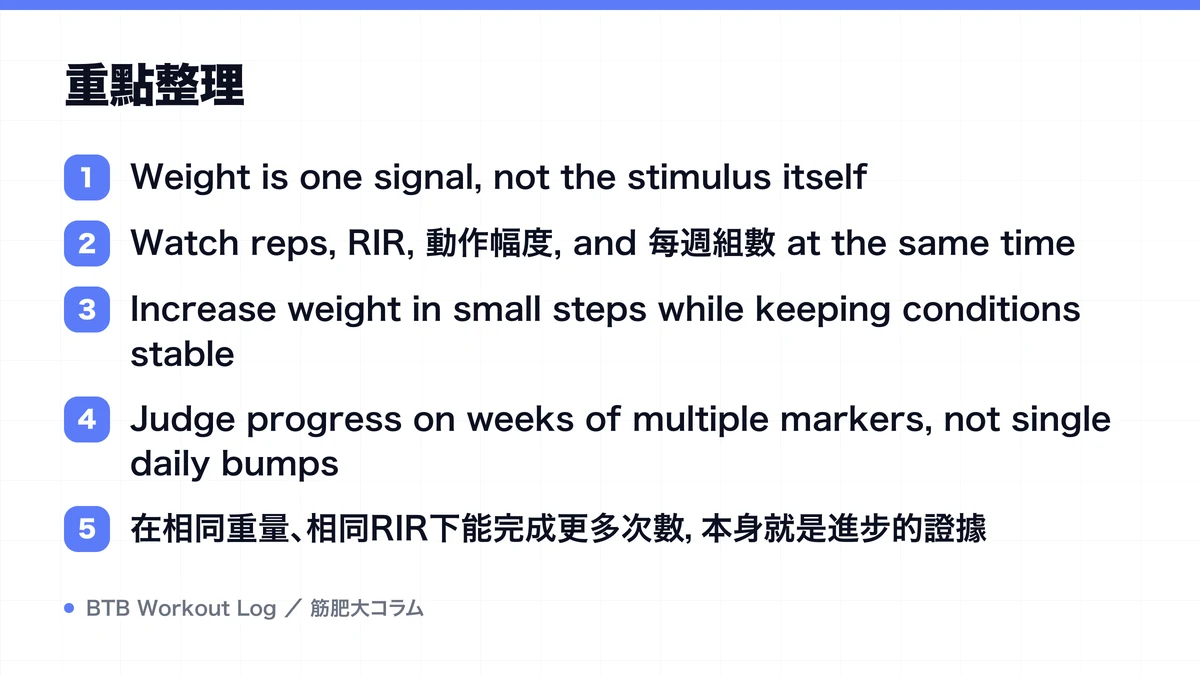
- Weight is one signal, not the stimulus itself
- Watch reps, RIR, 動作幅度, and 每週組數 at the same time
- Increase weight in small steps while keeping conditions stable
- Judge progress on weeks of multiple markers, not single daily bumps
- 在相同重量、相同RIR下能完成更多次數,本身就是進步的證據
參考文獻
- Low- vs High-load Resistance Training for Strength and Hypertrophy: Meta-analysis
- Resistance Exercise Load Does Not Determine Training-mediated Hypertrophic Gains in Young Men
- Proximity-to-Failure and Muscle Hypertrophy: Systematic Review with Meta-analysis
- Repetitions in Reserve Is a Reliable Tool for Prescribing Resistance Training Load
- ACSM Position Stand: Progression Models in Resistance Training for Healthy Adults
- Dose-response Relationship Between Weekly Resistance Training Volume and Muscle Mass