
每週練3次,全身真的能練大嗎?忙碌人士最想知道的現實答案
Yes. If you distribute the weekly volume each muscle group needs, maintain enough effort and 漸進超負荷, you can build muscle across your entire body on 3 days of full-body training.
But simply "showing up 3 days" isn't proof of sufficiency. You need to verify exercise selection covers all major muscles, each set has quality, recovery is adequate, and measurable progress is happening week to week.
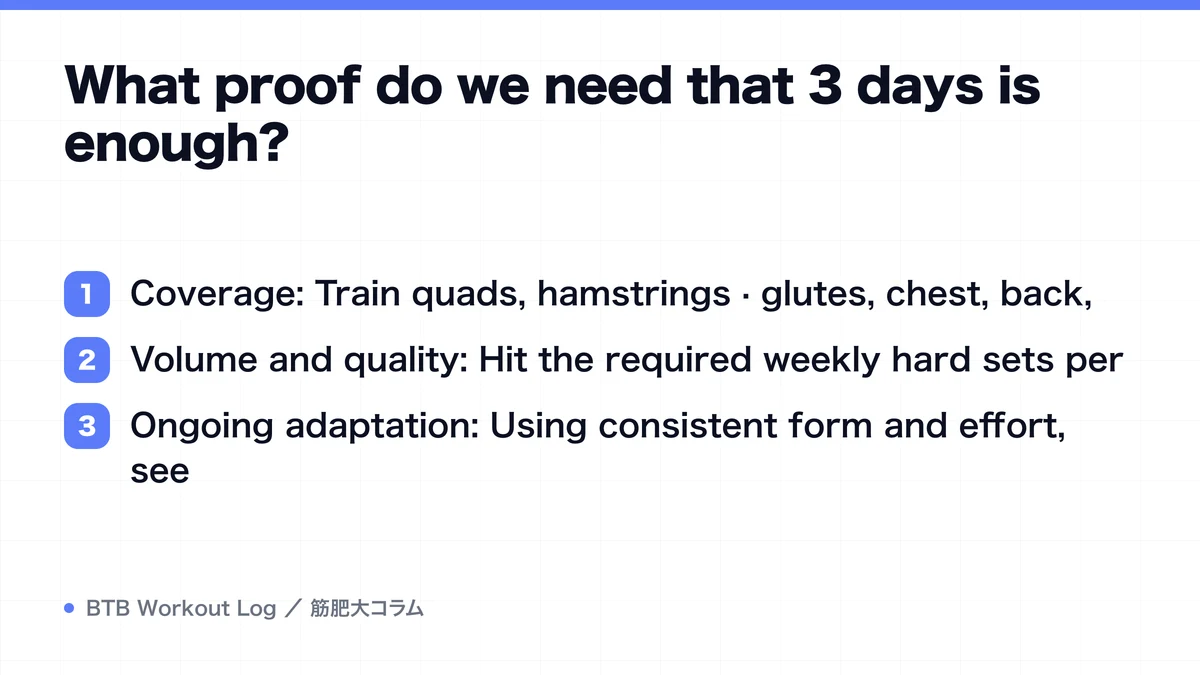
What proof do we need that 3 days is enough?
The question isn't whether 3 days is some magic minimum. The real test is whether those 3 sessions can deliver enough useful stimulus to every muscle group you need to train, with recovery in between. Frequency is just the container. What drives hypertrophy is total weekly volume per muscle, effort per set, and progressive overload.
Breaking down "full-body muscle gain" into at least three separate criteria removes confusion:
- Coverage: Train quads, hamstrings · glutes, chest, back, and shoulders every week. Add direct arm and calf work as needed.
- Volume and quality: Hit the required weekly hard sets per muscle and keep the target muscle and 動作幅度 intact through to the end of each session.
- Ongoing adaptation: Using consistent form and effort, see weight, reps, or sets climb week to week over a few weeks.
Conversely, if your entire workout is full-body movements but the last half becomes autopilot, and weak-point numbers haven't budged in weeks, you can't call 3 days "enough." Judge by whether each muscle group got real stimulus and showed adaptation—not by whether you completed the plan.
Research prioritizes total volume and effort over frequency alone
Systematic reviews and meta-analyses of training frequency show that when total weekly volume is equal, the muscle-building benefit of higher frequency alone is small or unclear. In other words, 3 days per week isn't automatically worse than 4–6 if volume is matched. Frequency's main job is splitting sets across multiple days so each session can stay high-effort. You can read more on this point in our training frequency article.
That said, research does support a dose–response: more sets per week generally correlates with more hypertrophy. But how far to push depends on your recovery capacity, exercise choice, RIR, sleep, and nutrition—it varies. Rather than applying one set number to everyone, the practical approach is to spread a recoverable total across 3 days, then bump volume slightly for any muscle groups that stall.
Also, training every set to failure is not required. RIR is an estimate of reps left in reserve. Keeping your main working sets around RIR 1–3 gives you enough effort while still managing the next exercise and your recovery. The research promise isn't "3 days guarantees success." It's that if you achieve proper total volume and near-maximum effort across 3 sessions, it can work—conditionally.

Programming every muscle group without quality drop
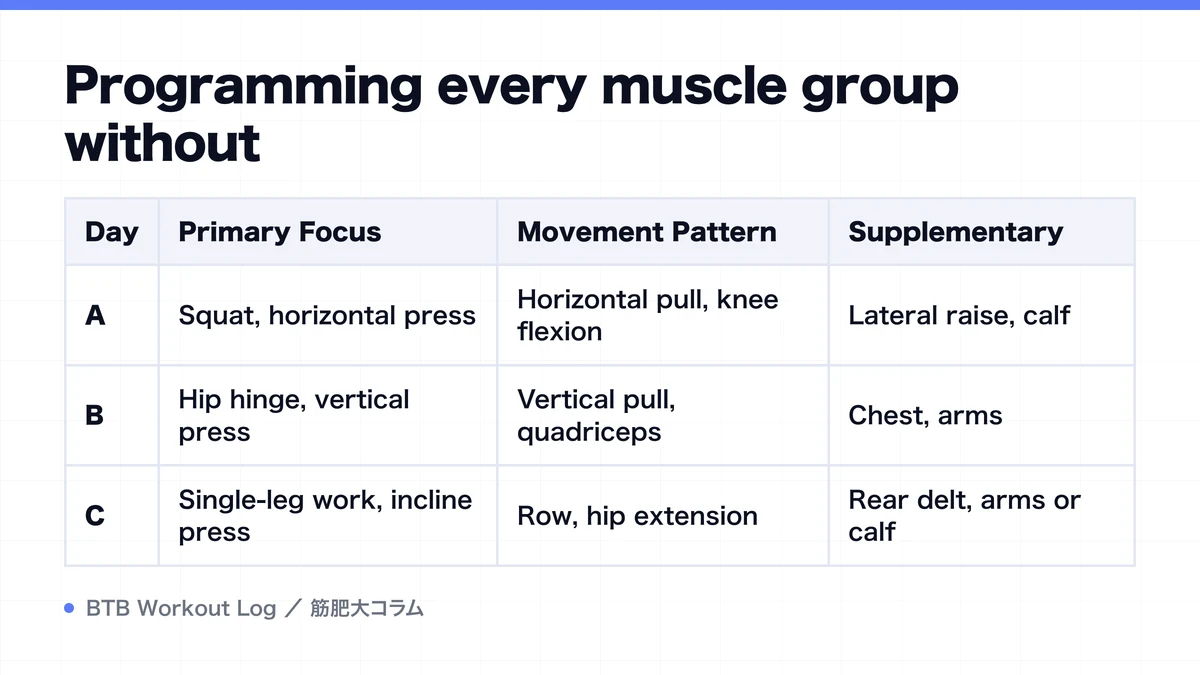
Three sessions a week of full-body training doesn't require the exact same exercises in the same order each time. By keeping leg patterns, pressing, and pulling motions in each session but alternating which body parts and exercise angles you prioritize first, you prevent specific muscle groups from consistently being fatigued and pushed to the back of the workout. The choice between full-body and split routines is covered in comparing three-day full-body versus split training; here we'll show a viable structure.
| Day | Primary Focus | Movement Pattern | Supplementary |
|---|---|---|---|
| A | Squat, horizontal press | Horizontal pull, knee flexion | Lateral raise, calf |
| B | Hip hinge, vertical press | Vertical pull, quadriceps | Chest, arms |
| C | Single-leg work, incline press | Row, hip extension | Rear delt, arms or calf |
This isn't a fixed template—it's a framework for distributing movement patterns and priorities. Starting main lifts with roughly 2–3 working sets each prevents jamming too much into one session, making it easier to layer stimulus across the week. Since bench press loads the triceps alongside the chest and rows load the biceps alongside the back, chasing arm volume with direct work alone can wreck recovery. That said, counting all indirect work as one set is too crude; watch arm progress and fatigue to dial supplementary volume.
Even training the same muscle group three times weekly, you don't need the same load and intensity each day. For instance, use lower–moderate reps on a priority day and moderate–high reps on others, managing RIR within a range where form holds across all sessions. Varying intensity this way isn't complex periodization—it's about spreading joint stress and local fatigue while stacking quality sets.
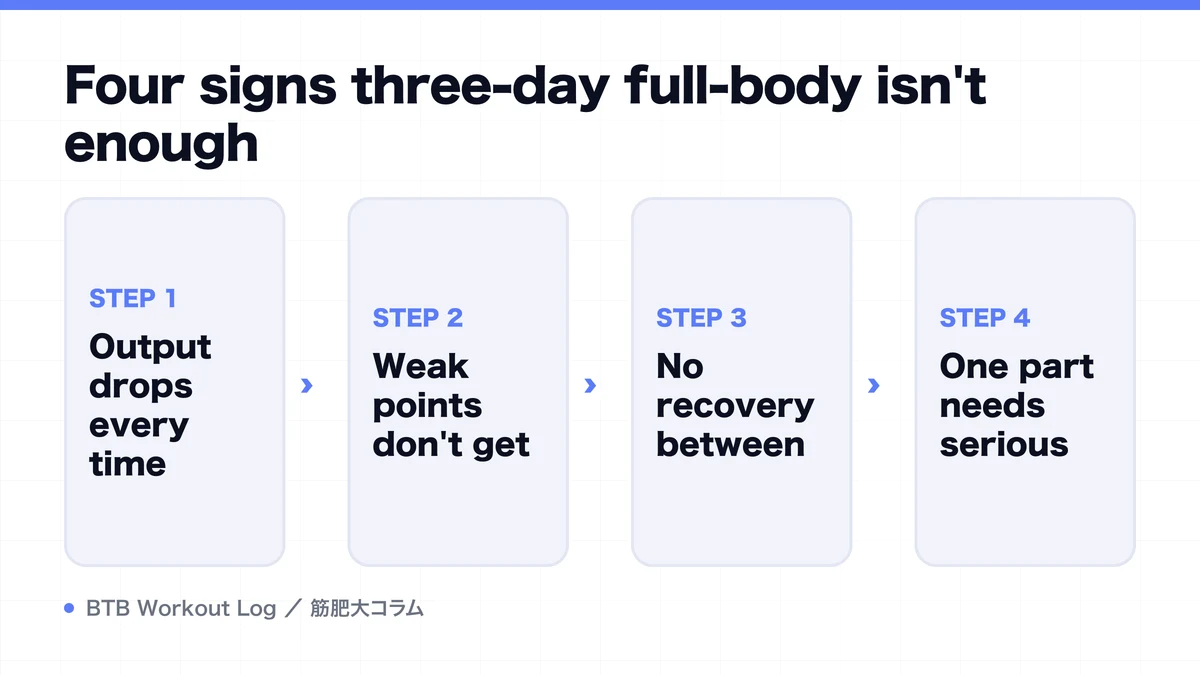
Four signs three-day full-body isn't enough
Often the limit isn't the number of days but what you can fit into one session. If any of these persist, it's time to rethink the full-body structure.
- Output drops every time you reach the end: Later exercises lose weight, reps, or range of motion. Either cut exercises or shift the weak point you want to develop earlier in the rotation.
- Weak points don't get direct work: Foundational movements consume the whole session and lagging areas like shoulders, arms, or calves never get their turn. Scrap duplicate or redundant exercises to carve out a short accessory block.
- No recovery between sessions: Beyond soreness, you notice output drops or joint discomfort lingers between workouts. Review your fatigue sources—going all-out on every set, using the same heavy compound every session, and so on.
- One part needs serious priority: If your goal is back or leg size alone rather than balanced development, you may not be able to fit the extra volume for that area into the last half of three sessions.
If you can't add more days, you don't have to abandon full-body training yet. First, try putting your priority muscle earlier on more days, pruning redundant exercises, or pairing non-competing body parts in supersets. If quality still suffers, you can keep three days a week but adjust how you split the routine.
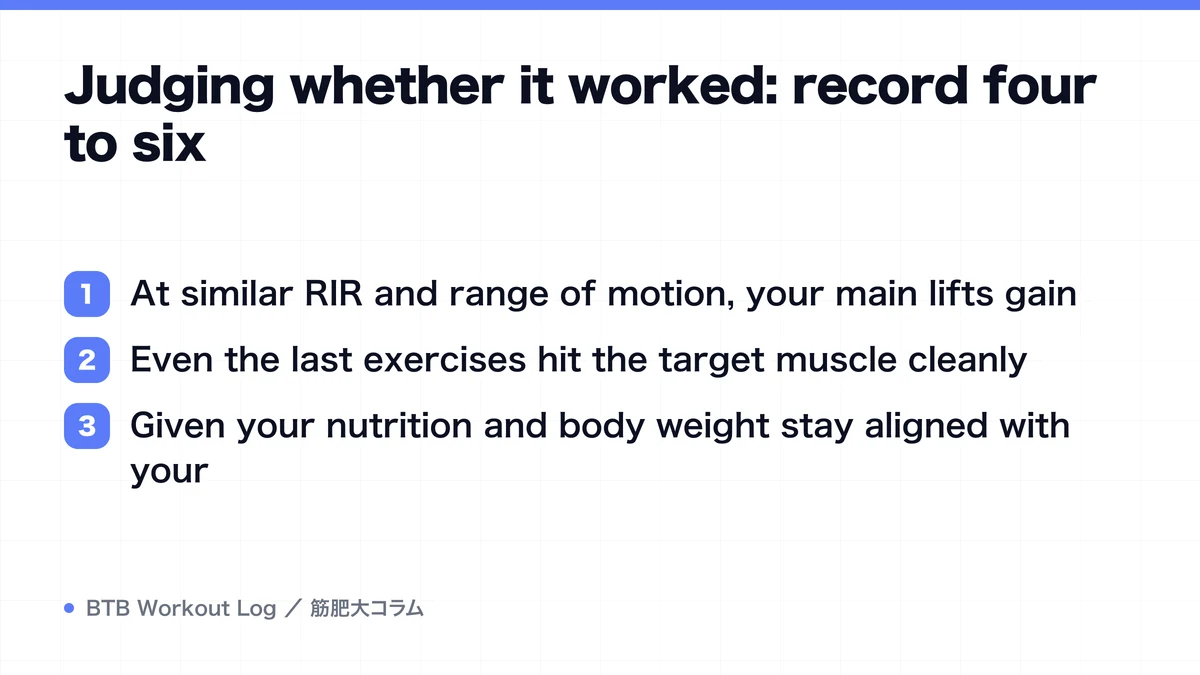
Judging whether it worked: record four to six weeks
You can't judge a program by one pump or next-day soreness. Start by logging each muscle group's weekly hard sets, your main lifts' weight·reps·RIR, and exercise order, then keep the broad structure for 4–6 weeks. Changing everything weekly clouds whether three days is the problem or your exercise selection and volume are.
Signs it's working
- At similar RIR and range of motion, your main lifts gain weight or reps across multiple weeks.
- Even the last exercises hit the target muscle cleanly without form breakdown, and output returns by the next session.
- Given your nutrition and body weight stay aligned with your goal, supplementary markers like limb circumference or photos move in the same direction over time.
Signs you need to adjust
- Weight and reps stall across multiple muscle groups, but RIR gets tighter.
- Only the latter exercises of one specific day decline, and moving them earlier fixes it.
- Output drops after adding sets and doesn't recover for several weeks.
If just one area stalls, either move it earlier in the rotation or shift its volume by 1–2 sets, locking other variables steady to observe. If fatigue is system-wide, cut total volume or all-out sets rather than add more. When both progressive overload and recovery are working, three days isn't "too few"—it's a smart design for sustaining necessary stimulus without breaking down.
Muscle growth happens from the three sessions themselves; logging exists to identify what to increase and where to cut fatigue next.
常見問題
- How many exercises do I need per session on a three-day full-body split?
- Don't decide by exercise count alone; instead anchor on leg patterns, pressing, and pulling, then fill weak spots. Most lifters start with 4–6 main lifts plus a short accessory block, then scale up or down based on output in the later exercises and total weekly sets—managing this is usually cleaner than chasing a fixed number.
- Can I do all three full-body sessions back-to-back and still build muscle?
- Yes, it's possible, but hitting your entire body hard three days in a row will cause your output on the same movements to drop. Ideally, you'd space them with rest days. If back-to-back sessions are your only option, vary your exercises, rep ranges, and priority muscle groups—reduce the volume on muscle groups that are still fatigued from the day before.
- Is full-body training three times a week sufficient even for advanced lifters?
- If your goal is building overall muscle mass, it can work. That said, advanced lifters typically need more volume for specific muscle groups, and the quality and time constraints in the later sets of each session tend to become limiting factors. If your lagging muscle groups aren't progressing, adjust your exercise order, set distribution, or switch to a split routine.
重點整理
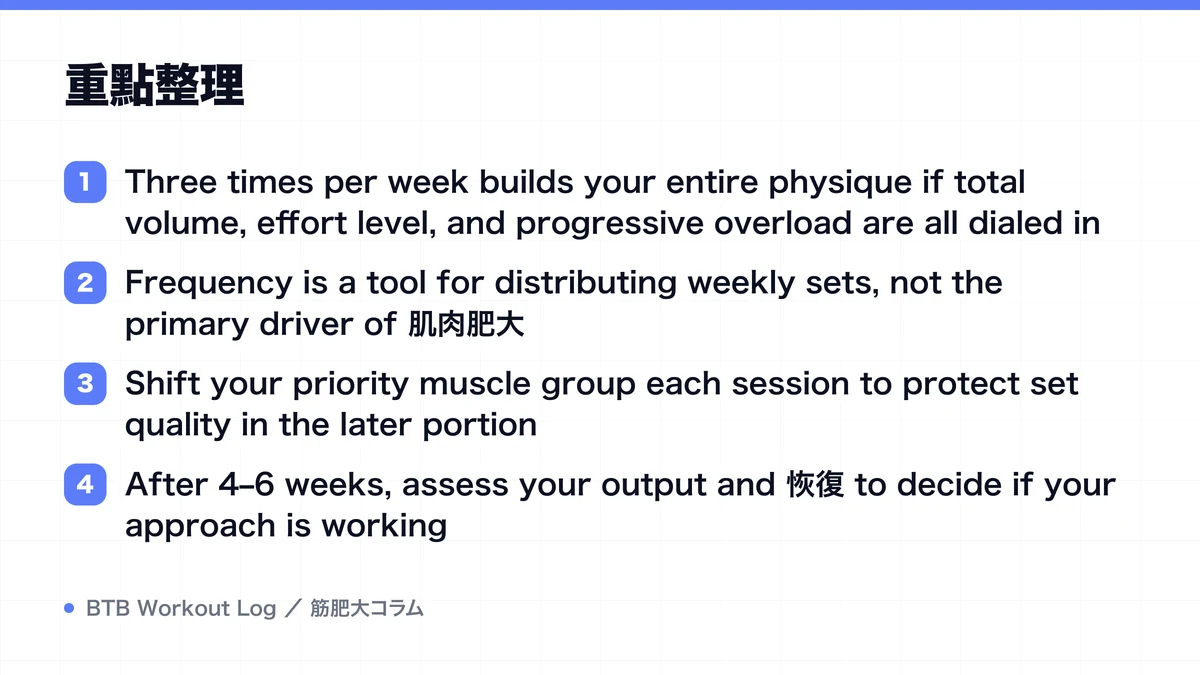
- Three times per week builds your entire physique if total volume, effort level, and progressive overload are all dialed in
- Frequency is a tool for distributing weekly sets, not the primary driver of 肌肉肥大
- Shift your priority muscle group each session to protect set quality in the later portion
- After 4–6 weeks, assess your output and 恢復 to decide if your approach is working
參考文獻
- Resistance Training Frequency and Muscle Hypertrophy: Systematic Review and Meta-analysis
- The Resistance Training Dose Response: Meta-Regressions Exploring the Effects of Weekly Volume and Frequency on Muscle Hypertrophy and Strength Gains
- Resistance Training Volume Enhances Muscle Hypertrophy in Trained Men
- Training to Repetition Failure or Non-failure: Systematic Review and Meta-analysis
- Proximity-to-Failure and Muscle Hypertrophy: Systematic Review with Meta-analysis