
就算重量沒有增加也能成長|靠增加次數來進階的原理
同樣重量下,如果動作、動作幅度、休息和 RIR 保持一致,而次數增加了,說明反覆能力進步,你完成的工作量比上次稍多。把這些細微進步累積起來,在次數範圍上限時增加重量,就是肌肉肥大式的漸進超負荷。
但接近極限的最後一次,或縮短動作幅度硬擠出來的一次,並不算相同的進步。我們來逐一分解「次數」這個數字究竟改變了什麼。
同樣重量多一次,這組動作的什麼會改變
多一次時,首先改變的是這組動作完成的反覆次數。同樣重量、同樣動作幅度、相同的動作速度下,目標肌肉在張力作用下發力的機會增加一次。總負荷量(重量×次數)也會增加,但總負荷量本身並不等於肌肉肥大刺激的評分。因為用淺幅度或借力堆砌次數,對目標肌肉的刺激增幅不一定成比例。
另一個關鍵是,額外的一次變成了能力進步的觀測值。上次 80kg 做 8 次·RIR2,這次同條件做 9 次·RIR2,說明在保持餘力的情況下,能反覆更多次了。RIR 代表「還能做幾次」。這個對比表明,你不是單純撐了更久,而是對這個重量的反覆能力可能確實進步了。
次數增加不是直接把肌肉變大的魔法操作。它是透過訓練和恢復產生的適應,轉化為數字,然後在下次訓練時逐步增加工作量的手段。包括重量在內的全景觀點,與漸進超負荷的框架相通。
額外一次如何推動成長刺激的更新
「多一次就能長肌肉」這樣直接連接會搞反因果。實際的邏輯是這樣的:
- 穩定負荷下目標肌肉發力:用穩定的動作和幅度反覆,肌纖維受到機械張力刺激。
- 循環刺激與恢復:充分補充營養、間隔恢復,持續同一動作,身體適應這些要求。
- 相同努力度下反覆能力提升:同樣重量比上次多舉,還能維持 RIR。
- 完成的工作稍微增加:額外的一次讓目標肌肉在張力下工作的機會增多,即使組數不變。
- 達到上限時增加重量:達到設定的次數範圍上限,進行最小增幅,用新的重量重新開始堆積次數。
在這個循環裡,次數增加既是「適應的結果」,也是「小幅提升刺激」的操作。對於用不上每次都加片的中級訓練者來說,能用比重量更細的梯度推進要求,這是實用優勢。重量和次數哪個先動,在增加重量 vs 增加次數的比較中有不同的判斷標準。
一般來說,肌肉肥大在輕負荷到重負荷的範圍都能發生,所以用次數調整負荷的方式也能相容。但重量越輕,通常要做越多次才能達到有效的反覆,而呼吸困難或局部灼熱感可能先成為限制。不是無限地增加次數,而是在適合這個動作的範圍內推進。

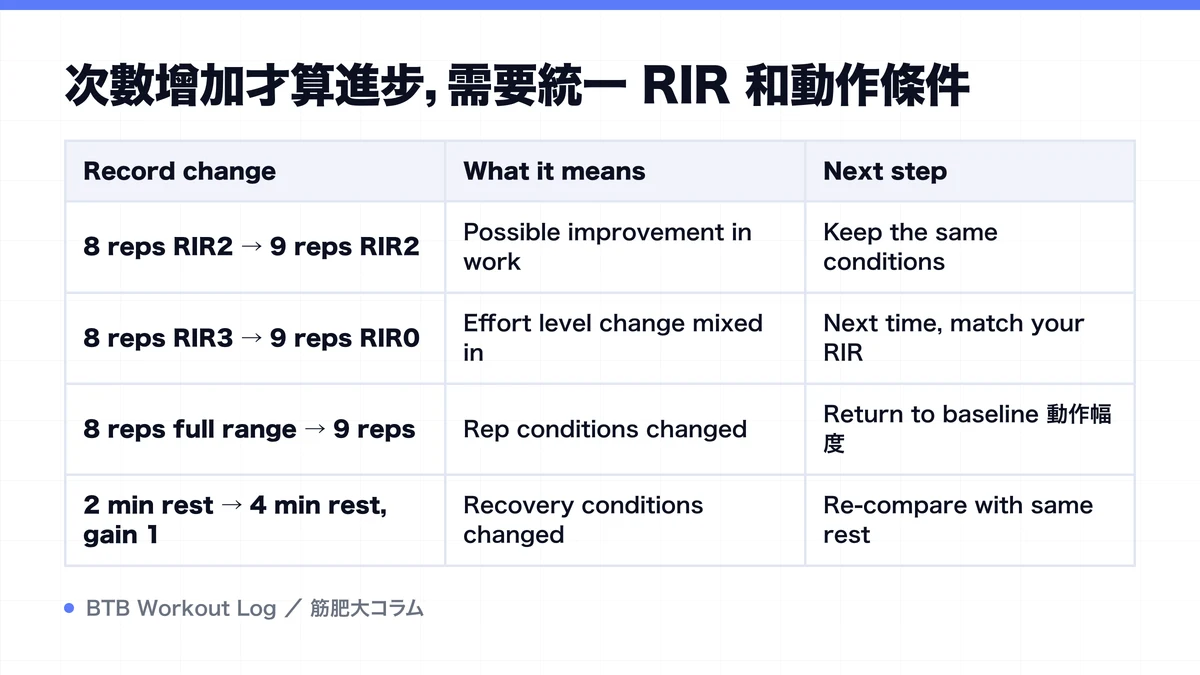
次數增加才算進步,需要統一 RIR 和動作條件
The trickiest variable to mix up when comparing reps is effort level. If your previous 80kg×8 was RIR3 and today's 80kg×9 is RIR0, you can't tell if you got stronger or just pushed harder to failure. If both are RIR2, you're comparing apples to apples: "same余力 left, one extra rep." The RIR guide has the full breakdown.
| Record change | What it means | Next step |
|---|---|---|
| 8 reps RIR2 → 9 reps RIR2 | Possible improvement in work capacity | Keep the same conditions |
| 8 reps RIR3 → 9 reps RIR0 | Effort level change mixed in | Next time, match your RIR |
| 8 reps full range → 9 reps shallow range | Rep conditions changed | Return to baseline 動作幅度 |
| 2 min rest → 4 min rest, gain 1 rep | Recovery conditions changed | Re-compare with same rest |
Sleep, stress, exercise order, and different equipment shift the needle by 1–2 reps on their own. So don't call one-off PRs proof of肌肉肥大; instead, watch the trend across several sessions under identical conditions. Reproducible reps are more useful data than a shaky single rep at the edge of form breakdown.
Convert reps to weight with double progression
Double progression is the simplest way to turn rep gains into real load increases. Pick a 次數範圍 first, hold weight steady within that range as you climb reps, then jump up once you hit the top. See how to set load from rep count for the relationship between weight and rep targets.
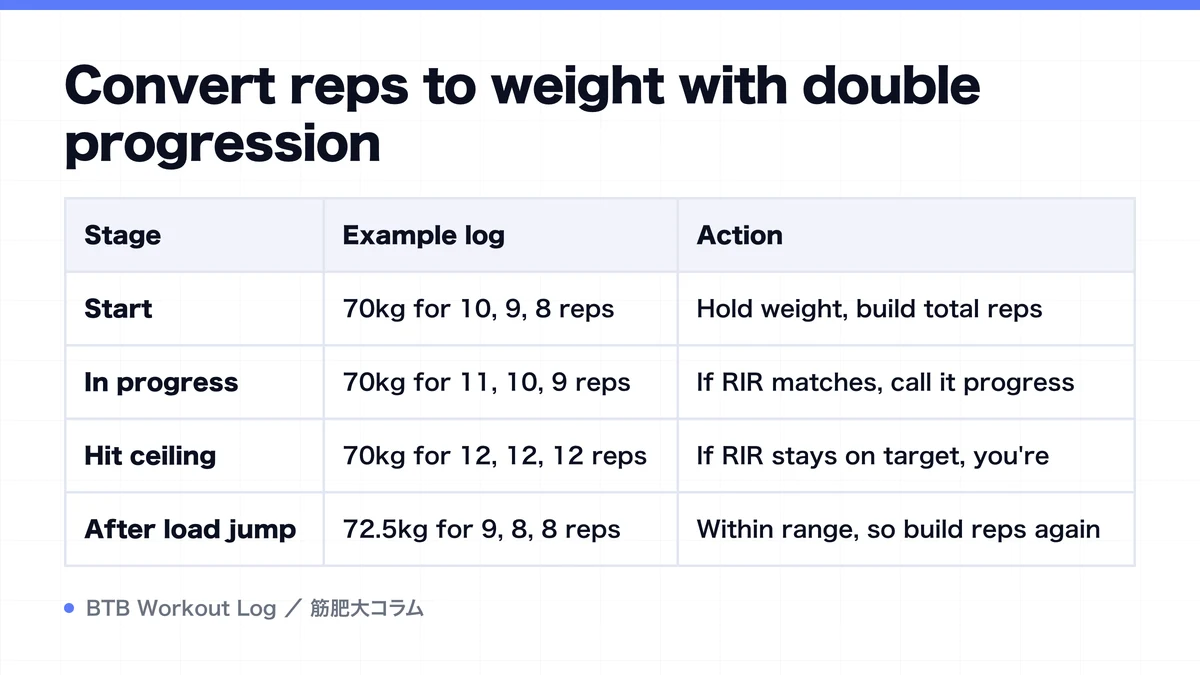
Example: 8–12 reps, 3 sets
| Stage | Example log | Action |
|---|---|---|
| Start | 70kg for 10, 9, 8 reps | Hold weight, build total reps |
| In progress | 70kg for 11, 10, 9 reps | If RIR matches, call it progress and continue |
| Hit ceiling | 70kg for 12, 12, 12 reps | If RIR stays on target, you're ready to增肌 |
| After load jump | 72.5kg for 9, 8, 8 reps | Within range, so build reps again |
Waiting for all sets to hit the ceiling is conservative and works well for dumbbells with big jumps between weights. You can also jump after just the first set tops out, or base it on total reps across all three. Pick a rule and stick with it—consistency is what lets you compare real progress. Also: if your first set gains 1 rep but the next two drop 3 total, your overall session work didn't necessarily go up. Line up reps per set, total reps, and RIR side by side to see whether you just ground harder on the first set or actually improved your base strength. For a fuller breakdown of total work, see 訓練量.
When to fix conditions instead of chasing more reps
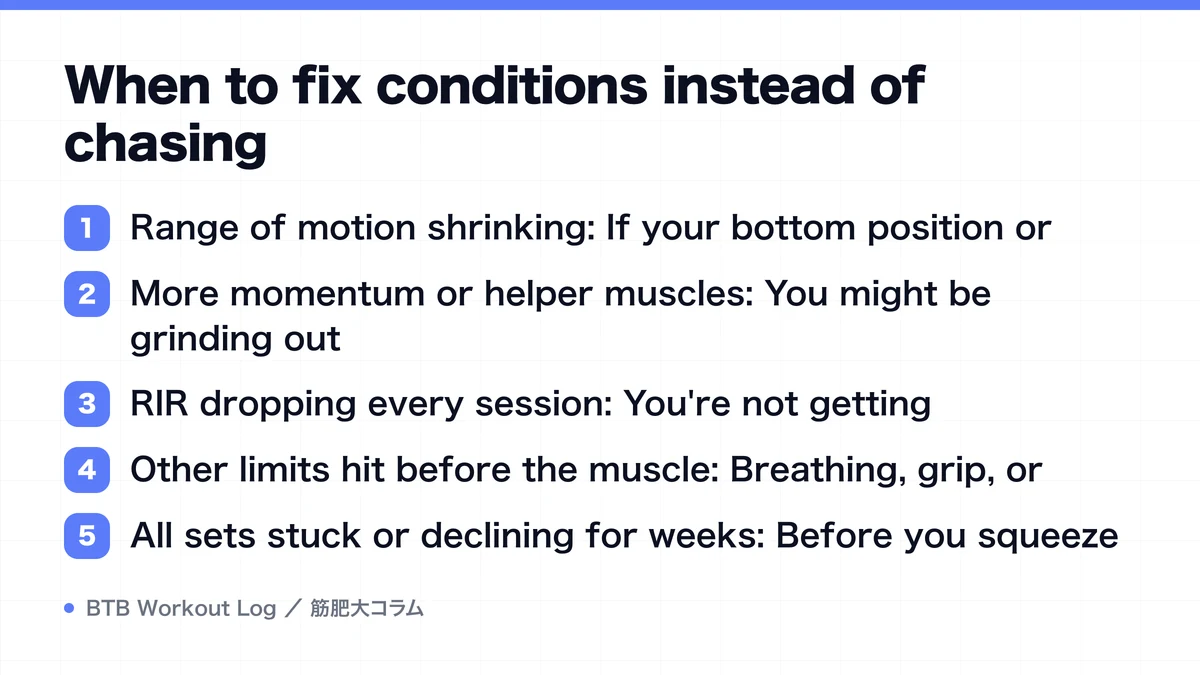
Forcing "one more rep than last time" every session eventually breaks your comparison baseline. These changes need fixing before you chase higher rep counts:
- Range of motion shrinking: If your bottom position or lockout shifts, you're not really comparing the same lift.
- More momentum or helper muscles: You might be grinding out reps with technique tricks instead of actual strength in the target muscle.
- RIR dropping every session: You're not getting stronger—you're just accumulating fatigue to chase the number.
- Other limits hit before the muscle: Breathing, grip, or posture gives out before your target muscle does, ending the set prematurely.
- All sets stuck or declining for weeks: Before you squeeze out more reps, check sleep, nutrition, weekly set count per exercise, and exercise order.
On the flip side, reps shine when your smallest load jump is huge. If moving up a dumbbell pair adds a lot of weight, building reps all the way to the top of your range first—then jumping—keeps you from overshooting the top of your target range after the increase.
The call is simple. As long as reps climb at the same RIR and conditions, hold the weight. Hit your target range ceiling, jump by the smallest increment available. Reps flatline and RIR and later sets fall apart at the same time? Add a set or check恢復 and current volume first.
Log weight, reps, and RIR together to make smart calls
To use reps as progression, log more than just weight and count—record the RIR for each set, rest periods, 動作幅度 and form tweaks in the same entry. Don't just ask "did I add one rep today?" Instead, check whether total reps trended up over weeks under identical conditions, or whether you held your target range even after loading up.
Logging doesn't create stimulus itself, but it feeds the next call: do another rep, go heavier, or dial in volume and 恢復. Rep progression only works if you know what you hit last time. BTB Workout Log is built to chase one more rep from that baseline.
常見問題
- Does one extra rep at the same weight prove 肌肉肥大?
- A single rep doesn't prove anything—fatigue state, rest depth, and RIR all shift your count. What matters is reps climbing across several sessions with matching form, 動作幅度, rest, and RIR. That trend suggests real capacity gain.
- When should I jump weight after adding reps?
- Decide your 次數範圍 per lift first. Once you hit the upper bound at your target RIR—either all sets or your chosen total—that's your signal to load. Pick a jump that keeps the new weight's lower range reachable; stick to the same rule through each cycle.
- My first set got stronger but later sets dropped. Is that progress?
- Early sets climbing while back sets crater doesn't mean your actual capacity went up. Compare each set and total reps against last session—check if you 力竭 the first one too hard. If totals stay stable and keep drifting up, that's real progress.
重點整理
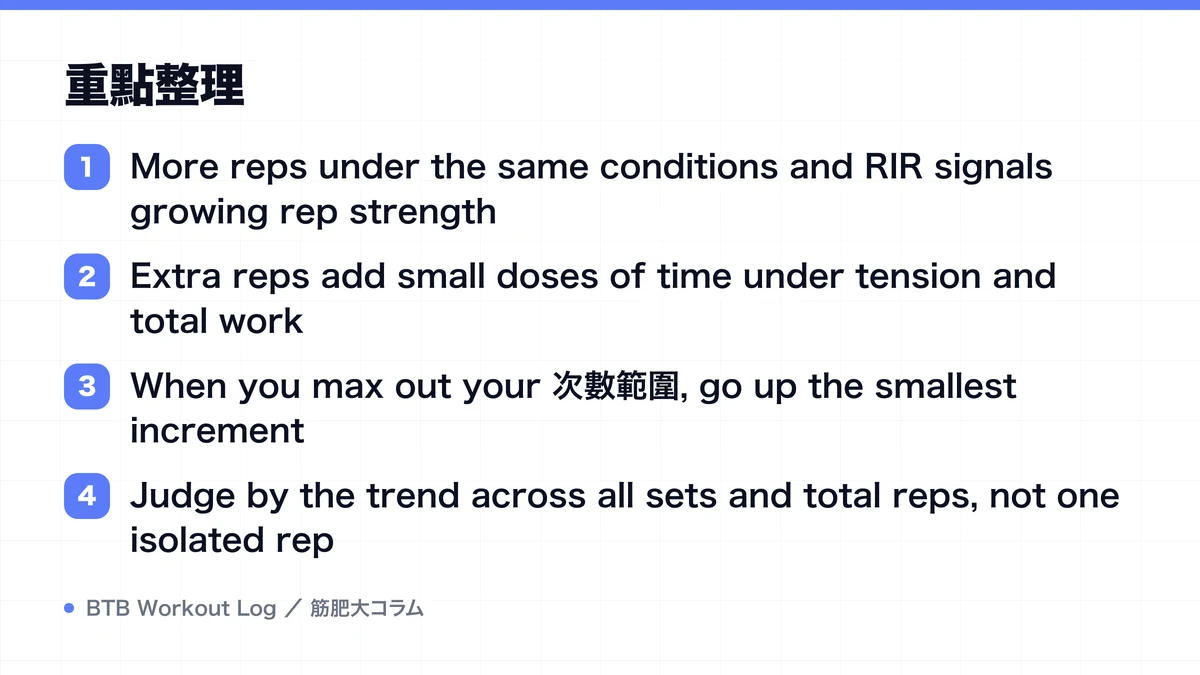
- More reps under the same conditions and RIR signals growing rep strength
- Extra reps add small doses of time under tension and total work
- When you max out your 次數範圍, go up the smallest increment
- Judge by the trend across all sets and total reps, not one isolated rep
參考文獻
- ACSM Position Stand: Progression Models in Resistance Training for Healthy Adults
- Low- vs High-load Resistance Training for Strength and Hypertrophy: Meta-analysis
- Proximity-to-Failure and Muscle Hypertrophy: Systematic Review with Meta-analysis
- Mechanisms of Muscle Hypertrophy: Current Understanding and Future Directions