1주일 운동을 쉬면 근육은 얼마나 줄어들까? 쉬는 게 두려운 사람을 위한 답
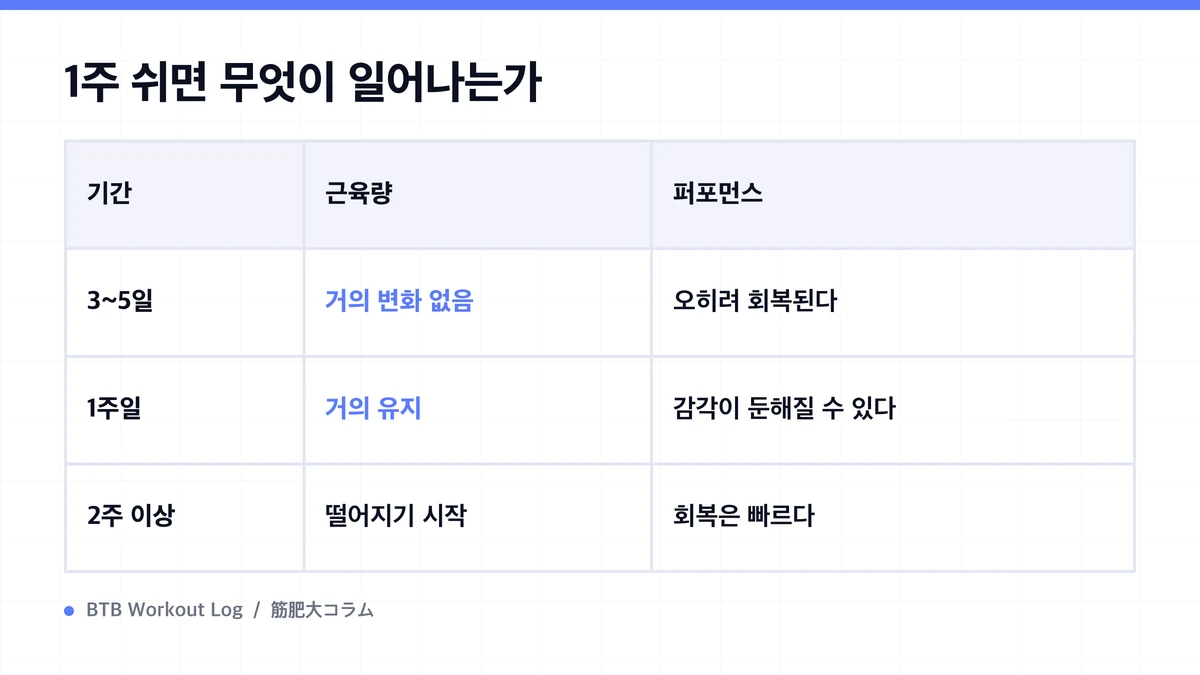
건강한 사람이 일상생활을 계속하고 식사를 크게 흐트러뜨리지 않으면서 1주일 쉰다면, 잃는 근육은 실질적으로 거의 없다고 봅니다. 다만 모두에게 공통으로 적용되는 저하율을 '몇 %'라고 정할 수는 없습니다.
보이는 펌프감, 체중, 복귀 첫 날의 반복 횟수는 1주일만에도 변하지만, 이것만으로 근섬유 자체의 감소를 의미하지는 않습니다. 무엇을 측정하고 어떤 조건에서 답이 달라지는지 따로 검증하겠습니다.
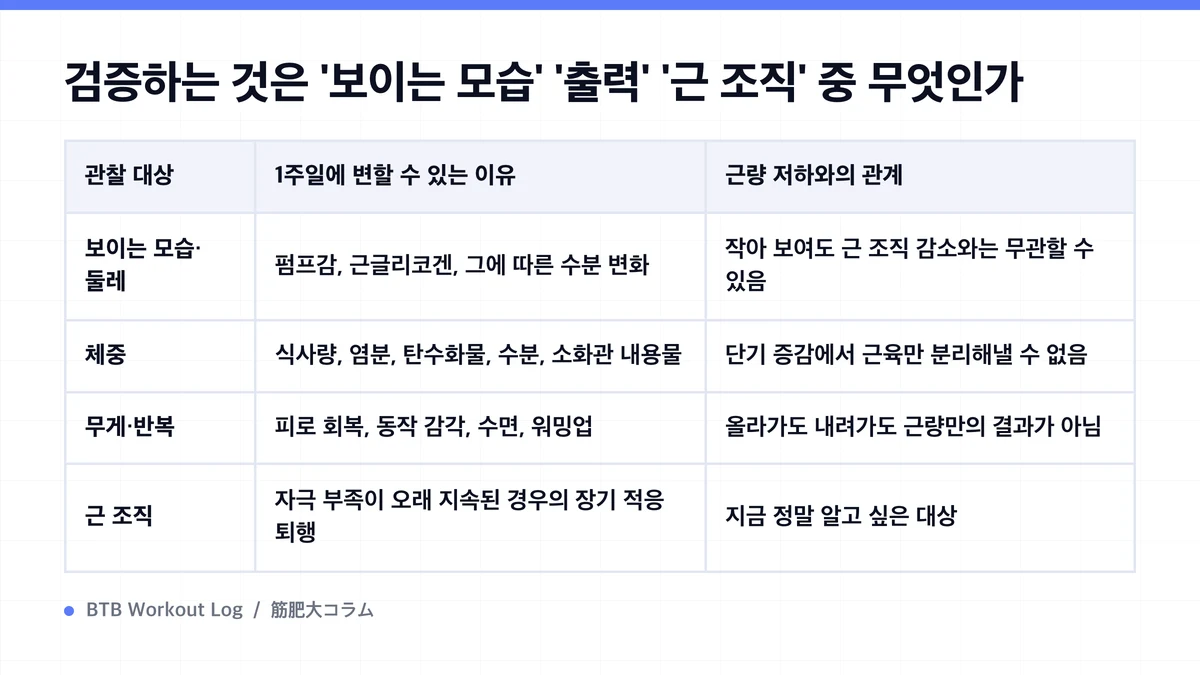
검증하는 것은 '보이는 모습' '출력' '근 조직' 중 무엇인가
'근육이 줄었다'는 느낌에는 최소한 세 가지 의미가 섞여 있습니다. 1주일 쉰 후 거울에 작아 보이거나 첫 세트가 무겁게 느껴져도, 근섬유가 같은 비율로 줄었다는 뜻은 아닙니다.
| 관찰 대상 | 1주일에 변할 수 있는 이유 | 근량 저하와의 관계 |
|---|---|---|
| 보이는 모습·둘레 | 펌프감, 근글리코겐, 그에 따른 수분 변화 | 작아 보여도 근 조직 감소와는 무관할 수 있음 |
| 체중 | 식사량, 염분, 탄수화물, 수분, 소화관 내용물 | 단기 증감에서 근육만 분리해낼 수 없음 |
| 무게·반복 | 피로 회복, 동작 감각, 수면, 워밍업 | 올라가도 내려가도 근량만의 결과가 아님 |
| 근 조직 | 자극 부족이 오래 지속된 경우의 장기 적응 퇴행 | 지금 정말 알고 싶은 대상 |
따라서 휴식 전후 사진이나 체중을 한 번 비교해서 '근육이 1kg 줄었다'고 판정할 수 없습니다. 며칠에서 수 개월까지의 변화 순서는 트레이닝 중단의 진행에서 다루지만, 여기서는 1주일이라는 짧은 기간에 집중합니다.
성장 자극이 멈추는 것과 근섬유가 바로 줄어드는 것은 같지 않다
근비대는 한 번의 운동으로 완성되는 변화가 아닙니다. 근섬유에 기계적 장력을 반복해서 주고, 운동 후 근단백질의 재구성과 회복을 장기간 쌓아올린 결과입니다. 반대로 한 번의 자극을 놓친 직후부터 지금까지의 적응이 같은 속도로 되돌아가지도 않습니다.
저항 운동 후 근단백질 합성 반응은 일시적입니다. 다만 그 반응이 정상으로 돌아온다는 것은 '그 시점부터 눈에 띄는 근 위축이 시작된다'는 뜻이 아닙니다. 근단백질은 운동 유무와 관계없이 합성과 분해를 반복하며, 일상 동작과 식사의 영향도 받습니다. 단기 생리 반응과 장기 근량 변화를 하나의 시간표로 보지 않는 것이 중요합니다.
더욱이, 힘든 기간 직후라면 1주일 동안 새로운 피로가 줄어드는 속도가 적응을 잃는 속도보다 클 수 있습니다. 그러면 휴식 후 같은 무게가 가볍게 느껴집니다. 이것은 단기간에 근육이 늘어났다기보다, 피로에 가려져 있던 출력이 드러난 가능성이 높습니다. 자세한 구분은 디로드로 출력이 회복되는 원리와 같습니다.
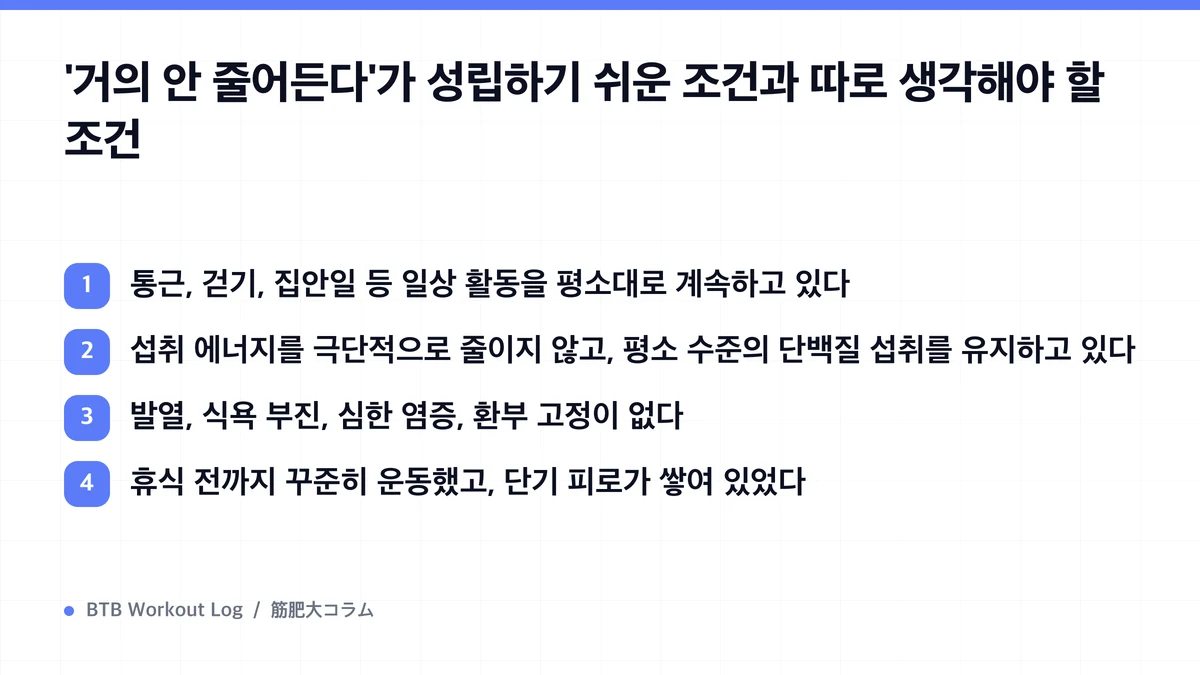
'거의 안 줄어든다'가 성립하기 쉬운 조건과 따로 생각해야 할 조건
1주일 휴식을 한묶음으로 보면 결론을 잘못 낼 수 있습니다. 건강한 트레이니가 출장이나 일 때문에 짐에 못 갈 때와 병이나 부상으로 신체 활동 자체가 크게 제한될 때는 근육이 받는 조건이 다릅니다.
실질적으로 거의 없다고 봐도 되는 조건
- 통근, 걷기, 집안일 등 일상 활동을 평소대로 계속하고 있다
- 섭취 에너지를 극단적으로 줄이지 않고, 평소 수준의 단백질 섭취를 유지하고 있다
- 발열, 식욕 부진, 심한 염증, 환부 고정이 없다
- 휴식 전까지 꾸준히 운동했고, 단기 피로가 쌓여 있었다
같은 '1주일'이어도 신중하게 다뤄야 할 조건
- 입원, 안정, 깁스 고정 등으로 해당 근육을 거의 쓰지 않는다
- 병으로 식사량과 활동량이 동시에 크게 떨어진다
- 급격한 감량으로 큰 에너지 부족이 계속되고, 체중도 급격히 줄어든다
- 고령, 치료 중, 긴 휴식의 마지막 1주일 등 단기 휴식 외 다른 요인이 겹친다
후자는 '짐을 1주일 쉔 효과'만을 검증하는 조건이 아닙니다. 특히 병이나 고정 상태에서는 회복과 의료 제한이 우선입니다. 피로 관리를 위해 의도적으로 부하를 줄이는 경우도 통상적인 완전 휴식과 목적이 다르므로, 구체적인 방법은 디로드 하는 법과 따로 생각합니다.
1주일에 줄어드는 양을 하나의 비율로 정할 수 없는 이유
The straightest answer to the title is: a healthy lifter continuing normal life won't experience meaningful muscle loss in a week, but there's no universal guarantee of zero change. Your muscle going in, training age, current age, daily activity, diet, and which body parts you measure—these all shift how your numbers move.
Also, one week is too short for clean measurement. The noise from measuring at different times of day, after different meals, with different hydration and preceding work will move your weight and arm circumference as much as the actual change you're trying to catch. Even if your scale reads a difference, that number isn't pure muscle loss. The more decimal places you claim, the more it looks precise—until you realize the conditions weren't controlled, and you can't actually use it to decide training.
If you want to track your own case, compare three sessions before the break to three after. Keep the time of day, meals, water intake, exercise order, and rest periods as consistent as you can manage. Don't judge by a single peak number. If your arm circumference bounces back and you hit the same weight and reps at the same RIR within a few sessions, you probably don't need to explain that initial dip as real muscle loss. If output is still down, check your overall health, any pain, sleep quality, and why you took the break in the first place before blaming muscle.
Research shows that 근비대 is a long-term adaptation from the mix of frequency, intensity, volume, and movement patterns—not something you can predict from a single muscle protein synthesis response. You can't directly calculate "everyone loses X% after one week off." So when deciding whether to rest, skip the decimal-point estimates. Instead, confirm why you're taking the break and check your activity and nutrition during that time.
Compare 2–3 sessions after returning under the same conditions, and you won't jump to conclusions about loss
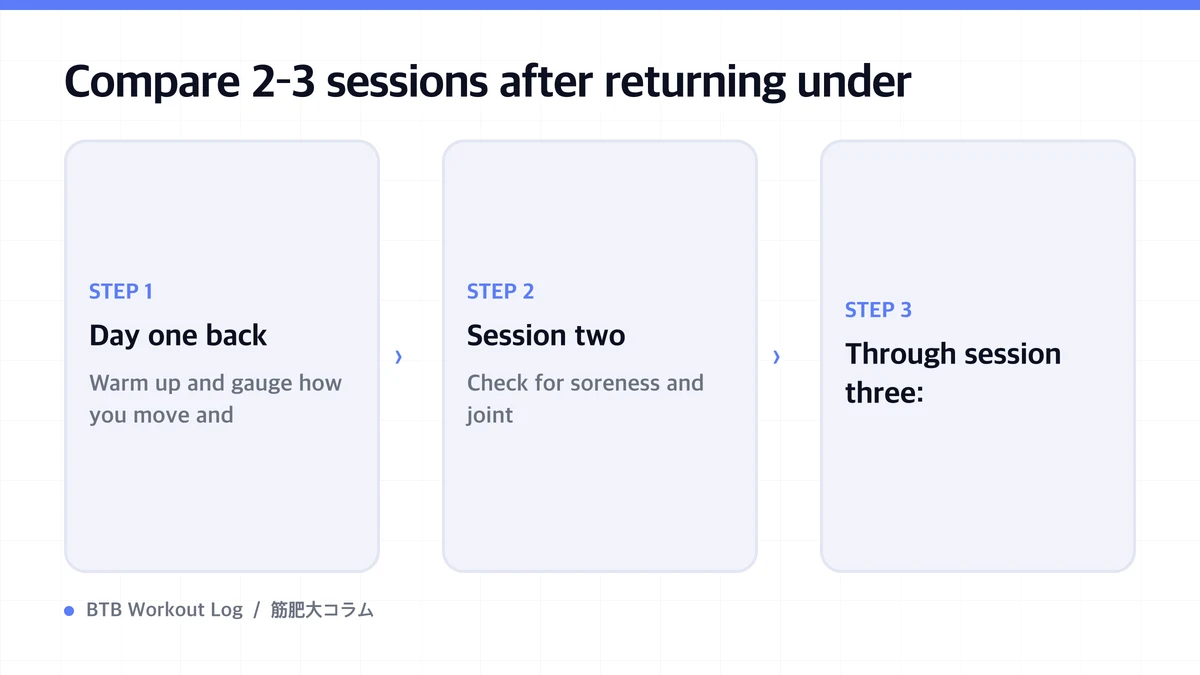
If you need a full week off, don't stuff extra 하드 세트 beforehand to protect muscle. Keep your last normal session before the break as your baseline, then return to the same exercises, same 가동 범위, same rest periods for comparison. You're not chasing a single rep max—you're tracking the combination of weight, reps, and RIR (how many reps left in the tank).
- Day one back: Warm up and gauge how you move and feel. You can test the old weight, but don't make hitting it mandatory—leave extra RIR.
- Session two: Check for soreness and joint feedback, bring assistance work and set count closer to normal.
- Through session three: Watch whether weight or reps return to pre-break range at the same RIR. If they do, that first-day dip was probably just skill rust or how you felt that day.
Don't add extra sets to "make up" for the week off. If you do, your comparison falls apart, and you undo the recovery you took a break for. Start from your pre-break record and pick up 점진적 과부하 from where you are now. That's enough.
Don't treat day one as a red mark and move on. Line up how you bounced back over 2–3 sessions, and you'll separate the feeling that you "lost muscle" from what your actual performance shows. One week off will tell its story when you compare the same lifts before and after. BTB Workout Log is built for that comparison.
자주 묻는 질문
- Should I do light 자중 training during that week off, just to preserve muscle?
- If you're taking the week to strip fatigue, you don't need to add movement out of fear of losing muscle. Feel free to move lightly if you're in good spirits—say, staying active on vacation—but don't push hard or you'll defeat the purpose of the break.
- If my weight or arm size dropped in that week, doesn't that prove I lost muscle?
- No. Carbs, salt, water, food in your digestive system, and the pump from training all shift your weight and circumference in the short term. Bring back your meals and training, then measure several times at the same time of day under the same conditions before you judge any real change.
- Can I use the same weight on day one back that I used before the break?
- You can try it after warming up if you feel good, but don't make the pre-break reps non-negotiable. If it feels heavy, dial back the weight or sets and leave extra RIR. You'll return to normal form and output over the next two or three sessions.
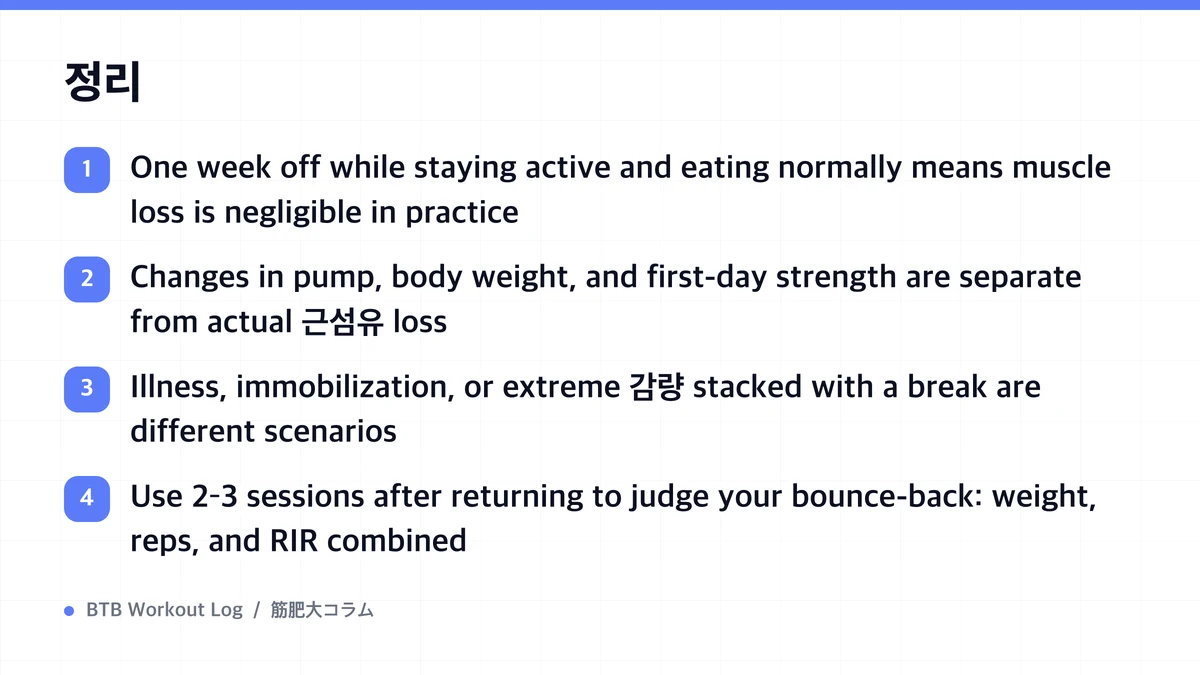
정리
- One week off while staying active and eating normally means muscle loss is negligible in practice
- Changes in pump, body weight, and first-day strength are separate from actual 근섬유 loss
- Illness, immobilization, or extreme 감량 stacked with a break are different scenarios
- Use 2–3 sessions after returning to judge your bounce-back: weight, reps, and RIR combined