
수면이 부족하면 운동에 무슨 일이 일어날까? 수면 부족이 근비대의 발목을 잡는 흐름
수면이 부족하면 먼저 트레이닝 준비 상태가 떨어지고, 동일한 무게의 상대적 난이도가 올라갑니다. 그 결과 복합 운동의 발휘 근력, 반복 횟수, 동작 재현성이 순서대로 무너지기 쉬워집니다.
하룻밤의 부족으로 근비대가 사라지지는 않습니다. 문제는 저출력 세션이 계속되면서, 점진적 과부하에 필요한 고품질의 반복을 쌓기 어려워진다는 점입니다.
수면 부족의 영향은 근육보다 먼저 '준비 상태'에 나타난다
수면 시간이 모자란 아침에도 근육 자체가 갑자기 작아지거나 이전까지의 적응이 사라지지는 않습니다. 먼저 변하기 쉬운 것은 졸음, 집중력 유지, 동작 개시 의욕, 주관적 난이도 같은 높은 출력을 끌어내기 위한 준비 상태입니다.
근력 운동 기록에는 준비 상태가 단독 수치로 드러나지 않습니다. 웜업이 평소보다 무겁게 느껴지고, 세트 전 집중이 시간이 걸리며, 같은 무게인데 일찍부터 여력이 없어진다는 식으로 나타납니다. 따라서 '근력이 떨어졌다'고 바로 판단하기보다는, 수면 조건에 따라 그 날 발휘할 수 있는 출력이 내려갔다고 봐야 더 실상에 가깝습니다. 지난번에 들던 무게가 갑자기 무겁게 느껴지는 원인은 일일 무게 변동에서도 정리했습니다.
여기서 중요한 건 수면 부족을 기분의 문제로만 보지 않는 것입니다. 트레이닝은 의도한 폼과 가동 범위로 힘을 내고, 세트 간에 그것을 재현하는 작업입니다. 각성도나 집중력이 떨어지면 이 작업 전체의 정확도가 내려가는 입구가 됩니다.
준비 상태 저하가 복합 운동의 발휘 근력으로 파급된다
Knowles 등이 정리한 시스템 리뷰에 포함된, 18~24세 남성 8명을 대상으로 한 연구에서는 3시간 수면을 3밤 연속한 조건에서 최대 근력이 암컬 컬에서는 유의한 저하를 보이지 않았고, 벤치프레스, 레그프레스, 데드리프트에서는 저하했습니다. 해당 연구들의 질에는 한계가 있으며, 모든 운동·사람에게 동일한 저하가 일어난다는 의미는 아닙니다.
스쿼트, 벤치프레스, 데드리프트 같은 복합 운동은 여러 관절을 협조시키고, 자세를 유지하며, 의도한 궤적에서 큰 힘을 내야 합니다. 수면 부족으로 집중과 준비 상태가 떨어진 날에 단순한 근수축만으로는 설명할 수 없는 부분까지 포함해서 성적이 흔들리기 쉬운 것은 실무상으로도 당연합니다. 다만 이 리뷰가 협응력 저하를 원인으로 직접 증명한 것은 아니므로, 메커니즘과 관찰 결과는 따로 생각할 필요가 있습니다.
또한 최대 근력만 보고 '오늘은 평소 무게를 들었으니 영향 없다'고 판단하는 것도 성급합니다. 첫 1회를 성공했더라도, 보통의 렙 범위를 유지할 수 있고 이후 세트에서 동일한 동작을 재현할 수 있는지는 별개의 문제입니다.
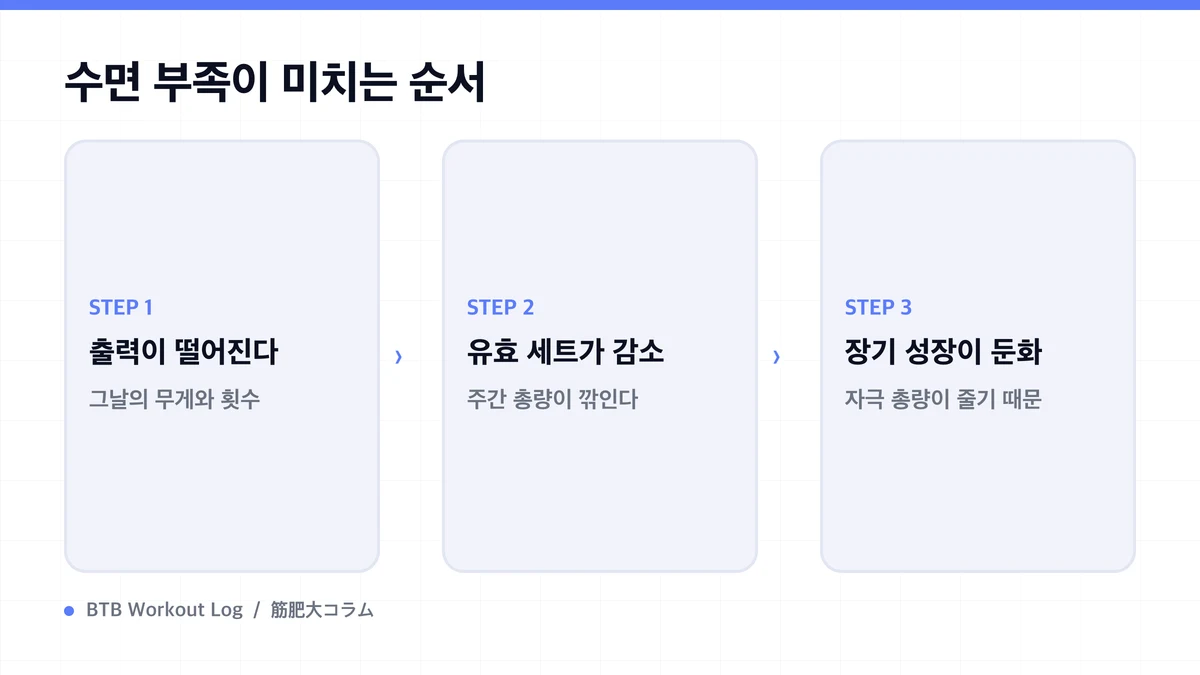
같은 무게라도 RIR이 줄어들고 세트 품질이 떨어진다
발휘 근력이 조금만 떨어져도 트레이닝 처방의 의미가 바뀝니다. 평소라면 8회를 해서 RIR2, 즉 '2회 더할 여력'이 남는 무게도 수면 부족한 날에는 6~7회에서 RIR0~1에 가까워질 수 있습니다. 무게 표시는 같아도 그 날의 능력에 대한 상대 강도는 높아집니다.
이 어긋남을 무시하고 계획한 횟수를 지키려 하면 가동 범위를 줄이거나, 반동을 늘리거나, 목표 근육 외에 다른 곳으로 밀어내는 대체 운동이 생기기 쉬워집니다. 반대로 폼을 지키면 반복 횟수가 떨어집니다. 어느 경우든 서류상의 '무게×세트 수'가 같다고 같은 자극을 받았다고 평가할 수 없습니다. RIR, 가동 범위, 폼을 맞춰야 처음으로 지난번과 비교할 수 있습니다.
더욱이 첫 세트에서 여력을 다 쓸수록 이후 세트의 횟수 저하는 커집니다. 부족분을 되돌리려고 한계까지의 세트나 추가 세트를 쌓으면 국소 피로뿐만 아니라 세션 전체의 피로도 늘어납니다. 수면 부족에서 근비대로 가는 경로는 '자지 않으면 근육이 자라지 않는다'는 단순한 설명이 아니라, 상대 강도 상승 → 반복과 동작 저하 → 품질 유지 가능한 작업량 감소로 보면 판단하기 쉬워집니다.
하룻밤의 부조와 수면 부족의 반복을 구분해서 생각하기
One poor night of sleep doesn't erase the value of that day's workout. If you adjust the load and maintain movement quality within your capacity, you can preserve the training stimulus. A single dip in performance isn't reason to treat it as a plateau and overhaul your entire program.
Problems compound when sleep restriction lasts days to weeks. Reps drop on compound lifts each session, weekly 하드 세트 quality declines, and opportunities to progress weight or reps diminish. The long-term hit to 근비대 comes most directly through difficulty repeating 점진적 과부하. We can't quantify from this single study exactly how much chronic sleep loss reduces muscle gain over time.
Sleep extension interventions in 14–30 year old athletes show potential to improve athletic performance, but the evidence base is thin and quality varies. It's not "sleep more, always improve"—rather, chronically sleep-deprived people who secure adequate sleep opportunity may see room for improvement.
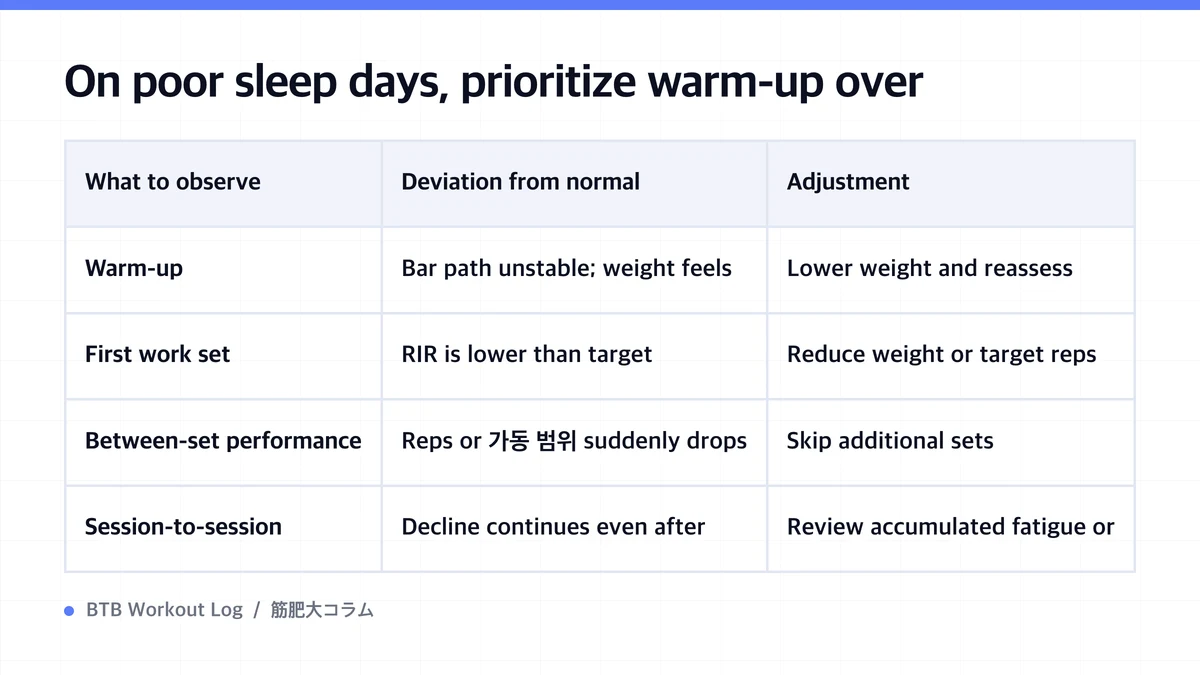
On poor sleep days, prioritize warm-up over your planned routine
Don't automatically cancel or proceed based solely on sleep hours. Use warm-up through your first work set as a test: can you execute the plan today?
| What to observe | Deviation from normal | Adjustment |
|---|---|---|
| Warm-up | Bar path unstable; weight feels heavier than usual | Lower weight and reassess |
| First work set | RIR is lower than target | Reduce weight or target reps |
| Between-set performance | Reps or 가동 범위 suddenly drops | Skip additional sets |
| Session-to-session | Decline continues even after sleep recovers | Review accumulated fatigue or program |
When you can proceed normally
If warm-up movement is stable and work sets hit your target RIR and 렙 범위, don't stop based on sleep hours alone. That said, defer personal records or risky heavy attempts to a better-rested day for safety.
When to reduce load or sets
If you can't hit target reps while keeping form, feel close to failure on set one, or see large rep drops between sets, match that day's capacity. Preserving repeatable, quality reps to the target muscle takes priority over hitting the planned weight. Once sleep normalizes, return to standard settings—don't fear a single adjusted session as undertraining.
When rest takes priority
If severe drowsiness delays safety checks, you can't control free weight positions, or daily decision-making suffers, prioritize sleep. If output doesn't bounce back after several sessions despite adequate sleep, accumulated training fatigue may also need resetting. A 디로드 or proper rest days are your next diagnostics.
Read sleep impact through conditional trends, not single weights
To assess sleep's effect, pair sleep hours with training results. At minimum, log time in bed, subjective grogginess, weight/reps/RIR per lift, and rep drop between sets. Sleep duration won't match actual sleep time, so treat it as a condition marker rather than a precise measurement.
One weight dip may just be daily variation. If compound lift RIR and reps worsen repeatedly on poor sleep days but recover when sleep normalizes, you have stronger evidence of a sleep link. If the decline persists despite sleep recovery, investigate volume, frequency, nutrition, or pain instead. Skip fixed 48-hour rules; match conditions to output to judge 회복.
Seven to nine hours is the sleep guideline for healthy young and older adults, but needs vary individually. Rather than forcing yourself to match an ideal, track sleep volumes where your output and daytime function stabilize—then build that into training decisions. That's the practical approach.
자주 묻는 질문
- Should I skip training after just one poor night of sleep?
- You don't have to cancel based on sleep hours alone. Check bar path during warm-up, how the weight feels compared to normal, and your RIR on the first work set. If movement is sound, adjust the load and train. If severe drowsiness makes safe movement hard, rest instead.
- How much percentage should I lower the weight on a poor sleep day?
- There's no fixed percentage. After warm-up, drop to whatever weight lets you hit your target 렙 범위 and RIR. If form or 가동 범위 remains unstable even after reducing weight, or rep drop between sets is steep, also cut sets to set up the next session better.
- Does chronic poor sleep stop muscle growth altogether?
- Not immediately. But if compound lifts and set quality consistently suffer, you'll struggle to progress weight, reps, and quality weekly volume. If weakness persists several sessions after sleep recovers, check accumulated fatigue and other recovery factors too.
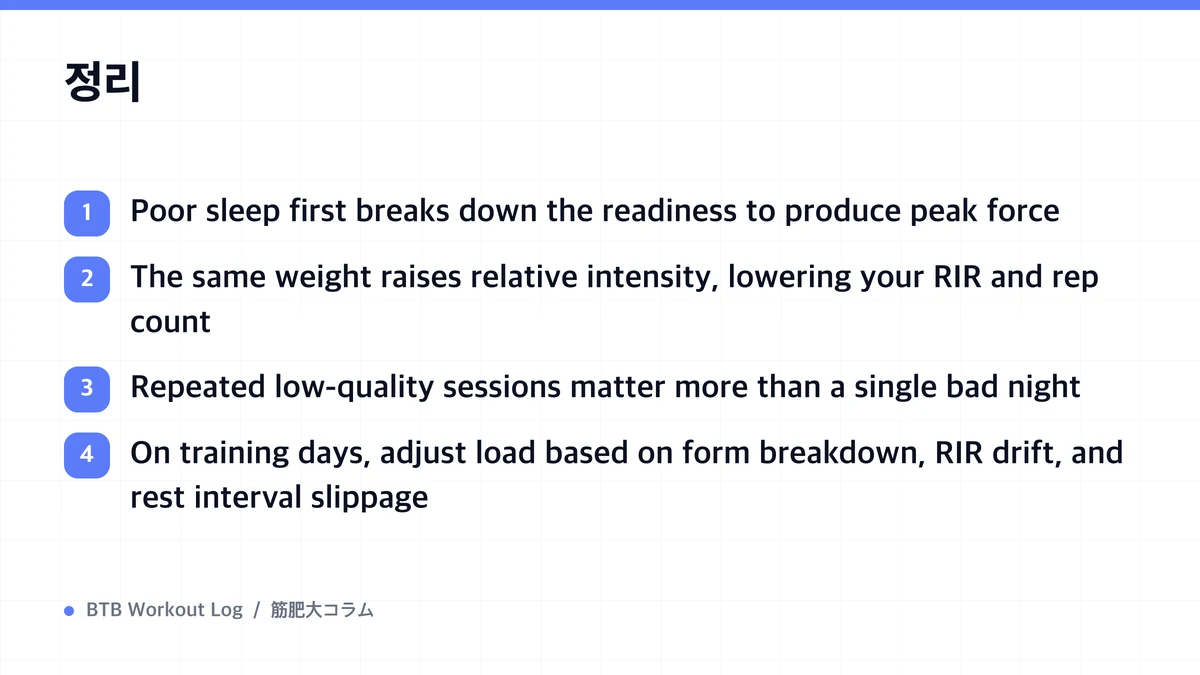
정리
- Poor sleep first breaks down the readiness to produce peak force
- The same weight raises relative intensity, lowering your RIR and rep count
- Repeated low-quality sessions matter more than a single bad night
- On training days, adjust load based on form breakdown, RIR drift, and rest interval slippage