주 10세트 vs 주 20세트, 근비대가 더 잘되는 쪽은? 두 배로 할 가치가 있을까
조건을 맞추면 주 20세트는 근비대를 더할 수 있지만, 주 10세트의 2배 성장을 의미하지 않습니다. 10세트로 진전 중이면 유지, 정체하면서 회복 여력이 있다면 단계적으로 20세트쪽으로 조정하는 것이 합리적입니다.
비교할 대상은 세트 수뿐 아니라 추가 세트가 만드는 작은 이득과 피로, 시간, 후반 질이라는 비용입니다. 숫자를 고정 처방으로 삼지 말고, 같은 근군의 같은 기간으로 판단합니다.
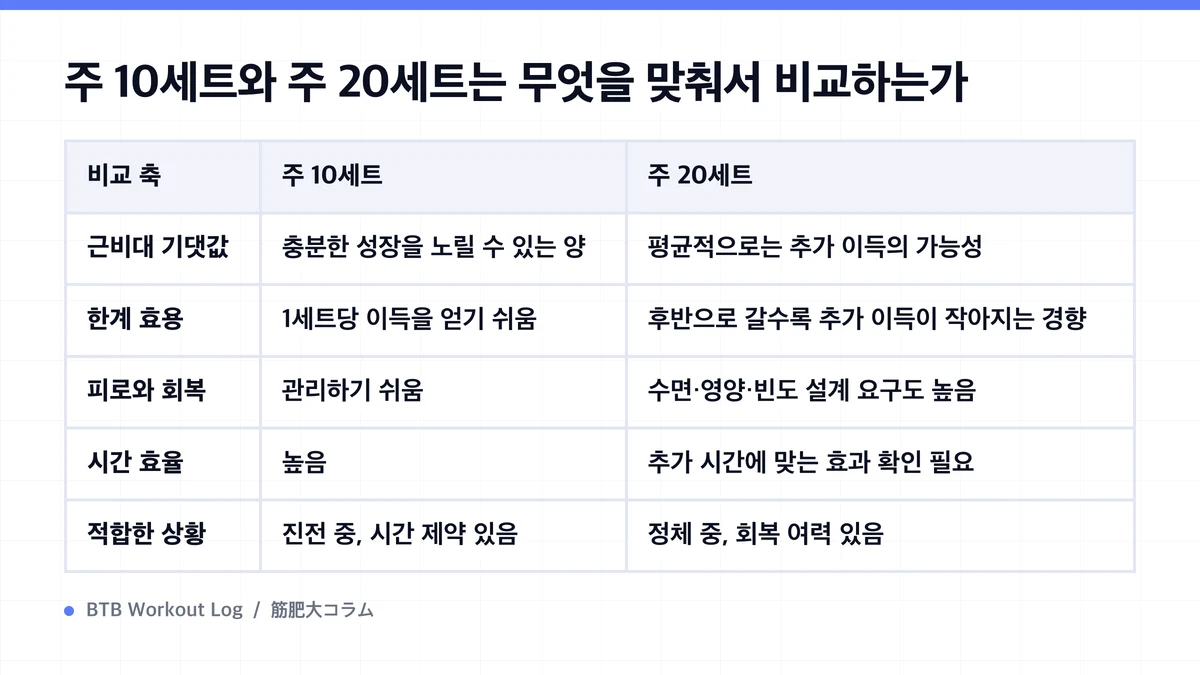
주 10세트와 주 20세트는 무엇을 맞춰서 비교하는가
여기서 말하는 세트 수는 근군별 주간 하드 세트 수입니다. 하드 세트란 목표 근육을 충분한 가동 범위에서 사용하고 한계까지 약 1~3회의 여력(RIR1~3)이 남을 때까지 수행하는 세트를 의미합니다. 워밍업이나 동작 연습으로 여력을 크게 남긴 세트는 포함하지 않습니다. 기본적인 세기 방식은 주간 세트 수의 개념에서 정리했습니다.
또한 직접 자극과 간접 자극을 구별합니다. 예를 들어 가슴 프레스는 대흉근으로의 직접 세트지만, 상완삼두근에도 부하가 걸립니다. 간접 세트를 모두 1세트로 세거나 0.5세트 상당으로 처리하는지에 따라 합계는 달라집니다. 어느 방식을 사용하든 비교 기간 중 세기 방식을 바꾸지 않는 것이 필요합니다. Pelland 등의 2026년 메타 회귀에서도 직접 세트와 간접 세트를 구별한 집계가 사용되었습니다.
| 비교 축 | 주 10세트 | 주 20세트 |
|---|---|---|
| 근비대 기댓값 | 충분한 성장을 노릴 수 있는 양 | 평균적으로는 추가 이득의 가능성 |
| 한계 효용 | 1세트당 이득을 얻기 쉬움 | 후반으로 갈수록 추가 이득이 작아지는 경향 |
| 피로와 회복 | 관리하기 쉬움 | 수면·영양·빈도 설계 요구도 높음 |
| 시간 효율 | 높음 | 추가 시간에 맞는 효과 확인 필요 |
| 적합한 상황 | 진전 중, 시간 제약 있음 | 정체 중, 회복 여력 있음 |
즉 "10대 20"은 종목, 폼, RIR, 휴식, 빈도가 거의 같을 때 비로소 의미 있는 비교가 됩니다. 질 높은 10세트와 후반 폼이나 출력이 무너진 20세트를 비교해도 숫자 차이는 자극 차이를 나타내지 않습니다. 같은 10세트도 내용이 다르다는 점을 먼저 확인할 필요가 있습니다.
근비대의 평균값에서는 20세트가 유리해도 이득은 체감한다
주간 볼륨과 근비대는 량이 증가할수록 평균적인 근비대도 증가하는 용량-반응 관계를 보입니다. Schoenfeld 등의 2017년 메타 분석에서는 낮은 주간 세트 수보다 높은 주간 세트 수에서 근량 증가가 더 큰 경향이 보고되었습니다. 저항 운동 경험자를 대상으로 여러 볼륨 조건을 비교한 2019년 연구에서도 일부 측정 부위에서 고볼륨 조건이 유리했습니다.
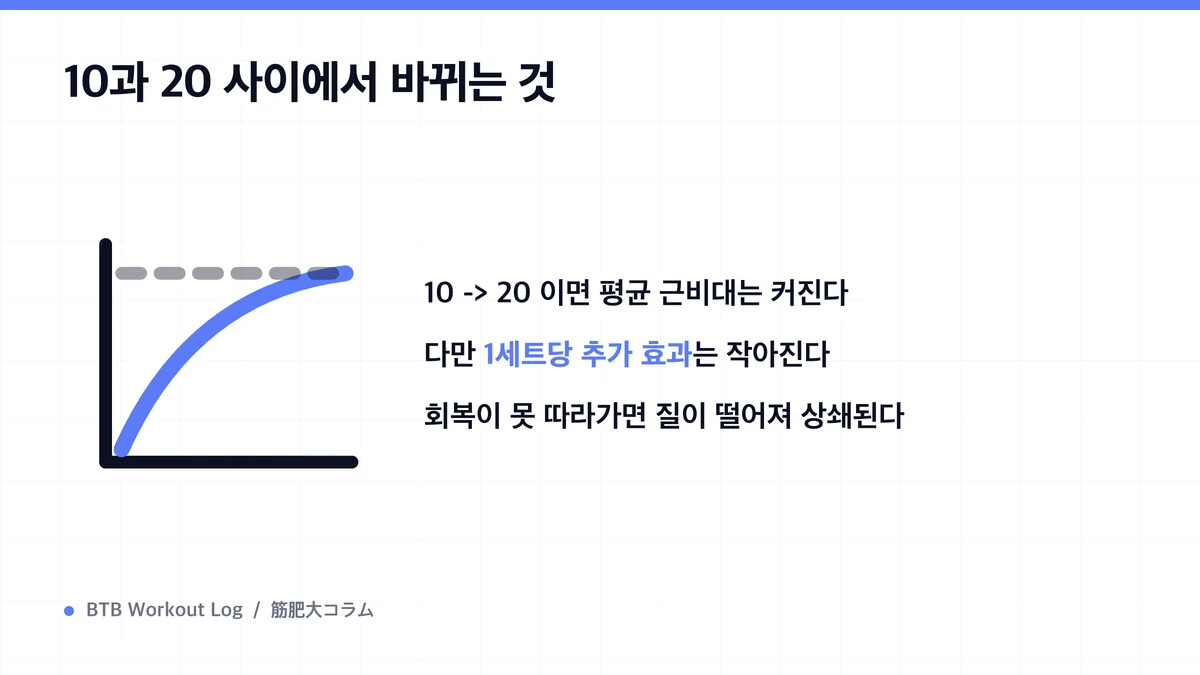
다만 이를 "20세트면 10세트의 2배 근비대가 된다"로 읽는 것은 오류입니다. 2026년 메타 회귀는 주간 세트 수가 증가할수록 근비대 추정값은 올라가는 한편, 추가 1세트에서 얻는 이득은 점차 작아진다는 형태를 보여줍니다. 10세트에서 더한 11세트목과 19세트에서 더한 20세트목을 같은 가치로 보기 어렵다는 뜻입니다.
연구의 평균값은 개인의 최적량을 직접 지정하지 않습니다. 대상자의 훈련 경력, 종목 구성, 세트 세기 방식, 중재 기간, 근육 두께 등 측정 부위가 다르고, 같은 고볼륨이어도 반응이 일정하지 않기 때문입니다. 주 20세트는 "상한"도 "필수량"도 아니며, 평균적인 추가 이득을 노리되 비용도 증가하는 선택지입니다.
추가 10세트는 자극뿐 아니라 피로와 시간도 늘린다
The problem with 20 sets isn't just more soreness. If your reps drop on the same weight in the latter half of the session, if your supporting muscles fatigue before your target muscle, or if local tension doesn't clear by the next workout, the quality of those additional sets declines. Simply completing the sets in that state can undermine your 점진적 과부하 the following week.
Training time cost matters too. Doubling from 10 to 20 sets literally doubles your main set volume. You save some time by sharing warm-ups, so your total session time doesn't quite double, but you still accumulate extra minutes in rest, equipment changes, and logging. Within a limited three sessions per week, adding 10 sets to chest often means cutting priority exercises for back or legs. Maximizing a single muscle group and building a complete full-body program sit on different scales.
If you choose 20 sets, spreading them across 2–4 sessions per week keeps output higher per set than cramming them into one. But higher frequency itself isn't the magic; it's a method to distribute the volume you need while maintaining quality. See the once-versus-twice-weekly comparison for set distribution guidance.
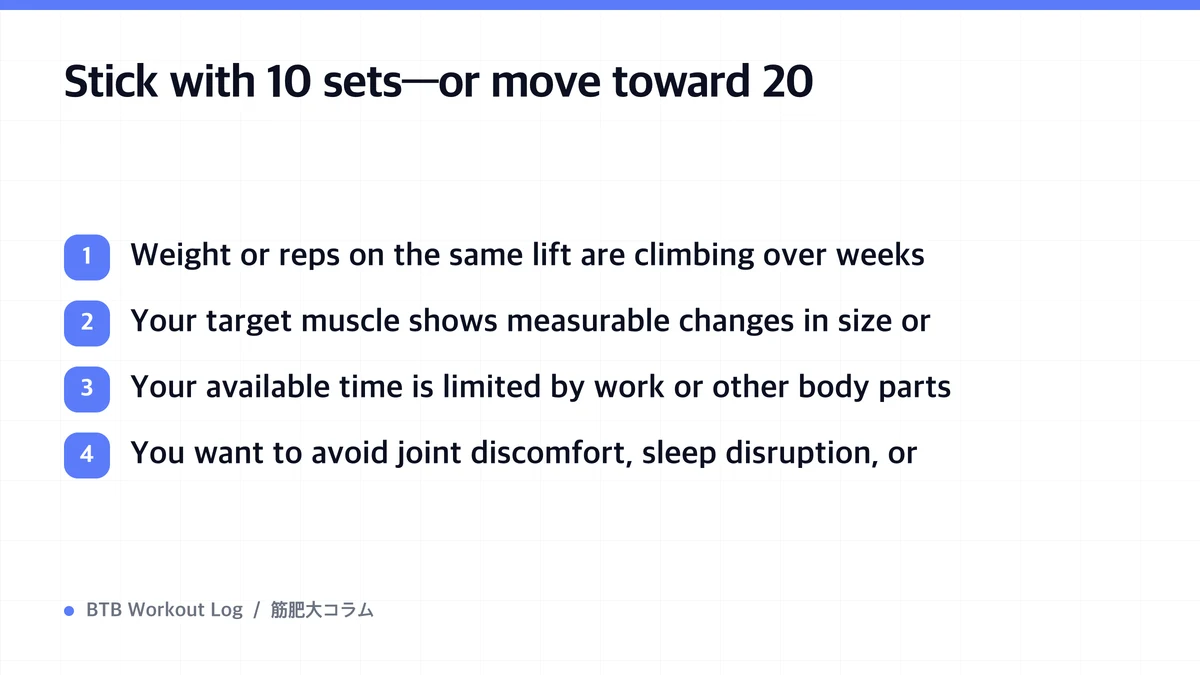
Stick with 10 sets—or move toward 20
Conditions to keep 10 weekly sets
- Weight or reps on the same lift are climbing over weeks
- Your target muscle shows measurable changes in size or circumference
- Your available time is limited by work or other body parts
- You want to avoid joint discomfort, sleep disruption, or dips in next session output
In this state, staying at that volume isn't a conservative choice. If 10 sets are driving progress, that amount is effective for you right now. Focus first on keeping RIR consistent, locking down exercise stability, and managing rest—then extract all the gains you can from that workload. Time efficiency beats adding volume for volume's sake.
Conditions to consider moving toward 20 sets
- Your target muscle's weight, reps, or measurements have 정체ed despite 10 sets for weeks
- Sleep, calorie intake, and protein are steady, and you recover between sessions
- Adding sets across multiple days doesn't crowd your other priority lifts
- You can log RIR and form consistently after adding sets
Even if these conditions exist, don't jump straight from 10 to 20. Add just 2 sets to one exercise as a small test, keep everything else unchanged for a few weeks, and watch what happens. If progress improves, hold it there. If fatigue rises and progress stalls, back off. Twenty isn't a target—it's a reference point you approach only if needed.
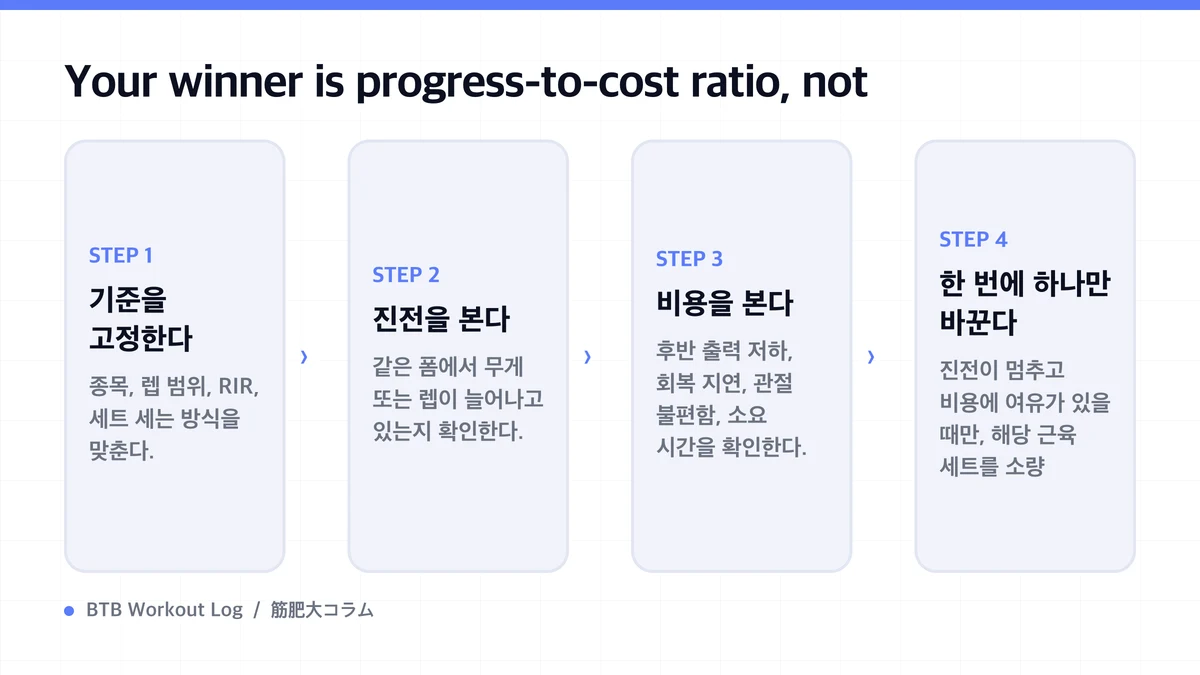
Your winner is progress-to-cost ratio, not set count
판단할 때는 부위별 세트 수뿐만 아니라 각 종목의 무게·렙 수·RIR, 세션 중 렙 저하, 다음 회복까지의 기간을 같은 스팬으로 봅니다. 근비대 변화는 단기간에는 읽기 어렵기 때문에 하루 컨디션 변화로 바꾸지 말고, 일정한 프로그램을 몇 주간 계속해서 추세를 봅니다. 일일 총 부하량과 주간 세트 수의 역할은 볼륨 관리에서 나누어 생각하면 정리하기 쉬워집니다.
- 기준을 고정한다: 종목, 렙 범위, RIR, 세트 세는 방식을 맞춘다.
- 진전을 본다: 같은 폼에서 무게 또는 렙이 늘어나고 있는지 확인한다.
- 비용을 본다: 후반 출력 저하, 회복 지연, 관절 불편함, 소요 시간을 확인한다.
- 한 번에 하나만 바꾼다: 진전이 멈추고 비용에 여유가 있을 때만, 해당 근육 세트를 소량 추가한다.
트레이닝 기록은 20 세트를 정당화하기 위한 것이 아니라, 10 세트를 계속할지 추가분을 시도할지 판단하는 근거로 사용합니다. 자신의 적정량은 늘린 후 몇 주를 본 후에야 결정됩니다. BTB Workout Log는 근군별 주간 하드 세트 수를 그 단위로 추적할 수 있습니다.
늘리는 방식은 한 번에 두 배로 하지 않는 것이 전제입니다. 주 10에서 20으로 단번에 옮기면, 효과와 피로 중 어느 쪽으로 결과가 바뀌었는지 알 수 없게 됩니다. 2주마다 2~4세트씩 더하고, 무게와 횟수가 지난번을 계속 웃도는 동안은 계속하며, 웃돌지 않게 되기 직전이 그 시기의 상한이라고 판정하는 쪽이 재현할 수 있습니다.
자주 묻는 질문
- Will a beginner build muscle faster with 20 sets per week?
- Beginners respond to low volumes and haven't yet locked down technique or recovery habits. Start around 10 weekly sets, confirm weight and reps are climbing, then add volume bit by bit only if you 정체 and still have recovery cushion. That makes it easier to tell whether added sets actually helped.
- Can I do all 20 sets in one session?
- Possible if you keep target muscle output and form right through the end, but 20 sets split across multiple days preserves quality better by design. If cramming them into one session tanks reps or RIR noticeably, spread them across 2–4 sessions instead.
- How many weeks does it take to decide whether to increase from 10 sets?
- Don't switch based on one or two off sessions. Track the same lift, RIR, and counting method for several weeks to spot the trend. Keep holding if weight or reps climb and recovery feels good. Consider adding volume when progress stops, sleep and nutrition are solid, and you have time and recovery room left.
정리
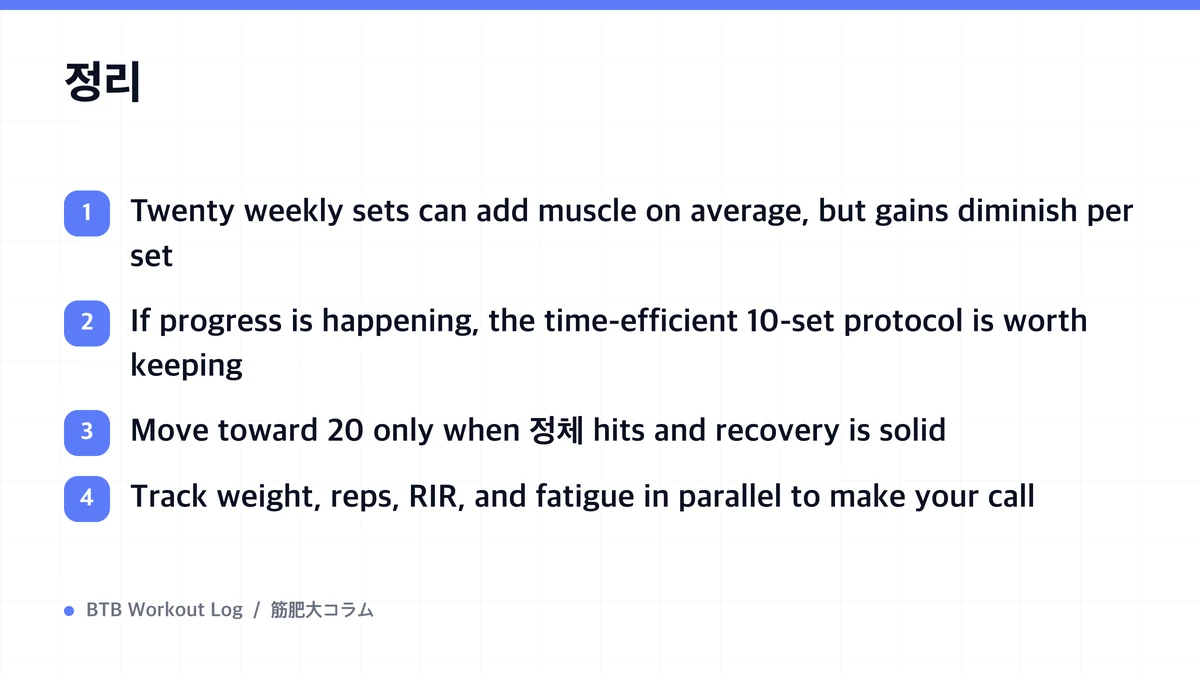
- Twenty weekly sets can add muscle on average, but gains diminish per set
- If progress is happening, the time-efficient 10-set protocol is worth keeping
- Move toward 20 only when 정체 hits and recovery is solid
- Track weight, reps, RIR, and fatigue in parallel to make your call
참고문헌
- The Resistance Training Dose Response: Meta-Regressions Exploring the Effects of Weekly Volume and Frequency on Muscle Hypertrophy and Strength Gains
- Dose-response Relationship Between Weekly Resistance Training Volume and Muscle Mass
- Resistance Training Volume Enhances Muscle Hypertrophy in Trained Men