세트 수를 너무 늘리면 역효과? 열심히 할수록 안 자라는 근비대의 맹점
주간 세트 수를 무리하게 늘리면 추가된 자극보다 피로 증가가 크므로, 후반부 세트와 다음 운동의 질이 떨어져 근비대 진전이 지연될 수 있습니다.
핵심은 '많은 세트가 근육을 태운다'는 것이 아닙니다. 회복 능력을 초과한 양이 무게·반복·동작 재현성을 무너뜨리고, 주간 전체에서 축적할 유효한 자극을 줄이는 것이 문제입니다.
'효과가 있는 세트를 더하면 더 효과적'이라는 직관의 함정
근비대와 주간 세트 수는 평균적으로 용량-반응 관계가 있습니다. 너무 적은 상태에서 세트를 추가하면 성장 기회가 늘어나기 쉽습니다. 여기까지는 주간 세트 수 개념으로 타당합니다.
다만, 첫 세트와 이미 많이 피로한 후의 10번째 세트를 같은 '1'로 더할 수 없습니다. 근비대에 기여하기 쉬운 것은 목표 근육을 충분한 가동 범위로 움직이고, 적절한 부하와 한계까지의 거리를 유지하는 세트입니다. 단순히 반복 수를 채우고, 대상 근육에서 부하가 빠지고, 동작 범위가 좁아진 세트는 장부상의 세트 수를 늘려도 같은 가치를 갖지 않습니다.
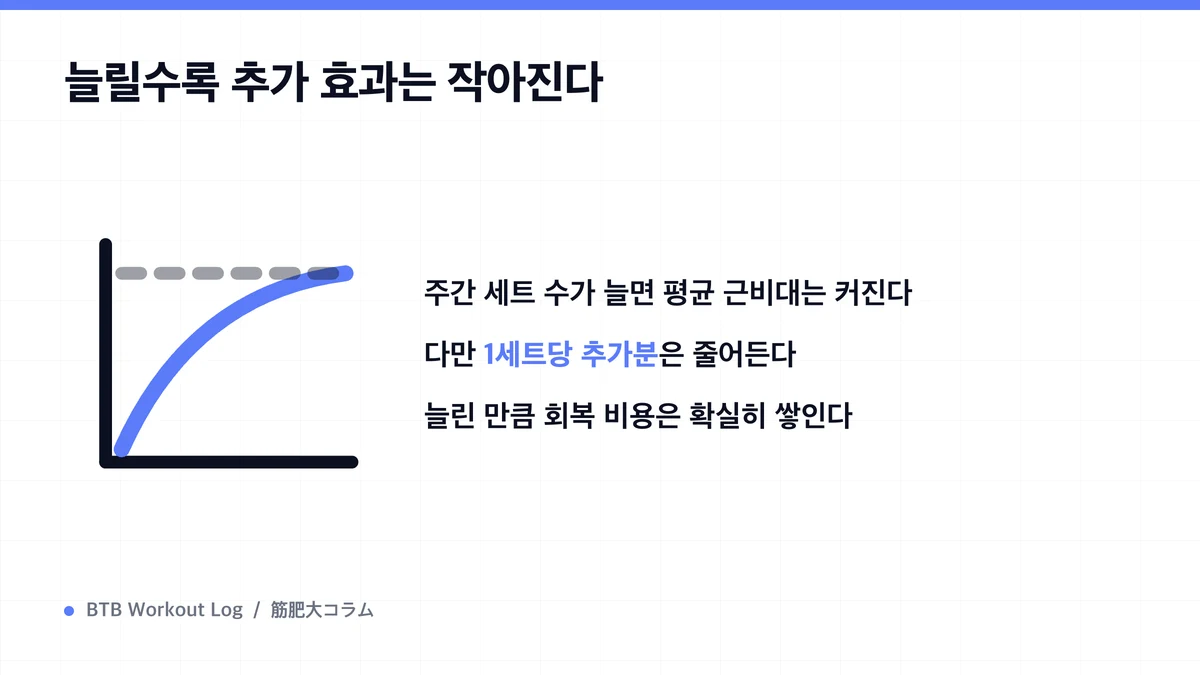
추가할수록 수익이 일정하게 쌓이는 것이 아니라 처음에는 이득이 크고, 나중으로 갈수록 추가 이득이 작아진다고 생각하는 것이 현실에 맞습니다. 한편 피로와 소요 시간은 추가할 때마다 늘어납니다. 이득의 증가량을 피로의 증가량이 앞지르는 시점부터 '더 한다'는 것이 불리해지기 시작합니다.
같은 세션 내에서 추가 세트일수록 출력을 유지하기 어렵다
하드 세트를 거듭하면 국소적 근육 피로에 더해 호흡 흐트러짐, 악력과 자세 유지 저하, 집중력 소모가 진행됩니다. 그 결과 같은 무게에도 반복 수가 떨어지고, 같은 반복 수를 목표로 해도 폼이 바뀌고, 보조 근육으로 들어올리는 등의 변화가 생깁니다.
여기서 RIR(Repetitions in Reserve, 아직 몇 회나 할 수 있는지라는 여력)만 보고 '한계에 가까우니까 효과적'이라 판단하는 것도 부족합니다. 피로한 상태에서 RIR 1이라 해도, 목표 근육의 긴장이 아니라 전신의 숨 참이나 보조 근육의 한계로 멈춘 경우가 있습니다. RIR은 무게·반복·가동 범위·폼이 크게 망가지지 않은 조건에서 의미를 갖는 지표입니다.
너무 짧은 휴식 시간으로 세트를 몰아 넣으면, 이 질 저하는 더욱 빨라집니다. 예정한 세트 수를 끝내는 것보다 주요 종목에서 출력을 유지할 수 있는 휴식을 취하고, 후반부 반복 수 저하가 허용 범위 안인지 보는 게 중요합니다. 추가 세트에서 무게를 많이 낮춰야 하고, 목표와 다른 근육이 먼저 한계에 닿고, 가동 범위를 줄여야만 완수할 수 있다면, 그 세트는 자극보다 피로를 더하고 있을 가능성이 있습니다.
진정한 역효과는 다음 고품질 세션을 해치는 것
한 번의 운동에서 출력이 다소 떨어져도 그것만으로 프로그램이 실패하는 것은 아닙니다. 더 중요한 것은 추가한 양에서 다음 운동까지 회복되어, 같은 종목에서 무게·반복·동작을 재현할 수 있느냐입니다.
예를 들어 가슴 세트를 늘린 결과, 며칠 후 프레스에서도 가슴, 어깨, 삼두의 피로가 남아 첫 하드 세트부터 지난번을 못 미치면, 추가분은 다음 고품질 자극과 맞바뀐 것입니다. 주 20세트를 예정대로 소화해도 후반부 질이 낮고 다음 출력도 떨어지면, 회복 가능한 주 14세트보다 유리할 리 없습니다.
이 문제는 복합 종목의 겹침에서도 생깁니다. 벤치프레스를 가슴만, 숄더프레스를 어깨만의 세트로 세면, 삼두와 전면 삼각근이 받는 간접 부하를 놓칩니다. 주 전체 세트는 근군별로 보면서 직접 세트와 간접 자극을 구분하세요. 한 날에 몰으면 질이 떨어지면, 총량을 늘리기 전에 빈도를 나눠서 분산하는 선택지가 있습니다.
반대로 근육통이 있을 뿐, 운동 후 피곤했다는 단독 감각은 감소 이유가 되지 않습니다. 판단 자료가 되는 것은 다음 운동까지 계속되는 퍼포먼스 저하, 여러 주에 걸친 정체, 관절이나 힘줄의 위화감, 수면과 의욕 악화가 겹쳤는가입니다. 피로 축적이 명확하면 세트 감소나 디로드로 회복시킵니다.
연구는 '많을수록 유리'와 '상한선 없음'을 같은 의미로 보지 않는다
Meta-analyses on weekly set volume show a trend toward greater muscle growth with higher volumes compared to lower ones. A study comparing volume over 8 weeks in 34 trained men also showed advantages for high-volume conditions in some muscle thickness measures. Therefore, cutting back to bare minimum sets out of fear of fatigue isn't rational either.
However, meta-regression across a broader research base reveals that while 근비대 gains increase with volume, the benefit from each additional set diminishes progressively. This doesn't mean researchers found a universal "maximum set count" that applies to everyone. Study populations, exercises, how sets are counted, proximity to failure, and intervention length all vary—and individual 회복 capacity remains hidden in the averages.
What's actionable from research isn't a fixed prescription like "higher volume always wins," but rather this principle: scaling up from too little has clear value, but gains don't scale linearly with every additional set. Your personal ceiling isn't determined by volume alone, but by whether that volume sustains both progress and 회복 over several weeks.
Before adding sets, log your data to judge whether to maintain, increase, or reduce
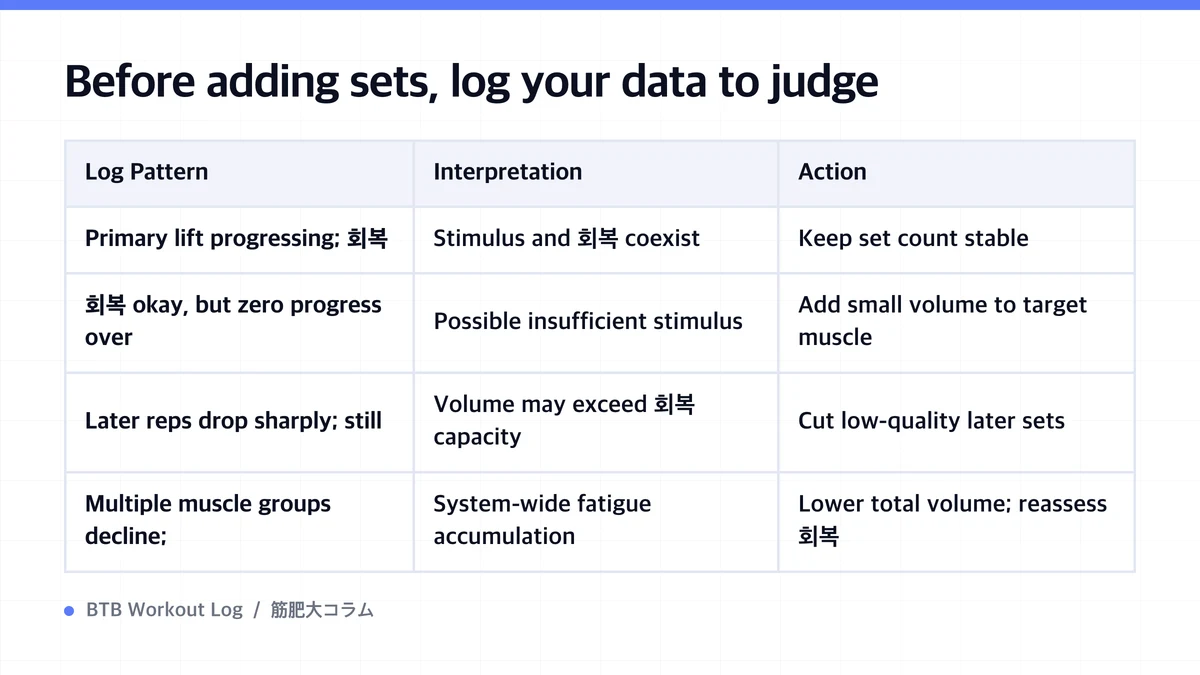
Adjust set count based on multi-week trends in your logs, not as a reflex when you 정체. Start by checking whether your target muscle's primary exercise is showing strength or rep increases. If it is, current volume likely provides enough stimulus, leaving little reason to add more.
| Log Pattern | Interpretation | Action |
|---|---|---|
| Primary lift progressing; 회복 complete before next session | Stimulus and 회복 coexist | Keep set count stable |
| 회복 okay, but zero progress over multiple weeks | Possible insufficient stimulus | Add small volume to target muscle only |
| Later reps drop sharply; still low next session | Volume may exceed 회복 capacity | Cut low-quality later sets |
| Multiple muscle groups decline; fatigue signs persist | System-wide fatigue accumulation | Lower total volume; reassess 회복 |
When adding volume, don't change exercise selection, set count, and RIR all at once. Move only the 주간 세트 수 for your target muscle slightly. Then track the primary set weight/reps, how much later sets drop off, and 회복 until next session under the same conditions. You don't need to take every set to failure; since increasing 몰아붙임 changes 회복 cost, keeping that variable stable while adjusting sets makes cause-and-effect clearer.
This requires actual weight, reps, and sets completed—not your planned numbers. Optimal set count isn't maximum volume; it's the amount that lets you recover from quality stimulus and repeat progress.
'세트 수는 많을수록 좋다'는 어디까지 옳은가
'세트 수는 많을수록 좋다'는 사고방식에는 옳은 범위가 있습니다. 주에 몇 세트밖에 하지 않는 부위에서는 세트를 더할수록 근비대의 증가를 기대할 수 있습니다. 용량 반응 연구가 보여 주는 관계도 낮은 양 쪽에서는 상승 방향입니다.
무너지는 것은 양이 늘어난 뒤입니다. 추가 1세트당 얹히는 효과는 양이 늘수록 작아지는 한편, 피로의 비용은 줄지 않습니다. 즉 '늘릴수록 유리하다'와 '상한이 없다'는 별개의 주장이며, 연구가 지지하는 것은 전자의 일부뿐입니다. 게다가 보고되는 최적 영역은 집단의 평균이며, 개인의 회복 능력, 종목, 생활의 부하까지는 포함하고 있지 않습니다.
세트 수가 과대평가되기 쉬운 것은 세기 쉽기 때문이기도 합니다. 주간 세트 수는 기록에 남길 수 있는 한편, 그 세트의 질과 회복 상태는 숫자가 되지 않습니다. 판단할 때는 '몇 세트 했는가'만이 아니라, 그 세트에서 노린 근육을 몰아붙였는지, 다음번 주요 종목의 중량·횟수가 유지되고 있는지를 함께 봅니다.
자주 묻는 질문
- How many sets before it becomes "too much"?
- No universal threshold exists. 회복 capacity varies with exercise selection, RIR, frequency, indirect stimulus, and training age. If later-set quality and your primary lift drops over multiple sessions, suspect current volume exceeds what you can handle.
- Should I cut sets if I still have soreness?
- Soreness alone isn't the deciding factor. Prioritize whether you can hit your planned 가동 범위 and form, and maintain the previous session's weight or reps. If strong soreness or joint discomfort appears alongside performance drops, consider reducing volume or taking extra rest.
- Should I just add sets whenever I 정체?
- First check RIR, 가동 범위, rest intervals, frequency, nutrition, and sleep. Once those stabilize and you're recovering from current volume but see zero progress over multiple weeks, carefully add only a small amount to the target muscle, then compare results.
정리
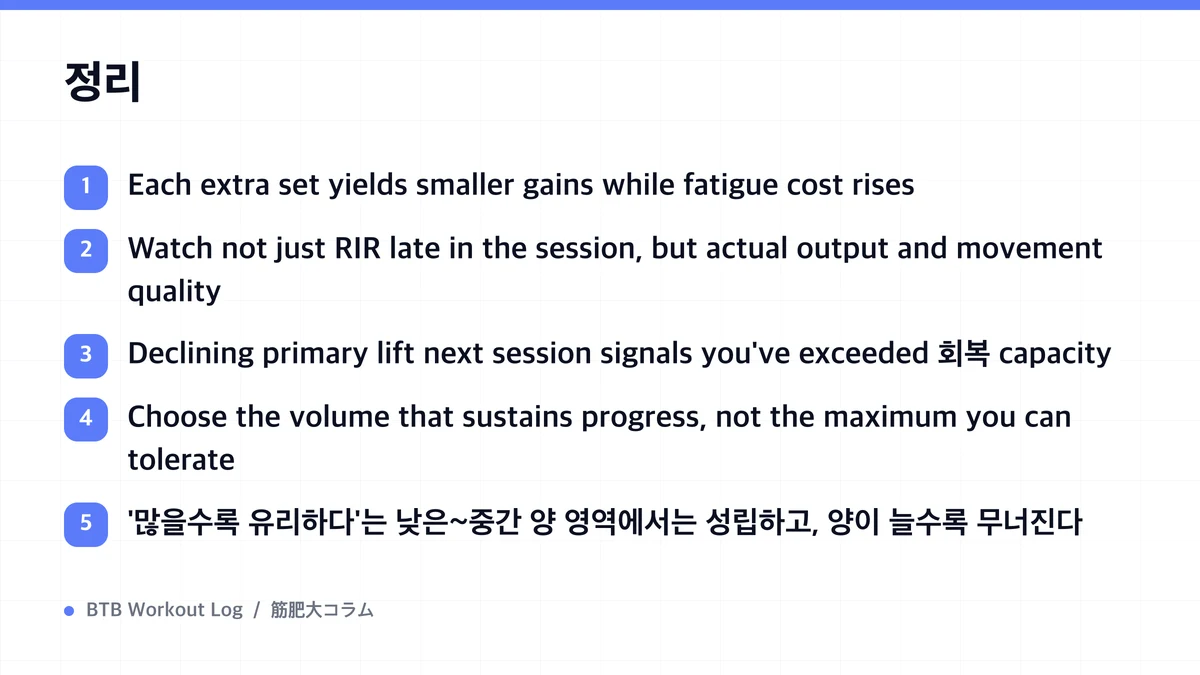
- Each extra set yields smaller gains while fatigue cost rises
- Watch not just RIR late in the session, but actual output and movement quality
- Declining primary lift next session signals you've exceeded 회복 capacity
- Choose the volume that sustains progress, not the maximum you can tolerate
- '많을수록 유리하다'는 낮은~중간 양 영역에서는 성립하고, 양이 늘수록 무너진다
참고문헌
- Dose-response Relationship Between Weekly Resistance Training Volume and Muscle Mass
- The Resistance Training Dose Response: Meta-Regressions Exploring the Effects of Weekly Volume and Frequency on Muscle Hypertrophy and Strength Gains
- Resistance Training Volume Enhances Muscle Hypertrophy in Trained Men
- Training to Repetition Failure or Non-failure: Systematic Review and Meta-analysis
- Proximity-to-Failure and Muscle Hypertrophy: Systematic Review with Meta-analysis