
세트 후반에 반복수가 줄어드는 이유는? '근성 부족'이 아닌 피로의 실체
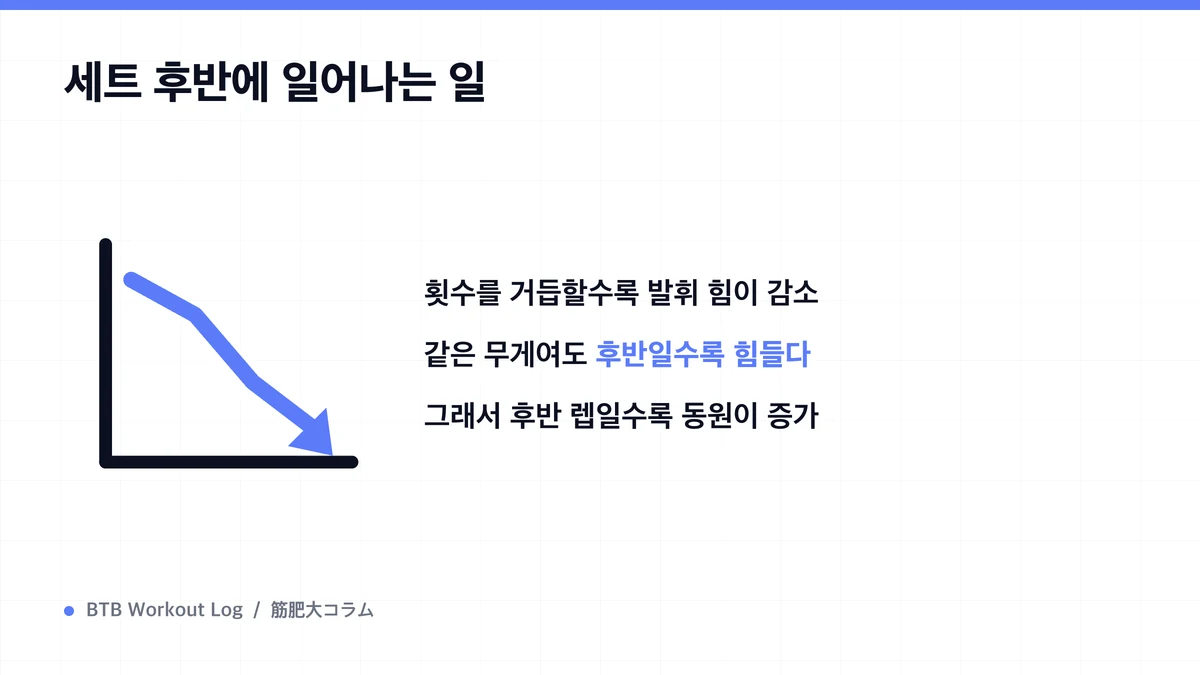
후반 세트에서 반복 횟수가 떨어지는 것은 앞의 세트에서 저하된 발휘 능력이 휴식 중에 완전히 회복되지 않아, 같은 중량이 상대적으로 무거워지기 때문입니다.
반복 저하 자체는 이상이 아닙니다. 저하가 어느 정도인지보다 폼과 가동 범위를 유지하고, 목표한 RIR에서 멈춘 결과인지를 구분하는 것이 중요합니다.
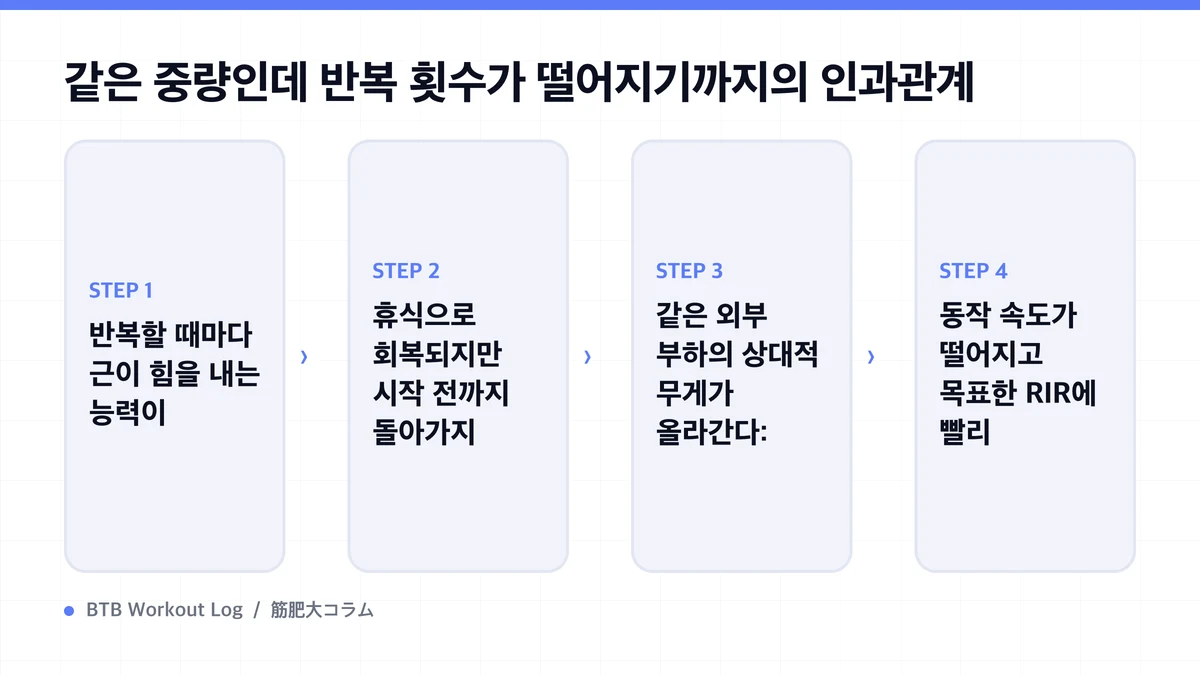
같은 중량인데 반복 횟수가 떨어지기까지의 인과관계
예를 들어 벤치프레스를 같은 100kg으로 했을 때 1세트는 10회, 2세트는 8회, 3세트는 7회가 된다고 합시다. 중량은 변하지 않았지만, 각 세트 시작 시점의 "그 중량을 반복할 수 있는 능력"은 같지 않습니다.
- 반복할 때마다 근이 힘을 내는 능력이 일시적으로 떨어진다: 높은 장력을 반복하면 수축을 뒷받침하는 에너지 공급이나 근 내 환경이 변화해, 같은 신경 지령으로도 낼 수 있는 힘이 작아집니다.
- 휴식으로 회복되지만 시작 전까지 돌아가지 않을 수 있다: 호흡이 안정돼도 국소의 발휘 능력까지 완전히 회복됐다고는 할 수 없습니다. 휴식이 짧을수록 남겨진 차이가 크습니다.
- 같은 외부 부하의 상대적 무게가 올라간다: 피로 전에는 여유가 있던 중량도 회복이 불충분한 상태에서는 현재의 최대 능력에 가까워집니다.
- 동작 속도가 떨어지고 목표한 RIR에 빨리 도달한다: RIR은 "앞으로 몇 회 더 할 수 있는가"의 추정값입니다. 1세트와 같은 RIR 2에서 멈춰도 후반은 더 적은 횟수에서 그 지점에 도달합니다.
즉, 반복 저하는 의지의 약함이 아니라 시작 시 능력 저하가 중단점을 더 앞으로 옮긴 결과입니다. 반대로 매 세트 같은 횟수로 맞추려 하면 후반은 RIR만 작아지고, 결국 한계 반복이나 폼 변경으로 맞추게 됩니다. RIR이 자극과 어떻게 연관되는지는 한계까지의 거리의 메커니즘과 함께 보면 정리하기 쉬워집니다.
피로는 하나의 물질이 아니라 발휘 능력이 떨어진 상태
트레이닝 중 피로는 특정 물질이 근육에 쌓이는 것만을 의미하지 않습니다. 여기서는 요구된 힘을 일시적으로 내기 어려워진 상태로 이해하는 것이 실무에 더 도움됩니다. 그 내용은 크게 두 가지로 나뉩니다.
근 내부나 말초에서 일어나는 국소 피로
단시간에 큰 힘을 내면 ATP 재공급을 돕는 크레아틴 인산의 사용과 재합성, 무기 인산 등 대사산물의 변화, 근소포체에서의 칼슘 방출과 수축 기구의 작동이 겹쳐 변합니다. 어느 하나만이 횟수를 정하는 것이 아니라 결과적으로 근섬유가 발휘할 수 있는 힘이 떨어집니다. 휴식 중에는 회복이 진행되지만 그 속도는 부하, 반복 시간, 단련한 근량, 종목에 따라 달라집니다.
신경계와 전신의 제약
높은 강도를 계속하면 근으로 계속 보내지는 신경 지령도 일정하지 않습니다. 또한 다관절 종목에서는 목표 근만이 아니라 악력, 호흡, 자세를 지탱하는 근육, 협력근 중 어느 것이 먼저 제한이 될 수도 있습니다. 스쿼트에서 다리보다 호흡이 먼저 고파지거나, 로잉에서 등보다 악력이 먼저 떨어지는 현상입니다. 같은 "반복 저하"라도 종료 이유가 다르면 세트 구성도 달라집니다.
젖산만을 피로의 원인으로 보는 설명으로는 이 여러 경로를 다룰 수 없습니다. 타는 감각이나 펌프는 국소에서 부하가 계속된 신호가 될 수 있지만, 회복도나 근비대 자극을 단독으로 측정하는 지표는 아닙니다. 봐야 할 것은 다음 세트에서 재현한 횟수, 동작, RIR입니다.
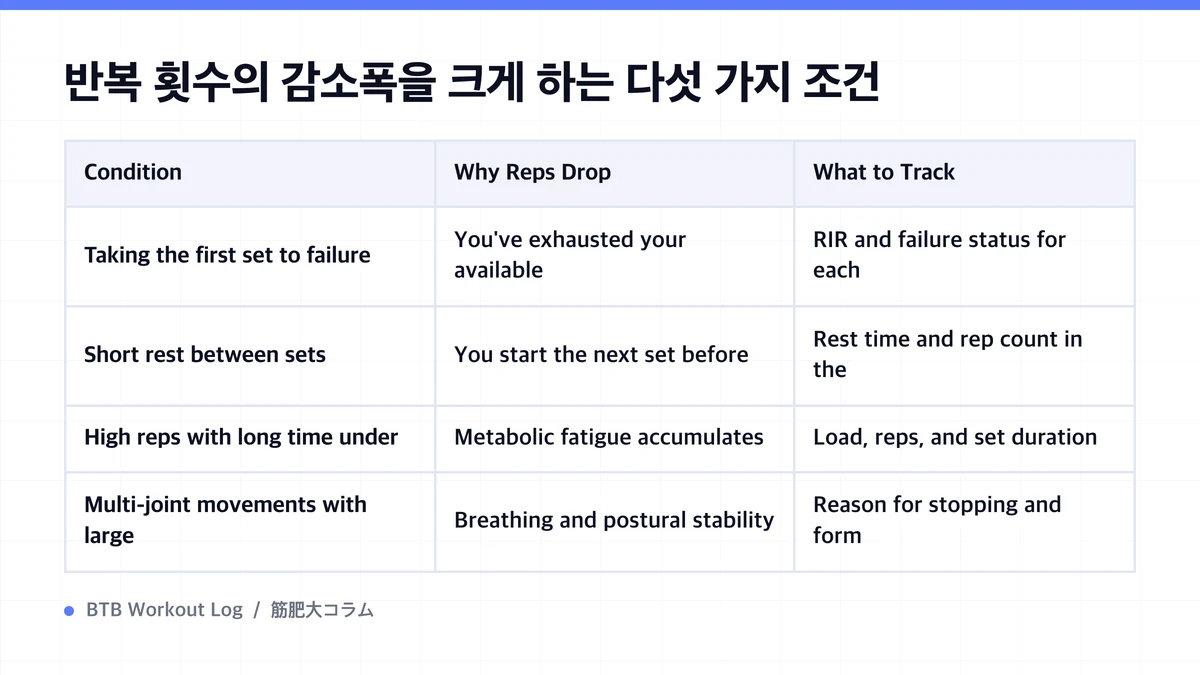
반복 횟수의 감소폭을 크게 하는 다섯 가지 조건
Rep loss between sets doesn't happen at the same rate every time. The more these conditions overlap, the more fatigue carries over to the start of later sets.
| Condition | Why Reps Drop | What to Track |
|---|---|---|
| Taking the first set to failure | You've exhausted your available reps, leaving little cushion for later sets | RIR and failure status for each set |
| Short rest between sets | You start the next set before local capacity recovers | Rest time and rep count in the following set |
| High reps with long time under tension | Metabolic fatigue accumulates within a single set | Load, reps, and set duration |
| Multi-joint movements with large muscle mass | Breathing and postural stability become limiting factors, not just the target muscle | Reason for stopping and form quality |
| Exercise placement late in the session | You carry over fatigue from the target muscle and synergists from earlier work | Exercise order and total volume that day |
The mechanism behind shorter rest intervals is covered in detail in how short rest changes your training. A study comparing 1-minute and 3-minute rest periods in 21 young men found the 3-minute group had advantages in 1RM on bench press and back squat, plus greater quad thickness gains. That said, not every exercise needs a full 3 minutes. Single-joint movements often preserve output with shorter rest for some lifters. Rather than fixing a time, adjust rest based on whether your next set hits the target reps and movement quality needed.
Taking the first set to failure does widen the rep drop, but it's not required for muscle growth. A meta-analysis of 15 studies comparing failure and non-failure reps in young adults found no significant difference in strength or hypertrophy overall. The goal isn't to max out every set—it's to distribute your effort across all sets so they remain productive.
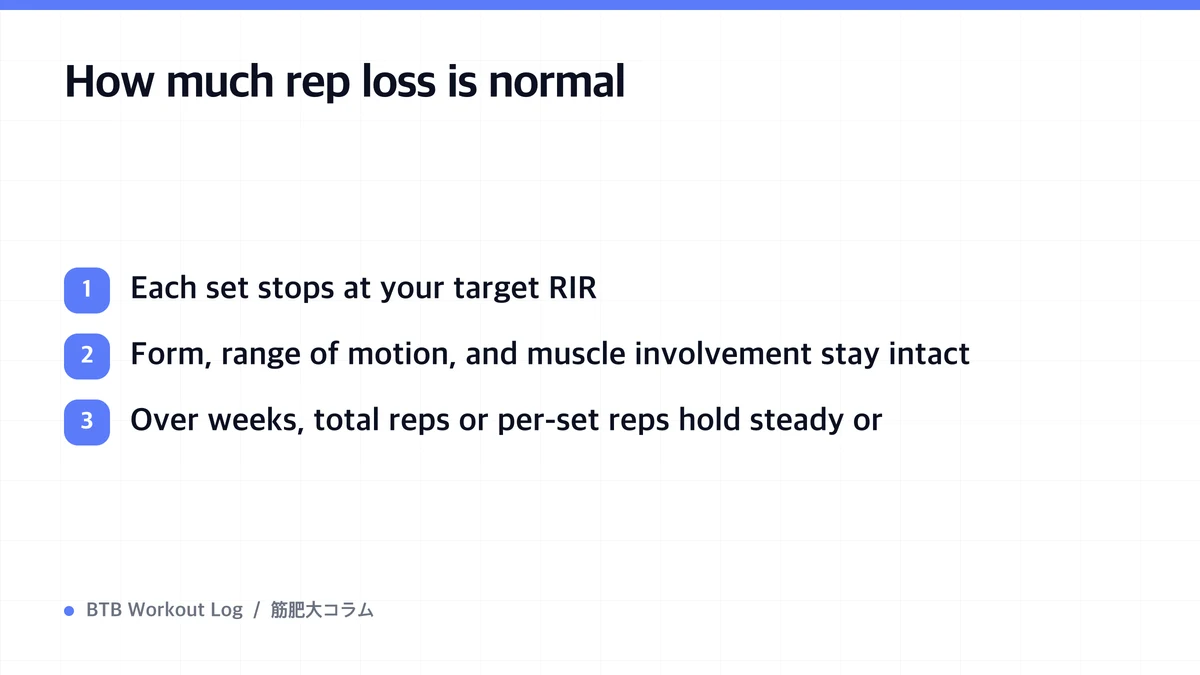
How much rep loss is normal
There's no universal cutoff for "too many reps lost." Dropping from 10 to 8 reps and dropping from 5 to 3 reps are both a loss of 2, but the percentage is different—and the meaning shifts again between a machine single-joint exercise and a free-weight multi-joint movement. Don't judge by absolute rep count alone. Instead, sort your results into two patterns.
Pattern 1: Fatigue that's within normal limits
- Each set stops at your target RIR
- Form, range of motion, and muscle involvement stay intact
- Over weeks, total reps or per-set reps hold steady or improve when compared under the same conditions
In this pattern, don't force a drop from 10, 9, 8 reps to disappear. Your later sets reach near-maximum effort at lower rep counts and still count as hard sets. Trying to match rep counts by shortening range of motion or adding momentum will just mess up your comparison.
Pattern 2: When to adjust your setup
- Later sets fail sooner than planned, and form breaks down
- Each set stops due to breathing, grip, or synergist fatigue instead of the target muscle
- Rep loss grows bigger from session to session and doesn't bounce back next time
- Adding more sets barely increases useful reps in the later work
For this pattern, try changes in this order: add 60–90 seconds to your rest, stop the first set one rep short of failure, move assistance work later, or split sets across different days. Lower the weight only after you've fixed rest and effort distribution but still can't hit your target rep range. Change one thing at a time, so you know what actually restored your reps.
Connect set-by-set records to your next decision
To manage fatigue, track not just total reps per exercise, but also load, reps per set, RIR, and rest intervals side by side. If possible, note sets where form or 가동 범위 deteriorated, and sets where non-target muscles became the limiting factor. Research on young novice men showed high test-retest reliability for 1 RIR load prescription on bench press and deadlift. Since RIR has individual and exercise-specific error margins, treat it as a guideline for general patterns alongside load, reps, and rest—not an absolute value.
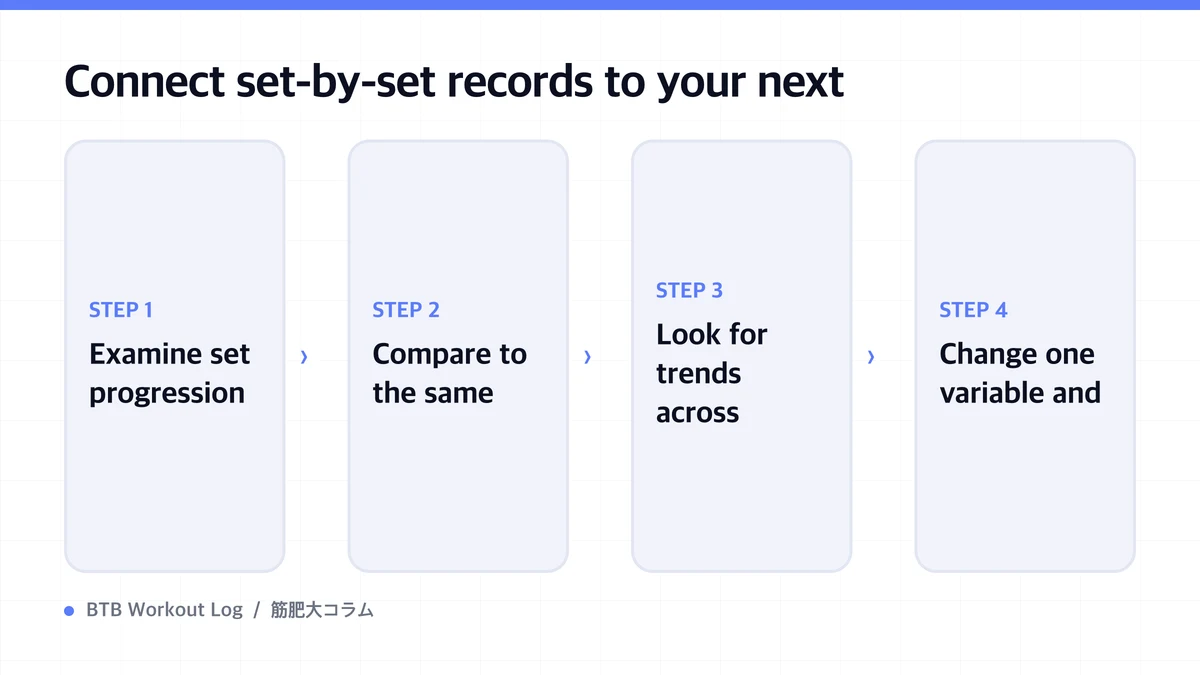
Follow this sequence to avoid confusion:
- Examine set progression within the same session: If only later sets drop, first suspect inadequate inter-set 회복 and poor effort distribution in set one.
- Compare to the same exercise last time: If total reps increase at the same load, rest, and RIR despite within-set decline, you're still making progress.
- Look for trends across multiple sessions: If all sets consistently fall below previous performance, check sleep, previous day's load, and weekly set volume—factors outside the session itself.
- Change one variable and retest: If longer rest restores later-set reps, recovery time was limiting. If adjusting set-one RIR fixes it, effort distribution was the constraint.
근비대 comes from the stimulus itself, not the log. But understanding why reps drop lets you adjust rest and RIR strategically for your next session.
자주 묻는 질문
- Should later sets match the rep count of the first set?
- No. If you stop at the same RIR, it's natural for fatigued later sets to reach that stopping point with fewer reps. Rather than force matching rep counts, maintain form and 가동 범위, then compare reps and RIR per set against last time under identical conditions.
- If reps drop sharply, should I reduce the load immediately?
- First check rest interval and how hard you pushed set one. If rest is too short or you went to failure from the start, try extending rest or stopping at RIR 1–2 before changing the load. Only consider a modest 감량 if you still can't sustain your target rep range.
- Do later sets still contribute to 근비대 even with fewer reps?
- If the target muscle works to your target RIR and form and 가동 범위 stay intact, even fewer reps can function as a 하드 세트. Conversely, if grip strength or breathing alone stops you, movement quality breaks down, or the fatigue persists into the next session, the fatigue cost may outweigh the stimulus.
정리
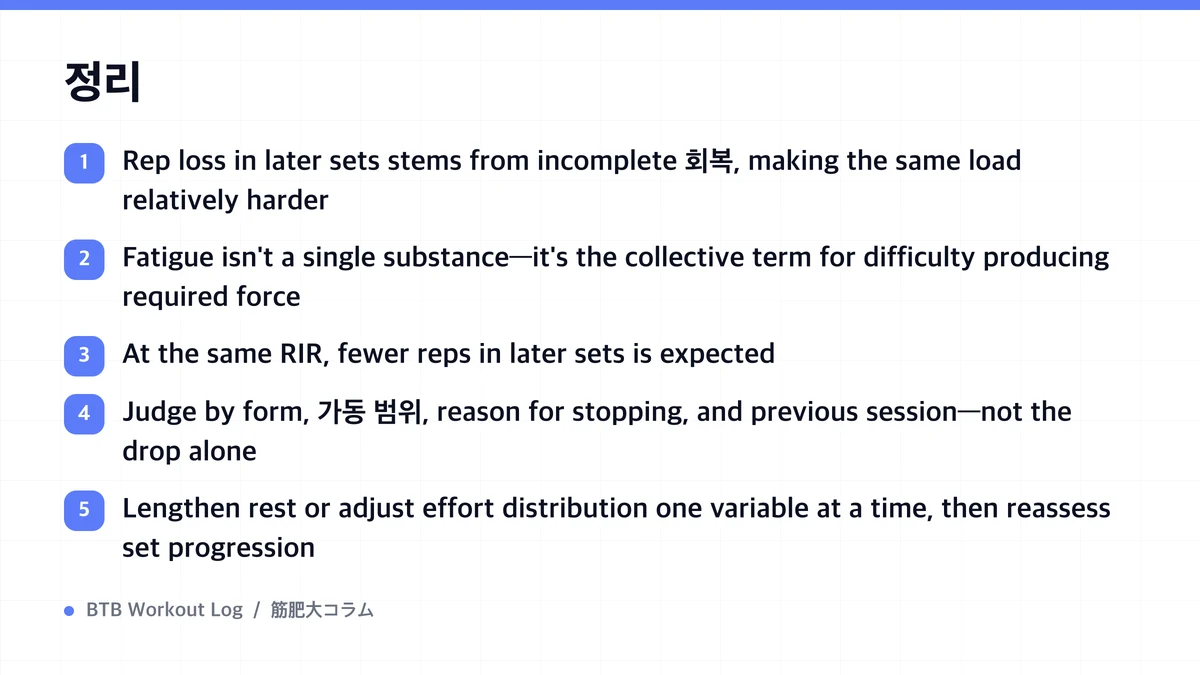
- Rep loss in later sets stems from incomplete 회복, making the same load relatively harder
- Fatigue isn't a single substance—it's the collective term for difficulty producing required force
- At the same RIR, fewer reps in later sets is expected
- Judge by form, 가동 범위, reason for stopping, and previous session—not the drop alone
- Lengthen rest or adjust effort distribution one variable at a time, then reassess set progression