휴식을 짧게 하면 무슨 일이 일어날까? 시간을 줄이려던 것이 근비대를 멀어지게 하는 원리
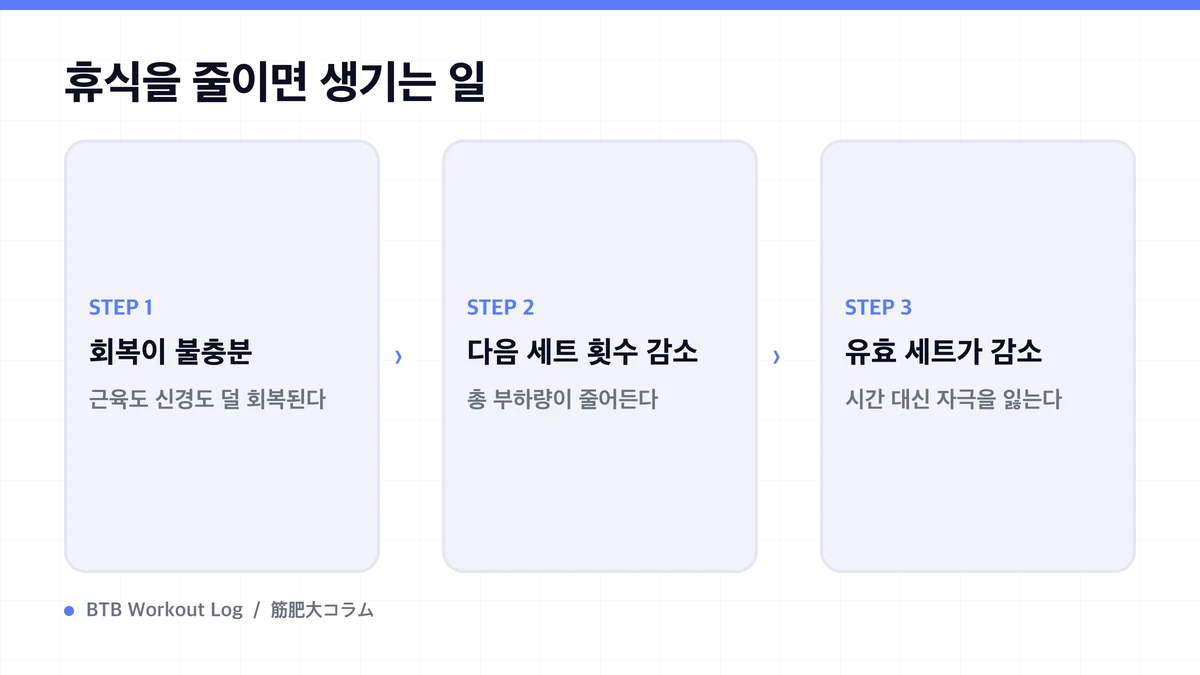
휴식 시간을 줄이면 근력·호흡·집중력이 돌아오기 전에 다음 세트가 시작되어 같은 무게라도 반복 수와 동작의 질이 떨어지기 쉬워집니다. 이 저하가 반복되면 주간 누적 근비대 자극까지 줄어들 수 있습니다.
한편 짧은 휴식 자체가 근비대를 방해하는 것은 아닙니다. 필요한 출력을 유지할 수 있는 운동이라면 시간 효율을 높일 수 있으므로, '몇 분 쉬었는가'보다 휴식 후 세트에서 무엇이 일어나는지로 판단합니다.
휴식을 줄이면 회복 도중에 다음 세트가 시작된다
세트를 끝낸 직후 몸은 단순히 목표근육만 피로한 상태가 아닙니다. 근수축에 쓸 에너지 공급, 힘을 발휘하는 신경계, 호흡과 순환, 자세를 지탱한 근육 전체, 악력, 집중력이 각각 다른 속도로 돌아옵니다. 세트 간 휴식은 이 모든 것을 완전히 초기 상태로 돌리는 시간이 아니라, 다음 세트에 필요한 수준까지 회복시키는 시간입니다.
여기를 너무 짧게 끝내면 회복하지 못한 요소가 다음 세트의 시작 조건이 됩니다. 고중량 스쿼트라면 다리뿐 아니라 호흡이나 체간이 제한 요인이 되고, 로우 운동이라면 등보다 악력이 먼저 한계에 도달할 수도 있습니다. 단관절 운동은 전신 피로가 작아도 목표근육의 국소 피로가 남아 있으면 같은 부하를 반복하는 능력이 떨어집니다.
따라서 휴식 60초를 줄인 영향이 모든 운동에서 같지는 않습니다. 사용 무게, 동원되는 근육량, 세트 길이, 한계까지의 거리, 운동 후반부인지 여부에 따라 회복해야 할 기능이 달라지기 때문입니다. 먼저 '짧은 휴식=고강도'로 묶지 말고, 어떤 회복이 시간에 맞지 않았는지 나누어 생각합니다.
회복 부족은 반복 수·속도·자세 저하로 나타난다
회복이 부족한 상태에서 같은 무게를 들면 한 번의 힘 발휘 부담이 상대적으로 커집니다. 바 속도는 빨리 떨어지고, 한계까지 남은 반복 횟수를 나타내는 RIR도 빨리 줄어듭니다. 첫 세트를 100kg으로 10회 할 수 있어도 짧은 휴식 후에 6회에서 한계가 된다면, 같은 무게라도 같은 세트를 재현한 것이 아닙니다.
여기서 헷갈리는 점은 휴식이 짧을수록 '극한까지 몰아붙였다'고 느끼기 쉽다는 것입니다. 숨가쁨, 작열감, 높은 심박수는 노력감을 강하게 하지만, 목표근육이 발휘한 힘의 양과는 일치하지 않습니다. 호흡이나 악력이 먼저 한계에 도달하면 주동근은 여력이 있는데도 세트를 끝낼 수 있습니다. 반대로 가벼운 단관절 운동은 국소 피로 자체가 목표이므로, 짧은 휴식이라도 목표근육을 충분히 활성화할 수 있는 경우가 있습니다.
반복 수만 보지 마세요
- 반복 횟수: 같은 무게로 첫 세트에서 몇 회 떨어졌는가.
- 가동 범위와 자세: 반동이 늘어나거나 끝점까지 못 움직이고 있진 않은가.
- 제한 요인: 목표근육, 숨가쁨, 악력, 체간 중 무엇이 세트를 멈추게 했는가.
- 목표 RIR: 예정보다 일찍 한계에 접근해 후속 세트를 삭제하고 있진 않은가.
세트 후반에 반복이 떨어지는 원리는 피로와 반복 저하에서도 자세히 다룹니다. 휴식 시간의 좋고 나쁨은 타이머보다 먼저 이 변화들에 드러납니다.
펌프나 일시적 호르몬 반응은 장기 근비대와 같지 않다
짧은 휴식에서는 대사산물이 남은 상태로 다음 세트를 시작하기 때문에 펌프감과 작열감이 더 강해지기 쉽습니다. 이 감각은 세트에 대한 집중이나 만족감으로 활용할 수 있지만, 강할수록 근비대한다는 득점으로는 사용할 수 없습니다. 일시적 변화와 수주에서 수개월에 걸쳐 일어나는 근섬유 성장은 시간축이 다릅니다.
짧은 휴식으로 성장호르몬 같은 것이 일시적으로 크게 올라가도 장기 적응을 보장하지 않습니다. 젊은 남성의 팔꿈치 굴곡근을 대상으로 한 조건에서 일시적 호르몬 상승 크기가 근비대나 근력 향상 차이로 이어지지 않는 경향을 볼 수 있습니다. 휴식 시간을 선택하는 근거는 호르몬 반응을 극대화하기보다, 목표근육에 필요한 장력을 주는 세트를 반복할 수 있다는 점에 두는 게 타당합니다.
이건 펌프를 피해야 한다는 뜻이 아닙니다. 짧은 휴식이든 긴 휴식이든 근비대는 일어날 수 있습니다. 문제가 되는 건 강한 느낌을 만들려고 반복, 가동 범위, 사용 무게를 잃고 그 저하를 놓치는 것입니다. 인터벌 기준은 출발점으로 사용하되, 자극의 수응감과 세트 질을 따로 관찰합니다.
출력 저하가 쌓이면 주간 근비대 자극에 영향을 미친다
The path from shortened rest to muscle growth follows this sequence: insufficient rest → incomplete recovery → reduced output on the next set → fewer high-quality reps and sets → changes in long-term accumulated stimulus. Don't collapse this into a single cause-and-effect; the critical step is examining set quality in between.
In young, trained men, 3 minutes of rest consistently outperforms 1 minute on bench press and squat 1RM and anterior thigh muscle thickness gains. This suggests that waiting for recovery often produces better long-term adaptation than pushing through with inadequate rest. That said, the comparison is 1 vs. 3 minutes—you cannot assume the same advantage applies to every lift, rest interval, or population.
Maximizing total load volume alone isn't the answer either. Adding reps with broken form or sets where you leave excessive余力 won't produce the same stimulus to the target muscle. What matters is how many hard sets you complete weekly—through full 가동 범위, ending at your target RIR—while staying within your recovery capacity. When you adjust weekly set volume, first confirm whether shortened rest has hollowed out each set's quality.
Conversely, if you hold reps and form steady at 90 seconds and log weight or rep increases over weeks, simply lengthening rest won't necessarily boost hypertrophy stimulus. Longer rest is a tool, not an end goal—it exists to restore the output you need.
Separate where shorter rest applies from where losses mount
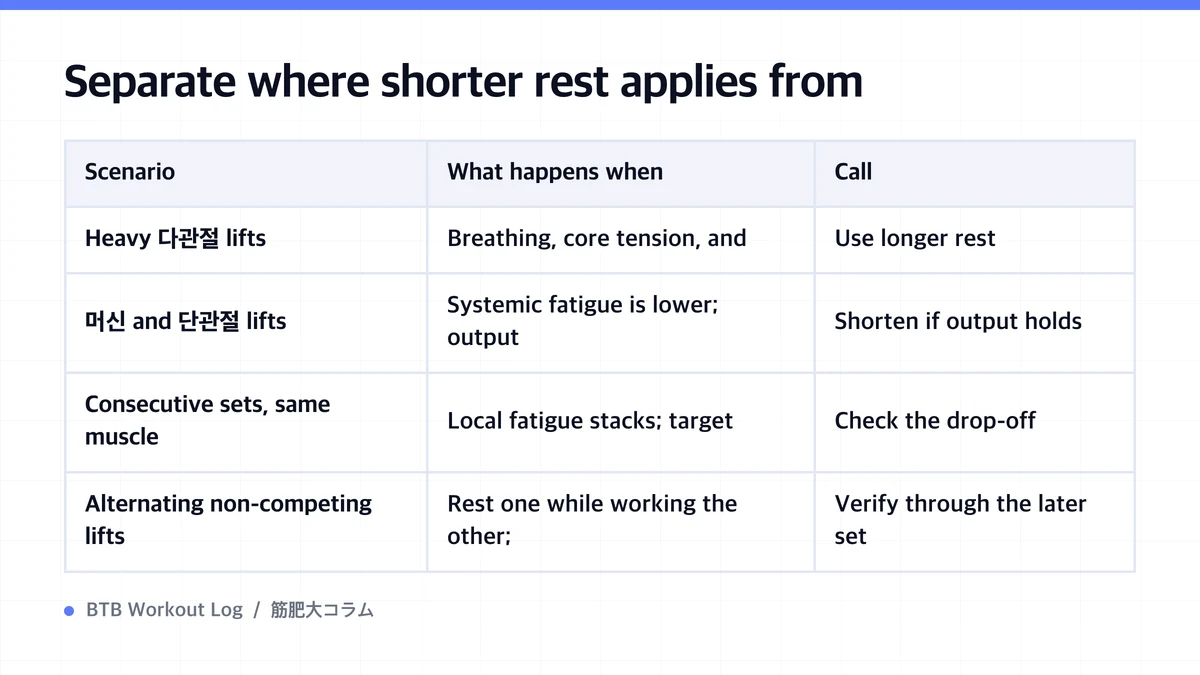
Rest intervals don't have to be uniform across a session—adjust them by lift and priority. The rule isn't "easier lifts mean shorter rest"; it's can you keep your target output at shorter rest?
| Scenario | What happens when shortened | Call |
|---|---|---|
| Heavy 다관절 lifts | Breathing, core tension, and technique lag; reps drop fast | Use longer rest |
| 머신 and 단관절 lifts | Systemic fatigue is lower; output often repeats even with shorter rest | Shorten if output holds |
| Consecutive sets, same muscle | Local fatigue stacks; target muscle reps decline | Check the drop-off |
| Alternating non-competing lifts | Rest one while working the other; time efficiency | Verify through the later set |
| Accessory vs. main lift priority | Protect main lift time and quality; trim accessory time later | Don't cut the main lift |
If time is tight, cutting rest uniformly across the board is inefficient. Keep the main lifts well-rested and trim only accessories where output doesn't tank as easily. Using non-competing muscle groups in alternation helps—see superset comparisons and rest interval strategy for depth.
Determine your needed rest from the gap between your first and last set
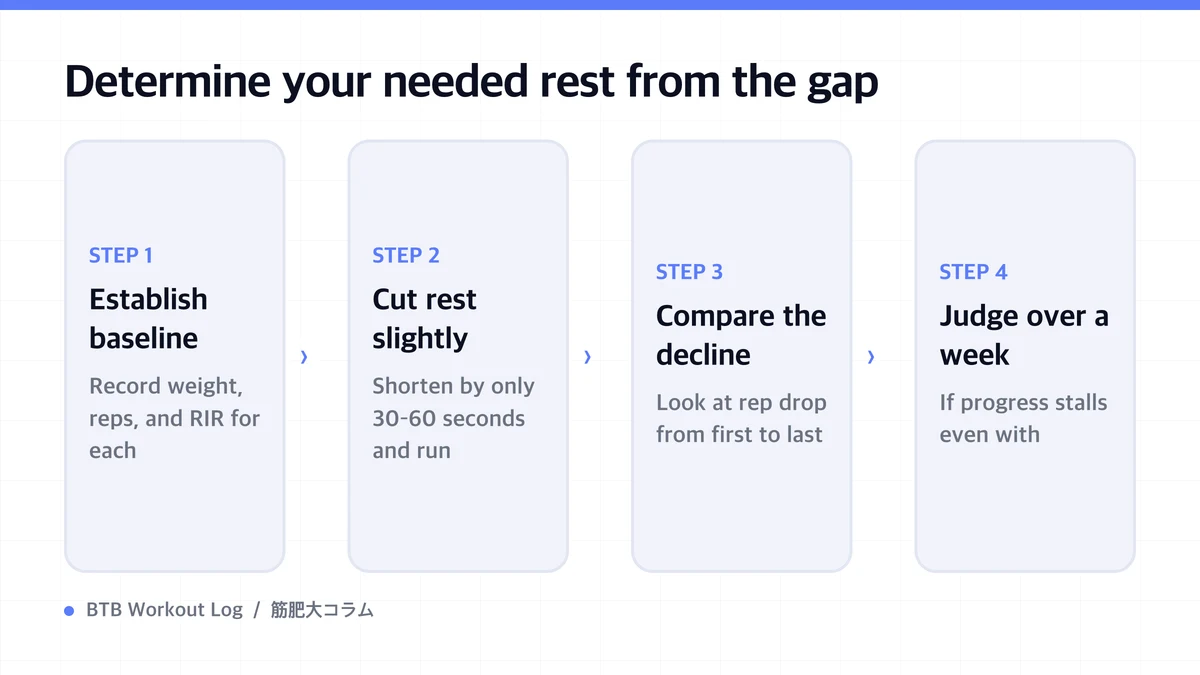
When picking a rest interval, lock in your current conditions for 2–3 sessions: same lift, load, target reps, set count, target RIR, and lift order—change only rest. Testing under different conditions muddles whether rep drops come from rest, load, or accumulated fatigue.
- Establish baseline: Record weight, reps, and RIR for each set at your current rest.
- Cut rest slightly: Shorten by only 30–60 seconds and run the same lift in the same sequence.
- Compare the decline: Look at rep drop from first to last set, form, what stopped the reps, and total session time.
- Judge over a week: If progress stalls even with completed sets, revert; if output stays level, adopt the shorter rest.
Matching your target RIR makes the call clearer when combined with RIR management. Hitting RIR 0 earlier under shorter rest means you finish sets faster—but that's not the distribution you planned.
Muscle growth comes not from the rest interval itself but from what you accumulate afterward. Your timer is a tuning lever to maintain that quality.
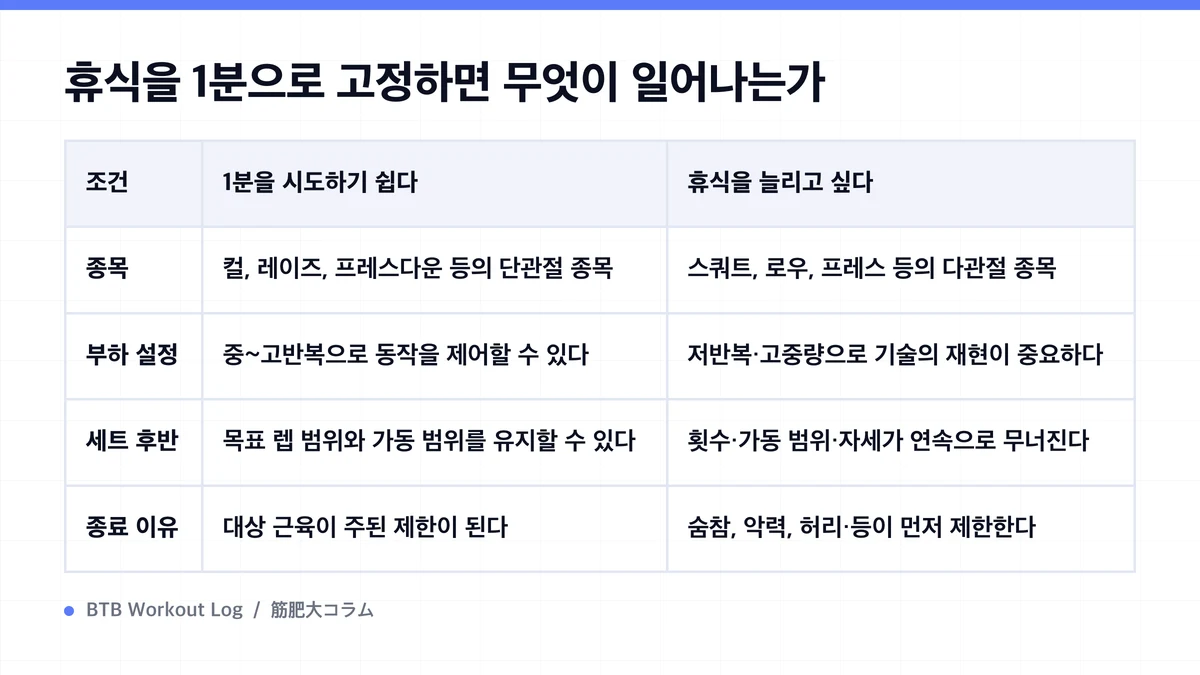
휴식을 1분으로 고정하면 무엇이 일어나는가
휴식을 1분으로 고정하면 세션은 확실히 짧아집니다. 문제는 그 시간 단축이 다음 세트의 질과 맞바꾸어진 것은 아닌가입니다. 판정에 필요한 것은 "1시간에 몇 세트를 소화했는가"가 아니라, 목표 근육에 충분한 장력을 걸 수 있었던 세트를 소요 시간 대비 몇 개나 재현할 수 있었는가입니다.
| 조건 | 1분을 시도하기 쉽다 | 휴식을 늘리고 싶다 |
|---|---|---|
| 종목 | 컬, 레이즈, 프레스다운 등의 단관절 종목 | 스쿼트, 로우, 프레스 등의 다관절 종목 |
| 부하 설정 | 중~고반복으로 동작을 제어할 수 있다 | 저반복·고중량으로 기술의 재현이 중요하다 |
| 세트 후반 | 목표 렙 범위와 가동 범위를 유지할 수 있다 | 횟수·가동 범위·자세가 연속으로 무너진다 |
| 종료 이유 | 대상 근육이 주된 제한이 된다 | 숨참, 악력, 허리·등이 먼저 제한한다 |
모든 종목을 1분으로 맞출 필요는 없습니다. 우선하는 다관절 종목은 충분히 쉬고 보조 종목만 짧게 하는 쪽이 잃는 것이 적습니다. 다만 남는 시간에 세트를 더하면 시간 단축과 주간 세트 수의 증가가 동시에 일어나기 때문에, 휴식의 효과는 판정할 수 없게 됩니다. 먼저 같은 세트 수로 출력 저하를 측정하고, 그 후에 추가를 생각하는 순서가 필요합니다.
자주 묻는 질문
- If reps drop with shorter rest but I push to failure, is it the same?
- Not necessarily. Breathlessness or grip weakness may hit their ceiling before the target muscle reaches sufficient tension. Track not just RIR—also 가동 범위, form, what ended the set, and how the next set suffers.
- If the pump is intense, does shorter rest favor 근비대?
- Pump intensity alone doesn't decide it. Shorter rest can amplify the burn and transient hormone spikes, but those aren't the same as long-term 근비대. Maintain reps and form, and prioritize weekly progress.
- Can I use different rest times for different lifts?
- Yes. Use longer rest for heavy 다관절 lifts and shorter rest for 머신 and 단관절 lifts where output recovers faster. Instead of a one-size-all number, find the shortest rest that holds your weight, reps, and 가동 범위 for each lift.
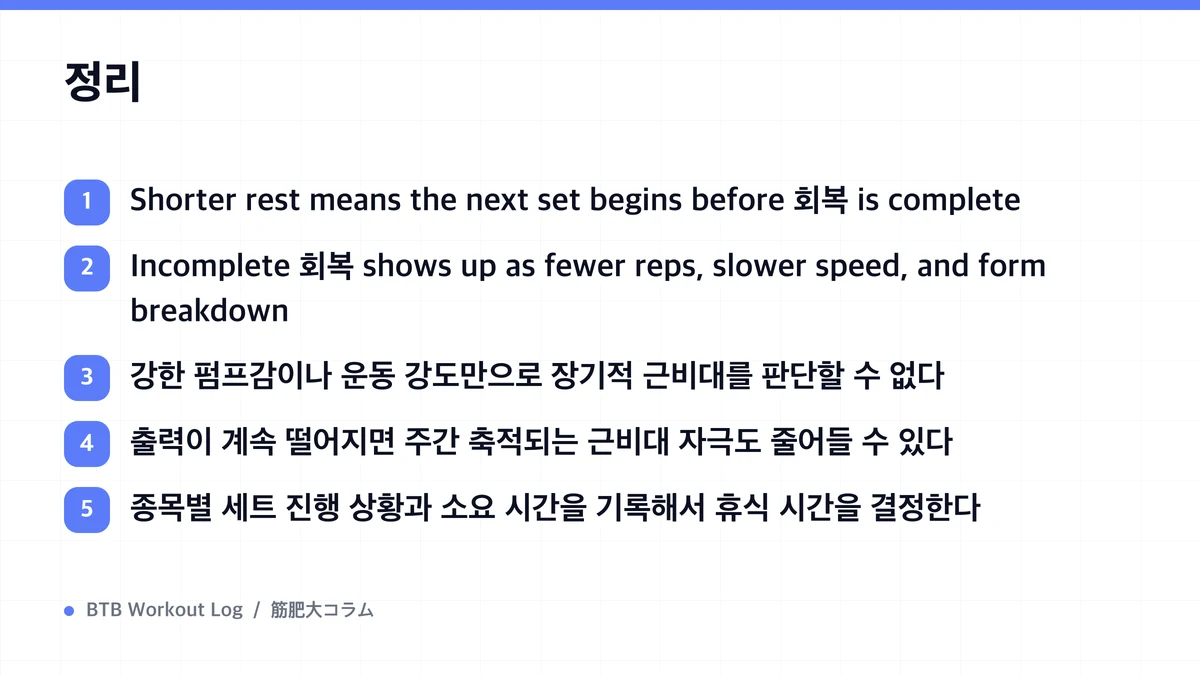
정리
- Shorter rest means the next set begins before 회복 is complete
- Incomplete 회복 shows up as fewer reps, slower speed, and form breakdown
- 강한 펌프감이나 운동 강도만으로 장기적 근비대를 판단할 수 없다
- 출력이 계속 떨어지면 주간 축적되는 근비대 자극도 줄어들 수 있다
- 종목별 세트 진행 상황과 소요 시간을 기록해서 휴식 시간을 결정한다
- 1분 고정은 단관절 종목에서는 성립할 수 있지만, 다관절 주요 종목에서는 손실이 크다